eu law

Public Procurement & ‘Design for All’ – It’s Crunch Time, Folks !

2011-10-12 & 2011-10-17:  Close your eyes … and imagine, for a split second, the value and material extent of all the Public Procurement Contracts being tendered for and awarded each week, throughout Europe.  ‘Enormous’ is the only appropriate word which must spring to your mind !   If you don’t believe me, check out the statistics for yourself !!   And that value is going to keep increasing !!!

The European Commission has recently proposed that suitable instruments be developed which will permit the operation of the Accessibility / Design for All Requirements in EU Public Procurement Directives to commence, with full effect.  This process is proving to be problematic … and it is certainly not as open and transparent as it should be.

Leaving aside the utilities sectors (water, energy, transport and postal services) … recall that EU Directive 2004/18/EC of the European Parliament and of the Council, of 31 March 2004, on the Co-Ordination of Procedures for the Award of Public Works Contracts, Public Supply Contracts and Public Service Contracts had to be implemented, at national level in all of the EU Member States, no later than 31 January 2006.  This Directive was amended, in a minor way, by Directives 2005/51/EC and 2005/75/EC.  In spite of these amendments, 31 January 2006 remained the target date for national implementation.

[ Ireland's national implementing legislation ... European Communities (Award of Public Authorities' Contracts) Regulations 2006 ... came into operation on 22 June 2006.]

In addition, each Member State had to ensure that Directive 2004/18/EC was properly implemented by using effective, available and transparent Monitoring Mechanisms.

With regard to specific rules governing specifications and contract documents … Article 23.1 of Directive 2004/18/EC stated, and still does state …

‘ The technical specifications as defined in point 1 of Annex VI shall be set out in the contract documentation, such as contract notices, contract documents or additional documents.  Whenever possible these technical specifications should be defined so as to take into account accessibility criteria for people with disabilities or design for all users.’

Not the strongest possible language to encourage ‘accessibility’ … there’s nothing quite like a shall to concentrate minds !

[ However, in Ireland ... with regard to the same specific rules governing specifications and contract documents ... Section 23 (2) of the European Communities (Award of Public Authorities' Contracts) Regulations 2006 states ...

' In awarding a public contract, a contracting authority shall, as far as practicable, ensure that the technical specifications for the contract take account of the need to prescribe accessibility criteria for all persons who are likely to use the relevant works, products or service, particularly those who have disabilities.' ]

As already discussed in my post, dated 2 November 2010 … many people in the European Union Institutions would prefer to steer completely away from the Social Aspects of Sustainable Human and Social Development … fuzzy areas, not capable of easy quantification … leaving small, peripheral groups in the Institutions (neither well connected to the mainstream, nor fully aware of the ‘ins’ and ‘outs’ of that mainstream) to look after the Social Aspects.

.

Public Procurement in the European Union (EU)

The Award of Public Works Contracts, Public Supply Contracts and Public Service Contracts concluded in the EU Member States on behalf of State, Regional or Local Authorities and other bodies governed by public law entities, is subject to the respect of Principles enshrined in the EU Treaties and, in particular, to …

  • the principle of freedom of movement of goods ;
  • the principle of freedom of establishment ;
  • the principle of freedom to provide services ;   and
  • the principles deriving therefrom, such as the principle of equal treatment, the principle of non-discrimination, the principle of mutual recognition, the principle of proportionality and the principle of transparency.

For Public Contracts Above A Certain Value … it has been deemed necessary to draw up provisions of Community Co-Ordination of National Procedures for the award of such contracts, which are based on these principles so as to ensure the effects of them and to guarantee the opening-up of public procurement to competition.

- Adapted from Preamble Paragraph #2, EU Directive 2004/18/EC

.

Is Europe Serious about Implementing the Public Procurement Accessibility / Design for All Requirements ?

Before looking at how Accessibility / Design for All is being handled within the fast evolving European Public Procurement Framework … it is sobering to compare and contrast how DG Environment (ENV), in the European Commission, is promoting and actively supporting Green Public Procurement, i.e. Public Procurement which is environment-friendly … http://ec.europa.eu/environment/gpp/index_en.htm … no messing about there !

If we (speaking as a European) are serious, therefore, about the ‘real’ implementation of Accessibility for All / Design for All / Inclusive Design / Universal Design / Barrier-Free Design in the Built Environment … it is of fundamental importance that an easily assimilated Standard (as defined in Paragraph #2, ANNEX VI of Directive 2004/18/EC) be produced ‘on the table’ for reference by Public Contracting Authorities … NOW !!!

Built Environment:  Anywhere there is, or has been, a man-made or wrought (worked) intervention in the natural environment, e.g. cities, towns, villages, rural settlements, service utilities, transport systems, roads, bridges, tunnels, and cultivated lands, lakes, rivers, coasts, and seas, etc … including the Virtual Environment.

Virtual Environment:  A designed environment, electronically generated from within the built environment, which may have the appearance, form, functionality and impact – to the  person perceiving and actually experiencing it – of a real, imagined and/or utopian world.

The Built and Virtual Environments continue to merge into a new Augmented Reality.

A comprehensive document capable of answering a major portion of Europe’s current needs in this area is on the verge of being published as a full International Standard … ISO 21542: ‘Building Construction – Accessibility & Usability of the Built Environment’.  And … as is the case with hundreds of ISO Standards in other sectors, this standard could easily be approved by CEN, one of Europe’s Standards Organisations, as an EN (European Standard) … under the Vienna Agreement on Technical Co-Operation between ISO and CEN, which was confirmed by both organizations in 2001 … and the period to practical application of ISO 21542 on the ground would be relatively swift.

Every delay represents not only a precious opportunity missed to improve the Accessibility of the Built Environment … but another blatant Denial of Human and Social Rights to vulnerable groups of people in all our communities !

Yes, this document was badly managed at the beginning of its very long gestation period, and its contents were a bit of a mess for the first few years … AND European countries were indignant, then, at the prospect of it becoming a European Standard.  However, walking around any major city in any country in Europe today, and witnessing the universally appalling and miserable efforts at Accessibility Implementation … you would have to be outraged at the level of hypocrisy and blatant self-delusion practiced by Europeans !

BUT NOW … ISO FDIS 21542 … the Final Draft of the International Standard which was issued for voting, beginning on 22 September 2011 … is a very respectable looking document altogether.  It makes important statements about ‘creating a sustainable built environment which is accessible’.  Its purpose is ‘to define how the built environment should be designed, constructed and managed to enable people to approach, enter, use, egress from and evacuate a building independently, in an equitable and dignified manner and to the greatest extent possible’ … ‘principles which are supported by Preamble (g) and Articles 9, 10 and 11 of the United Nations Convention on the Rights of Persons with Disabilities’.  I could go on, and on … but I will resist the temptation, since I was heavily involved in the development of this ISO Standard !

The point is … there is no longer any reason for European countries to complain about the inadequacy of this International Standard … and it should be the preferred instrument of choice to facilitate the immediate operation of the Accessibility / Design for All Requirements in EU Public Procurement Directive 2004/18/EC.

Unfortunately, this may not happen !

.

Years too late, near the end of 2007 … DG Employment, Social Affairs & Inclusion (EMPL), in the European Commission, issued the following Mandate …

M/420 EN – Brussels, 21 December 2007

Standardization Mandate 420 to CEN, CENELEC and ETSI in Support of European Accessibility Requirements for Public Procurement in the Built Environment

Click the Link Above to read and/or download PDF File (67.4 kb)

.

This Mandate covers 2 Phases of Work.  Phase I deals with compiling an inventory of existing accessibility-related standards and an analysis of any gaps … as well as with issues of accessibility implementation monitoring and conformity assessment.  Phase II is the actual accessibility standard(s) development phase.

However … Mandate M/420 EN is a flawed document, and it should have received much closer scrutiny from the European Standards Organizations named in the document title … before any work in Phase I commenced.  Failing that … the first work item on the Phase I Agenda should certainly have been a critical examination of the mandate.

In a post, dated 15 January 2011 … I wrote …

The European Union’s Accessibility Strategy, related Policies and Programmes … and the monitoring, targeting and independent verification of Accessibility Implementation … all require a radical overhaul !

All those Officials in the European Commission who are involved, in any way, shape or form, with Accessibility of the ‘Human Environment’ would do well to RE-READ AND MEDITATE DEEPLY on the contents of the 2003 Final Report from the Group of Accessibility Experts, which was established by the European Commission itself … “

The Final Report from the 2003 EU Group of Accessibility Experts, of which I was a Member, can be downloaded towards the end of that post.

The Officials who drafted Commission Mandate M/420 EN paid little, if any, attention to that 2003 Expert Group Report.

.

At the end of Phase I … in response to the European Commission’s Mandate M/420 EN … a long, rambling CEN Joint Report (document ref. CEN/BT/WG 207 N 29) of 425 Pages was issued, dated 8 August 2011, for general discussion and comment.

Some Comments on the CEN Joint Report …

1.  Terminology

CEN Joint Report – CEN/BT/WG 207 N 29

3.4     Conclusions View, Findings and Recommendations

3.4.1  Overview

Terms such as ‘procurement’, ‘inclusion’, ‘accessibility’ and ‘compliance’ are difficult to define precisely, and they are often not fully understood by those responsible for managing or providing the products or environments people use.  They are also not readily understood by those administrating and triggering the procurement process.

It is strange, therefore … and unacceptable … that this Report does not attempt to reduce and/or remove the ambiguity surrounding these terms … by providing a clear definition, with a supporting explanatory text, for each of the terms listed above.

I’m not even sure that the large numbers of people who helped to draft the CEN Joint Report fully understand those terms !

Most importantly, the Report is not at all precise about … and in fact appears to be completely confused by … the clear distinction which must be made between ‘accessibility’ and ‘access’.

2.  ‘Accessibility’ & UN CRPD

Accessibility does not begin and end with Article 9 of the United Nations 2006 Convention on the Rights of Persons with Disabilities (CRPD) !!!   See my post, dated 15 January 2011 … and #6 below.

3.  EU Ratification of UN CRPD

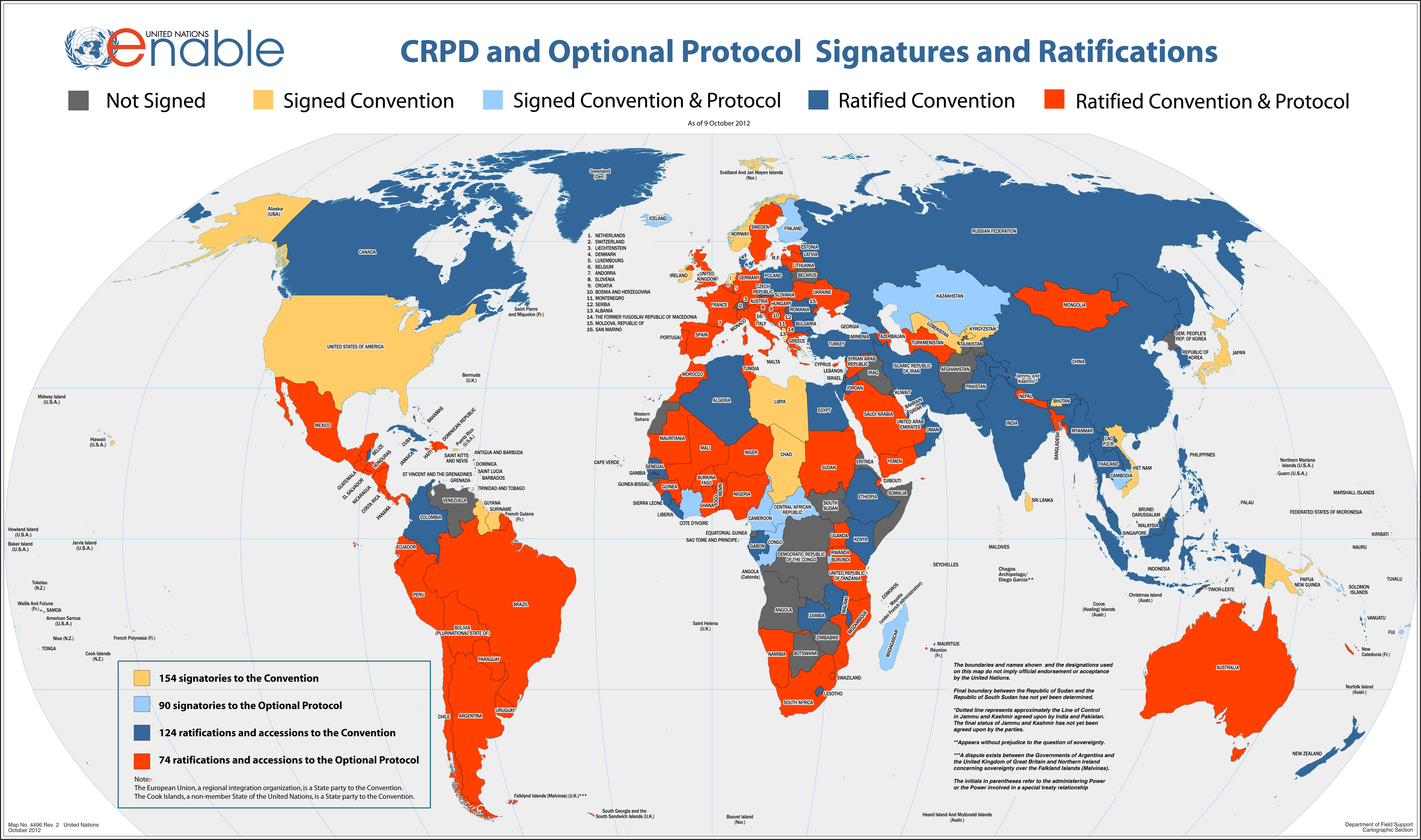
The full implications arising from European Union (EU) Ratification, on 23 December 2010, of the United Nations 2006 Convention on the Rights of Persons with Disabilities (CRPD) … for both EU Institutions, and the EU Member States (whether or not they have individually ratified the UN Convention) … have not been properly examined in the CEN Joint Report.

See my post, dated 5 February 2011 .

4.  Mainstreaming ‘Accessibility’

For the majority of people involved in the spatial planning, design and development of the European Built Environment, Accessibility is all about transport issues … for example, how far a proposed new building is from a transportation node.

We are communicating such a confused message (is it Accessibility for All, Design for All, Inclusive Design, Universal Design, or Barrier-Free Design ?) … that many policy and decision makers just could not be bothered.  And who, in Europe, is really concerned with the quality of Accessibility Implementation ???

In addition … the CEN Joint Report neglected to deal adequately … or at all … with a major body of EU Legislation which has been implemented at national level, in the Member States, many years ago … Safety at Work Legislation !   All of the EU Directives require that workplaces be accessible.  Yet, I know for a fact that, in Ireland, the Health & Safety Authority (HSA) is doing absolutely nothing to check whether this requirement is being complied with or not.

A Sustainable Built Environment is Accessible for All !   So many different types of International/European/National Legislation mandate that the Built Environment shall be Accessible for All !!   Good Design demands that the Built Environment is Accessible for All !!!

So why is Accessibility not being properly integrated into the operation of Environmental Impact Assessment (EIA) Legislation ?

Environmental Impact:  Any effect caused by a given activity on the environment, including human health, safety and welfare, flora, fauna, soil, air, water, and especially representative samples of natural ecosystems, climate, landscape and historical monuments or other physical structures, or the interactions among these factors; it also includes effects on accessibility, cultural heritage or socio-economic conditions resulting from alterations to those factors.

No case need be made for the integration of Accessibility into Sustainability Impact Assessment (SIA) … it self-evidently must be !

Sustainability Impact Assessment:  A continual evaluation and optimization process – informing initial decision-making, or design, and shaping activity/product/service realization, useful life and termination, or final disposal – of the interrelated positive and negative social, environmental, economic, institutional, political and legal impacts on balanced and equitable implementation of Sustainable Human and Social Development.

5.  What Is The Overriding European Social Priority ?

The overriding European Social Priority is to commence operation, with full effect, of the Accessibility / Design for All Requirements within the fast evolving European Public Procurement Framework … as quickly as possible.

Do we have to wait another 2 or 3 years, at least, for the production of an ‘acceptable’ European Accessibility Standard ??   Instead, why not approve ISO 21542 as the European Standard when it is published as a full standard … which will be very soon ?   ISO 21542 is already being used as the benchmark in the CEN Joint Report !

AND … do we have to wait, for who knows how long … before Effective Monitoring Procedures … and Independent Verification Procedures … are put in place at European and National/Regional/Local Levels ???

Quality of European Accessibility Implementation … is critical !

.

2011-10-17 …

6.  Post UN CRPD – A More Demanding Scope & Quality of Implementation

Not unexpected … but it has still been a most enlightening experience to read the recent UN CRPD Committee Report on Spain … selected extracts from which are reproduced below.  The language used by the Committee is strong and direct … finally !

This is not a good report and, in places, it makes for unpleasant reading … a concrete example of the ‘hypocrisy and blatant self-delusion practiced by Europeans’, which I talked about earlier.

In accordance with Article 36.3 of the UN Convention on the Rights of Persons with Disabilities (CRPD) … the UN Secretary-General will be making this Report available to all States Parties.

.

United Nations Committee on the Rights of Persons with Disabilities

Sixth Session – 19 to 23 September 2011

Concluding Observations on Initial Report of Spain

(Article 35 of UN CRPD)

The Committee considered the initial report of Spain (CRPD/C/ESP/1) at its 56th and 57th meetings, held on 20 September 2011, and adopted the following concluding observations at its 62nd meeting, held on 23 September 2011.

. 

III.  Principal Areas of Concern & Recommendations

A.  General Principles & Obligations (Articles 1 & 4)

11.  The Committee takes note of the adoption of Act 26/2011 which introduces the concept of ‘person with disabilities’ as defined in the Convention and expands the protection of persons with disabilities.  However, it is concerned that not all persons with disabilities are covered by the law.

12.  The Committee urges the State Party to ensure that all persons with disabilities enjoy protection against discrimination and have access to equal opportunities irrespective of their level of disability.

13.  The Committee welcomes Act 49/2007, dated 26 December 2007, establishing the Permanent Specialized Office to deal with offences and sanctions in equal opportunities, non-discrimination and universal accessibility by persons with disabilities.  However, it is concerned by the slow development and lack of promotion of this arbitration system at the regional government level; by the lack of information on the number of sanctions submitted and resolved; and by the failure of the State Party to report on actions undertaken to implement this law.  The Committee is concerned about the overall effectiveness of the system.

14.  The Committee recommends that the State Party raise awareness among persons with disabilities about the system of arbitration; increase the level of free legal aid; and ensure the regulation of offences and sanctions at the regional government level.

15.  The Committee regrets the lack of information on the meaningful participation of persons with disabilities and their representative organisations at the regional level in designing, and evaluating the implementation of legislation, policy and decision-making processes; and the participation of children with disabilities at all levels.

16.  The Committee recommends that the State Party take specific measures to: ensure the active participation of persons with disabilities in public decision-making processes at the regional level; and to include children with disabilities at all levels.

17.  The Committee takes note of Act 2/2010 of 3 March 2010 on sexual and reproductive health decriminalizing voluntary termination of pregnancy, allowing  pregnancy to be terminated up to 14 weeks and including two specific cases in which abortion is allowed for longer time limits due to the fact that the foetus has a disability:  until 22 weeks of gestation, provided there is ‘a risk of serious anomalies in the foetus’, and beyond week 22 when, inter alia, ‘an extremely serious and incurable illness is detected in the foetus’.  It also notes the explanations provided by the State Party for maintaining this distinction.

18.  The Committee recommends that the State Party abolish the distinction made in Act 2/2010 in the period allowed under law within which a pregnancy can be terminated, based solely on disability.

B. Specific Rights (Articles 5-30)

Equality and non-discrimination (Article 5)

19.  The Committee welcomes the adoption of Act 26/2011 amending regulations which will abolish the need to have a disability certificate to bring a discrimination claim before a judicial body.  However, it regrets the lack of information on cases of discrimination, and it is concerned that persons with disabilities will still be marginalized.  The Committee is further concerned by the lack of information on reasonable accommodation.  It is also concerned that in practice disability affects parents’ guardianship or custody of their children and that legal protection against discrimination on the grounds of disability is not enforceable in cases of discrimination due to perceived disability or association with a person with a disability.

20.  The Committee urges the State Party to expand the protection of discrimination on the grounds of disability to explicitly cover multiple disability, perceived disability and association with a person with a disability, and to ensure the protection from denial of reasonable accommodation, as a form of discrimination, regardless of the level of disability.  Moreover guidance, awareness raising and training should be given to ensure a better comprehension by all stakeholders, including persons with disabilities, of the concept of reasonable accommodation and prevention of discrimination.

Article 8 – Awareness-Raising

25.  The Committee commends the many initiatives taken by the State Party to implement the Convention.  However, it notes that more needs to be done to increase awareness in society, in the media and amongst persons with disabilities themselves of the right of persons with disabilities.

26.  The Committee calls upon the State Party to take proactive measures to enhance awareness of the Convention and its Optional Protocol at all levels, in particular among the judiciary and the legal profession, political parties, Parliament and Government officials, civil society, media, persons with disabilities, as well as the general public.

Article 9 – Accessibility

27.  The Committee takes note that Act 26/2011 amends regulations which will shorten the timelines for meeting accessibility requirements in public facilities; and goods and services available to the public.  However, it remains concerned at the low level of compliance with these requirements, in particular, at regional and local levels, in the private sector, and in relation to existing facilities.  The Committee is aware of situations of discrimination faced by air passengers with disabilities, including situations of denial of boarding.  The Committee reminds the State Party that Article 9 of the Convention also demands access to information and communication.

28.  The Committee recommends that sufficient financial and human resources be allocated as soon as possible to implement, promote and monitor compliance with accessibility legislation through national measures as well as through international cooperation.

Article 11 – Situations of Risk & Humanitarian Emergencies

31.  The Committee is concerned at the insufficiency of specific protocols for persons with disabilities in emergency situations.

32.  The Committee calls upon the State Party to review its laws and policies related to emergency situations with a view to including provisions guaranteeing the security and protection of persons with disabilities.

[ My Comment:  This is a gross understatement of a serious problem which continues to fester not only in Spain but, more generally, in Europe ! ]

Article 19 – Living Independently & Being Included in the Community

39.  The Committee is concerned at the lack of resources and services to guarantee the right to live independently and to be included in the community, in particular in rural areas.  It is further concerned that the choice of residence of persons with disabilities is limited by the availability of the necessary services, and that those living in residential institutions are reported to have no alternative to institutionalization.  Finally, the Committee is concerned about linking eligibility of social services to a specific grade of disability.

40.  The Committee encourages the State Party to ensure that an adequate level of funding is made available to effectively enable persons with disabilities to: enjoy the freedom to choose their residence on an equal basis with others; access a full range of in-home, residential and other community services for daily life, including personal assistance; and to enjoy reasonable accommodation so as to better integrate into their communities.

41.  The Committee is concerned that the law for the promotion of autonomy limits the resources to hire personal assistants only to those persons who have level 3 disabilities and only for education and work.

42.  The Committee encourages the State Party to expand resources for personal assistants for all persons with disabilities in accordance with their requirements.

Article 24 – Education

43.  The Committee welcomes the fact that the principle of inclusion governs the schooling of pupils with special educational needs; that discrimination in education is prohibited; and that most children with disabilities are included in the regular education system.  It commends the enactment of Organic Act 2/2006 on Education, which obliges the education authorities to provide specialist teachers, qualified professionals and the necessary materials and resources, as well as the laws that oblige schools to make necessary curricular adjustments and diversifications for pupils with disabilities.  However, the Committee is concerned by the implementation of these laws in practice, in view of reported cases of failure to provide reasonable accommodation, of continued segregation and exclusion, of financial arguments used as justification for discrimination, and of the cases of children enrolled in special education against their parents’ will.  The Committee notes with concern that parents challenging the placement of their children with disabilities in special education have no possibility of appeal and that their only alternative is to educate them at their own expense or pay for the reasonable accommodation of their child in the regular education system.

44.  The Committee reiterates that denial of reasonable accommodation constitutes discrimination and the duty to provide reasonable accommodation is immediately applicable and not subject to progressive realisation.  It recommends the State Party to:

     (a)  Increase its efforts to provide reasonable accommodation in education, allocating sufficient financial and human resources to implement the right to inclusive education; paying particular attention to assessing the availability of teachers with specialist qualifications; and ensuring that educational departments of local governments understand their obligations under the Convention and act in conformity with its provisions ;

     (b)  Ensure that the decisions to place children with a disability in a special school or in special classes, or to offer them solely a reduced standard curriculum, are taken in consultation with the parents ;

     (c)  Ensure that the parents of children with disabilities are not obliged to pay for the education or for the measures of reasonable accommodation in mainstream schools ;

     (d)  Ensure that decisions on placing children in segregated settings can be appealed swiftly and effectively.

C.  Specific Obligations (Articles 31-33)

Statistics and data collection (Article 31)

49.  The Committee regrets the low level of disaggregated data on persons with disabilities.  The Committee recalls that such information is indispensable to: understanding the situations of specific groups of persons with disabilities in the State Party who may be subject to varying degrees of vulnerability; developing laws, policies and programmes adapted to their situations; and assessing the implementation of the Convention.

50.  The Committee recommends that the State party systematize the collection, analysis and dissemination of data, disaggregated by sex, age and disability; enhance capacity building in this regard; and develop gender-sensitive indicators to support legislative developments, policymaking and institutional strengthening for monitoring and reporting on progress made with regard to the implementation of the various provisions of the Convention.

51.  The Committee regrets that the situation of children with disabilities is not reflected in the data on the protection of children.

52.  The Committee recommends that the State Party systematically collect, analyse and disseminate data, disaggregated by sex, age and disability, on abuse and violence against children.

.

.

END

Tags: , , , , , , , , , , , , , , , , , , , , , , , , , , , , , , , , , , , , , , , , , , , , , , , , , , , , , , , , , , , , , , , , , , , , , , , , , , , , , , , , , , , , , , , , , , , , , , , , , , , , , , , , , , , , , , , , , , , , , , , , , , , , , , ,

Buildings & Firefighters Not Yet Safer ! – 10 Years After 9-11 (II)

2011-09-20:  Continuing on from where I left off on 11 September 2011

Applying the Recommendations contained in the 2005 & 2008 National Institute of Standards & Technology (NIST – USA) Reports on the 9-11 WTC Buildings 1, 2 & 7 Collapses to the everyday practice of Architecture and Fire Engineering has been a central part of our work for many years.  Long discussions on this subject have taken place within CIB (International Council for Building Research) Working Commission 14: ‘Fire Safety’ … and I also chair Commission 14′s Research Working Group IV on ‘Fire-Induced Progressive Collapse’.

My particular interest in Disproportionate Damage and Progressive Collapse reaches back as far as the late 1980′s !

So I was intrigued, amused … and at the same time, highly concerned … to read the following Letter to the Editor of the Irish Times Newspaper, on Saturday 10 September 2011 …

Recalling 9/11

Sir, – One of the most important factors in the tragedy of 9/11, and one that has received scant attention, was the mode of failure of the towers.

They were struck high up on their structures and failed via progressive collapse.  Had they been designed this side of the Atlantic, they would not have collapsed.  These were flimsy structures. -

Yours, etc,

Jim Ryan, Chartered Structural Engineer,

Waterfall, Cork.

.

JIM …  If the WTC Towers (which were not flimsy structures !) had been designed on this side of the Atlantic … they would have collapsed.

Furthermore …  If the Towers had only been completed last week in the USA, Ireland, England & Wales, India or China … they would still collapse, if a similar event were to occur next year.

To be crystal clear …  What we witnessed, on Tuesday 11 September 2001, was a Collapse Level Event (CLE) which exposed, very harshly and cruelly, a catastrophic failure in all of our common Design and Construction Practices and Procedures used in/by/as …

  • Architectural Design | (Ambient) Structural Engineering | Fire Engineering ;
  • Building Management Systems ;
  • Emergency Responders | Firefighters | Rescue Teams ;
  • Technical Control Organizations Having Authority (AHJ’s) or Jurisdiction ;
  • Fire Safety Objectives in Building Legislation, Codes and Standards.

To the average ‘person in the street’ …  Whether he/she lives in Manhattan or Chicago in the USA, Dublin or Cork in Ireland, Cardiff or London in Britain, Dilli or Mumbai in India, Beijing or Shanghai or Hong Kong in China … it is unacceptable that buildings collapse … entirely unacceptable !!

.

COLLAPSE OF WTC BUILDINGS 1, 2 & 7

JIM …  Unless you believe in conspiracy theories, please study the 2005 & 2008 NIST(USA) Reports on the 9-11 WTC Buildings 1, 2 & 7 Collapses.  The 2 Final Reports can be downloaded from this Page on Sustainable Design International’s Corporate WebSitehttp://www.sustainable-design.ie/fire/structdesfire.htm … along with other key documents and links.

Some indication of the enormous quantity of 9-11 WTC Incident Documentation issued by NIST(USA) can be seen below …

Colour photograph showing the enormous quantity of 9-11 WTC Incident Documentation, issued by the U.S. National Institute of Standards & Technology, which is still readily available for the public to access and download.

Colour photograph showing the enormous quantity of 9-11 WTC Incident Documentation, issued by the U.S. National Institute of Standards & Technology, which is still readily available for the public to access and download.

.

PUBLIC SAFETY 10 YEARS AFTER 9-11 ?

If it is entirely unacceptable to the Public that buildings collapse … in how many National Building Codes does the following Critical Public Safety Equation appear today ?   The answer is NONE !

Colour image showing Page 21 from my Overhead Presentation on 'Sustainable Fire Engineering' ... scheduled for this Thursday, 22 September 2011, at the ASFP Ireland Fire Seminar & Workshop ... to be held at the RDS, in Ballsbridge, Dublin. Click to enlarge.

Colour image showing Page 21 from my Overhead Presentation on 'Sustainable Fire Engineering' ... scheduled for this Thursday, 22 September 2011, at the ASFP Ireland Fire Seminar & Workshop ... to be held at the RDS, in Ballsbridge, Dublin. Click to enlarge.

.

Is there some fundamental reason why Levels of Safety for the Public should vary so much from one country to another ?   NO, there is not !

Within Europe, and in relation to the New EU Construction Product Regulation 305/2011, which I discussed here a few days ago … the European Commission, in a discussion document dating back to the mid-1980′s, suggested that the only way to effectively realize a Single Market for Construction Products would be to introduce Harmonized EU Building Regulations in all of the EU Member States.  Of course the Member States, at the time, went ballistic at the very mention of this idea … and it was quickly withdrawn.  I take great pleasure in repeating that important idea today.

Jim …  The Critical Public Safety Statement above is fully consistent with … and meets … the ‘Basic Requirements for Construction Works’ in Annex I of EU Regulation 305/2011.

.

However, in relation to any one EU Member State … let’s take Ireland as an example … compare a situation where, in a remote rural location, it might take almost an hour for a sufficient fire service presence to arrive at the scene of a building fire emergency … with a similar situation in the middle of a city, or large town, where the time required will not be greater than 15 minutes … then, although the Level of Safety for the Public can be / should be / must be the same in both situations … I would expect, in the remote rural location having a poor fire service support infrastructure, that the range of Fire Protection Measures to be employed in a typical building would be more extensive, and the performance expected of those Measures would be higher … in order to achieve an Equivalent Level of Safety in both rural and urban locations.  Is that not a rational idea ??

Unfortunately, that’s not how the present systems work … National or European !   Levels of Public Safety differ from one country to the next … and from one region, within any one country, to the next … without any good reason … and without meaningful consultation and the full understanding of the Public.

.

BUILDINGS & FIREFIGHTERS ARE NOT YET SAFER

JIM …  In spite of all of the spin coming from the other side of the Atlantic … and discounting criminality and fraud in construction practices … Buildings and Firefighters are not yet safer … because the large, difficult, complex flaws and failures in Conventional Fire Engineering have not yet been aggressively confronted … and properly solved.

In a post last year, on 18 October 2010 … I referred to the Cul-de-Sac of Current Fire Engineering … and illustrated a typical architectural detail in a Dublin Building – a common detail also to be found in India, China, USA, England & Wales, etc., etc – which demonstrates a Fundamental Flaw at the very core of conventional thinking and practice.

On Thursday next … 22 September 2011 … at the ASFP Ireland Fire Seminar and Workshop in the RDS, Dublin … I will present this flawed detail … and a solution which is fully compatible with … and answers … the NIST Recommendations !

BUT … would anybody like to show me where any National Building Codes have been revised and updated to solve this Fundamental Flaw ?

Colour image showing Page 33 from my Overhead Presentation on 'Sustainable Fire Engineering' ... scheduled for this Thursday, 22 September 2011, at the ASFP Ireland Fire Seminar & Workshop ... to be held at the RDS, in Ballsbridge, Dublin. Click to enlarge.

Colour image showing Page 33 from my Overhead Presentation on 'Sustainable Fire Engineering' ... scheduled for this Thursday, 22 September 2011, at the ASFP Ireland Fire Seminar & Workshop ... to be held at the RDS, in Ballsbridge, Dublin. Click to enlarge.

. 

Colour image showing Page 35 from my Overhead Presentation on 'Sustainable Fire Engineering' ... scheduled for this Thursday, 22 September 2011, at the ASFP Ireland Fire Seminar & Workshop ... to be held at the RDS, in Ballsbridge, Dublin. Click to enlarge.

Colour image showing Page 35 from my Overhead Presentation on 'Sustainable Fire Engineering' ... scheduled for this Thursday, 22 September 2011, at the ASFP Ireland Fire Seminar & Workshop ... to be held at the RDS, in Ballsbridge, Dublin. Click to enlarge.

.

Colour image showing Page 36 from my Overhead Presentation on 'Sustainable Fire Engineering' ... scheduled for this Thursday, 22 September 2011, at the ASFP Ireland Fire Seminar & Workshop ... to be held at the RDS, in Ballsbridge, Dublin. Click to enlarge.

Colour image showing Page 36 from my Overhead Presentation on 'Sustainable Fire Engineering' ... scheduled for this Thursday, 22 September 2011, at the ASFP Ireland Fire Seminar & Workshop ... to be held at the RDS, in Ballsbridge, Dublin. Click to enlarge.

.

Colour image showing Page 37 from my Overhead Presentation on 'Sustainable Fire Engineering' ... scheduled for this Thursday, 22 September 2011, at the ASFP Ireland Fire Seminar & Workshop ... to be held at the RDS, in Ballsbridge, Dublin. Click to enlarge.

Colour image showing Page 37 from my Overhead Presentation on 'Sustainable Fire Engineering' ... scheduled for this Thursday, 22 September 2011, at the ASFP Ireland Fire Seminar & Workshop ... to be held at the RDS, in Ballsbridge, Dublin. Click to enlarge.

.

Colour image showing Page 38 from my Overhead Presentation on 'Sustainable Fire Engineering' ... scheduled for this Thursday, 22 September 2011, at the ASFP Ireland Fire Seminar & Workshop ... to be held at the RDS, in Ballsbridge, Dublin. Click to enlarge.

Colour image showing Page 38 from my Overhead Presentation on 'Sustainable Fire Engineering' ... scheduled for this Thursday, 22 September 2011, at the ASFP Ireland Fire Seminar & Workshop ... to be held at the RDS, in Ballsbridge, Dublin. Click to enlarge.

.

A CASE STUDY OF ENGLAND & WALES

10 years after 9-11 … there are two reasons for taking a closer look at England & Wales (Britain)

  • The Building Regulations for England & Wales were used as the model for the Irish Building Regulations, which were first introduced here in the early 1990′s.  And, in the absence of Harmonized European Standards … British National Standards tend, with only a few exceptions, to become the default Irish National Standard ;
  • British National Standards are being applied in many different parts of the world outside England & Wales … in most cases, without any proper consideration of content … or adaptation to local conditions.

.

Colour image showing the Cover Page of Approved Document B: 'Fire Safety' ... Volume 2 - Buildings Other Than Dwellinghouses ... from the Building Regulations for England & Wales. Click to enlarge.

Colour image showing the Cover Page of Approved Document B: 'Fire Safety' ... Volume 2 - Buildings Other Than Dwellinghouses ... from the Building Regulations for England & Wales. Click to enlarge.

.

The Institution of Fire Engineers (Ireland) Annual Fire Conference, which was held last year, on Wednesday 20th October 2010 … in the Dublin Fire Brigade Training Centre, Marino, Dublin … threw up some interesting ‘notions’ for consideration by a diverse range of participants.

One curious proposition … repeated quite often during the day … was that Approved Document B, in the British System of Building Regulations, was basically still a sound document … and that it should pass an upcoming major review with little difficulty.

I don’t agree … Approved Document B is inadequate and dysfunctional !

With regard to Structural Performance in Fire … instead of referring to Approved Document A – Structure … the reader is referred to Appendices at the back of Approved Document B, which only reinforce the erroneous concept of Single Structural Element Fire Protection …

And along with its many other major problems … see my post, dated 2009-06-14 … British Standard BS 9999 takes no account of any of the 2005 & 2008 NIST Recommendations, Fire-Induced Progressive Collapse or Disproportionate Damage … and, in fact, directly conflicts with aspects of the Building Regulations for England & Wales …

Colour image showing Page 51 in the Appendix of my Overhead Presentation on 'Sustainable Fire Engineering' ... scheduled for this Thursday, 22 September 2011, at the ASFP Ireland Fire Seminar & Workshop ... to be held at the RDS, in Ballsbridge, Dublin. Click to enlarge.

Colour image showing Page 51 in the Appendix of my Overhead Presentation on 'Sustainable Fire Engineering' ... scheduled for this Thursday, 22 September 2011, at the ASFP Ireland Fire Seminar & Workshop ... to be held at the RDS, in Ballsbridge, Dublin. Click to enlarge.

.

In order to take a close look at Approved Document B … I used the vehicle of a Notional Hotel Project in Cardiff, Wales … similar to the Early 1990′s Dublin Hotel Project shown above …

Colour image showing Page 52 in the Appendix of my Overhead Presentation on 'Sustainable Fire Engineering' ... scheduled for this Thursday, 22 September 2011, at the ASFP Ireland Fire Seminar & Workshop ... to be held at the RDS, in Ballsbridge, Dublin. Click to enlarge.

Colour image showing Page 52 in the Appendix of my Overhead Presentation on 'Sustainable Fire Engineering' ... scheduled for this Thursday, 22 September 2011, at the ASFP Ireland Fire Seminar & Workshop ... to be held at the RDS, in Ballsbridge, Dublin. Click to enlarge.

.

With regard to properly showing Fitness for Intended Use of Fire Protection related Products and Building Systems … instead of referring to Regulation 7 … the reader is again referred to Appendices at the back of Approved Document B … which explains why we have such serious problems, i.e. lack of Durability and very low Resistance to Mechanical Damage, with the Thermal Insulation Products used for the Fire Protection of Structural Steelwork …

I also had to quote from Part D of the Irish Building Regulations to fill a gap in the British Regulation 7

Colour image showing Page 53 in the Appendix of my Overhead Presentation on 'Sustainable Fire Engineering' ... scheduled for this Thursday, 22 September 2011, at the ASFP Ireland Fire Seminar & Workshop ... to be held at the RDS, in Ballsbridge, Dublin. Click to enlarge.

Colour image showing Page 53 in the Appendix of my Overhead Presentation on 'Sustainable Fire Engineering' ... scheduled for this Thursday, 22 September 2011, at the ASFP Ireland Fire Seminar & Workshop ... to be held at the RDS, in Ballsbridge, Dublin. Click to enlarge.

.

.

END

Tags: , , , , , , , , , , , , , , , , , , , , , , , , , , , , , , , , , , , , , , , , , , , , , , , , , , , , , , , , , , , , , , , , , , , , , , , , , , , , , , , , , , , , , , , , , , , , , , , , , , , , , , , , , , , ,

New EU Construction Product Regulation 305/2011 – Halleluiah !

2011-09-13:  Closely related to our current discussions about the 10th Anniversary of the 9-11 WTC Incident in New York …

For more years than I care to remember … I have been involved, directly and/or indirectly, with piecing together the edifice that is European Union (EU) Council Directive 89/106/EEC Interpretation … a lumbering giant which has failed, miserably, to bring about the necessary conditions for the efficient operation of an effective European Economic Area (EEA) Single Market for Construction Products.

Proper Implementation has always been the fatal weakness of this ‘system’ … because on the ground, in Europe, no such Single Market exists in reality.  Politicians, at both European and national levels and typically lacking a competence on technical issues, believe otherwise.  Bureaucrats, at both European and national levels and always lacking a working familiarity with the full scope of EU Treaties, do not want to recognise this fundamental truth.

To refresh your memories … the full title of the now Repealed EU Directive 89/106/EEC was …

Council Directive, of 21 December 1988, on the Approximation of Laws, Regulations and Administrative Provisions of the Member States relating to Construction Products

ANNEX I of that Directive described 6 ‘Essential Requirements’ …

  1. Mechanical Resistance & Stability
  2. Safety in Case of Fire
  3. Hygiene, Health & the Environment
  4. Safety in Use
  5. Protection against Noise
  6. Energy Economy & Heat Retention

The unusual feature of this particular New Approach Directive was that the ‘suitable’ construction products, i.e. products which could be shown to be fit for their intended use, had to facilitate the construction works in satisfying all of the 6 Essential Requirements, taken together as a whole … not just some of the Requirements.

Down through the years, however, it has been deeply frustrating … to have to pressure the TÜV Organization in Germany, for example, to issue proper Test Reports to their German Clients … or, as recently as last July, to have to explain basic information about CE Marking to Manufacturers.  And there appears to be no proper infrastructure in any EU Member State to check and control CE Marks on industrial products generally, never mind construction products.

Further up the chain, there were also problems.  In developing a family of 6 Separate Interpretative Documents for each of the Essential Requirements … important cross linking concepts between Requirements, e.g. Fire-Induced Progressive Building Collapse, fell into a deep void, almost never to be heard from again.  And concepts explicitly referenced in ANNEX I, such as the Safety of Rescue Teams (i.e. firefighters), received little or no attention in those Interpretative Documents … which then had a serious knock-on effect when Harmonized European Standards, European Technical Approvals (ETA’s) and EuroCodes were being drafted, based on the guidelines in Interpretative Documents.

.

Lucca, Italy - Early Morning on 21 August 2011. Photograph by CJ Walsh. Click to enlarge.

Lucca, Italy - Early Morning on 21 August 2011. Photograph by CJ Walsh. Click to enlarge.

.

Halleluiah !   At Long Last … published on 4th April 2011, in the Official Journal of the European Union … the new EU Construction Product Regulation 305/2011 … the full title of which is …

Regulation (EU) No. 305/2011 of the European Parliament and of the Council, of 9 March 2011, laying down Harmonized Conditions for the Marketing of Construction Products and Repealing Council Directive 89/106/EEC

ANNEX I of these New Regulations now describe 7 ‘Basic Requirements for Construction Works’ … requirements which are appropriate to the needs of our time.  Please note the newly revised/additional texts, highlighted in red …

Construction works as a whole and in their separate parts must be fit for their intended use, taking into account in particular the health and safety of persons involved throughout the life cycle of the works.  Subject to normal maintenance, construction works must satisfy these basic requirements for construction works for an economically reasonable working life.

     1. Mechanical Resistance and Stability

The construction works must be designed and built in such a way that the loadings that are liable to act on them during their construction and use will not lead to any of the following:

(a)   collapse of the whole or part of the works ;

(b)   major deformations to an inadmissible degree ;

(c)   damage to other parts of the construction works or to fittings or installed equipment as a result of major deformation of the load-bearing construction ;

(d)   damage by an event to an extent disproportionate to the original cause.

     2. Safety in Case of Fire

The construction works must be designed and built in such a way that in the event of an outbreak of fire:

(a)   the load-bearing capacity of the construction works can be assumed for a specific period of time ;

(b)   the generation and spread of fire and smoke within the construction works are limited ;

(c)   the spread of fire to neighbouring construction works is limited ;

(d)   occupants can leave the construction works or be rescued by other means ;

(e)   the safety of rescue teams is taken into consideration.

     3. Hygiene, Health and the Environment

The construction works must be designed and built in such a way that they will, throughout their life cycle, not be a threat to the hygiene or health and safety of workers, occupants or neighbours, nor have an exceedingly high impact, over their entire life cycle, on the environmental quality or on the climate during their construction, use and demolition, in particular as a result of any of the following:

(a)   the giving-off of toxic gas ;

(b)   the emission of dangerous substances, volatile organic compounds (VOC’s), greenhouse gases or dangerous particles into indoor or outdoor air ;

(c)   the emission of dangerous radiation ;

(d)   the release of dangerous substances into ground water, marine waters, surface waters or soil ;

(e)   the release of dangerous substances into drinking water, or substances which have an otherwise negative impact on drinking water ;

(f)    faulty discharge of waste water, emission of flue gases or faulty disposal of solid or liquid waste ;

(g)   dampness in parts of the construction works or on surfaces within the construction works.

     4. Safety and Accessibility in Use

The construction works must be designed and built in such a way that they do not present unacceptable risks of accidents or damage in service or in operation such as slipping, falling, collision, burns, electrocution, injury from explosion and burglariesIn particular, construction works must be designed and built taking into consideration accessibility and use for disabled persons.

     5. Protection against Noise

The construction works must be designed and built in such a way that noise perceived by the occupants or people nearby is kept to a level that will not threaten their health and will allow them to sleep, rest and work in satisfactory conditions.

     6. Energy Economy and Heat Retention

The construction works and their heating, cooling, lighting and ventilation installations must be designed and built in such a way that the amount of energy they require in use shall be low, when account is taken of the occupants and of the climatic conditions of the location.  Construction works must also be energy-efficient, using as little energy as possible during their construction and dismantling.

     7. Sustainable Use of Natural Resources

The construction works must be designed, built and demolished in such a way that the use of natural resources is sustainable and in particular ensure the following:

(a)   re-use or recyclability of the construction works, their materials and parts after demolition ;

(b)   durability of the construction works ;

(c)   use of environmentally compatible raw and secondary materials in the construction works.

.

I will be anxious to see if the full intent of these ‘Basic Requirements for Construction Works’ is properly transposed into the new interpretative framework (comprising Delegated Acts, Harmonized Standards, etc., etc.) of EU Regulation 305/2011 …

and …

I will be even more anxious to see how and when specific output (Harmonized Standards, European Technical Approvals (ETA’s) and EuroCodes) from the obsolete interpretative framework of the Repealed Directive 89/106/EEC is revised and updated !

and, finally …

When will we ever see the vital Infrastructure of Implementation operating successfully in the EU Member States … so that Manufacturers can reap the enormous benefits of an effective EEA Single Market for Construction Products ??

.

.

END

Tags: , , , , , , , , , , , , , , , , , , , , , , , , , , , , , , , , , , , , , , , , , , , , , , , , , , , , , , , , , , , , , , , , , , , ,

Disability Access Certificates (DAC’s) in Ireland – Confused ??

2011-09-01:  To say, bluntly, that there is confusion out there … at every level … would be a mild understatement !   Yes, the Disability Access Certificate (DAC) & Revised DAC Process is new … but that cannot explain what is happening … or, more precisely, what is not happening.

BUT … before jumping in at the deep end and examining the existing and operative Part M of the Irish Building Regulations … let me just mention, very briefly, two wider legal ‘niceties’ concerning Accessibility of Buildings for People with Disabilities

     1.  The Black Hole between Building Regulations and Equality Law

The definition of People with Disabilities in the existing Part M is limited.  It is inadequate.  Compare, now, that definition with the definition of Disability in Irish Equality Legislation … which is the complete opposite, being very wide in scope.  A deep chasm exists between the two.  Check each of them out for yourself !   And because few people are aware of this chasm … a better description of that large space might be a Black Hole.

However, the clear consequence of the Black Hole for building owners … and building designers alike … is that the ‘act’ of merely going through the motions with regard to compliance with Part M … and being satisfied with getting ‘the’ piece of paper, i.e. a Disability Access Certificate … will, without any shadow of a doubt, open the building owner to a complaint under Equality Law.  And when a building owner encounters this sort of problem … who will he, or she, hunt down for an explanation ??

Client Organizations beware … prevention is a far better strategy !!   Check out the Level of Accessibility Performance required to avoid complaints under Equality Legislation.

[ You should also consider the following ... the Health & Safety Authority in Ireland is doing absolutely nothing to ensure that Workplaces are Accessible ... a requirement contained in all of the European Union (EU) Safety at Work Directives and the Irish National Legislation implementing those Directives.  So, also cross check the Level of Accessibility Performance required to comply with Safety at Work Legislation.  Compliance with Part M is not sufficient ! ]

     2.  European Union Ratification of the 2006 United Nations Convention on the Rights of Persons with Disabilities (CRPD)

For a sizeable group of vulnerable people in every EU Member State, the sole route of access to many, if not most, of the Human and Social Rights set down in the 1948 Universal Declaration of Human Rights (UDHR) is the UN Convention on the Rights of Persons with Disabilities (CRPD) … which became an International Legal Instrument on 3 May 2008, and was ratified by the European Union on 23 December 2010.  That is precisely why Accessibility is such a critical component of the 2006 UN Convention !

Articles 31 & 33 of the 2006 UN Convention on the Rights of Persons with Disabilities – together – mandate that Accessibility Implementation is taken seriously … that it is competent and effective … and, most importantly, that independent monitoring and verification is a fundamental part of the process.

Ireland has not yet ratified the UN CRPD.  And, as far as our National Authorities Having Jurisdiction (AHJ’s) are concerned … everything in the garden is beautiful … Ireland is doing just great and nothing much needs to be altered in our laws, administrative provisions or resourcing … to allow Ireland to ratify the Convention, and then properly implement it.  Nothing could be further from the truth !

In Order to Protect your Organization and its many interests … Your Policy and Decision Makers, in Ireland, should study the implications flowing directly from EU Ratification of the UN CRPD … and then, the various Articles of the UN Convention should be examined and properly implemented … insofar as those Articles are relevant to you and your organization’s activities.  See my earlier post, dated 5 February 2011.

To date … the quality of Accessibility Implementation in Irish Buildings has been dreadful !!   For important reasons … which all parties involved should fully understand … this situation is longer acceptable.

.

Colour photograph showing the front entrances to dwelling units in a New Inner City Housing Scheme in Dublin ... User Unfriendly ... Inaccessible for Many Vulnerable People in Our Society ... Dreadful Accessibility Implementation ! Photograph taken by CJ Walsh. 2003-09-13. Click to enlarge.

Colour photograph showing the front entrances to dwelling units in a New Inner City Housing Scheme in Dublin ... User Unfriendly ... Inaccessible for Many Vulnerable People in Our Society ... Dreadful Accessibility Implementation ! Photograph taken by CJ Walsh. 2003-09-13. Click to enlarge.

.

Disability Access Certificates (DAC’s) & Part M

The submission of sufficient, quality information, i.e. detailed design documentation, at Disability Access Certificate (DAC) Application Stage typically signals the following to an experienced technical controller …

  • The intent of the Applicant, and the Agent(s) acting on his/her/their behalf, with regard to properly and satisfactorily complying with the relevant building legislation, i.e. Part M: ‘Access for People with Disabilities’ of the Second Schedule to the Irish Building Regulations ;  and
  • In the absence of an inspection by the Building Control Authority (BCA) during actual construction … whether or not it is likely that the completed works will match the DAC certified design documentation with regard to Accessibility Performance.

From the beginning, it is necessary to distinguish between Access and Accessibility.

To be written in stone when International Standard ISO 21542 is soon published … the components of Building Accessibility comprise …

  • Approach to the building ;
  • Entry ;
  • Use of the building, its services and facilities ;
  • Egress from the building (during normal conditions) ;
  • Removal from the vicinity of the building (during normal conditions) ;

and

  • Evacuation from the building (during, for example, a fire emergency) ;
  • Safe Movement to a ‘place of safety’ (during, for example, a fire emergency), which is remote from the building.

This is also a useful guideline with regard to segregating those aspects of Accessibility Design which relate to Part M: ‘Access for People with Disabilities’ of the Second Schedule to the Irish Building Regulations, and which should be considered in any application for a Disability Access Certificate (DAC) … and those, after ‘and‘ … which relate to Part B: ‘Fire Safety’, and which should be considered in every application for a Fire Safety Certificate (FSC).

.

The 2000 Building Regulations (Amendment) Regulations … Statutory Instrument No. 179 of 2000 … elaborate the relevant Irish Building Legislation concerning building access, i.e. Part M: ‘Access for People with Disabilities’ of the Second Schedule to the Building Regulations …

Access and Use

M1     Adequate provision shall be made to enable people with disabilities to safely and independently access and use a building.

Sanitary Conveniences

M2     If sanitary conveniences are provided in a building, adequate provision shall be made for people with disabilities.

Audience or Spectator Facilities

M3     If a building contains fixed seating for audience or spectators, adequate provision shall be made for people with disabilities.

Definition for This Part

M4     In this Part, ‘people with disabilities’ means people who have an impairment of hearing or sight or an impairment which limits their ability to walk, or which restricts them to a wheelchair.

Application of This Part

M5     Part M does not apply to works in connection with extensions to and the material alterations of existing dwellings, provided that such works do not create a new dwelling.”

My Note 1:  In order to safely and independently use a building … it is also necessary, under normal conditions, to use the egress routes of a building.

My Note 2:  The limited definition of ‘people with disabilities’ in Requirement M4 does not include, for example, a person without arms … or those people with a mental, cognitive or psychological impairment.

.

Technical Guidance Document M (2000, re-printed in 2005) provides guidance in relation to Part M: ‘Access for People with Disabilities’ of the Second Schedule to the Irish Building Regulations.  TGD M was issued by the Department of the Environment, under Article 7 of the 1997 Building Regulations … Statutory Instrument No. 497 of 1997 … which states …

” 7.     (1)  The Minister may publish, or arrange to have published on his behalf, documents to be known as ‘technical guidance documents’ for the purpose of providing guidance with respect to compliance with the requirements of any of the provisions of the Second Schedule.

          (2)  Subject to the provisions of sub-article (3), where works or a building to which these Regulations apply is or are designed and constructed in accordance with any guidance contained in a technical guidance document, this shall, prima facie, indicate compliance with the relevant requirements of these Regulations.

          (3)  The provisions of any guidance contained in a technical guidance document published under sub-article (1) concerning the use of a particular material, method of construction or specification, shall not be construed as prohibiting compliance with a requirement of these Regulations by the use of any other suitable material, method of construction or specification.”

My Note 3:  Since the introduction of national legal building legislation in the early 1990′s, the Irish Building Regulations have a Functional Format, as required by European Union (EU) Law.  In other words, satisfactory compliance with short functional statements is mandated by law … and provided the requirements of those short statements are properly shown to be complied with, it is entirely optional as to which materials, methods of construction, standards and other specifications (including technical specifications) are used.  In this way, the free movement of products and services within the EU is facilitated and encouraged while, at the same time, technical barriers to trade are avoided.

My Note 4:  For the convenience of readers, the short functional statements mandated by law are reproduced, in a shaded box, at the beginning of each of the Technical Guidance Documents.  The Guidance Texts in each Technical Guidance Document, however, are not Prescriptive Regulations.  These texts are merely an indicator of what is likely to be suitable for the purposes of compliance with the Regulations … they are, prima facie (i.e. on ‘first appearance’ only), an indication of compliance ;  they are not ‘deemed-to-satisfy’ the Requirements of Part M.

My Note 5:  Where gaps are identified in the guidance texts of Technical Guidance Document M … and in the absence of an Irish National Standard on Building Access or Accessibility … a suggested hierarchy of approach should be to source an appropriate European Standard (EN) or, if such a standard does not yet exist, then an appropriate International Standard (ISO), or then a National Standard of any country which is a contracting party to the Agreement on the European Economic Area (EEA) which provides in use an appropriate level of Access/Accessibility Performance (refer to Part D of the Second Schedule to the Building Regulations).  In the unlikely absence of any of the above, an appropriate Design Guidance Document – national or otherwise – should be referenced which provides in use an appropriate level of Access/Accessibility Performance.

.

Our Organization – Sustainable Design International – provides an independent (and confidential) Accessibility Monitoring and Verification Service.

.

.

END

Tags: , , , , , , , , , , , , , , , , , , , , , , , , , , , , , , , , , , , , , , , , , , , , , , , , , , , , , , , , , , , , , , , , , , , , , , , , , , , , , , , , , , , , , ,

2011 IFE International Fire Conference & AGM in Cardiff, Wales

2011-07-17:  On 6th & 7th July last … in Cardiff, the Capital City of Wales … the Institution of Fire Engineers (IFE) held its Annual General Meeting (AGM), followed by a very well attended 1½ Day International Fire Conference.  Participants came from as far away as Australia, New Zealand, Malaysia, Taiwan, Hong Kong (in China), Canada, U.S.A., Nigeria and Switzerland.  A large, vocal group of delegates from The Netherlands also attended … and of course, there were many people from these islands … Ireland and Great Britain … the Irish Isles !

For me, it was an enjoyable few days in Cardiff.

The Immediate Past President of the IFE, Mr John Woodcock, had initiated an important programme of activities during his 2010/2011 Term of Office on the theme of ‘Fire Engineering & Sustainability’.  The New IFE President for 2011/2012, Mr. H.G. (Hao-Giang) Tay, has stated that he will continue this work with enthusiasm.

This brings me very neatly to the reason for my attendance at the Cardiff ‘Gig’.  I had been invited by HG Tay to make a presentation on ‘Sustainable Fire Engineering’.  This, I was very pleased and honoured to do.

.

” The audience found the conference extremely valuable and I had many delegates who spoke to me specifically about how good the conference was and the high standard of the presentations.  The number of questions on each presentation was a testament to the interest of the audience.

The subject is of such importance that we really need to make sure the voice of the profession is firmly planted in all decision-making on design, protection and management of buildings.”

[Short Extract, Letter from HG Tay, International IFE President, dated 27 July 2011]

.

Tremendous Injury was caused to the Local Environment in Buncefield ... but Our Planet can no longer suffer these Criminal Human Acts !

Tremendous Injury was caused to the Local Environment in Buncefield ... but Our Planet can no longer suffer these Criminal Human Acts !


2011 IFE Cardiff Overhead Presentation

CJ Walsh: “Sustainable Fire Engineering IS THE FUTURE !”

Click the Link Above to read and/or download PDF File (3.98 Mb)

.

In order to properly protect the interests of Society and our Clients/Client Organizations … and to effectively realize a Safe and Sustainable Built Environment in the 21st Century … it is necessary, in designing a building for fire and its immediate aftermath, for the Fire Engineer to develop Project-Specific Fire Engineering Design Objectives … which must never be confused with the minimal Fire Safety Objectives mandated in Building and Fire Regulations and Codes.

Sustainable Fire Engineering is concerned with far more than compliance with Legislation !   For this reason, a Fire Engineering Code of Ethics is essential.

.

Ethically Based Sustainable Fire Engineering must also consider the following issues, which are relevant to Today’s Human Environment :

  1. Sustainable Human & Social Development.
  2. Adaptation to Climate Change and Severe Weather Events … not less than a recurrence interval of 100 years should be used in design, always bearing in mind that the minimum Building Life Cycle for a Sustainable Building is 100 years.
  3. Resistance to Fire-Induced Progressive Building Collapse and Disproportionate Damage.
  4. Sufficient attention and care for Vulnerable Building Users in ‘situations of risk’ – refer to Article 11 of the 2006 United Nations Convention on the Rights of Persons with Disabilities.
  5. Safety of Firefighters & Rescue Teams – refer to Essential Requirement 2 of the European Union’s Construction Products Directive 89/106/EEC.

.

In this Overhead Presentation …

  • Clearly outlined is a Holistic Perspective of the much wider scope for Sustainable Fire Engineering in the Future … Fire Engineering which has an empirical and scientifically robust foundation … Fire Engineering which is not afraid to confront and absorb the lessons of the 9-11 WTC Incident (2001) in New York, or the 2008 Mumbai ‘Hive Attacks’ … Fire Engineering which discards its outrageously shameful disregard for People with Activity Limitations … Fire Engineering which understands Fire-Induced Progressive Collapse and Disproportionate Damage in Buildings and, most importantly, understands the difference between these two related structural concepts … Fire Engineering which is capable of full integration with the Mainstream Construction Sector ;
  • Sustainable Human & Social Development is clearly defined, and the current widespread confusion about the far more limited concept of ‘Green’ is removed ;
  • The UNESCO WFEO/FMOI Model Code of Ethics, updated by CJ Walsh in 2011, is proposed as a suitable and very necessary template for the Institution of Fire Engineers (IFE) ;
  • As Sustainable Design Solutions are appropriate to Local Geography, Culture, Climate (and Climate Change), Economy, Social Need, Language/Dialect, etc … it is strongly recommended that the IFE should develop Global Regional Guidance Documents on Sustainable Fire Engineering, i.e. separate documents for Africa, Asia, Europe, South America, etc ;
  • Finally … this Presentation initiates a fresh and entirely new dialogue within the International Fire Science and Engineering Community.

.

What are your views and comments ?

.

.

END

Tags: , , , , , , , , , , , , , , , , , , , , , , , , , , , , , , , , , , , , , , , , , , , , , , , , , , , , , , , , , , , , , , , , , , , , , , , , ,

Building Design Must Improve Firefighter Safety in Fire Incidents !

2011-07-05 … 
It has been a harsh experience to leave the last post undisturbed for a few weeks !   It was necessary … and I feel better as a result.
 

Back to the present … and in any jurisdiction, news of  Firefighter Fatalities and/or Injuries is very distressing.  It has been remarkable to note, however, how some countries, e.g. Japan, are expending significant time and resources on developing innovative ways to improve firefighter safety in buildings … while most countries are not.  Over many years, I have formed the clear impression that, generally, firefighters are regarded in much the same way as soldiers, i.e. they are a disposable asset … ‘Theirs not to reason why / Theirs but to do and die’ … etc., etc.  This situation is entirely unacceptable, and in need of urgent resolution !

On 6th & 7th July … in Cardiff, Wales … I have been invited by the International President of the Institution of Fire Engineers (IFE), Mr. HG Tay, to make a presentation on ‘Sustainable Fire Engineering’ at the 2011 IFE International Fire Conference and Annual General Meeting.  I am greatly honoured by this invitation.

During the course of that presentation, I will be referring to Firefighter Safety … but much more needs to be said, beforehand, in relation to the untapped contribution of building design to greater levels of firefighter safety …

INTRODUCTION

It may be obvious for some (but, believe me, not for all !) that with regard to fighting fires in buildings … Firefighters have 2 Basic Functions :

  • to rescue people who are trapped in a Fire Building (i.e. a building which is on fire) … or people who, for some reason, cannot independently evacuate the building (e.g. people with activity limitations) ;   and
  • to fight those fires, and ensure that they are properly extinguished.

Note:  Extinction of a fire is confirmed only after a thorough visual inspection by a competent person.

.

DESIGN & CONSTRUCTION

In a previous post, dated 13 December 2010 I said that it was no longer ethically acceptable to ignore the issue of Firefighter Safety in the design and construction of buildings … because design can make a major contribution to their safety.

Unfortunately, Firefighter Safety must continue to remain an ethical issue because Building Regulations in most countries rarely, if ever, refer to this important aspect of design and construction.  Safety at Work Legislation has a related, but different, intent.

Regrettably, most of the building design professions either have no Code of Ethics … or there is a Code which is ‘lite-lite-lite’, i.e. very weak on ethics … or, worse still, they have a Code … but it is called a Code of Professional Conduct, the principal intent of which is to preserve and protect the profession and its vested interests.

At European Level …

Essential Requirements 1 & 2 (of 6 … for the time being) … in Annex I of European Union (EU) Council Directive 89/106/EEC, of 21 December 1988, on the approximation of laws, regulations and administrative provisions of the Member States relating to Construction Products … state the following …

1. Mechanical Resistance & Stability

The construction works must be designed and built in such a way that the loadings that are liable to act on it during its construction and use will not lead to any of the following:

(a) collapse of the whole or part of the works ;

(b) major deformations to an inadmissible degree ;

(c) damage to other parts of the works or to fittings or installed equipment as a result of major deformation of the load-bearing construction ;

(d) damage by an event to an extent disproportionate to the original cause.

2. Safety in Case of Fire

The construction works must be designed and built in such a way that in the event of an outbreak of fire:

- the load-bearing capacity of the construction can be assumed for a specific period of time ;

- the generation and spread of fire and smoke within the works are limited ;

- the spread of the fire to neighbouring construction works is limited ;

- occupants can leave the works or be rescued by other means ;

- the safety of rescue teams is taken into consideration.

.

Sweden … has incorporated all 6 Essential Requirements of EU Construction Products Directive 89/106/EEC into its National Building Regulations … but has omitted the reference to the ‘safety of rescue teams’, i.e. Firefighter Safety.  Why is that ?

Ireland, along with England & Wales, has not incorporated the EU CPD Essential Requirements into its National Building Regulations.  There is no requirement, in Part B of the Building Regulations of either of these two separate jurisdictions, to consider Firefighter Safety in the design and construction of buildings.

In these three specific cases, taken as a simple example, this is a serious legal flaw … especially since the European Template, above, has existed since the late 1980′s !

.

Let me illustrate how Building Design & Construction can make a major contribution to improved levels of Firefighter Safety …

     A.  Accessible Internal Staircases Having Sufficient Unobstructed Width

From a building user’s point of view … the success of a building depends, to a large extent, on the ‘quality’ of its circulation spaces.  During the design process, however, an architect is typically concerned with the relationship between different functions and spaces … while, at the same time, he/she is shaping and moulding the internal and external forms of the building.

The full range of tasks and activities in these circulation spaces is rarely, if ever, considered by the building designer.  The subject is not covered in Architectural Schools … and in later professional life, a reluctance to carry out Building Post-Occupation Evaluations (POE’s) reinforces this low level of awareness.

Some Tasks & Activities in Building Circulation Spaces …

  • Access to the building’s spaces and use of its services and facilities ;
  • Egress from the building during normal, everyday circumstances ;
  • Independent Evacuation, in the event of an emergency ;
  • Assisted Evacuation by others, or Rescue by Firefighters, for those building users who cannot independently evacuate the building, e.g. people with activity limitations ;
  • Firefighter Access & Reconnaissance, in the event of an emergency ;
  • Firefighter Attack, as they approach the proximity of the fire scene ;
  • Firefighter Removal from the building, by colleagues, in the event of injury, impairment, or a fire event induced health condition ;
  • Firefighter Withdrawal at the successful conclusion of firefighting operations.

.

Colour photograph showing an injured, or impaired, firefighter being assisted by two colleagues in an upward staircase removal exercise. For reasons outlined in a previous post (2010-12-13) ... all three firefighters must continue to wear full Personal Protection Equipment (PPE) ... and use Self-Contained Breathing Apparatus (SCBA). Click to enlarge.

Colour photograph showing an injured, or impaired, firefighter being assisted by two colleagues in an upward staircase removal exercise. For reasons outlined in a previous post (2010-12-13) ... all three firefighters must continue to wear full Personal Protection Equipment (PPE) ... and use Self-Contained Breathing Apparatus (SCBA). Click to enlarge.

.

The photograph above was extracted from this  2010 Poster Presentation

Daniel DiRenzo, Cherry Hill Fire Department, New Jersey, USA

Building Fires – Personal Harness Use – Firefighter Removals

Click the Link Above to read and/or download PDF File (1.73 Mb)

No matter what the jurisdiction … no matter what Building Regulations do or do not require … it is clear that, during a ‘real’ fire emergency, patterns of circulation are not simple … and they cannot easily be segregated into categories with simple titles.  They are complex … and, quite often, they overlap.

In the case of the firefighter removal on a staircase (shown above) … there is a necessity to consider another type of ‘Contraflow’ … where the injured, or impaired, firefighter with two of his/her colleagues rendering assistance are together moving away from the scene of the fire … while other firefighters are moving in the opposite direction, towards the fire.

In all but the most simple and smallest building types, this is what a Fire Evacuation Staircase should look like below … having a clear unobstructed staircase width, between handrails, of 1500 mm … with a stair going/tread of 300 mm, and a stair riser of 150 mm.  Proper attention by the designer to Accessibility Design Criteria will also make the staircase far, far easier … and safer … for Firefighter Movement …

Colour drawing taken from International Standard ISO FDIS 21542, and associated inset photographs ... showing a Fire Evacuation Staircase suitable for All Building Types, which is designed for Firefighter Safety. The staircase is also designed to accommodate Building User Evacuation/Firefighter Contraflow, illustrated with an inset colour photograph ... the Rescue/Assisted Evacuation of People with Activity Limitations, also illustrated with an inset colour photograph ... and the Use of a Stretcher. The staircase design is based on the work of CJ Walsh. Click to enlarge.

Colour drawing taken from International Standard ISO FDIS 21542, and associated inset photographs ... showing a Fire Evacuation Staircase suitable for All Building Types, which is designed for Firefighter Safety. The staircase is also designed to accommodate Building User Evacuation/Firefighter Contraflow, illustrated with an inset colour photograph ... the Rescue/Assisted Evacuation of People with Activity Limitations, also illustrated with an inset colour photograph ... and the Use of a Stretcher. The staircase design is based on the work of CJ Walsh. Click to enlarge.

.

     B.  Accessible Façade Walkways in High-Rise Buildings

With today’s powerful drivers of greater energy conservation and efficiency in buildings, adaptation to climate change, and a paradigm shift in thinking on the reduction of adverse environmental impact by buildings … External Façade Design is rapidly evolving … becoming far more complex and, in many cases, comprising multiple ‘skins’.

Just check out this architectural feature, below, in an Osaka (Japan) High-Rise Hotel … which not only serves as an accessible route for evacuation and/or rescue in the event of a fire incident … but also permits much easier access for maintenance and window cleaning.

This architectural feature should be mandatory in the case of high-rise buildings with a single, central core …

Colour photograph showing the High-Rise Swissôtel Nankai in Osaka, Japan. Photograph by CJ Walsh. 2010-04-20. Click to enlarge.

Colour photograph showing the High-Rise Swissôtel Nankai in Osaka, Japan. Photograph by CJ Walsh. 2010-04-20. Click to enlarge.

.

Colour photograph showing the External Walkway on the Building Façade of the High-Rise Swissôtel Nankai in Osaka, Japan. Photograph by CJ Walsh. 2010-04-19. Click to enlarge.

Colour photograph showing the External Walkway on the Building Façade of the High-Rise Swissôtel Nankai in Osaka, Japan. Photograph by CJ Walsh. 2010-04-19. Click to enlarge.

.

Colour photograph showing the Hotel Room Evacuation Panel to the External Façade Walkway, which can also facilitate rescue by firefighters during a fire incident. Photograph by CJ Walsh. 2010-04-19. Click to enlarge.

Colour photograph showing the Hotel Room Evacuation Panel to the External Façade Walkway, which can also facilitate rescue by firefighters during a fire incident. Photograph by CJ Walsh. 2010-04-19. Click to enlarge.

.

Building Design can make a substantial contribution to greater Firefighter Safety !!

BUT … who is raising the awareness of building designers about this issue ???

.

.

END

Tags: , , , , , , , , , , , , , , , , , , , , , , , , , , , , , , , , , , , , , , , , , , , , , , , , , , , , , , , , , , , , , , , , , , , , , , , , , , , , ,

“April in Paris !” – Recent Meeting of CIB W14: Fire Safety

2011-04-29:  A Meeting of  CIB Working Commission 14: ‘Fire Safety’  took place at the Headquarters of Groupe AFNOR … Association Française de NORmalisation … which is located just outside the centre of Paris, France … on Monday, 11 April 2011.

These meetings are typically, though not always, co-ordinated with a long series of  ISO Technical Committee 92: ‘Fire Safety’ Meetings at the same venue.  Both technical bodies have a very good working relationship, and there is a strong interchange of membership between the two.  The recent revision to the description and scope of CIB W14 will be of enormous benefit to all.

Colour photograph showing the CIB W14: 'Fire Safety' Meeting in Paris, on 11 April 2011, at the Groupe AFNOR Headquarters. Photograph by CJ Walsh. 2011-04-11. Click to enlarge.

Colour photograph showing the CIB W14: 'Fire Safety' Meeting in Paris, on 11 April 2011, at the Groupe AFNOR Headquarters. Photograph by CJ Walsh. 2011-04-11. Click to enlarge.

.

Some Matters of Interest at the CIB W14: ‘Fire Safety’ Meeting – Presentations & Discussions about Two of the Current Pre-Normative Innovation & Research Projects …

1.  CIB W14 Working Group IV: ‘Structural Reliability & Fire-Induced Progressive Collapse’

See the Dedicated Page on this Technical Web Log (Tech-BLOG) Sitehttp://www.cjwalsh.ie/progressive-collapse-fire/ … for the latest update on the Research Project … which has proposed the following, as a Rational Route Forward

     A.  Mainstream the Language, Practices, Procedures and Design Methodologies of Fire Science & Engineering … so that other design disciplines can appreciate that Ethical Fire Science & Engineering also has a sound, modern, rational and empirical basis.   [Task for CIB W14]

     B.  Raise awareness about the primacy, and encourage the wide acceptance, of Fire Serviceability Limit States in Structural Fire Engineering … and the universal requirement that buildings must resist Fire-Induced Progressive Collapse and, in addition, also resist Disproportionate Damage.   [Task for CIB W14 Working Group IV]

     C.  Indicate the need for, and foster the development of, innovative Structural Thermal Insulation Fire Protection Systems which are durable, can resist mechanical damage in ambient and fire conditions, and can be properly shown to be ‘fit for their intended life-cycle use’.   [Task for the Fire Industry]

     D.  In steel construction … depending on its location in a building and having designed sufficiently robust connections for fire conditions … show why, where and how Thermal Insulation must now be used to maintain a Lower Temperature in the Steel … in order to ensure that its deformations (+/- deflection, expansion and distortion, etc.) remain within design parameters … both during the fire and, for a minimum period afterwards, during the ‘cooling phase’.   [Task for CIB W14 Working Group IV]

     E.  Encourage the development of Fire Engineering Design Guidelines for new and existing buildings, along with the Decision Support Tools needed for their use in practice … to support #2 and #4 above.  And propose how Existing Code/Regulation Provisions and Standards should be suitably updated and revised.   [Task for the International Fire Science & Engineering Community]

During the discussion which followed my presentation, and having reviewed progress … it was generally felt that the time was now ripe to prepare a Discussion Document for Comment.  This will be circulated about a month before the next meeting of CIB W14 … to be held in October 2011.

2.  CIB W14 Working Group 5: ‘Fire Incident Human Behaviour & Abilities’

The photograph above was actually taken during the presentation of this Research Project … at the time being given by Project Leader, Douglas Hillhouse, Organizer of the Fire Risk Engineering Programme at Glasgow Caledonian University, in Scotland.

Prior to the Paris Meeting, Douglas had circulated a Project Discussion Document for Comment … which was focused mainly on people with disabilities.  The Co-Ordinator of CIB W14, Prof. Dr. George Hadjisophocleous, was pleased to see this Research Project develop and gather momentum.

During the discussion which followed the Presentation, I made the following points …

  • The United Nations Convention on the Rights of Persons with Disabilities (CRPD) was adopted on 13 December 2006; it came into force, i.e. became an International Legal Instrument, on 3 May 2008; and it was ratified by a European Union (E.U.) having, for the first time after the Lisbon Treaty, its own separate legal personality … on 23 December 2010.

In February 2011 … the 2010 European Foundation Centre (EFC) Report: ‘Study on Challenges and Good Practices in the Implementation of the UN Convention on the Rights of Persons with Disabilities’, was approved for publication by the European Commission.  Under a duty of loyal co-operation, which derives from Article 4.3 of the Treaty on European Union (TEU), each E.U. Member State is now obliged to properly implement the critical accessibility-related provisions of the UN CRPD, i.e. Preamble (g) and Articles 4.3, 9, 10, 11, with 31 & 33.

  • The Final Draft of International Standard … ISO FDIS 21542: ‘Building Construction – Accessibility & Usability of the Built Environment’ … was registered with ISO Central Secretariat on 17 March 2011.  In spite of the technically flawed submission from ISO Technical Committee 92 to ISO Technical Committee 59, which is responsible for the production of ISO 21542 … we had successfully managed to retain a substantive, and meaningful, body of text relating to Fire Safety for People with Activity Limitations.
  • Our concern, throughout this CIB W14 Research Project, would be Fire Safety for All … including people with a wide range of behavioural responses and physical/mental/cognitive/psychological abilities during a fire incident … including people with activity limitations, not just people with disabilities … and firefighters.  The user profile in a ‘real’ building must be viewed as a continuum.
  • In attempting to provide better Fire Engineering Design Solutions for people with cognitive impairments, I had realized … many years ago … that the field of Cognitive Psychology offered huge potential for a paradigm shift in Fire Engineering Research.  This potential will be identified in the Project.
  • Amongst the International Fire Science and Engineering Community, there is widespread ignorance about Panic and Panic Attacks … this may help to explain the irrational fear about dealing with this important issue … a fear which the WG 5 Project will confront !

.

Of Unrelated Interest ?

During visits to Paris, I regularly ‘pop-in’ to Père Lachaise Cemetery … in the east of the city.  Access is very convenient … the Père Lachaise Métro Station being directly served by Lines 2 & 3.  Here are the last resting places (?) of Some Interesting Personalities

A.  Camille Pissarro (1830-1903) – Impressionist Painter

Colour photograph by CJ Walsh. 2011-04-12. Click to enlarge.

Colour photograph by CJ Walsh. 2011-04- 12. Click to enlarge.

.

B.  Jim Morrison (1943-1971) of ‘The DOORS’ – Lead Singer, Songwriter & Poet

Colour photograph by CJ Walsh. 2011-04-12. Click to enlarge.

Colour photograph by CJ Walsh. 2011-04-12. Click to enlarge.

.

C.  Maria Callas (1923-1977) – Opera Singer & Diva

Colour photograph by CJ Walsh. 2011-04-12. Click to enlarge.

Colour photograph by CJ Walsh. 2011-04-12. Click to enlarge.

.

.

END

Tags: , , , , , , , , , , , , , , , , , , , , , , , , , , , , , , , , , , , , , , , , , , , , , , , , , , , , , , , , , , , , , , , , , , , , , , , , , , , ,

New Dublin Criminal Courts Building – Denying Human Rights !

2011-04-07:  The United Nations Convention on the Rights of Persons with Disabilities (CRPD) is an issue, right here and now, for Architects in Ireland … and the Irish Built Environment, whoever designs, constructs, operates or manages it … not because this country has, or has not, ratified the Convention … but because the European Union has ratified this Convention !   And as we have all witnessed, on countless times since the early 1970′s … it has required a big stick from Europe to drag Ireland’s social legislation into the modern era.

UN CRPD Article 13 – Access to Justice

1.  States Parties shall ensure effective access to justice for persons with disabilities on an equal basis with others, including through the provision of procedural and age-appropriate accommodations, in order to facilitate their effective role as direct and indirect participants, including as witnesses, in all legal proceedings, including at investigative and other preliminary stages.

2.  In order to help to ensure effective access to justice for persons with disabilities, States Parties shall promote appropriate training for those working in the field of administration of justice, including police and prison staff.

Last week … from Monday, 28 March 2011 … until Thursday, 31 March 2011 … I attended as a Juror at the  New Criminal Courts of Justice Building, which is located at the Main Gate to the Phoenix Park in Dublin … near the junction between Parkgate Street and Infirmary Road.

I was very curious to experience this new building as an ordinary user.  However, I was not at all happy at the outcome … the accessibility performance was so inadequate.

In the case of this new building, it is clear that the Irish State has failed – is failing – to comply with Article 13 of the UN Convention on the Rights of Persons with Disabilities … and is thus denying a basic human right to many people in our society.

Colour photograph showing the Main Entrance to the New Criminal Courts of Justice Building in Dublin, with entrance steps in the foreground. Photograph taken by CJ Walsh. 2011-03-30. Click to enlarge.

Colour photograph showing the Main Entrance to the New Criminal Courts of Justice Building in Dublin, with entrance steps in the foreground. Photograph taken by CJ Walsh. 2011-03-30. Click to enlarge.

.

Post Occupation Evaluation (POE) is not a well-known architectural concept among architects … and even when it is known, it is not the most favoured.  This subject has, in my direct experience, been treated with light-hearted frivolity in 8 Merrion Square, Dublin !   Afterall, who wants to meet the failures of their cherished designs head-on … up-front and in their faces ??   To some architects, successes never seem to count as being of equal, or more, importance.  But, they are both a vital tool in continuous learning.

POE, however, is a crucial part of work as a practicing architect.  It is essential to feed previous design failures and successes … and ‘real’ information about building user/occupant behaviour … back into new projects !   This is ‘real’ CPD (Continuing Professional Development) in action … and a serious issue which is completely overlooked in the Royal Institute of the Architects of Ireland’s current approach to CPD !!

The reason so much of the built environment … so many buildings … is/are so inaccessible for many people … is not because designers have something against people with activity limitations … it is because designers just do not want human beings … anybody … to enter and use their buildings.  People are so messy … and they always want to do silly things with a building which were never planned … or they want to change things around, spoiling ‘the design’ … etc., etc., etc.

This problem begins back in the architectural schools, and becomes a deeper problem on the professional practice courses organized by professional institutes … here, and in other countries.  POE and building user/occupant behaviour is not covered … at all !   Can you believe that ??   I still can’t.

Tyranny of the Plan is another architectural concept.  I will try to explain it this way.  Take the photograph above.  Why, for example, are there no handrails on the right hand side … the major part … of those steps ?   Because of that Tyranny of the Plan Drawing !   It looked ‘right’ … beautiful, almost sexy … just to have handrails on that part of the steps leading from the main front doors … design movement was continued and controlled.  This is not the same as people movement.

On Sunday morning last, I measured those steps myself … (riser) 150 mm in height x (going) 300 mm in depth … (2 x riser) + (1 x going) = 600 mm … ideal dimensions for steps inside a building … but not the most convenient, comfortable or safe dimensions for steps outside a building.

Handrails are definitely required throughout the full extent of the steps !   But, that would have looked very sloppy on the plan drawing.  Now, however, take a closer look at those steps … looking down from above … and just imagine that you are a frail, older person and your sight may not be the greatest … that you are visually impaired in some manner …

Colour photograph showing details of the steps, handrails and tactile ground surface indicators at the Main Entrance to the New Criminal Courts of Justice Building in Dublin, Ireland. Photograph taken by CJ Walsh. 2011-03-30. Click to enlarge.

Colour photograph showing details of the steps, handrails and tactile ground surface indicators at the Main Entrance to the New Criminal Courts of Justice Building in Dublin, Ireland. Photograph taken by CJ Walsh. 2011-03-30. Click to enlarge.

The wrong type of tactile ground surface information is being given at the top and bottom of the steps … we would like to warn users of the hazard they are approaching, i.e. the steps, by using a ‘blister’ surface indicator … not direct them to turn left or right when they perceive those continuous ‘corduroy’ ridges.  The horizontal handrail extensions at the top and bottom of the short flight of steps are insufficiently long.  There is inadequate visual contrast at all of the step nosings (i.e. the leading top edges) which would have helped people to accurately locate those edges.  And, as already referred to above, the step dimensions could have been greatly improved with a slight adjustment … for example, (riser) 125 mm in height x (going) 350 mm in depth … (2 x riser) + (1 x going) = 600 mm … much better altogether for steps outside a building !   Compare and contrast with the many Japanese photographs shown in earlier posts.  There is no comparison !   This is sloppy work in Dublin.

Mies van der Rohe (1886-1969), the Master German Architect, is often quoted as having said: “God is in the details”.  Right on, Ludwig … ride ‘em cowboy !!!

.

For security reasons, it was not possible to take any photographs inside the building.  However, it was abundantly clear that accessibility for people with activity limitations, generally, was inadequate.  While some small account had been taken of the needs of people using wheelchairs … people with a visual impairment would have a very difficult time using this building.  Furthermore, when it came to the ‘swearing-in’ of Jurors at Court No.7, circulation was incredibly confined and restricted … I was having to squeeze myself forward in order to be ‘processed’.  What a mess !

This was an unacceptable and very disappointing example of poor, misguided and minimalist accessibility implementation … making an ironclad case for effective independent verification of Accessibility Performance, as required by the United Nations Convention on the Rights of Persons with Disabilities … at the end of the design stage in a project, and especially during the actual process of construction … to ensure that an ‘informed’ design intention becomes reality.

UN CRPD Article 33 – National Implementation & Monitoring

1.  States Parties, in accordance with their system of organization, shall designate one or more focal points within government for matters relating to the implementation of the present Convention, and shall give due consideration to the establishment or designation of a co-ordination mechanism within government to facilitate related action in different sectors and at different levels.

2.  States Parties shall, in accordance with their legal and administrative systems, maintain, strengthen, designate or establish within the State Party, a framework, including one or more independent mechanisms, as appropriate, to promote, protect and monitor implementation of the present Convention.  When designating or establishing such a mechanism, States Parties shall take into account the principles relating to the status and functioning of national institutions for protection and promotion of human rights.

3.  Civil society, in particular persons with disabilities and their representative organizations, shall be involved and participate fully in the monitoring process.

.

And that is not the end of the story !   When construction of a building has been completed and it is then occupied, Competent Building Management  is critical in maintaining an initial level of good accessibility performance throughout the life cycle of that building.  Once again, however, the management of this building was sloppy … take a bow, the  Courts Service of Ireland !

Symptoms of Larger Problems … Two Short Little Anecdotes …

a) Unheeded Building Evacuation Warning

In the middle of Roll Call, on the first morning that I attended as a Juror, a Voiced Stand-By Building Evacuation Warning was announced over the building’s public address system.  It was explained that there had been ‘an incident’.  That’s all … no other information was given.  This announcement was repeated again, and again, and again.  It then stopped, momentarily, and then started again.  It finally ended.

During the announcements … we all looked around … there were at least 150 people in the room … then looked at each other, shrugged our shoulders and smiled.  We at least thought that the person in charge of the Roll Call would be in a position to quickly find out what was going on … but no, she also shrugged her shoulders and carried on calling out names.

Afterwards, I asked one of the many ushers what had happened … was it a serious incident ?   He didn’t know, and just stated that ushers are generally told nothing.

This is entirely unacceptable !   Are clowns managing the New Criminal Courts of Justice Building in Dublin ??

b) Disrespectful ‘Swearing-In’ of Jurors

An Information Leaflet, produced by the Courts Service back in January 2010, entitled: ‘Attending for Jury Service’ … contains the following Introduction …

Jury Service is an important civic duty.  It is a vital part of our criminal justice system.  You must arrive on time to ensure trials are not delayed.  To assist you we have prepared this leaflet which includes a map to guide you to (the) jury assembly area of the Criminal Courts of Justice.

Concerning ‘Swearing-In a Jury’ … it is stated in the Leaflet …

The court registrar calls out your name and asks you to take an oath on the Holy Book of your choice, or you may affirm.

From the beginning, nobody was informed about these options.  On the final morning, when I was selected to be a Juror, the only Holy Book which was placed in front of Jurors was the Christian Bible.  No other Holy Book was visible.  Everyone was being processed in one way … without any consideration or respect for their dignity as an individual person.

With all of the stress of these occasions, and the formalities involved … the ‘Swearing-In’ Judge was even wearing a wig (I thought that those days were long gone !) … it would be all too easy for people … ‘automatically’, almost by reflex action, and not wanting to make a fuss … to go through a ‘standard’ processing procedure, which for them had little or no meaning.  Is that the intended purpose of ‘Swearing-In’ ??

It may have escaped the attention of the Courts Service that Ireland is now a pluralist and richly varied multi-cultural society.  Some people are religious, others are not … some people are Christians, others are Moslems, Jews or Buddhists, etc., etc … whatever !

A range of Holy Books must be visible to all Jurors … and they must all be informed about the option of ‘Affirming’ … before ‘Swearing-In’ commences !

.

.

END

Tags: , , , , , , , , , , , , , , , , , , , , , , , , , , , , , , , , , , , , , , , , , , , , , , , , , , , , , , , , , , , , , , , , ,

‘Accessibility-for-All’ – Post EU Ratification of the 2006 UN CRPD

2011-02-28:  Further to my posts, dated  15 January 2011  and  5 February 2011

There is an easy way to understand the 2006 United Nations Convention on the Rights of Persons with Disabilities (CRPD), which was ratified by the European Union (EU) just before Christmas Day 2010:

For a sizeable group of vulnerable people in all of our societies, the sole route of access to many, if not most, of the Human and Social Rights set down in the 1948 Universal Declaration of Human Rights (UDHR) … is the UN CRPD … which only became an International Legal Instrument on 3 May 2008 … just short of 60 Years after the UDHR was adopted on 10 December 1948 !

That is precisely why Accessibility is such a critical component of the 2006 UN Convention … which has already been described, here, as a ‘Mixed Agreement’ (see the post of 5 February 2011).

Accessibility is the principal, common ingredient in ‘fields that fall in part within the competence of the European Union, in part within that of the Member States and in part within the shared competence of the EU and its Member States’.  Accessibility has an impact … and always will have an impact … on all of these fields.

Policy and Decision Makers at every level within the European Union and the EU Member States would need to become accustomed to this new concept very, very quickly.

It is also essential, therefore, for the EU and the Member States to closely co-operate in implementing legislation which stems from the UN CRPD in a coherent manner … and to ensure unity in the international representation of the Union.

.

APPROACHING THE TASK OF ACCESSIBILITY IMPLEMENTATION

1.  Establishing an Initial Framework …

Exactly how should we make sense of … bring order and assign priorities to … the Accessibility-related Articles in the UN Convention … using the different terms ‘Accessibility’ and ‘Accessibility-for-All’ … ‘People/Persons with Disabilities’ and ‘People with Activity Limitations’ (2001 WHO ICF) … in relation to the different components of the Human Environment, i.e. the Built, Social, Virtual and Economic Environments ???

Our recommendation … SDI’s Recommendation … is to refer, in the first instance, to this ‘Accessibility-for-All’ Matrix … which we developed a few years ago … in preparation for this crucial period of implementation …

Colour image showing Sustainable Design International's 'Accessibility-for-All' Matrix. The Goal is a Sustainable Human Environment which is Accessible-for-All. Click to enlarge.

Colour image showing Sustainable Design International's 'Accessibility-for-All' Matrix. The Goal is a Sustainable Human Environment which is Accessible-for-All. Click to enlarge.

.

If we then drill down … in order to fully understand ‘Accessibility of a Building’, for example … this then comprises:

  • Approach to the building ;
  • Entry through principal entrance(s) ;
  • Health, Safety, Convenience & Comfort in Use, including thermal comfort, indoor air quality, protection from fire, etc ;
  • Egress from the building (during normal conditions) ;
  • Removal from the vicinity of the building (during normal conditions) ;

and

  • Evacuation from the building (during, for example, a fire emergency) ;
  • Safe Movement to a ‘place of safety’ (during, for example, a fire emergency), which is remote from the building ;

and

  • Each stage of a Work Process, at every level, in places of work ;
  • Use of Electronic, Information & Communication Technologies (EICT’s) ;

and

  • Management, Services, and Attitudes of People in the building ;
  • Recruitment, Employment, Training & Promotion Practices.

.

2.  Overlaying UN CRPD Article 9 – Accessibility …

Onto the Initial Framework outlined above … overlay Article 9 … and crosscheck in detail.  Note well the strong language used … ‘States Parties shall’ … and do not forget that this is not a Wish List … but a clear delineation of the Scope of an Important Human and Social Right which now has a proper basis in both International and European Union Law !

1.  To enable persons with disabilities to live independently and participate fully in all aspects of life, States Parties shall take appropriate measures to ensure to persons with disabilities access, on an equal basis with others, to the physical environment, to transportation, to information and communications, including information and communications technologies and systems, and to other facilities and services open or provided to the public, both in urban and in rural areas.  These measures, which shall include the identification and elimination of obstacles and barriers to accessibility, shall apply to, inter alia:

(a)  Buildings, roads, transportation and other indoor and outdoor facilities, including schools, housing, medical facilities and workplaces ;

(b)  Information, communications and other services, including electronic services and emergency services.

2.  States Parties shall also take appropriate measures:

(a)  To develop, promulgate and monitor the implementation of minimum standards and guidelines for the accessibility of facilities and services open or provided to the public ;

(b)  To ensure that private entities that offer facilities and services which are open or provided to the public take into account all aspects of accessibility for persons with disabilities ;

(c)  To provide training for stakeholders on accessibility issues facing persons with disabilities ;

(d)  To provide in buildings and other facilities open to the public signage in Braille and in easy to read and understand forms ;

(e)  To provide forms of live assistance and intermediaries, including guides, readers and professional sign language interpreters, to facilitate accessibility to buildings and other facilities open to the public ;

(f)  To promote other appropriate forms of assistance and support to persons with disabilities to ensure their access to information ;

(g)  To promote access for persons with disabilities to new information and communications technologies and systems, including the Internet ;

(h)  To promote the design, development, production and distribution of accessible information and communications technologies and systems at an early stage, so that these technologies and systems become accessible at minimum cost.

.

So … what is the situation in the Member States of the European Union ?

In an upcoming post … let’s take Ireland as a case in point, just for the hell of it … and discuss some of the consequences … stemming from the EU’s ratification of the UN CRPD … on the operation of the Building Regulations and Disability Access Certificates (DAC’s).

.

.

END

Enhanced by Zemanta

Tags: , , , , , , , , , , , , , , , , , , , , , , , , , , , , , , , , , , , , , , , , , , , , , , , , , , , , , , , , , , , , , , , , , , , , , , , , , , , ,

EU Ratification of UN Disability Convention – EFC Legal Study

2011-02-05:  Further to my post, dated 15 January 2011

Many people directly or indirectly involved with Disability-Related Issues in Europe … may not yet know that, a few weeks ago, the European Union ratified the 2006 United Nations Convention on the Rights of Persons with Disabilities (UN CRPD).  They may not even know that their own country, as a Member State of the European Union, had perhaps already ratified the UN Convention one or two years earlier.

At this time, the majority of Member States have proceeded, voluntarily, to ratify the Convention … with some of those, inexplicably, declining/refusing to ratify the Convention’s Optional Protocol.

Human & Social Rights can be a difficult subject area !

Ireland has not ratified the UN Convention … and, unfortunately, the attitude of many policy-makers and decision-makers within our Irish Institutions of State, large and small, is that it’s business as usual … no need to worry or fuss, or give a damn … until this country does actually sign on the Convention’s bottom line … an attitude which displays a magnificent ignorance of the changed reality, post Lisbon Treaty, which is the European Union’s Current Legal Environment !!

Please examine carefully, for yourselves, the findings of this Legal Study, recently approved for publication by the European Commission …

European Foundation Centre (EFC)

Brussels, October 2010

Study on Challenges and Good Practices in the Implementation of the UN Convention on the Rights of Persons with Disabilities

Click the Link Above to read and/or download PDF File (1.46 Mb)

.

EU RATIFICATION OF THE UN CRPD – ASPECTS OF EU LAW

The following are selected extracts from the EFC Study … my selection (!) … to answer specific issues relating to UN CRPD Implementation within the European Union.  Typographical errors in the Study have also been corrected … and, post Lisbon Treaty, references to the EU Treaties have been properly updated …

The legal basis for the conclusion of the United Nations Convention on the Rights of Persons with Disabilities (UN CRPD) signals the appropriate legal basis for its implementation within the European Union (EU).  In this respect, and in line with Article 4 of the UN Convention, implementation implies that instruments may be adopted or modified by the Union in order to comply with the Convention and give effect to its provisions and principles.  Although the choice of the legal basis for the decision concluding an international agreement is very important, it is not decisive for implementation.  In European Court of Justice Case C-178/0345, which concerned the implementation of the Rotterdam Convention on International Trade in Hazardous Chemicals, the Court stated that ” the fact that one or more provisions of the Treaty have been chosen as legal bases for the approval of an international agreement is not sufficient to show that those same provisions must also be used as legal bases for the adoption of measures intended to implement that agreement at Community level “.   The latter statement means that EU Treaty provisions other than those mentioned in EU Council Decision 2010/48/EC to conclude the UN CRPD can be used as legal bases to implement UN CRPD obligations in specific fields.

.

The United Nations Convention on the Rights of Persons with Disabilities (UN CRPD) is an international human rights agreement where both the European Union (EU) and its Member States are contracting parties.  The UN Convention is thus a Mixed Agreement.  Mixed Agreements involve a Shared Contractual Relationship between the EU, its Member States and one or more third countries and/or international organisations.  As a Mixed Agreement, the UN CRPD covers fields that fall in part within the competence of the EU, in part within that of the Member States and in part within the shared competence of the EU and its Member States.  It is therefore essential for the EU and the Member States to closely co-operate, in order to implement legislation stemming from the Convention in a coherent manner and ensure unity in the international representation of the Union.

EU Member States, when participating in Mixed Agreements, do not act as entirely autonomous subjects of international law; they are subject to a Duty of Loyal Co-Operation between one another and the EU.  This duty extends to each of the negotiation, conclusion and implementation phases.  In this sense, there is a collective management of the obligations under international law.  The duty of loyal co-operation, deriving from Article 4.3 of the Treaty on European Union (TEU), embraces two sets of obligations: first, Member States shall take appropriate measures, whether general or particular, to ensure fulfilment of the obligations arising out of the EC Treaty or resulting from action taken by the EU Institutions;  and second: Member States shall facilitate the achievement of the Union’s tasks and shall abstain from any measure which could jeopardise the attainment of the Union’s objectives … which are set out in Article 3 of the Treaty on European Union (TEU).

Treaty on European Union (TEU) – Consolidated Version, as Amended by the Treaty of Lisbon

Article 4.3

Pursuant to the principle of sincere mutual co-operation, the Union and the Member States shall, in full mutual respect, assist each other in carrying out tasks which flow from the Treaties.

The Member States shall take any appropriate measure, general or particular, to ensure fulfilment of the obligations arising out of the Treaties or resulting from the acts of the institutions of the Union.

The Member States shall facilitate the achievement of the Union’s tasks and refrain from any measure which could jeopardise the attainment of the Union’s objectives.

.

In relation to EU Member States Compliance with a Mixed Agreement concluded by the EU … the European Court of Justice has inferred that for matters falling within EU competence … the Member States fulfil, within the EU system, an obligation in relation to the Union which has assumed responsibility for due performance of the agreement.  In other words, if a Member State fails to take all appropriate measures to implement provisions of the Mixed Agreement that fall within the competence of the EU … it not only fails to fulfil its international obligation, but is also acting in breach of EU Law.  The European Commission may thus bring an infringement case against a Member State that has not properly fulfilled its duty.  The principle underpinning such mechanisms is the ‘duty of loyal co-operation’, which provides the foundation for managing shared competence within Mixed Agreements.

The line dividing international responsibility for implementation of the International Mixed Agreement between the EU and its Member States depends on the obligations respectively assumed.  The UN CRPD contains a clause setting out ‘separate’ responsibility.  According to Article 44.1, Regional Integration Organisations acceding to the Convention shall declare, in their instruments of formal confirmation or accession, the extent of their competence.  This division of responsibility for implementation implies that the European Union only bears responsibility for the breach of those obligations it has assumed.

EU Council Decision 2010/48/EC on the conclusion of the UN CRPD refers to EU competence in respect of those matters governed by the UN CRPD, and lists EU Instruments which demonstrate such competence.

.

STRUCTURE OF THE EFC REPORT

The main objective of the Study was to analyse the obligations set out in the UN CRPD and, in particular, to gather information about the various practices of the EU Member States and the European Union in implementing the UN CRPD.

The work was carried out by the European Foundation Centre (EFC), representing the European Consortium of Foundations on Human Rights and Disability … under Contract No. VC/2008/1214 … for the European Commissions Directorate-General for Employment, Social Affairs & Inclusion.

Section 1 of this Report sets the appropriate background for the analysis that will follow.

Section 2 of the Report provides an overview and general recommendations on the implementation of the social model of disability, and core obligations deriving from Article 1 and Preamble Paragraph (e) of the UN CRPD.

Section 3 of the Report provides an overview and general recommendations on the implementation of Article 3 (General Principles), Article 4 (General Obligations), Article 5 (Equality and Non-Discrimination), and Article 9 (Accessibility) of the UN CRPD.  The section also reviews UN CRPD articles on Inter-Sectionality, namely Articles 6 (Women with Disabilities) and Article 7 (Children with Disabilities).  It is worth noting that the articles addressed in this section are articles of general and crosscutting application, and therefore their application is relevant for the implementation of all articles of the Convention.

Section 4 of the Report provides an overview and general recommendations on the implementation of selected substantive provisions of the UN CRPD which apply existing civil, political, economic, social and cultural rights within the context of disability.  Specifically, the section considers the implementation of Articles 16 (Freedom from Exploitation, Violence and Abuse) and 17 (Protecting the Integrity of the Person), which are seeking to assert protections that underscore the humanity of all persons with disabilities.  The section also considers the implementation of Articles 12 (Equal Recognition before the Law) and 19 (Living Independently and Being Included in the Community), both of which aim at maintaining and safeguarding the autonomy of the person.  Furthermore, articles on specific accessibility rights, namely Article 13 (Access to Justice) and Article 29 (Participation in Political and Public Life), are likewise addressed.  Finally, the section considers the implementation of Articles 24 (Education) and 27 (Work and Employment).

Section 5 of the Report contains an overview and general recommendations on the implementation of articles which outline steps that are necessary to support reforms.  Specifically, the section considers the implementation of Article 31 (Statistics and Data Collection), Article 32 (International Co-Operation), and Article 33 (National Implementation and Monitoring).

Section 6 of the Report suggests good practices for the EU and national policy-makers for the future and overall implementation of the Convention, and the effective achievement of its objectives.

It is worth noting that, while it is hard to be definitive, given that the UN Committee on the Rights of Persons with Disabilities is still in its infancy and has yet to pronounce on the obligations of the UN CRPD … it is nevertheless possible on the basis of the general principles of the Convention and interpretative tools, such as the Vienna Convention on the Law of Treaties, to identify illustrative challenges to the implementation of the UN CRPD.  For the purposes of this Study, the review of EU and Member States policies and legal instruments is based on the analysis of the UN CRPD and checklists that were produced from this Study to measure progress.

Finally, for the purposes of the Study, a challenge is defined as a ‘difficulty’ posed by existing national or EU practice which may potentially hamper the full and effective implementation of the UN CRPD by the EU Member States and/or the European Union.  In order to meet such challenges, it will be necessary, inter alia, for the EU (as appropriate) and/or its Member States to review legislation and/or policy with a view to full compliance.  On the other hand, a practice is defined as good if it fulfils certain requirements of the Convention or mainstreams the general principles, consistent with Article 3 of the UN CRPD, and has an awareness-raising impact.

.

.

END

Tags: , , , , , , , , , , , , , , , , , , , , , , , , , , , , , , , , , , , , , , , , , , , , , , , , , , , , , , , , , , , , , , , , , , , , , , , ,

Search


May 2012
S M T W T F S
« Apr    
 12345
6789101112
13141516171819
20212223242526
2728293031  

Links