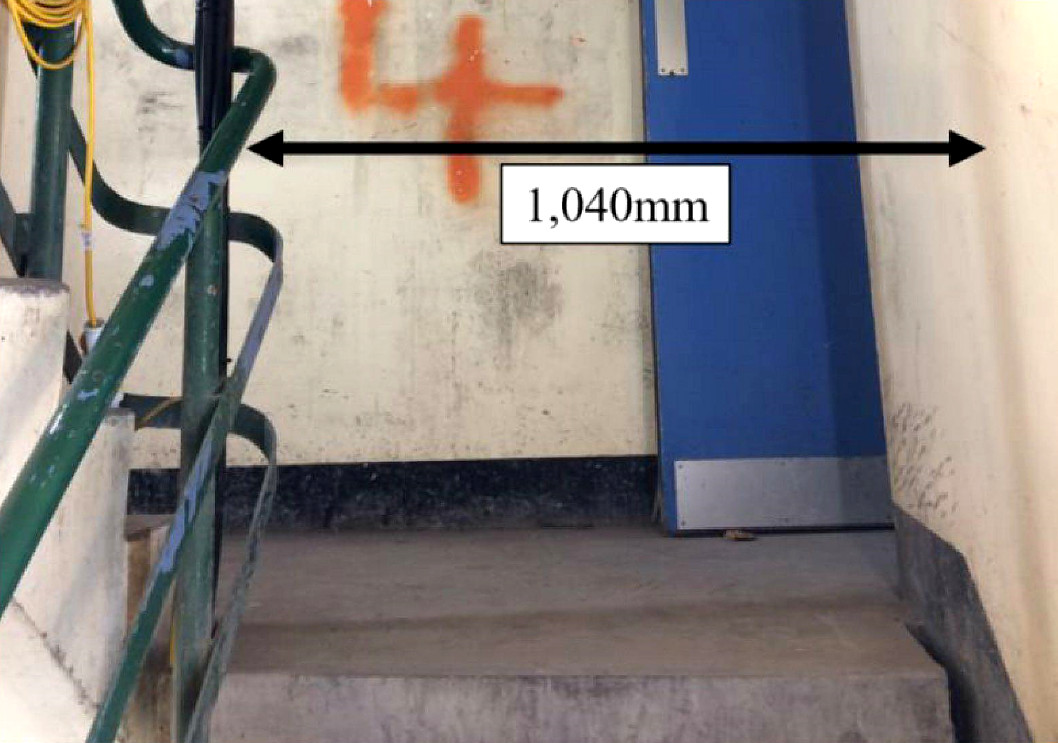
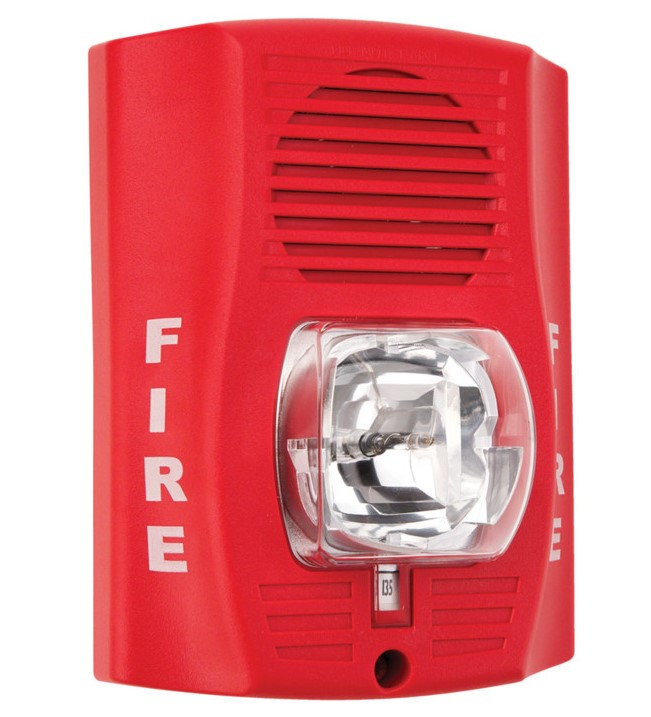
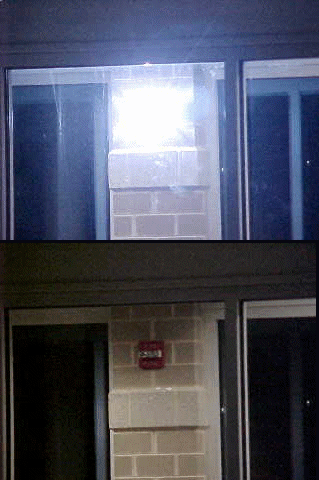
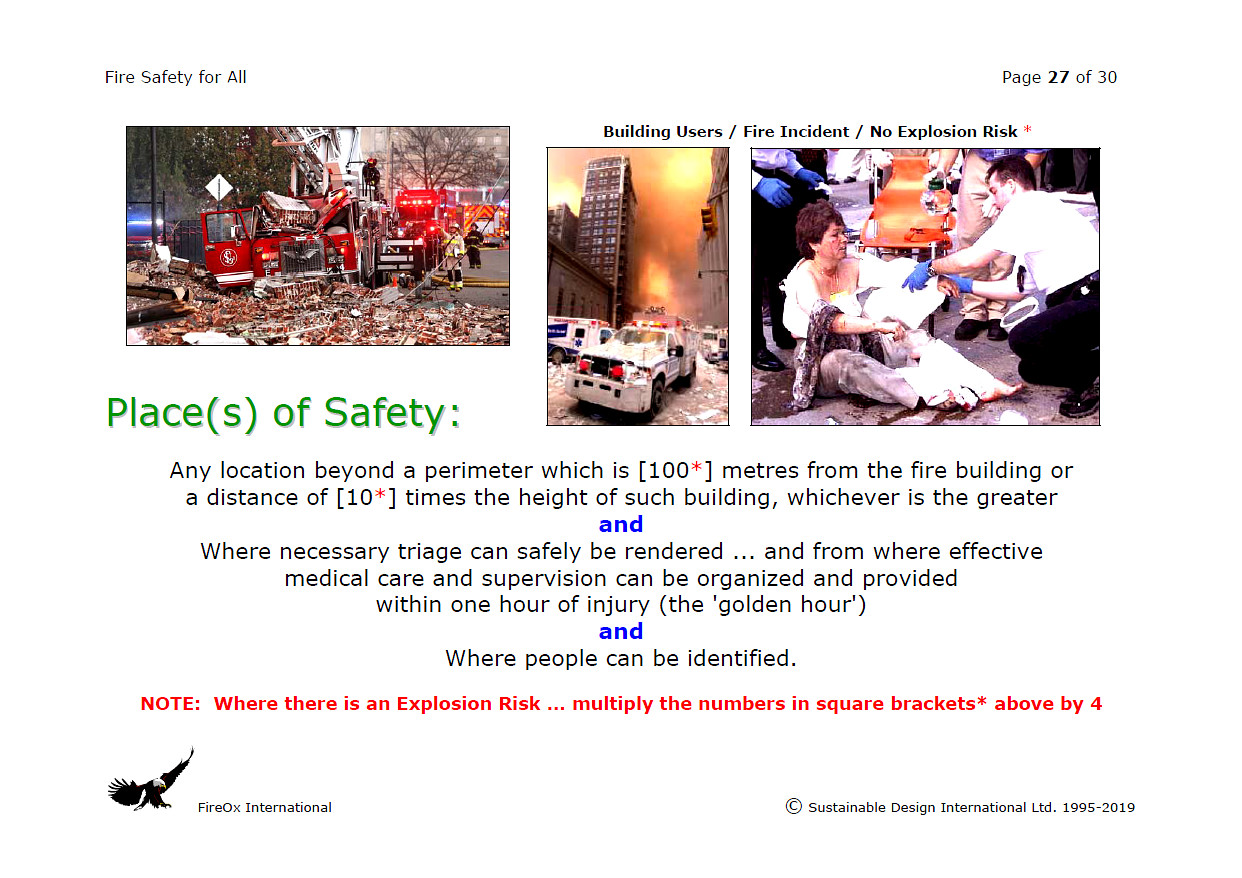
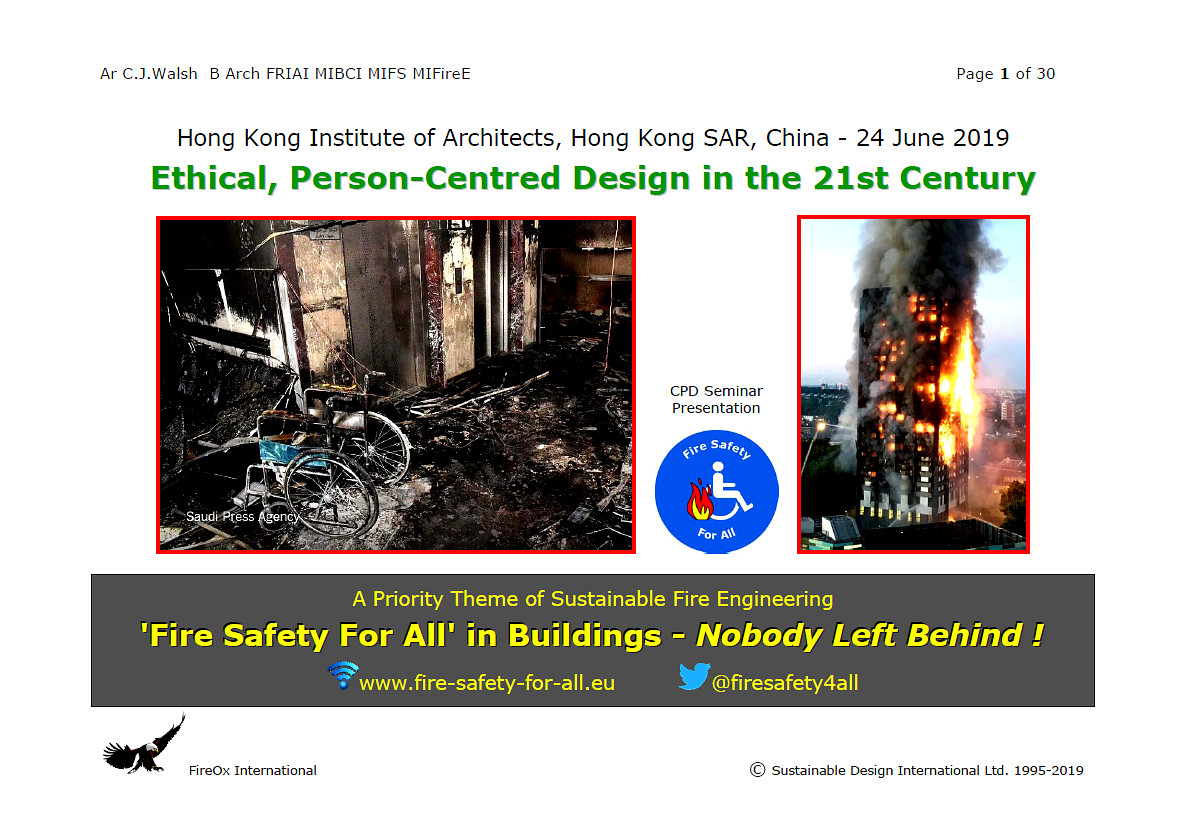
Area of Rescue Assistance in a Building
Buildings & Firefighters Not Yet Safer ! – 10 Years After 9-11 (II)
2011-09-20: Continuing on from where I left off on 11 September 2011 …
Applying the Recommendations contained in the 2005 & 2008 National Institute of Standards & Technology (NIST – USA) Reports on the 9-11 WTC Buildings 1, 2 & 7 Collapses to the everyday practice of Architecture and Fire Engineering has been a central part of our work for many years. Long discussions on this subject have taken place within CIB (International Council for Building Research) Working Commission 14: ‘Fire Safety’ … and I also chair Commission 14′s Research Working Group IV on ‘Fire-Induced Progressive Collapse’.
My particular interest in Disproportionate Damage and Progressive Collapse reaches back as far as the late 1980′s !
So I was intrigued, amused … and at the same time, highly concerned … to read the following Letter to the Editor of the Irish Times Newspaper, on Saturday 10 September 2011 …
Recalling 9/11
Sir, – One of the most important factors in the tragedy of 9/11, and one that has received scant attention, was the mode of failure of the towers.
They were struck high up on their structures and failed via progressive collapse. Had they been designed this side of the Atlantic, they would not have collapsed. These were flimsy structures. -
Yours, etc,
Jim Ryan, Chartered Structural Engineer,
Waterfall, Cork.
.
JIM … If the WTC Towers (which were not flimsy structures !) had been designed on this side of the Atlantic … they would have collapsed.
Furthermore … If the Towers had only been completed last week in the USA, Ireland, England & Wales, India or China … they would still collapse, if a similar event were to occur next year.
To be crystal clear … What we witnessed, on Tuesday 11 September 2001, was a Collapse Level Event (CLE) which exposed, very harshly and cruelly, a catastrophic failure in all of our common Design and Construction Practices and Procedures used in/by/as …
- Architectural Design | (Ambient) Structural Engineering | Fire Engineering ;
- Building Management Systems ;
- Emergency Responders | Firefighters | Rescue Teams ;
- Technical Control Organizations Having Authority (AHJ’s) or Jurisdiction ;
- Fire Safety Objectives in Building Legislation, Codes and Standards.
To the average ‘person in the street’ … Whether he/she lives in Manhattan or Chicago in the USA, Dublin or Cork in Ireland, Cardiff or London in Britain, Dilli or Mumbai in India, Beijing or Shanghai or Hong Kong in China … it is unacceptable that buildings collapse … entirely unacceptable !!
.
COLLAPSE OF WTC BUILDINGS 1, 2 & 7
JIM … Unless you believe in conspiracy theories, please study the 2005 & 2008 NIST(USA) Reports on the 9-11 WTC Buildings 1, 2 & 7 Collapses. The 2 Final Reports can be downloaded from this Page on Sustainable Design International’s Corporate WebSite … http://www.sustainable-design.ie/fire/structdesfire.htm … along with other key documents and links.
Some indication of the enormous quantity of 9-11 WTC Incident Documentation issued by NIST(USA) can be seen below …

Colour photograph showing the enormous quantity of 9-11 WTC Incident Documentation, issued by the U.S. National Institute of Standards & Technology, which is still readily available for the public to access and download.
.
PUBLIC SAFETY 10 YEARS AFTER 9-11 ?
If it is entirely unacceptable to the Public that buildings collapse … in how many National Building Codes does the following Critical Public Safety Equation appear today ? The answer is NONE !

Colour image showing Page 21 from my Overhead Presentation on 'Sustainable Fire Engineering' ... scheduled for this Thursday, 22 September 2011, at the ASFP Ireland Fire Seminar & Workshop ... to be held at the RDS, in Ballsbridge, Dublin. Click to enlarge.
.
Is there some fundamental reason why Levels of Safety for the Public should vary so much from one country to another ? NO, there is not !
Within Europe, and in relation to the New EU Construction Product Regulation 305/2011, which I discussed here a few days ago … the European Commission, in a discussion document dating back to the mid-1980′s, suggested that the only way to effectively realize a Single Market for Construction Products would be to introduce Harmonized EU Building Regulations in all of the EU Member States. Of course the Member States, at the time, went ballistic at the very mention of this idea … and it was quickly withdrawn. I take great pleasure in repeating that important idea today.
Jim … The Critical Public Safety Statement above is fully consistent with … and meets … the ‘Basic Requirements for Construction Works’ in Annex I of EU Regulation 305/2011.
.
However, in relation to any one EU Member State … let’s take Ireland as an example … compare a situation where, in a remote rural location, it might take almost an hour for a sufficient fire service presence to arrive at the scene of a building fire emergency … with a similar situation in the middle of a city, or large town, where the time required will not be greater than 15 minutes … then, although the Level of Safety for the Public can be / should be / must be the same in both situations … I would expect, in the remote rural location having a poor fire service support infrastructure, that the range of Fire Protection Measures to be employed in a typical building would be more extensive, and the performance expected of those Measures would be higher … in order to achieve an Equivalent Level of Safety in both rural and urban locations. Is that not a rational idea ??
Unfortunately, that’s not how the present systems work … National or European ! Levels of Public Safety differ from one country to the next … and from one region, within any one country, to the next … without any good reason … and without meaningful consultation and the full understanding of the Public.
.
BUILDINGS & FIREFIGHTERS ARE NOT YET SAFER
JIM … In spite of all of the spin coming from the other side of the Atlantic … and discounting criminality and fraud in construction practices … Buildings and Firefighters are not yet safer … because the large, difficult, complex flaws and failures in Conventional Fire Engineering have not yet been aggressively confronted … and properly solved.
In a post last year, on 18 October 2010 … I referred to the Cul-de-Sac of Current Fire Engineering … and illustrated a typical architectural detail in a Dublin Building – a common detail also to be found in India, China, USA, England & Wales, etc., etc – which demonstrates a Fundamental Flaw at the very core of conventional thinking and practice.
On Thursday next … 22 September 2011 … at the ASFP Ireland Fire Seminar and Workshop in the RDS, Dublin … I will present this flawed detail … and a solution which is fully compatible with … and answers … the NIST Recommendations !
BUT … would anybody like to show me where any National Building Codes have been revised and updated to solve this Fundamental Flaw ?

Colour image showing Page 33 from my Overhead Presentation on 'Sustainable Fire Engineering' ... scheduled for this Thursday, 22 September 2011, at the ASFP Ireland Fire Seminar & Workshop ... to be held at the RDS, in Ballsbridge, Dublin. Click to enlarge.
.

Colour image showing Page 35 from my Overhead Presentation on 'Sustainable Fire Engineering' ... scheduled for this Thursday, 22 September 2011, at the ASFP Ireland Fire Seminar & Workshop ... to be held at the RDS, in Ballsbridge, Dublin. Click to enlarge.
.

Colour image showing Page 36 from my Overhead Presentation on 'Sustainable Fire Engineering' ... scheduled for this Thursday, 22 September 2011, at the ASFP Ireland Fire Seminar & Workshop ... to be held at the RDS, in Ballsbridge, Dublin. Click to enlarge.
.

Colour image showing Page 37 from my Overhead Presentation on 'Sustainable Fire Engineering' ... scheduled for this Thursday, 22 September 2011, at the ASFP Ireland Fire Seminar & Workshop ... to be held at the RDS, in Ballsbridge, Dublin. Click to enlarge.
.

Colour image showing Page 38 from my Overhead Presentation on 'Sustainable Fire Engineering' ... scheduled for this Thursday, 22 September 2011, at the ASFP Ireland Fire Seminar & Workshop ... to be held at the RDS, in Ballsbridge, Dublin. Click to enlarge.
.
A CASE STUDY OF ENGLAND & WALES
10 years after 9-11 … there are two reasons for taking a closer look at England & Wales (Britain) …
- The Building Regulations for England & Wales were used as the model for the Irish Building Regulations, which were first introduced here in the early 1990′s. And, in the absence of Harmonized European Standards … British National Standards tend, with only a few exceptions, to become the default Irish National Standard ;
- British National Standards are being applied in many different parts of the world outside England & Wales … in most cases, without any proper consideration of content … or adaptation to local conditions.
.

Colour image showing the Cover Page of Approved Document B: 'Fire Safety' ... Volume 2 - Buildings Other Than Dwellinghouses ... from the Building Regulations for England & Wales. Click to enlarge.
.
The Institution of Fire Engineers (Ireland) Annual Fire Conference, which was held last year, on Wednesday 20th October 2010 … in the Dublin Fire Brigade Training Centre, Marino, Dublin … threw up some interesting ‘notions’ for consideration by a diverse range of participants.
One curious proposition … repeated quite often during the day … was that Approved Document B, in the British System of Building Regulations, was basically still a sound document … and that it should pass an upcoming major review with little difficulty.
I don’t agree … Approved Document B is inadequate and dysfunctional !
With regard to Structural Performance in Fire … instead of referring to Approved Document A – Structure … the reader is referred to Appendices at the back of Approved Document B, which only reinforce the erroneous concept of Single Structural Element Fire Protection …
And along with its many other major problems … see my post, dated 2009-06-14 … British Standard BS 9999 takes no account of any of the 2005 & 2008 NIST Recommendations, Fire-Induced Progressive Collapse or Disproportionate Damage … and, in fact, directly conflicts with aspects of the Building Regulations for England & Wales …

Colour image showing Page 51 in the Appendix of my Overhead Presentation on 'Sustainable Fire Engineering' ... scheduled for this Thursday, 22 September 2011, at the ASFP Ireland Fire Seminar & Workshop ... to be held at the RDS, in Ballsbridge, Dublin. Click to enlarge.
.
In order to take a close look at Approved Document B … I used the vehicle of a Notional Hotel Project in Cardiff, Wales … similar to the Early 1990′s Dublin Hotel Project shown above …

Colour image showing Page 52 in the Appendix of my Overhead Presentation on 'Sustainable Fire Engineering' ... scheduled for this Thursday, 22 September 2011, at the ASFP Ireland Fire Seminar & Workshop ... to be held at the RDS, in Ballsbridge, Dublin. Click to enlarge.
.
With regard to properly showing Fitness for Intended Use of Fire Protection related Products and Building Systems … instead of referring to Regulation 7 … the reader is again referred to Appendices at the back of Approved Document B … which explains why we have such serious problems, i.e. lack of Durability and very low Resistance to Mechanical Damage, with the Thermal Insulation Products used for the Fire Protection of Structural Steelwork …
I also had to quote from Part D of the Irish Building Regulations to fill a gap in the British Regulation 7 …

Colour image showing Page 53 in the Appendix of my Overhead Presentation on 'Sustainable Fire Engineering' ... scheduled for this Thursday, 22 September 2011, at the ASFP Ireland Fire Seminar & Workshop ... to be held at the RDS, in Ballsbridge, Dublin. Click to enlarge.
.
.
END
10 Years After 9-11 … Are Our Buildings & Firefighters Safer ??
2011-09-11: From the beginning of the past week, news media (printed and on-line), and the television and radio schedules have all been full of articles, stories, opinions, and interpretative and speculative pieces about the 9-11 World Trade Center (WTC) Incident in New York, and its tragic aftermath. Today is the 10th Anniversary … a long ten years since that sunny Tuesday morning in Manhattan !
BUT … is anybody out there asking the questions: “Are Our Buildings Safer ?” … and … “Are Our Firefighters Safer ?” AND … if you do ask those questions … are you able to distinguish between solid, reliable information and ‘spin’ ?
So many Irish people, and people of Irish descent, were directly involved in this traumatic event … working inside the WTC offices, as stockbrokers … or outside, as maintenance personnel, or firefighters, policemen and women, or as members of the emergency medical services …

Colour photograph showing the thick cloud of toxic dust and debris spreading rapidly throughout lower Manhattan, and beyond, after the Second Tower Collapse (WTC 1/North Tower) just before 10.30 hrs (local time) on the morning of 11 September 2001. Earlier, seismic sensors located 160 Km away had recorded the time and intensity of the First Tower Collapse (WTC 2/South Tower) at 09.59 hrs (local time). Click to enlarge.
.
REALPOLITIK
The previous post about the United Nations Gaza Flotilla Report, I hope, created an uncertainty in your mind … a worrying thought regarding political interference and the negative, and very often, destructive influence of vested interests … which is a necessary frame of mind to have, also, for an essential discussion – on the 10th Anniversary of the 9-11 WTC Incident – about the Safety of Our Buildings, particularly High-Rise Buildings, Iconic Buildings, and those Buildings having a Critical Function and/or an Innovative Design … and the Safety of Our Firefighters.
By ‘Our Buildings’ … I don’t just mean buildings in Ireland, or Europe … I mean buildings on every continent of our small planet. And … such a discussion must be trans-disciplinary, involving the use of simple language only … because it is necessary for each discipline to clearly understand what the others are saying (this rarely happens !) … and the discussion must also be transparent to, and be easily assimilated by, the general population in all of our societies. And by ‘Our Firefighters’ … I mean firefighters worldwide.
Concerning the Gaza Flotilla Report … we could ask …
- Would the Findings and Recommendations have been different … if there had been 4 independent and obviously impartial people on the Panel of Inquiry instead ? The answer is … yes, of course ! And …
- Why did UN Secretary-General Ban Ki-moon nominate President Álvaro Uribe (Vice-Chair), an ‘ultra’ rightwing politician from Columbia … and Mr. Joseph Ciechanover Itzhar, an Israeli, to serve on the Panel ? I will leave you to answer that for yourself …
The important point I wish to make is that the community of International Fire Science and Engineering – just like every other ‘human’ community – is not immune from these sorts of malevolent influences !
.

Colour photograph showing advanced clean up operations at the World Trade Center Complex after 11 September 2001. Fires continued to smoulder for weeks after the Incident. Click to enlarge.
.
LONG-TERM ENVIRONMENTAL IMPACTS OF 9-11
Just five weeks after the 9-11 World Trade Center (WTC) Incident in New York … I found myself in Manhattan for the purpose of making an important presentation to a conference which was taking place not far from Madison Square Garden … while staying Down-Town in Battery Park City, at an apartment within the Security Zone. Yes, I was worried and fearful before going … but …
Environmental Impact: Any effect caused by a given activity on the environment, including human health, safety and welfare, flora, fauna, soil, air, water, and especially representative samples of natural ecosystems, climate, landscape and historical monuments or other physical structures, or the interactions among these factors; it also includes effects on accessibility, cultural heritage or socio-economic conditions resulting from alterations to those factors.
On first arriving in the city, by taxi from Kennedy Airport … I witnessed, at first hand, the racist hostility of a policeman towards our coloured Asian driver, who had simply asked about the procedure to pass through the Security Zone Boundary. Later, walking near the WTC Site, I would encounter the ‘macho’ behaviour of many National Guardsmen on security duty.
At the conference, I met a person who was literally unable to speak – could not even bear to talk about – the 9-11 Incident.
Everywhere south of Canal Street was in a terrible, horrific condition.
The weather, fortunately, had remained generally very good … sunny, with a light breeze coming in from the sea. Then, unexpectedly, one day towards the end of my stay … the sky was overcast and the air stood still … in lower Manhattan, it assaulted my eyes, nose and the back of my throat. Many times, during that particular day, I retched … but could not vomit ! Yet, a representative of the U.S. EPA (Environmental Protection Agency) announced that there was no problem with air quality ! Meanwhile, in Mid-Town, everything ‘appeared’ normal.
10 Years Afterwards … people, communities and the country (USA) are all still suffering … physically, mentally and psychologically … from the 9-11 WTC Incident … unable to ask for help, or perhaps, too proud or ashamed to speak up.
September 2001 – World Health Organization
WHO: How to Address Psychosocial Reactions to Catastrophe
Click the Link Above to read and/or download PDF File (12.5 kb)
.
10 YEARS AFTER 9-11 – ARE OUR BUILDINGS & FIREFIGHTERS SAFER ?
Or to put it in a more technical way … how are the Critical Recommendations contained in the 2005 & 2008 NIST(USA) Reports on the 9-11 WTC Buildings 1, 2 & 7 Collapses being implemented ? And, what is the quality of that implementation ?
At this time, two years ago … I asked …
- Why are so many Key Institutions and Organizations in the International Building Sector still desperately trying to ignore and/or deny the Recommendations in those 2 NIST Reports ?
- Why have National Building and Fire Codes/Regulations and Standards not yet been revised to respond, properly and satisfactorily, to the NIST Recommendations ?
- Why can we not yet use All Lifts (Elevators) in a Building during a fire incident ? Why are Lift (Elevator) Manufacturers still actively resisting this necessary change ?
.

Colour image showing an Ostrich with its Head in the Sand ... an accurate description of the International 'Technical' Reaction to the 9-11 WTC Incident ... "it never happened" ... or "it was a unique event, and it will never happen again" ... or "this unusual event only has implications for very, very, very tall buildings" ... blah, blah, blah !!
.
The answers to the questions are NO … and NO … minor revisions (tinkering at the edges) have been made to Codes/Regulations & Standards in some countries … and, generally, progress on implementing the NIST Recommendations is proving to be very slow … too slow ! Most surprisingly, no revisions have been made to Codes/Regulations & Standards in many countries.
To illustrate tinkering at the edges … refer to the USA’s International Building Code (2012 Edition) … which, despite its grandiose title, is really just another of the USA’s National Model Building Codes … and check out this very disappointing Article: ‘Evolution of Building Code Requirements in a Post 9/11 World’, by David Drengenberg and Gene Corley, in the recently published Special Issue III (2011) of the Council on Tall Buildings and Urban Habitat (CTBUH) Journal … which is available at http://www.ctbuh.org/
Progress at the National Fire Protection Association (NFPA), in the USA, is a little more apparent … but still, far too little and far too slow. Check out this recent Special 9-11 Report: ‘A Decade of Difference’, by Fred Durso Jr … on the NFPA WebSite … http://www.nfpa.org/publicJournalDetail.asp?categoryID=2248&itemID=53000&src=NFPAJournal …
And … released earlier this year, NFPA’s Third Needs Assessment of the U.S. Fire Service has identified ‘areas of ongoing concern’ !!
.
To Be Continued …
.
.
END
2011 IFE International Fire Conference & AGM in Cardiff, Wales
2011-07-17: On 6th & 7th July last … in Cardiff, the Capital City of Wales … the Institution of Fire Engineers (IFE) held its Annual General Meeting (AGM), followed by a very well attended 1½ Day International Fire Conference. Participants came from as far away as Australia, New Zealand, Malaysia, Taiwan, Hong Kong (in China), Canada, U.S.A., Nigeria and Switzerland. A large, vocal group of delegates from The Netherlands also attended … and of course, there were many people from these islands … Ireland and Great Britain … the Irish Isles !
For me, it was an enjoyable few days in Cardiff.
The Immediate Past President of the IFE, Mr John Woodcock, had initiated an important programme of activities during his 2010/2011 Term of Office on the theme of ‘Fire Engineering & Sustainability’. The New IFE President for 2011/2012, Mr. H.G. (Hao-Giang) Tay, has stated that he will continue this work with enthusiasm.
This brings me very neatly to the reason for my attendance at the Cardiff ‘Gig’. I had been invited by HG Tay to make a presentation on ‘Sustainable Fire Engineering’. This, I was very pleased and honoured to do.
.
” The audience found the conference extremely valuable and I had many delegates who spoke to me specifically about how good the conference was and the high standard of the presentations. The number of questions on each presentation was a testament to the interest of the audience.
The subject is of such importance that we really need to make sure the voice of the profession is firmly planted in all decision-making on design, protection and management of buildings.”
[Short Extract, Letter from HG Tay, International IFE President, dated 27 July 2011]
.

Tremendous Injury was caused to the Local Environment in Buncefield ... but Our Planet can no longer suffer these Criminal Human Acts !
2011 IFE Cardiff Overhead Presentation
CJ Walsh: “Sustainable Fire Engineering IS THE FUTURE !”
Click the Link Above to read and/or download PDF File (3.98 Mb)
.
In order to properly protect the interests of Society and our Clients/Client Organizations … and to effectively realize a Safe and Sustainable Built Environment in the 21st Century … it is necessary, in designing a building for fire and its immediate aftermath, for the Fire Engineer to develop Project-Specific Fire Engineering Design Objectives … which must never be confused with the minimal Fire Safety Objectives mandated in Building and Fire Regulations and Codes.
Sustainable Fire Engineering is concerned with far more than compliance with Legislation ! For this reason, a Fire Engineering Code of Ethics is essential.
.
Ethically Based Sustainable Fire Engineering must also consider the following issues, which are relevant to Today’s Human Environment :
- Sustainable Human & Social Development.
- Adaptation to Climate Change and Severe Weather Events … not less than a recurrence interval of 100 years should be used in design, always bearing in mind that the minimum Building Life Cycle for a Sustainable Building is 100 years.
- Resistance to Fire-Induced Progressive Building Collapse and Disproportionate Damage.
- Sufficient attention and care for Vulnerable Building Users in ‘situations of risk’ – refer to Article 11 of the 2006 United Nations Convention on the Rights of Persons with Disabilities.
- Safety of Firefighters & Rescue Teams – refer to Essential Requirement 2 of the European Union’s Construction Products Directive 89/106/EEC.
.
In this Overhead Presentation …
- Clearly outlined is a Holistic Perspective of the much wider scope for Sustainable Fire Engineering in the Future … Fire Engineering which has an empirical and scientifically robust foundation … Fire Engineering which is not afraid to confront and absorb the lessons of the 9-11 WTC Incident (2001) in New York, or the 2008 Mumbai ‘Hive Attacks’ … Fire Engineering which discards its outrageously shameful disregard for People with Activity Limitations … Fire Engineering which understands Fire-Induced Progressive Collapse and Disproportionate Damage in Buildings and, most importantly, understands the difference between these two related structural concepts … Fire Engineering which is capable of full integration with the Mainstream Construction Sector ;
- Sustainable Human & Social Development is clearly defined, and the current widespread confusion about the far more limited concept of ‘Green’ is removed ;
- The UNESCO WFEO/FMOI Model Code of Ethics, updated by CJ Walsh in 2011, is proposed as a suitable and very necessary template for the Institution of Fire Engineers (IFE) ;
- As Sustainable Design Solutions are appropriate to Local Geography, Culture, Climate (and Climate Change), Economy, Social Need, Language/Dialect, etc … it is strongly recommended that the IFE should develop Global Regional Guidance Documents on Sustainable Fire Engineering, i.e. separate documents for Africa, Asia, Europe, South America, etc ;
- Finally … this Presentation initiates a fresh and entirely new dialogue within the International Fire Science and Engineering Community.
.
What are your views and comments ?
.
.
END
Building Design Must Improve Firefighter Safety in Fire Incidents !
Back to the present … and in any jurisdiction, news of Firefighter Fatalities and/or Injuries is very distressing. It has been remarkable to note, however, how some countries, e.g. Japan, are expending significant time and resources on developing innovative ways to improve firefighter safety in buildings … while most countries are not. Over many years, I have formed the clear impression that, generally, firefighters are regarded in much the same way as soldiers, i.e. they are a disposable asset … ‘Theirs not to reason why / Theirs but to do and die’ … etc., etc. This situation is entirely unacceptable, and in need of urgent resolution !
On 6th & 7th July … in Cardiff, Wales … I have been invited by the International President of the Institution of Fire Engineers (IFE), Mr. HG Tay, to make a presentation on ‘Sustainable Fire Engineering’ at the 2011 IFE International Fire Conference and Annual General Meeting. I am greatly honoured by this invitation.
During the course of that presentation, I will be referring to Firefighter Safety … but much more needs to be said, beforehand, in relation to the untapped contribution of building design to greater levels of firefighter safety …
INTRODUCTION
It may be obvious for some (but, believe me, not for all !) that with regard to fighting fires in buildings … Firefighters have 2 Basic Functions :
- to rescue people who are trapped in a Fire Building (i.e. a building which is on fire) … or people who, for some reason, cannot independently evacuate the building (e.g. people with activity limitations) ; and
- to fight those fires, and ensure that they are properly extinguished.
Note: Extinction of a fire is confirmed only after a thorough visual inspection by a competent person.
.
DESIGN & CONSTRUCTION
In a previous post, dated 13 December 2010 … I said that it was no longer ethically acceptable to ignore the issue of Firefighter Safety in the design and construction of buildings … because design can make a major contribution to their safety.
Unfortunately, Firefighter Safety must continue to remain an ethical issue because Building Regulations in most countries rarely, if ever, refer to this important aspect of design and construction. Safety at Work Legislation has a related, but different, intent.
Regrettably, most of the building design professions either have no Code of Ethics … or there is a Code which is ‘lite-lite-lite’, i.e. very weak on ethics … or, worse still, they have a Code … but it is called a Code of Professional Conduct, the principal intent of which is to preserve and protect the profession and its vested interests.
At European Level …
Essential Requirements 1 & 2 (of 6 … for the time being) … in Annex I of European Union (EU) Council Directive 89/106/EEC, of 21 December 1988, on the approximation of laws, regulations and administrative provisions of the Member States relating to Construction Products … state the following …
1. Mechanical Resistance & Stability
The construction works must be designed and built in such a way that the loadings that are liable to act on it during its construction and use will not lead to any of the following:
(a) collapse of the whole or part of the works ;
(b) major deformations to an inadmissible degree ;
(c) damage to other parts of the works or to fittings or installed equipment as a result of major deformation of the load-bearing construction ;
(d) damage by an event to an extent disproportionate to the original cause.
2. Safety in Case of Fire
The construction works must be designed and built in such a way that in the event of an outbreak of fire:
- the load-bearing capacity of the construction can be assumed for a specific period of time ;
- the generation and spread of fire and smoke within the works are limited ;
- the spread of the fire to neighbouring construction works is limited ;
- occupants can leave the works or be rescued by other means ;
- the safety of rescue teams is taken into consideration.
.
Sweden … has incorporated all 6 Essential Requirements of EU Construction Products Directive 89/106/EEC into its National Building Regulations … but has omitted the reference to the ‘safety of rescue teams’, i.e. Firefighter Safety. Why is that ?
Ireland, along with England & Wales, has not incorporated the EU CPD Essential Requirements into its National Building Regulations. There is no requirement, in Part B of the Building Regulations of either of these two separate jurisdictions, to consider Firefighter Safety in the design and construction of buildings.
In these three specific cases, taken as a simple example, this is a serious legal flaw … especially since the European Template, above, has existed since the late 1980′s !
.
Let me illustrate how Building Design & Construction can make a major contribution to improved levels of Firefighter Safety …
A. Accessible Internal Staircases Having Sufficient Unobstructed Width
From a building user’s point of view … the success of a building depends, to a large extent, on the ‘quality’ of its circulation spaces. During the design process, however, an architect is typically concerned with the relationship between different functions and spaces … while, at the same time, he/she is shaping and moulding the internal and external forms of the building.
The full range of tasks and activities in these circulation spaces is rarely, if ever, considered by the building designer. The subject is not covered in Architectural Schools … and in later professional life, a reluctance to carry out Building Post-Occupation Evaluations (POE’s) reinforces this low level of awareness.
Some Tasks & Activities in Building Circulation Spaces …
- Access to the building’s spaces and use of its services and facilities ;
- Egress from the building during normal, everyday circumstances ;
- Independent Evacuation, in the event of an emergency ;
- Assisted Evacuation by others, or Rescue by Firefighters, for those building users who cannot independently evacuate the building, e.g. people with activity limitations ;
- Firefighter Access & Reconnaissance, in the event of an emergency ;
- Firefighter Attack, as they approach the proximity of the fire scene ;
- Firefighter Removal from the building, by colleagues, in the event of injury, impairment, or a fire event induced health condition ;
- Firefighter Withdrawal at the successful conclusion of firefighting operations.
.

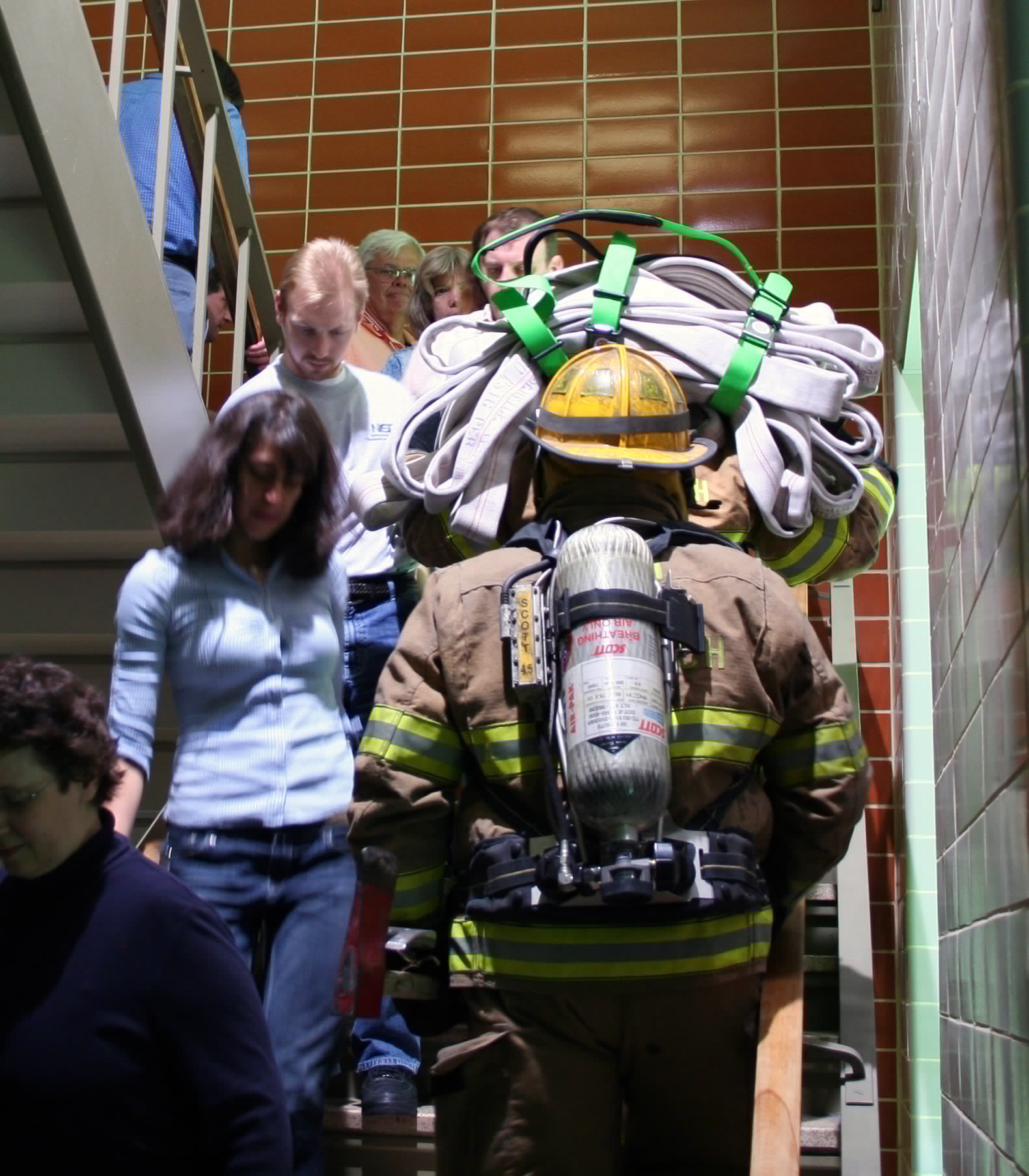
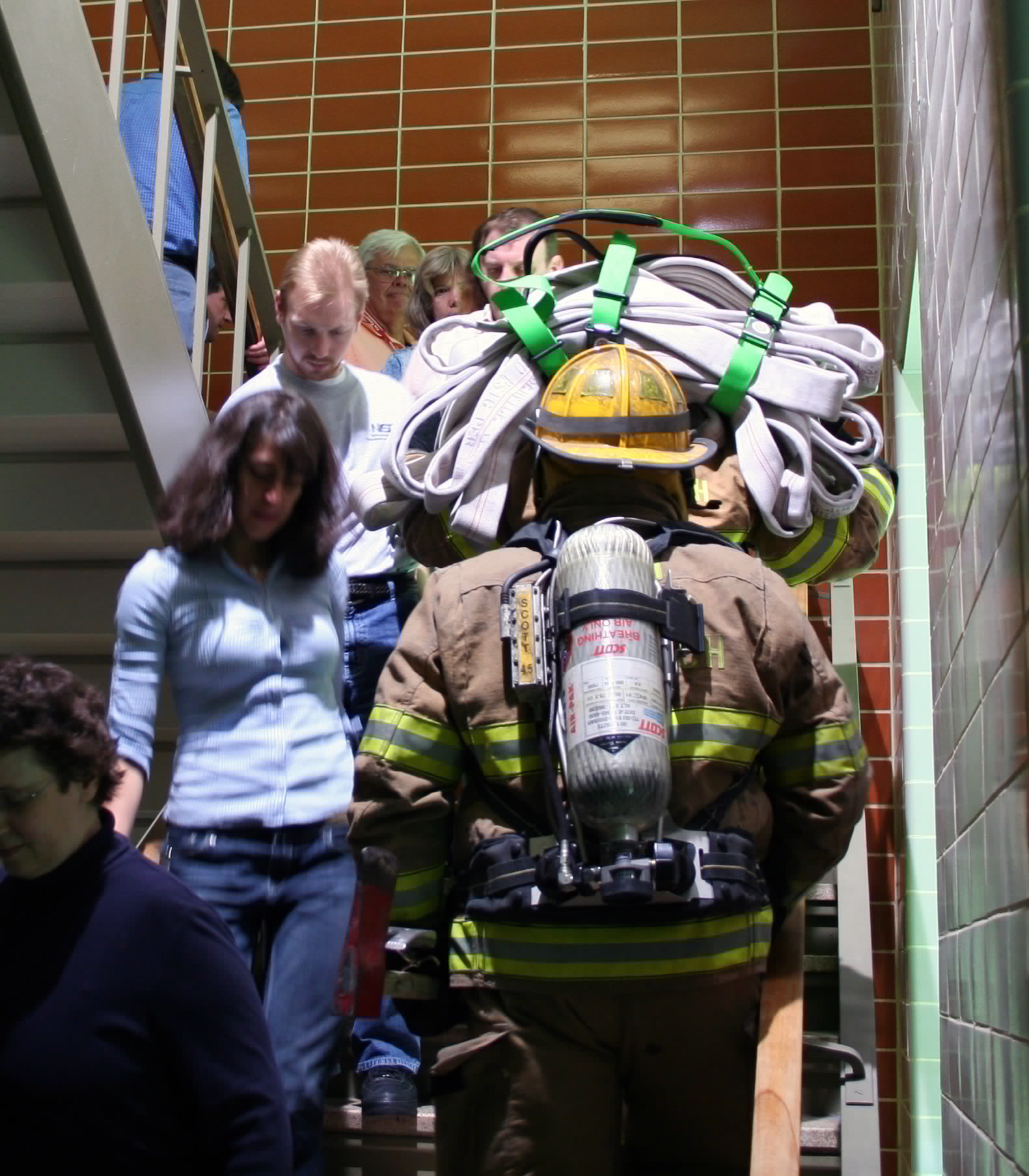
Colour photograph showing an injured, or impaired, firefighter being assisted by two colleagues in an upward staircase removal exercise. For reasons outlined in a previous post (2010-12-13) ... all three firefighters must continue to wear full Personal Protection Equipment (PPE) ... and use Self-Contained Breathing Apparatus (SCBA). Click to enlarge.
.
The photograph above was extracted from this 2010 Poster Presentation …
Daniel DiRenzo, Cherry Hill Fire Department, New Jersey, USA
Building Fires – Personal Harness Use – Firefighter Removals
Click the Link Above to read and/or download PDF File (1.73 Mb)
No matter what the jurisdiction … no matter what Building Regulations do or do not require … it is clear that, during a ‘real’ fire emergency, patterns of circulation are not simple … and they cannot easily be segregated into categories with simple titles. They are complex … and, quite often, they overlap.
In the case of the firefighter removal on a staircase (shown above) … there is a necessity to consider another type of ‘Contraflow’ … where the injured, or impaired, firefighter with two of his/her colleagues rendering assistance are together moving away from the scene of the fire … while other firefighters are moving in the opposite direction, towards the fire.
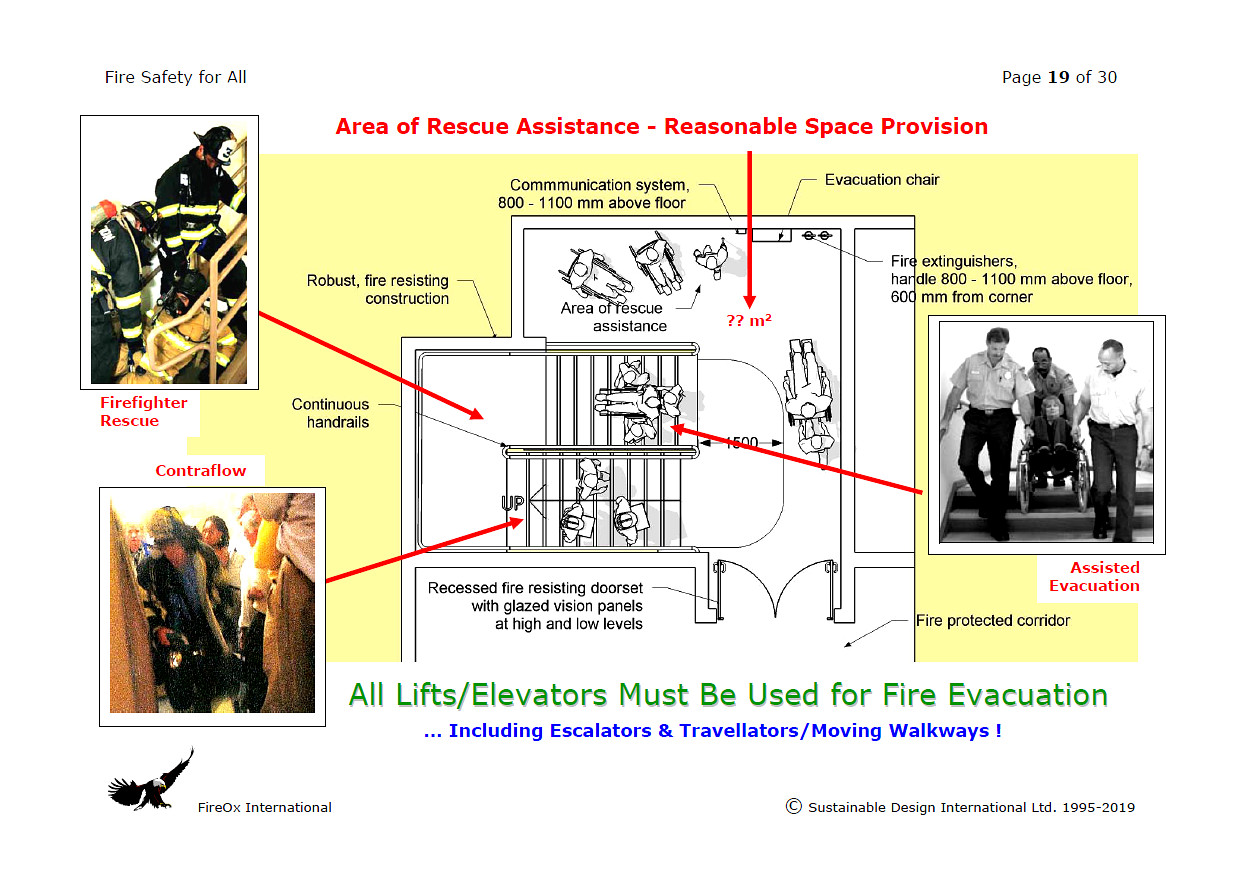
In all but the most simple and smallest building types, this is what a Fire Evacuation Staircase should look like below … having a clear unobstructed staircase width, between handrails, of 1500 mm … with a stair going/tread of 300 mm, and a stair riser of 150 mm. Proper attention by the designer to Accessibility Design Criteria will also make the staircase far, far easier … and safer … for Firefighter Movement …

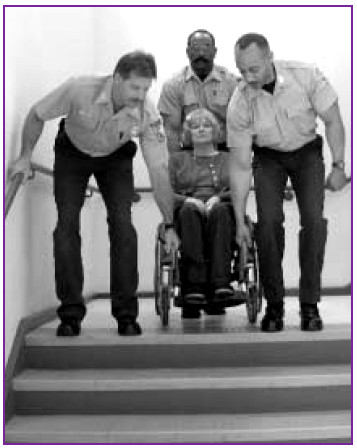
Colour drawing taken from International Standard ISO FDIS 21542, and associated inset photographs ... showing a Fire Evacuation Staircase suitable for All Building Types, which is designed for Firefighter Safety. The staircase is also designed to accommodate Building User Evacuation/Firefighter Contraflow, illustrated with an inset colour photograph ... the Rescue/Assisted Evacuation of People with Activity Limitations, also illustrated with an inset colour photograph ... and the Use of a Stretcher. The staircase design is based on the work of CJ Walsh. Click to enlarge.
.
B. Accessible Façade Walkways in High-Rise Buildings
With today’s powerful drivers of greater energy conservation and efficiency in buildings, adaptation to climate change, and a paradigm shift in thinking on the reduction of adverse environmental impact by buildings … External Façade Design is rapidly evolving … becoming far more complex and, in many cases, comprising multiple ‘skins’.
Just check out this architectural feature, below, in an Osaka (Japan) High-Rise Hotel … which not only serves as an accessible route for evacuation and/or rescue in the event of a fire incident … but also permits much easier access for maintenance and window cleaning.
This architectural feature should be mandatory in the case of high-rise buildings with a single, central core …

Colour photograph showing the High-Rise Swissôtel Nankai in Osaka, Japan. Photograph by CJ Walsh. 2010-04-20. Click to enlarge.
.

Colour photograph showing the External Walkway on the Building Façade of the High-Rise Swissôtel Nankai in Osaka, Japan. Photograph by CJ Walsh. 2010-04-19. Click to enlarge.
.

Colour photograph showing the Hotel Room Evacuation Panel to the External Façade Walkway, which can also facilitate rescue by firefighters during a fire incident. Photograph by CJ Walsh. 2010-04-19. Click to enlarge.
.
Building Design can make a substantial contribution to greater Firefighter Safety !!
BUT … who is raising the awareness of building designers about this issue ???
.
.
END
EU Sustainable vs. Green Public Procurement – Beware !
2010-11-02: For a long, long time … too long … I have been bleating on about the major and substantial difference between Sustainable Design and Green Design … or ‘Sustainability’ and ‘Green-ness’. See my previous Posts.
This bores me no end !
HOWEVER … there are some serious implications if this difference is not properly understood … particularly by individuals, groups or organizations attempting to advance the Application of Criteria which address Social and/or Ethical Concerns within, for example, the European Union’s Public Procurement Framework … or the EU’s Construction Product Framework.
The following is a nice little example of exactly what I am talking about … explained by no less an authority than the Directorate General for Environment in the European Commission itself … on its very own Public Procurement WebPage at http://ec.europa.eu/environment/gpp/index_en.htm … as viewed, by me, on 2010-09-12 …
[ For a moment, let's just overlook the simplistic and crude 'three pillars' understanding of Sustainable Development. See my previous Posts.]
Sustainable Public Procurement (SPP) … means that public authorities seek to achieve the appropriate balance between the three pillars of sustainable development – economic, social and environmental – when procuring goods, services or works at all stages of the project.
Green Public Procurement (GPP) … means that public authorities seek to procure goods, services and works with a reduced environmental impact throughout their life cycle compared to goods, services and works with the same primary function that would otherwise be procured.
Practical Differences Between SPP & GPP !
GPP is often more easily accommodated than SPP within the existing legal and practical framework of procurement. Green requirements can be included in technical or performance-based specifications for products, services and works. Provided the conditions set out in the ‘Helsinki Bus’ and ‘Wienstrom’ Cases, and Evropaïki Dynamiki vs. European Environment Agency (EEA) … are met, green award criteria can also be applied (further information on these cases is available at http://ec.europa.eu/environment/gpp/case_law_en.htm).
The application of Criteria aimed at addressing Social or Ethical Concerns can be more difficult in the context of regulated public procurement procedures. Public authorities are specifically empowered to include social requirements in their conditions for the performance of contracts or to reserve certain contracts for performance by sheltered workshops or employment programmes (Articles 26 and 19 of Directive 2004/18/EC respectively).
.
My Note: DIRECTIVE 2004/18/EC of the European Parliament and of the Council, of 31 March 2004, on the co-ordination of procedures for the award of public works contracts, public supply contracts and public service contracts.
[ For another moment, let's just overlook the unfortunate use of disability-related language ... which fails, utterly, to take account of the 2001 World Health Organization's International Classification of Functioning, Disability & Health (ICF). See my previous Posts.]
Article 19 – Reserved Contracts
Member States may reserve the right to participate in public contract award procedures to sheltered workshops or provide for such contracts to be performed in the context of sheltered employment programmes where most of the employees concerned are handicapped persons who, by reason of the nature or the seriousness of their disabilities, cannot carry on occupations under normal conditions.
The contract notice shall make reference to this provision.
Article 26 – Conditions for Performance of Contracts
Contracting authorities may lay down special conditions relating to the performance of a contract, provided that these are compatible with Community law and are indicated in the contract notice or in the specifications. The conditions governing the performance of a contract may, in particular, concern social and environmental considerations.
ANNEX VI – Definition of Certain Technical Specifications
For the purposes of this Directive:
1. (a) ‘technical specification’, in the case of public works contracts, means the totality of the technical prescriptions contained in particular in the tender documents, defining the characteristics required of a material, product or supply, which permits a material, a product or a supply to be described in a manner such that it fulfils the use for which it is intended by the contracting authority. These characteristics shall include levels of environmental performance, design for all requirements (including accessibility for disabled persons) and conformity assessment, performance, safety or dimensions, including the procedures concerning quality assurance, terminology, symbols, testing and test methods, packaging, marking and labelling and production processes and methods. They shall also include rules relating to design and costing, the test, inspection and acceptance conditions for works and methods or techniques of construction and all other technical conditions which the contracting authority is in a position to prescribe, under general or specific regulations, in relation to the finished works and to the materials or parts which they involve ;
(b) ‘technical specification’, in the case of public supply or service contracts, means a specification in a document defining the required characteristics of a product or a service, such as quality levels, environmental performance levels, design for all requirements (including accessibility for disabled persons) and conformity assessment, performance, use of the product, safety or dimensions, including requirements relevant to the product as regards the name under which the product is sold, terminology, symbols, testing and test methods, packaging, marking and labelling, user instructions, production processes and methods and conformity assessment procedures ;
2. ‘standard’ means a technical specification approved by a recognised standardising body for repeated or continuous application, compliance with which is not compulsory and which falls into one of the following categories:
- International Standard: a standard adopted by an international standards organisation and made available to the general public ;
- European Standard: a standard adopted by a European standards organisation and made available to the general public ;
- National Standard: a standard adopted by a national standards organisation and made available to the general public.
.
In order for a Criterion … any Criterion … to be acceptable within the European Union’s Public Procurement Framework, it should be expressly linked to the subject matter of the Contract … should be specific … and should be capable of objective verification.
Beware !!
.
.
END
Dublin IFE Fire Conference – Sustainable Fire Engineering !
Nothing less than a complete Paradigm Shift to Sustainable Fire Engineering is now needed … because it is Necessary … because it is Inevitable … because it is The Future !!!
This process will not proceed, however, unless the International Fire Science & Engineering Community begins to communicate and engage, meaningfully, with the Mainstream Construction Sector … where this process is already well advanced.
One Organization in our community has recently decided to bite the bullet … CIB (International Council for Research & Innovation in Building & Construction) … where Working Commission 14 (W14) – ‘Fire Safety’ … agreed, at a meeting in Zurich, to significantly expand and elaborate its own Scope … please note the keywords in bold text …
A CIB Working Commission … W14 is an international, multi-stakeholder, trans-disciplinary, pre-normalization forum for discussion, and action, on research and innovation in Fire Science and Engineering for the design, construction and operation of a Safe and Sustainable Built Environment.
.

Colour image showing the Title Page of CJ Walsh's Presentation at the Institution of Fire Engineers (Ireland Branch) Annual Fire Conference ... which will be held on Wednesday, 20th October 2010, in Dublin. Click to enlarge.
.
This will be my important message on Wednesday next, 20th October 2010, when I address the Institution of Fire Engineers (Ireland Branch) Annual Fire Conference … which will be held in the Dublin Fire Brigade Training Centre, Marino, Dublin 1 … beginning at 09.30 hrs in the morning.
Institution of Fire Engineers (Ireland Branch)
2010 IFE Annual Fire Conference Brochure
Click the Link Above to read and/or download PDF File (326kb)
.
.
Three Powerful Pulling Forces for Change … or should I say Dragging Forces, with a lot of kicking and screaming involved (!) … will have a direct impact …
1. Sustainable Design
The interior view shown below is not that of a Sustainable Building … but of a Modern Architectural Icon, designed by the Master Architect Mies van der Rohe towards the end of the 1920′s … way back in the last century ! Two innovative architectural concepts are elegantly illustrated in the photograph …
- Open Planning – one space ‘flows’ into the next without interruption by a physical barrier … drawing the eye and encouraging movement. In this particular building … a building of architectural, cultural and historical importance … any attempt to impose ‘fire compartmentation’ on the layout would be utterly ridiculous !
- Separation of Building Structure & Fabric – notice the column in the foreground. This is quite unlike the massive form of building construction in the past !
.

Colour photograph showing an Interior View of the Barcelona Pavilion, designed by the German Architect Ludwig Mies van der Rohe in 1929. Photograph taken by CJ Walsh. 2009-03-20. Click to enlarge.
.
Fire Engineering is still trying to grapple … unsuccessfully … with innovative approaches, dating from the early part of the 20th Century, to Architectural Design. In the 21st Century, Sustainable Design – not Green Design – involves a far more radical approach to Design, the use of Building Materials, and Construction. In the face of this much greater challenge, Fire Engineering must begin to respond effectively … with creativity and imagination. There is no other alternative !
.
2. Cul-de-Sac of Current Fire Engineering
Working in Building Control at the time … I encountered the Typical Building Detail shown below in an early 1990′s Dublin Hotel Extension Project … comprising a 10 metre span steel beam … with non-loadbearing steel stud partitioning beneath, separating a corridor from bedrooms … each with 1 Hour’s Fire Resistance. During a fire and long before the period of 1 Hour has elapsed … that steel beam will have deflected by a considerable dimension. What happens, then, to the non-loadbearing steel stud partition, below, and its fire resistance performance ??? This makes no sense.
Does current Fire Engineering have a robust rational and empirical basis … or is it just one remove from Voodoo and Witchcraft ??

Black and white 'concept' drawing, with a small touch of colour, showing a typical detail in an early 1990's Dublin Hotel Extension Project ... of a 10 metre span steel beam ... with non-loadbearing steel stud partitioning beneath, separating a corridor from bedrooms ... each with 1 hour's fire resistance ?!? Drawn by CJ Walsh.
.
3. NIST(USA) Recommendations on the 9-11 WTC Building Collapses
Determined resistance by Vested Interests … a Lack of Institutional Capacity, i.e. failure to be able to properly anticipate, or to be adequately prepared, and/or to respond effectively and in a timely manner to major fire incidents … and a small element of the ‘Issue Attention Cycle’, where considerable investment in time and resources were necessary to make real progress on the issues thrown up by 9-11 but, unfortunately, governmental and public attention soon waned and dissipated … shifting to new problems, e.g. the Illegal Iraq ‘Crusade’ … have all contributed to a situation where there has been little in the way of substantive implementation of the Recommendations contained in the 2005 and 2008 NIST(USA) Reports on the 9-11 WTC Buildings 1, 2 & 7 Collapses … in the United States of America, Europe … or anywhere else.
.

Colour photograph of the World Trade Center Complex in New York, taken at the time of the 2nd Plane Impact during the morning of Tuesday, 11th September 2001. Click to enlarge.
.
That is not our approach, here, at FireOx International – the Fire Engineering Division of Sustainable Design International Ltd. Instead, we have decided to present all of the NIST Recommendations … to our readers … in a Series of Posts on this Technical Blog.
Sustainable Fire Engineering HAS a robust rational and empirical basis !
.
.
END
Evacuation Chair Devices – Fire Engineering for All in Buildings ?
2010-06-06: This post has been running around in the back of my mind for quite some time … and I know now, for far too long ! But recently, my patience with certain manufacturers and suppliers of evacuation chair devices has reached its limit.
In relation to Building Users … previous posts have examined the technical term: Place of Safety (see the post dated 2009-10-24) … and why this concept is an essential starting point in the development of any practical … and comprehensive … fire engineering strategy for a building.
Previous posts have also explored the complex issue of Areas of Rescue Assistance in a building (see posts dated 2009-03-10 & 2009-03-17).
For the purposes of this discussion, now, a clear statement of Fire Engineering Design Objectives is required …
- Evacuation for All Building Users … with an assurance of health, safety and welfare protection during the course of that evacuation.
- Sustain Building Serviceability during Evacuation … at the very least, while people are waiting in Areas of Rescue Assistance … and, until all of those people can be rescued by Firefighters and can reach a Place of Safety.
.
We are rapidly approaching the day when all lifts/elevators in a building must be capable of being used during the course of a fire incident. AND … these lifts/elevators must be situated so that … alternative, safe and intuitive means of evacuation … are effectively presented to all building users.
Greedy vested interests continue to impede the onset of that inevitable day.
Another surprising barrier to the implementation of this goal, however, is the sloppy and incompetent drafting of fire engineering design standards and codes of practice. Previous posts have discussed … and shown … some of the serious problems with British Standard BS 9999 – Code of Practice for Fire Safety in the Design, Management and Use of Buildings (2008).
A ‘Restricted’ Architectural Vocabulary is yet another barrier to implementation. High-Rise and/or Complex Buildings are still typically being designed for Access … not Evacuation ! This fault very definitely lies with the architectural and engineering schools throughout Europe.
.
Until all lifts/elevators in a building are capable of being used during the course of a fire incident … there is an obvious and pressing need for a fire engineering design solution which involves the installation, maintenance and proper use of Approved Fire Evacuation Chair Devices … which need to be powered or manual depending upon the particular circumstances in a building !
AND, even when all lifts/elevators are capable of being used during the course of a fire incident … because lifts/elevators must always undergo routine servicing and maintenance and they will not, therefore, be in operation for short periods of time … there will still be an obvious need for Approved Fire Evacuation Chair Devices. So, these fire-evacuation related products should never be regarded as a wasted investment !
I have repeated the word ‘Approved’ because, unfortunately, since these are also disability related products … insufficient attention, and emphasis, is given to Product Approval in this Market Sector, i.e. showing that the product is ‘fit for its intended use, in the location of use’.
At the most basic level imaginable … National Building Regulations in the European Union Member States, and E.U. Safety at Work and Product Liability Legislation … all demand Product Approval.
.
Performance Requirements for Fire Evacuation Chair Devices: Fire Evacuation Chair Devices, powered or manual, must be capable of …
- being safely and easily operated ;
- carrying people of large weight (150 Kg minimum) ;
- going down staircases which, in existing buildings of historical, architectural and cultural importance, may be narrow and of unusual shape ;
- travelling long distances horizontally … in a robust and stable manner … both within a building … and externally, perhaps over rough ground … in order to reach a Place of Safety.
When going up a staircase is necessary in order to reach a Place of Safety, a powered evacuation chair device must be provided !
.
Fire Evacuation Staircases: A vivid image, with a few accompanying words, are necessary …

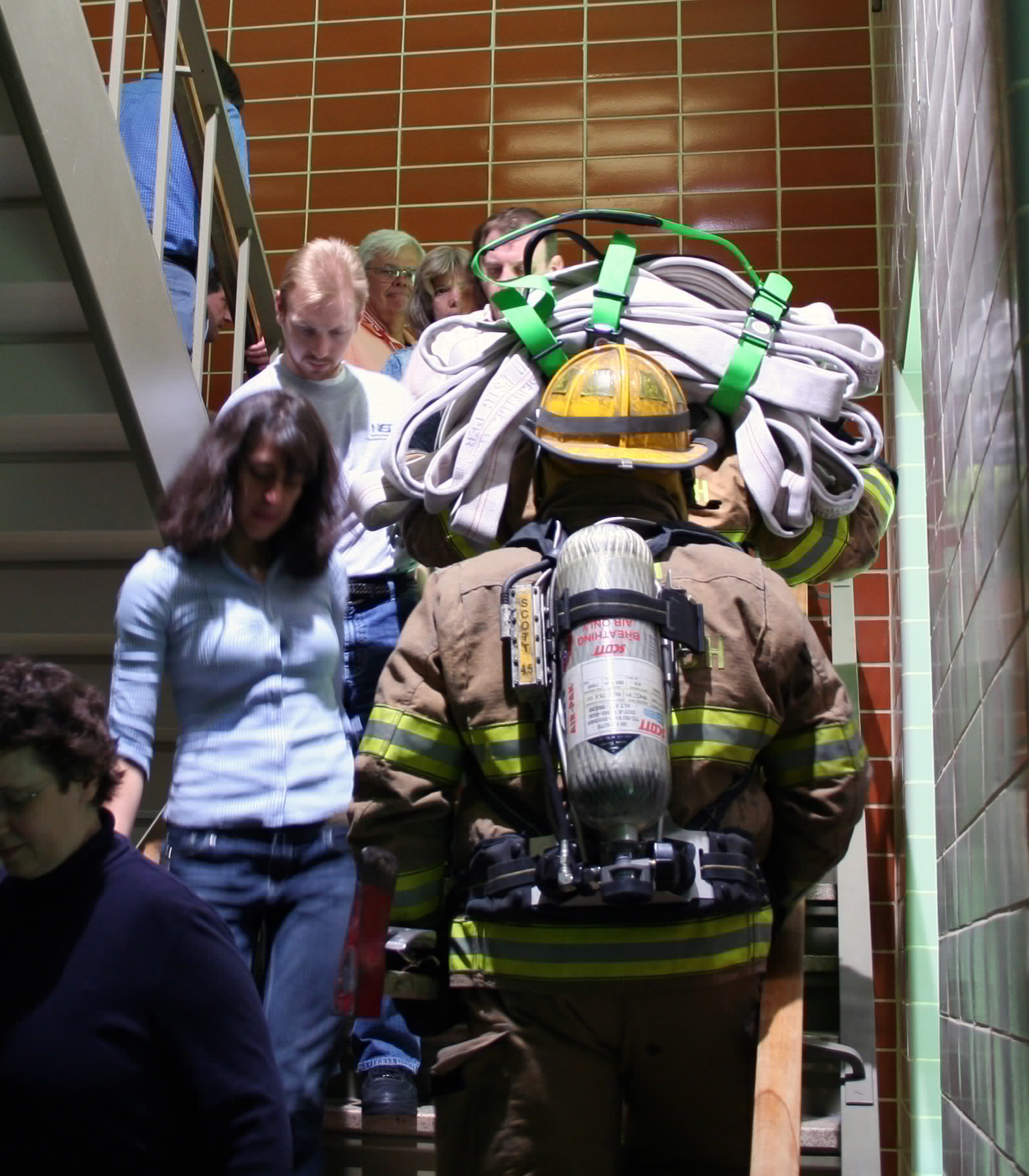
Unlike the incredible scene shown in the colour photograph above ... Fire Evacuation Staircases must be suitable for Safe, Intuitive and Unhampered Building User Evacuation, Firefighter Contraflow and the Assisted Evacuation of People with Activity Limitations. A Minimum Clear Width of 1.5 Metres (from edge of handrail to edge of handrail !) is required. Click to enlarge.
.
Fire Evacuation Chair Devices & What To Avoid: Can you spot the Evacuation Chair Device in the first photograph below ?

Colour photograph showing a Fire Evacuation Chair Device Installation at Dublin Airport, Ireland. On so many levels and in so many ways, this 'decorative' installation ... intended to demonstrate that an organization is complying with legislation ... will prove to be, in the event of a real fire emergency, SO wrong and unworkable. Photograph taken by CJ Walsh. 2008-04-04. Click to enlarge.
.

Colour photograph showing a Manual/Gravity Fire Evacuation Chair Device in operation. Transfer from a wheelchair to this type of device at the top of a staircase can be difficult and hazardous ... it can only travel down a staircase, using gravity (never up, against gravity !) ... and during horizontal travel, it is shaky and unstable. Click to enlarge.
.
Fire Evacuation Chair Devices & Issues To Carefully Consider: Modern wheelchairs come in all shapes, sizes and styles … are highly adapted by their owners … and can be very expensive. Why is it a surprise, therefore, to learn that most wheelchair users will not want to abandon their expensive personal property, i.e. the wheelchair, in the event of a real fire emergency.
The answer, of course, is PROPER CONSULTATION with All Building Users (where these are known !) during the preparation of a Fire Defence Plan for a Building.
The following photographs illustrate different aspects of the capability of Powered Fire Evacuation Chair Devices …

Colour photograph showing a Powered Fire Evacuation Chair Device in operation. This particular device facilitates evacuation, down and up a staircase, using the person's own manual wheelchair. Having completed its task at the bottom (or top !) of a staircase ... the device can be quickly released for use by another person who needs assistance on the staircase. Throughout this process, wheelchair users move independently to a Place of Safety. Click to enlarge.
.

Colour photograph showing another Powered Fire Evacuation Chair Device. This particular device facilitates evacuation of an adapted manual wheelchair, which may (or may not !) be the person's own wheelchair. It also facilitates travel on narrow or unusually shaped staircases. Click to enlarge.
.

Colour photograph showing a Powered Fire Evacuation Chair Device in operation. This particular device facilitates evacuation, down and up a staircase. It is also robust and stable while travelling horizontally ... both within a building ... and externally, perhaps over rough ground ... in order to reach a Place of Safety. Click to enlarge.
.
Product Approval in the European Union Single Market: Fire Evacuation Chair Devices must be permanently CE Marked … including the product itself, any cover (such as that shown in the Dublin Airport photograph above), all product literature, and any product packaging.
It is not acceptable to print the CE Mark on an adhesive label … and then stick the label to the product ! Correct informative text must always accompany a CE Mark !
Please note that the CE Mark is not a Safety Mark. A CE Mark denotes conformity with the Essential Requirements of a single, specific European Union Directive.
.
.
END
‘Sustainable Fire Engineering’ – Important Keynote Presentation at Indian National Fire Seminar
It is really enjoyable to be back behind my desk, here in Dublin. Apologies for the prolonged absence.
Since the middle of June last, my travels have taken me to Turkey, France, Italy, the south-west of Ireland to attend my cousin’s wedding in Cork … and back again to Bengaluru (Bangalore) in Southern India to make an important Keynote Presentation at the 2009 Fire & Safety Association of India (FSAI) National Fire Seminar: ‘Engineering a Safe & Secure India’, which was held on Friday, 28th August, at the Leela Palace Hotel.
My Presentation Title & Abstract …
Sustainable Fire Engineering: Fire Safety, Protection & Evacuation for All
India, like other economically advanced developing countries, is at an important crossroads. Difficult, resource-dependent decisions must be made in the next few short years concerning the rapid implementation of a Sustainable Built Environment across a vast country, i.e. one which must serve local needs and meet regional performance requirements during a long life cycle … one which will be adaptable to climate change, variability and extremes … will be in harmony and dynamic balance with the Natural Environment … and, not least, will be super energy-efficient.
Citizens of Developed Nations also have legitimate expectations. They will express anger when they witness recently constructed buildings in seismic zones collapse, in an earthquake, like a deck of cards (China 2008, Italy 2009) … or they discover that federal/state authorities having jurisdiction, which are funded by their taxes, are ill-prepared to respond effectively to intentional traumatic disruptions to the Social Environment (New York 2001, Mumbai 2008). Retaining the public’s confidence in national institutions is a fundamental political priority.
In the case of all new High-Rise Buildings, Iconic Buildings, and Buildings of Innovative Design or having a Critical Function … Trans-Disciplinary Building Design Teams must, at a minimum, properly respond to the Recommendations of the 2005 & 2008 NIST(USA) Final Reports on the 9-11 WTC 1, 2, and 7 Collapses. In practice, the majority of these Recommendations should be applied to the design of all new buildings !
Fire Engineers, competent concerning the processes of ‘real’ building design and construction, must begin to understand the ‘real’ people who occupy or use buildings, every day of every week, in all parts of India … and that they each have widely differing ranges of human abilities and activity limitations. Just as they are different from each other, they will react differently than expected in a ‘real’ building fire emergency.
Based on a Keynote Presentation before International Council for Building Research (CIB) Working Commission 14 : Fire and Sub-Committee 3 & 4 Members of ISO Technical Committee 92 : Fire Safety, at Lund University in Sweden … and his fire safety texts which have been fully incorporated into International Standard ISO DIS 21542 on Accessibility-for-All, currently under development and due for publication before the end of 2010 … CJ Walsh’s Presentation, at the FSAI National Fire Seminar in Bengaluru, will focus on ‘Fire Safety, Protection & Evacuation for All’.
END
National Disability Authority – 2nd Time Unlucky with Evacuation ?
Further to one of our first posts, dated 12th December 2008 (or 2008-12-12 !), concerning the National Disability Authority’s 2008 Publication: ‘Promoting Safe Egress and Evacuation for People with Disabilities’ …
On 15th April 2009 … we were circulated by Mr. Shane Hogan (NDA), in a general e-mail communication which was not addressed to us … with a Proposed 2nd Draft of the Evacuation Document. Comments on this 2nd Draft were requested.
So … here are our comments …
1. We repeat the earlier statement that ‘the document has many technical errors’. It is clear that the National Disability Authority does not possess the requisite technical competence to oversee the proper development of such a publication.
Furthermore … many of the inadequate, flawed and discriminatory practices in relation to Fire Safety, Protection and Evacuation for All which have originated in Britain over many years … and are described yet again and most recently in BS 9999:2008 – Code of Practice for Fire Safety in the Design, Management and Use of Buildings (see previous post) … are just mindlessly regurgitated in the NDA Publication.
2. We very much believe in, and are promoters of, Open Content on the Internet. For that reason, SDI’s Copyright Guidelines are quite liberal. And … although we do reserve all rights … we also state that …
‘ Reproduction by others of content produced and/or developed by Sustainable Design International Limited is permitted, except for commercial purposes, provided the source is acknowledged.’
It is clearly shown in the NDA’s 2nd Draft that copyright material developed by FireOx International (the Fire Engineering Division of Sustainable Design International Ltd.) was used, and abused, by White Young Green Consultants (Ireland) in the original 2008 NDA Publication.
We do not wish technical terms to be altered … or our material to be linked directly with BS 8300:2009 – Design of Buildings and Their Approaches to Meet the Needs of Disabled People … and BS 9999:2008. Please re-read our previous post !
White Young Green Consultants (Ireland) gained commercially from the use of our copyright material. They did not inform us … nor did they request any permission from us … prior to that use.
Our material has been used again in the NDA’s 2nd Draft … and still nobody has bothered to seek our permission … for or about anything !
In order to at least appear to be acting ethically … perhaps somebody in the NDA, e.g. Ms. Mary Van Lieshout, Mr. Shane Hogan, Dr. Gerald Craddock or Ms. Angela Kerins might care to communicate directly with us now.
Finally, our private thoughts and feelings with regard to the actions of White Young Green Consultants (Ireland) shall remain just that … private !
Perhaps, however, White Young Green Consultants (Ireland) might cover the costs involved in consulting with our team of legal advisors.
END
BS 9999:2008 & BS 8300:2009 – Sleepwalking into Problems ?
2009-06-14: Ireland has no national standard codes of practice of its own covering Building Accessibility or Fire Safety in Buildings. Instead, many people and organizations in this country will just switch to automatic pilot and – without thinking or questioning – adopt the following two standards of another jurisdiction as the default Irish National Standards …
British Standard BS 9999:2008 – Code of Practice for Fire Safety in the Design, Management and Use of Buildings … was published on 31 October 2008.
British Standard BS 8300:2009 – Design of Buildings and Their Approaches to Meet the Needs of Disabled People. This Code of Practice was published on 28 February 2009.
If Ireland does not quickly open its eyes … we will be sleep walking into a very problematic legal environment, as far as building accessibility and fire safety in buildings is concerned.
.
1. An Immediate Challenge
A Sub-Group (established at a meeting of the NSAI Accessibility-for-All Standards Consultative Committee WG1 held on Tuesday 2009-05-19) was tasked with developing a common position, suitable for application in Ireland and compatible with European Technical Harmonization, on the following issues:
- Clear Width of Internal & External Door Openings ;
- Turning Circles for Occupied Wheelchairs ;
- Car Parking Spaces ;
- Fire Safety Issues.
A series of coherent proposals will be presented to the next NSAI AASCC WG1 Meeting, on Friday 19th June 2009 … and, given the absence of Irish National Standards, it will also be suggested how these proposals may be confirmed as best current practice here.
.
2. Overview of BS 8300:2009 & BS 9999:2008
During the development of the Draft ISO Accessibility-for-All Standard, it has been unanimously agreed that Accessibility encompasses the full range of activity related to buildings: to approach, enter, use, egress from and evacuate a building independently, in an equitable and dignified manner (Introduction, 2nd Paragraph, Page 5). ‘Egress’ under normal, ambient conditions is distinguished from ‘Evacuation’ in the event of a fire emergency. Use of the word ‘Escape’ is discouraged in any circumstance. For the first time, fire safety texts have been fully incorporated into the main body of the Draft ISO Standard.
Accessibility within the British Standards Institution (BSI), on the other hand, is still segregated between BS 8300:2009 – approach, entry and use and BS 9999:2008 – fire evacuation. Conflicts and gaps in content naturally result from such a configuration, which can now be seen as outdated and fundamentally flawed.
This configuration has been replicated, in Irish Building Regulations, with the separate scopes of Part M / Technical Guidance Document M and Part B / Technical Guidance Document B. Integration between these 2 Technical Guidance Documents is very poor. In practice, fire safety for people with activity limitations is widely disregarded within the process of Fire Safety Certification in Ireland.
2.1 BS 8300:2009
BSI has arrogantly gone on a solo run, and decided to deviate from some very widely accepted concepts of accessibility, e.g. ‘clear width’ of a door opening (discussed in more detail later). The ‘Ergonomic Research’ supporting door opening forces of 30 N is at complete variance with earlier research in Britain and must, therefore, be strongly questioned. Perhaps, it is the case that the Fire Services in England & Wales re-asserted their authority, supported by reference to European Fire Product Standards with little if any input from the European Disability Sector, and insisted on a ‘definite’, i.e. high, closing force being exerted on the door leaves in fire resisting doorsets.
2.2 BS 9999:2008
People with disabilities have a right, recognized in international law after 3rd May 2008, to equal opportunity and non-discrimination in matters of building fire safety, protection and evacuation. A minimum response to Article 11 (Situations of Risk) in the 2006 United Nations Convention on the Rights of Persons with Disabilities is required, therefore, from fire regulators and code writers. Such a response is absent in British Standard BS 9999:2008.
A close examination of the fire safety texts relating to ‘disability’ in BS 9999:2008 shows that they have not been properly integrated into the ‘mainstream’ content. In fact, much of the content from the replaced BS 5588:Part 8 has just been grafted onto BS 9999, with very little change or alteration from the first version of Part 8 published in 1988 !
Compare Figure G.1 on Page 360 of BS 9999:2008 … with … Figure 4 on Page 8 of BS 5588:Part 8:1988 … both are exactly the same …

Black and white drawing showing both a token and an inadequate 'area of rescue assistance' in BS 9999:2008 - exactly as shown in the first version of BS 5588:Part 8 published back in 1988 ! Click to enlarge.
Two Critical Observations in relation to the ‘area of rescue assistance’ shown above:
- This drawing in BS 9999:2008 is in direct conflict with the text located directly above it … ‘where the wheelchair space is within a protected stairway, access to the wheelchair space should not obstruct the flow of persons escaping’ ;
but, more importantly …
- In BS 9999:2008, fire safety for people with activity limitations receives treatment which is superficial and merely token. Many times in relation to buildings generally, it is stated in Annex G.1, Page 359 …
‘A refuge needs to be of sufficient size both to accommodate a wheelchair and to allow the user to manoeuvre into the wheelchair space without undue difficulty.’
‘ In most premises, it is considered reasonable to have refuges of a size where each one is able to accommodate one wheelchair user. Where it is reasonably foreseeable that the proportion of disabled users in a building will be relatively high, or where the use of the premises is likely to result in groups of wheelchair users being present (e.g. some types of sporting, entertainment, transport or public assembly buildings), consideration should be given to increasing the size and/or number of refuges accordingly.’
‘ NOTE 3 Managers of sporting or other venues where a number of disabled people might be present are advised not to restrict the number of disabled people who can be admitted to that venue on the grounds of the size of refuges, since some disabled people who use mobility aids such as a wheelchair will be able to self-evacuate in the case of a real fire.’
and again in Annex G.2.2 on Page 367 …
‘Where it is reasonably foreseeable that the refuges will be used by more than one user (e.g. some types of sporting, entertainment, transport or public assembly buildings), … ‘
.
Within such an inadequate and token context, it is understandable that an unduly heavy reliance is placed on the practice of developing Personal Emergency Evacuation Plans (PEEPS) for individuals with activity limitations. See Paragraph #46.7a) on Page 248, which states …
‘ By taking into account the individual needs of a person when preparing a PEEP, management will be able to make any reasonable adjustments to the premises or procedures that are necessary.’
These Plans are flawed and discriminatory because they are:
- person specific ; and
- location specific ;
… with the underlying assumption in the text being that, beyond the specified location(s), the building is not properly accessible, i.e. does not meet the functional requirements of Parts B & M in the Building Regulations for England & Wales – or, in the case of Ireland, Parts B & M of our Building Regulations.
.
There are silly technical errors in BS 9999:2008, e.g. in Annex G.2.3 on Page 368, it states …
‘Unless a different order has been agreed with the fire authority, evacuation should normally be in the following order:
1) the fire floor ;
2) the floor immediately above the fire floor ; [This should read 'the floors immediately above and immediately below the fire floor' !]
3) other floors above the fire floor starting at the top storey ;
4) all remaining floors.’
.
A Technical Term is used in BS 9999:2008 – Place of Ultimate Safety – which complicates the already widely accepted term: ‘Place of Safety’. The definition provided for the British Term in Section 3: Terms & Definitions (#3.84, Page 17) is so vague that it is of no practical use to fire engineering designers, building managers or building users.
.
3. Comments: i) Clear Width of Door Openings
Paragraph #6.4.1, on Page 36 of BS 8300:2009 introduces a new understanding of ‘clear width’ for door openings, which is illustrated in Figure 11 (Page 37) … and also a new term ‘effective clear width’.
The new understanding of ‘clear width’ is a complete departure from the standard understanding, widely accepted throughout the world, which is shown in the bottom left hand drawing of Figure 11.
The new term ‘effective clear width’ will complicate the already difficult concept of ‘clear width’. Wasn’t the ‘clear width’ of a door opening always supposed to be ‘effective’, i.e. properly permit circulation for wheelchair users ?
However, the issue raised in the top right hand drawing of Figure 11 is valid …

Colour photograph showing the Final Fire Exit from a building (somewhere in Ireland). The 'clear width' of the door opening is seriously compromised - the door leaf cannot be fully opened and the panic bar reduces the 'clear width' still more. Click to enlarge.
Solution: Retain the current international/European/national understanding of ‘clear width’ for door openings in Ireland … but include text, with supporting drawings, in Revised Technical Guidance Documents B & M to ensure that there is no encroachment on that ‘clear width’ caused by protruding door leaf ironmongery or, more importantly, where the door leaf itself cannot be fully opened to 90o-100o.
.
4. Comments: i) Clear Width of Door Openings in Existing Buildings
Table 2, on Page 37 of BS 8300:2009, permits the ‘clear width’ for door openings in existing buildings to be reduced significantly below 800mm.
If buildings of historical, architectural and cultural importance are properly identified, and proper allowance is made for these specific building types in Revised Technical Guidance Documents B & M … there is no need to permit a general reduction in the ‘clear width’ for door openings in existing buildings.
Solution: Clearly indicate in the Revised Technical Guidance Document M that the last ‘Existing Buildings’ Column on the right of Table 2 in BS 8300 should be disregarded.
.
5. Comments: ii) Turning Circles for Occupied Wheelchairs
Down through the years, it has been just possible to communicate the concept of the ‘wheelchair turning circle’ to building designers and urban planners … whether it be the older 1.5m diameter circle or the newer 1.8m diameter circle.
The new Figures and Tables in Annexes C.3 and C.4 of BS 8300:2009 will be difficult to communicate … and may be a complication too far ?
.
6. Comments: iv) Fire Safety Issues

Colour photograph showing people trapped at the top of one of the WTC Towers. This Tower collapsed soon afterwards. Click to enlarge.
The Recommendations contained in the 2005 & 2008 National Institute of Standards & Technology (USA) Reports on the WTC 9-11 Incident in New York provide an invaluable and essential empirical basis for the practice of effective fire engineering design in today’s built environment.
The first of these two reports has special relevance for NSAI AASCC WG1 because the typical problems encountered by people with activity limitations during a ‘real’ building fire incident have been highlighted by NIST and closely investigated. As a result, three important fire engineering keywords have been re-stated with strong emphasis: ‘reality’ – ‘reliability’ – ‘redundancy’. And, a new key phrase in relation to way finding during evacuation has been introduced to the everyday practice of fire engineering design: ‘intuitive and obvious’.
The 2005 NIST Report, particularly, must be given proper consideration during the development of any reputable fire safety related standard or code of practice for the following reasons:
- at the time of the ‘real’ fire incident, approximately 8% of building users were people with disabilities, with 6% having mobility impairments ; [The percentage of 'building users with activity limitations' exceeded the 8% quoted above.]
- NIST found that the average surviving occupant in the buildings descended stairwells at about half the slowest speed previously measured for non-emergency/test evacuations. This raises a serious question over the use of standard movement times in fire engineering design calculations for evacuation ;
- NIST strongly recommended that fire-protected and structurally hardened lifts (elevators) should be installed in buildings to facilitate the evacuation of building users with disabilities, and to improve emergency response activities by providing timely emergency access to firefighters ; [In Ireland, building designers have already adopted this approach by constructing cores of reinforced concrete ... even in the absence of European/national standards.]
- it was recommended that evacuation routes should have consistent layouts, and be ‘intuitive and obvious’ for all building users, including visitors who may be unfamiliar with the building, during evacuations ;
- NIST recommended that staircase capacity and stair discharge door widths should be adequate to accommodate contraflow in circulation spaces, i.e. the simultaneous emergency access by firefighters into a building and towards a fire, while building users are still moving away from the fire and evacuating the building. This has implications for the minimum clear width of all fire evacuation staircases. Wider staircases facilitate the assisted evacuation and rescue of people with disabilities.
.
No consideration was given in BS 9999:2008, however, to any of the Recommendations contained in the 2005 & 2008 NIST Reports … there is not even a mention of either Report in the Bibliography (Pages 423-429).
- For such an important national standard in Europe – BS 9999:2008 – there is no understanding demonstrated of the Fundamental Functional Requirement for Public Safety in Buildings …
Buildings shall remain structurally stable and serviceable …
1. while people are waiting in ‘Areas of Rescue Assistance’ ; and
2. until all of these people can be rescued by Firefighters and can reach a ‘Place of Safety’, which is remote from a fire building – with an assurance of individual health, safety & welfare for the people involved ;
- There is a reference to ‘normal movement times’ which are used to calculate evacuation times in Mobility-Impaired People (Paragraph #46.2, Page 247), even though it was found by NIST that the average surviving occupant in the WTC Towers descended stairwells at about half the slowest speed previously measured for non-emergency evacuations. In a ‘real’ fire incident, there is no such thing as ‘normal’ or ‘standard’ evacuation movement times, and the idea that any building must be clear of occupants within a very short timeframe, e.g. 2.5-3.5 minutes, is ludicrous ;
- In the sensitive area of the Resistance to Damage of Enclosing and Separating Partitions (Paragraph #21.2.5 on Page 101) surrounding Firefighting Shafts, it is still permissible in BS 9999:2008 to use non-robust construction, e.g. lightweight plasterboard. Fire-Induced Progressive Collapse is not discussed in the BS 9999 … and neither is Disproportionate Collapse, which is one of the functional requirements – A3 – in Part A of the Building Regulations for England & Wales (and Ireland !) ;
- Although in Wheelchair Users (Paragraph #46.3 on Page 247), it is stated …
‘It should be noted that it can take as many as four people to use an evacuation chair safely and effectively.’
… the dimensions for the minimum width of staircases in Width of Escape Stairs (Table 14 on Page 88) and Firefighting Stairs (Paragraph #21.3.2 on Page 106) disregard the guidance given on Page 247 … and ignore the minimum clear staircase width (1.5m) required to safely assist the evacuation of a person in a manual wheelchair …

Black and white photograph (US FEMA 2002) showing the correct way to assist the fire evacuation of a wheelchair user in an evacuation staircase ... one person at each side, with another person behind.
And … for some unexplained reason, handrails are permitted to intrude into the ‘clear width’ of a firefighting staircase in BS 9999:2008 (Paragraph #21.3.2, Page 106).
Please note well … this method (shown below) of assisting the evacuation of a person in a manual wheelchair is NOT correct. It is not possible to support any weight by holding the foot rests on a manual wheelchair, or by grasping the wheelchair by the front wheels …

Black & white sketch showing how definitely NOT to assist the fire evacuation of a wheelchair user in an evacuation staircase.
Manual handling of occupied wheelchairs in a fire evacuation staircase, even with adequate training for everyone directly and indirectly involved, is hazardous for the person in the wheelchair and those people – minimum three – giving assistance.
The weight of an average unoccupied powered wheelchair, alone, makes manual handling impractical. All lifts (elevators) in new buildings should, therefore, be capable of being used for evacuation in a fire situation. Lifts (elevators) in existing buildings, when being replaced or undergoing a major overhaul, should then be made capable of use for this purpose.
.
Contraflow Circulation, i.e. the simultaneous emergency access by firefighters into a building and towards a fire, while building users are still moving away from the fire and evacuating the building, has not been considered at all in BS 9999:2008.
A clear staircase width of 1.5m provides sufficient space for a mobile person to evacuate (700 mm) and a heavily protected and equipped firefighter to simultaneously move in the opposite direction (800 mm) …

Colour drawing, with photograph insets, showing the symbiotic relationship between Contraflow Circulation and Proper Assisted Evacuation in a building. Click to enlarge.
Human Behaviour in Fires should have been discussed in far more detail in BS 9999:2008 … but wasn’t. It is important for fire engineering designers to understand that the ‘real’ people who use ‘real’ buildings every day of every week, in all parts of the world, have widely differing ranges of human abilities and activity limitations … they are different from each other, and they will react differently in a fire emergency.
Building users need to be Skilled for Evacuation to a place, or places, of safety remote from a fire building. In the case of people with a mental or cognitive impairment, there is a particular need to encourage, foster and regularly practice the adaptive thinking which will be necessary during a ‘real’ fire evacuation.
Meaningful Consultation with every person known to occupy or use a building, for the purposes of receiving his/her active co-operation and obtaining his/her informed consent (involving a personal representative, if necessary), is an essential component of adequate pre-planning and preparation for a fire emergency.
Adequate Warning of a fire incident in a building should be communicated well in advance of the time when it is necessary to act and should continue for the full duration of the incident. Warnings should be informative, and easily assimilated in a form (e.g. oral, written, braille) and language understood by the people using the building.
Panic attacks, during evacuation in a ‘real’ fire incident, exist. The 2005 National Building Code of India refers extensively to this issue.
Solution: To resolve the technical inadequacies, inconsistencies and content gaps in BS 9999:2008 … it will be necessary to revise Technical Guidance Document B in Ireland. Fire safety, protection and evacuation from buildings for people with disabilities must be comprehensively included in the process of Fire Safety Certification.
.
7. Conclusions – BS 9999:2008 & BS 8300:2009
There are many gaps and conflicts between these two British Standards, principally because … they are two separate standards … drafted by two different Technical Committees within the British Standards Institution (BSI).
Because of its deviation from widely accepted concepts of accessibility and its tortuous use of terminology, BS 8003:2009 will have an adverse impact on the practice of Accessibility Design in Ireland … and has already complicated the development of the ISO Accessibility-for-All Standard (DIS ISO 21542).
Arrogance within BSI is not the only reason for such deviations. Distorting the European Union Single Market, for the purpose of introducing technical barriers to trade, is common in Britain … refer to the ‘deemed-to-satisfy’ status of the Approved Documents in the Building Regulations for England & Wales … and the Fire Protection Association’s ‘LPC Sprinkler Rules’.
Input from the Disability Sector during the drafting of BS 9999:2008 was not at all sufficient to ensure that there was a meaningful consideration of the problems encountered by people with activity limitations during a ‘real’ building fire incident. The necessary range of available and effective fire engineering solutions has not, therefore, been presented in the standard.
In addition … the complete and abject failure to consider the important Recommendations contained in the 2005 & 2008 National Institute of Standards & Technology (USA) Reports on the WTC 9-11 Incident in New York was an inexcusable and unforgivable technical oversight.
The result is a crassly inadequate, discriminatory and deeply flawed national fire safety standard in Great Britain & Northern Ireland. BS 9999:2008 became obsolete on the very day of its publication !
.
.
Postscript
Please refer to our 1999 Submission to the Department of the Environment & Local Government, in Dublin, concerning the use of British Standard BS 5588:Part 8 in Ireland …
http://www.sustainable-design.ie/arch/submissions.htm
Following this Submission, our understanding is that an ‘Internal’ Working Party was established within the Department. However, the Working Party never reported. No proper response to this Submission has ever been received from the Minister or the Department.
.
On 29th November 2006, similar and very polite comments were sent directly to the British Standards Institution (BSI) by e-mail. Receipt of this e-mail was never acknowledged by anyone in BSI.
The contents of the e-mail were ignored.
.
.
END
Search
Recent Comments
- therese on Accessible Toilet Room in a Japanese Public Place – Kanazawa
- noel on Fixing ‘Priory Hall’ in Dublin – Practical Solutions Needed Now !
- dt on Beautiful Sunset – Turgutreis, Bodrum Peninsula, Turkey
- Cathy on A More Balanced Presentation of Recent UN Gaza Flotilla Report
- Jolyn on New EU Construction Product Regulation 305/2011 – Halleluiah !
Categories
- architecture
- art
- built environment
- cinema
- climate change
- design
- economic environment
- eu law
- european union
- fire
- human & social rights
- human environment
- human health & safety
- institutional environment
- international law
- judicial
- media
- national law
- natural environment
- photography
- political environment
- regulations & standards
- social environment
- sustainability
- technical control
- travel
- virtual environment
| S | M | T | W | T | F | S |
|---|---|---|---|---|---|---|
| « Jan | ||||||
| 1 | 2 | 3 | 4 | |||
| 5 | 6 | 7 | 8 | 9 | 10 | 11 |
| 12 | 13 | 14 | 15 | 16 | 17 | 18 |
| 19 | 20 | 21 | 22 | 23 | 24 | 25 |
| 26 | 27 | 28 | 29 | |||
Links
- 'Spirit of Ireland' Project – National Energy Independence. At last … some 'real' Innovation in this country !
- 2bscene Web Design & Development – Dublin, Ireland.
- AL JAZEERA – News & Views from the ARAB WORLD (1431 H)
- ALBA – Alianza Bolivariana para los Pueblos de Nuestra América / Bolivarian Alliance for the Peoples of Our America
- Amnesty International – Irish Section
- CJ Walsh: Architectural, Design & Technical Control Practice (Ireland, Italy & Turkey)
- Contact Us – Sustainable Design International Ltd. (Ireland, Italy & Turkey)
- Cuba Support Group – Ireland
- Department of the Environment, Heritage & Local Government (DEHLG) – Ireland
- E-PRTR – European Pollutant Release and Transfer Register … a Europe-wide register providing easily accessible key environmental data from industrial facilities in EU Member States and in Iceland, Liechtenstein & Norway.
- EL NACIONAL – News & Views from VENEZUELA
- EU Fundamental Rights Agency – The Agency focuses on the situation of fundamental rights in the European Union (EU) and its 27 Member States.
- EUR-Lex – Full, direct and free access to all European Union (EU) Legislation
- European Consumer Centres' Network (ECC-Net) – European Union (EU) wide network of Consumer Protection Centres, co-sponsored by the European Commission and the Member States. The network comprises 29 Centres … one in each of the 27 EU Member States
- EUROPEANA – Access to Europe’s Cultural & Scientific Heritage though a Cross-Domain Digital Portal
- FireOx International: Fire Engineering Consultancy, Research & Design Practice (Ireland, Italy & Turkey)
- GRANMA INTERNACIONAL – News & Views from CUBA
- HÜRRİYET – News & Views from TURKEY
- Ireland – Information about our Public Institutions, including Pretty Pictures of our green countryside !
- Irish Seed Savers Association … Working to Conserve Irish Biodiversity. They research, locate, preserve & use traditional varieties, cultivars of fruit, vegetables, potatoes & grains.
- James Taylor – Singer & Songwriter
- JOURNAL DE BRASÍLIA – News & Views from BRAZIL
- Kanchi (Ireland) – Changing Society's View of Disability for the Better
- NAVBHARAT TIMES – News & Views (in Hindi) from INDIA
- PRAVDA – News & Views from RUSSIA
- Robert F Kennedy Centre for Justice & Human Rights (USA)
- Rocky Mountain Institute (USA) – Super Energy Efficiency by Design
- RTE Lyric FM – Classical (in its widest meaning !) Music on Irish Radio
- Senator Shane Ross – Ireland's Principal Economics Troubleshooter. What happened to George ?
- Survivors of Institutional Abuse Ireland [SOIAI] – WE (collectively) did not cherish all the children of OUR nation equally !
- Sustainable Design International: Experts in the Theory & Implementation of Sustainable Human & Social Development (Ireland, Italy & Turkey)
- Tom Doyle's Blog :: TALK
- UNFCCC (United Nations Framework Convention on Climate Change) + Kyoto Protocol + COP-15
- United Nations Human Rights Council – Established 15 March 2006
- WikiLeaks – A non-profit media organization dedicated to bringing important news and information to the public.
- WISE – Water Information System for Europe … a single location (portal) where geographically-mapped information on water-related issues can be found for the whole of Europe.
- XINHUA News Agency – News & Views from CHINA
Archives
- January 2012
- December 2011
- November 2011
- October 2011
- September 2011
- July 2011
- May 2011
- April 2011
- March 2011
- February 2011
- January 2011
- December 2010
- November 2010
- October 2010
- June 2010
- May 2010
- April 2010
- March 2010
- February 2010
- January 2010
- December 2009
- November 2009
- October 2009
- September 2009
- July 2009
- June 2009
- May 2009
- April 2009
- March 2009
- February 2009
- January 2009
- December 2008