environmental aspects of sustainable development
Sustainable Buildings – Design Agenda for the 21st Century ?
From the late 1980′s and the beginning of the 1990′s in European Union (EU) Research Programmes, it was noticeable that the more pressing early concerns about Energy-efficiency – logical after the oil crises of the 1970′s – were beginning to merge with those of Environment-friendliness, i.e. protection of the environment. Even at that time, however, faint background references to Sustainability were becoming more common.
In 1995, therefore, Sustainable Design International developed and introduced the acronym ‘SEED’ … which stands for Sustainable, Environment-friendly, Energy-efficient Development … as a practical control, or check, on our own work output.
The next break-through came a few years later. I briefly discussed the wide conceptual basis for our Corporate Design Philosophy in the post: ‘Sustainable Human & Social Development ?’, dated 2009-03-31. This basis, while still continually evolving, is critical in terms of services provided, performance targets to be achieved, methods of working and relationships with client organizations, builders, craftsmen/women, manufacturers, etc.
This should explain the futility, in our humble view, of the ‘Green’ Agenda (as distinct from the ‘Sustainability’ Agenda) … and approaches based solely on Environmental Aspects of Sustainable Development. They are a complete waste of time and resources.
Now in 2009, we remain fully convinced that Sustainable Design Solutions are appropriate to local geography, social need, climate, economy and culture … and are ‘person-centred’ and ‘reliability-based’.
Forget the images of mud housing and reading by candle light … the Future of our Built Environment is High-Tech, Smart … and Sustainable ! Let there be no doubt !!
Why not begin, so, by looking at a Simple Building Type … Sustainable Housing ?
With all of the current hype and fuss about German ‘Passiv’ Houses and Austrian High-Tech Timber Framed Construction … we have been in contact with a number of manufacturers in this region of Central Europe. After many meetings and detailed discussions, we are disappointed … broken hearted !
Below follows our shopping list for the practical, commercial and affordable application, i.e. non-research, of Advanced Systems of Construction (small/medium/large scale projects – new-build and existing projects).
N.B. Current Irish legal requirements and local authority technical control procedures are entirely inadequate.
Is anybody out there listening ???
To meet the urgency of Climate Change Adaptation and the challenge of Reliable Sustainability Implementation … a ‘SEED’ Building in Ireland must reach these performance targets:
- be set in Sustainable Landscaping (where appropriate) with Life Cycle Sustainable Drainage … and exhibit a considered, harmonious relationship between the building’s ‘interior’ environment and the ‘exterior’ built and social environments ;
- have a Minimum Building Life Cycle of 100 Years ;
- be Smart/Intelligent, Electronically Mature and facilitate Remote Building Management ;
- be properly shown to be Fit for Intended Use (in the Location of Use) … by CE Marking, using European Standards/Norms & European Technical Approvals (refer to Part D of the Irish Building Regulations and similar requirements in other European national building codes, European Union Safety at Work and Product Liability Legislation) ;
- be Super Energy-Efficient, with negligible thermal bridging and accidental air seepage … and promote and encourage, by design, Energy Conservation ;
- have a substantial component of Renewable Energy & Heat Technologies … sufficient to return a multiple of the building’s energy consumption to an Intelligent Regional or District Grid … and also incorporate Recycling, Rainwater Re-Use and Waste Management Technologies ;
- offer a high level of Indoor Air Quality, including proper protection from Natural Radon ;
- be Flexible and Adaptable with regard to internal layout, and Accessible for People with Activity Limitations (2001 WHO ICF) – in order to prolong Building Life Cycle and maximize Building Usability ;
- contain, as standard and for reasons of safety, a Domestic Sprinkler System and a remotely monitored Fire Detection System … plus a Carbon Monoxide (CO) Detection System, with a detection unit in the vicinity of each fuel burning appliance ;
and
- be Competently Built and Reliably Completed to project programme and cost estimate … with the building’s ‘Real’ Performance-in-Use capable of being tested, and continually monitored, over the complete building life cycle ;
and
- be simple and straightforward for Building Users/Occupiers to operate.
Principal Areas of Inadequate Performance …
1. Showing Fitness for Intended Use. Although a Single European Market for the Construction Sector exists on paper (not yet in reality) … this requirement is not well understood by manufacturers … particularly in Germany and Austria, where outdated national approaches to building product/system approval still take precedence over anything at European level.
2. Domestic Sprinkler Systems. There is a high level of resistance, among most manufacturers, to the installation of these systems. Not acceptable !!
3. Accessibility of Buildings for People with Activity Limitations. Not well understood by manufacturers and building organizations (at all levels). Although there is a lot of legislation in Europe covering this particular issue … it is routinely disregarded and/or very poorly implemented. In Germany and Austria, for example, the long outdated term ‘barrier-free design’ is still in common use. Can you believe that ?
4. Radon Protection of Buildings. Not considered important in Germany and Austria … so manufacturers just don’t bother.
5. Fabric Thermal Performance. Where building systems are ‘adapted’ for use in Ireland, I have seen thermal performance, as originally designed in Germany/Austria, seriously compromised by the installation of meter boxes and permanent ventilation openings in external walls. Just the tip of the iceberg !
Sustainable Human & Social Development ?
‘Sustainable’ … ‘Sustainability’ … ‘Sustainable Development’ … what’s all this about ? … and where to begin ?
Words much abused … not only in English … but definitely in French !
Words much confused … for example, in the USA … where ‘Sustainable’ and ‘Green’ can be interchanged in the same conversation without apparent rhyme or reason. Is there a difference between the two ? Some people don’t want to admit that there is … those working in the Green Building Council … or those peddling the LEED Environmental Building Rating System around the more economically advanced developing countries in the world. In India … you can find a ‘LEED’ Building, minimally adapted to local conditions and having used many imported products and systems in its construction (from you-know-where !) … sitting prettily in the neighbourhood of a slum.
In Ireland … remember the good old days, 12-18 months ago … when Economists could afford (?!?) to talk about ‘Sustainable Economic Development’ … did they really mean economic development which is compatible with sustainable development ? No, they didn’t !
Is there any level of awareness amongst our Politicians ? In the National Development Plan (2007-2013), Mr. Brian Cowan T.D., then Minister for Finance, wrote in a January 2007 Foreword to the Plan …
” This National Development Plan is about the future of those young people, their parents, and their grandparents. It establishes a blueprint for the economic and social development of this island for future generations.
In this Plan, we have a unique window of opportunity to get it right: in terms of spatial planning, support infrastructure, environmental sustainability and economic growth.”
… an unusual limitation on the use and context for the word ‘sustainability’ … which should now also be exhibited in the National Gallery of Art !?!
Some Organizations openly state that they are dealing with … or they will only be dealing with … environmental aspects of sustainable development. That is a silly waste of time … and counterproductive !
Properly Defining Sustainable Development
Let us quickly re-wind back to the end of the 20th Century …
… not as far back as the Stockholm Declaration of the United Nations Conference on the Human Environment, which met in Sweden, from 5-16th June 1972 … which, for us, was a very interesting exercise …
… but to the 1987 Report of the World Commission on Environment and Development (WCED), which was chaired by Gro Harlem Brundtland (Norway). Mansour Khalid (Sudan) was Vice-Chair of the Commission.
The definition of ‘Sustainable Development’ appears at the beginning of Chapter 2 …
” Sustainable Development is development that meets the needs of the present without compromising the ability of future generations to meet their own needs. It contains within it two key concepts:
- the concept of ‘needs’, in particular the essential needs of the world’s poor, to which overriding priority should be given ; and
- the idea of limitations imposed by the state of technology and social organization on the environment’s ability to meet present and future needs.”
Many readers may only be familiar with the first sentence above but, in isolation, that leaves the definition of ‘sustainable development’ so vague that it is almost meaningless. And let us be clear in our own minds … an ambiguous definition will continue to be rejected by the Developing and Least Developed Regions of the World … the concept being viewed as an unaffordable luxury and/or a means of continued domination and control by the ‘North’.
Other readers may be surprised by the second, and more important, half of the WCED/Brundtland Definition. It is clear, however, that it was always intended that there would be more than 3 Aspects of Sustainable Development … Environmental, Social and Economic … to be identified and examined. How, on this Earth, was it possible for anybody to ever bring into existence that clumsy 3-Circle Diagram ???
The 1987 WCED/Brundtland Report continues a little further on …
” The satisfaction of human needs and aspirations is the major objective of development. The essential needs of vast numbers of people in developing countries – for food, clothing, shelter, jobs – are not being met, and beyond their basic needs these people have legitimate aspirations for an improved quality of life. A world in which poverty and inequity are endemic will always be prone to ecological and other crises. Sustainable Development requires meeting the basic needs of all and extending to all the opportunity to satisfy their aspirations for a better life.”
Sustainable Development is the greatest challenge ahead of us in this 21st Century. It remains very much an intricate, open, dynamic and evolving concept …
… and a clear choice must be made: decide to pursue the detailed elaboration of this concept … either with the aim of practical implementation … or of intellectual masturbation.
We made that choice many years ago … back in the mid-1990′s.
Practical Implementation of Sustainable Human & Social Development
In order to make any ‘real’ progress … how can we establish, agree upon and achieve a wide international consensus on what the ‘basic needs of all’ are … and with some precision ?
Is there an internationally recognized document, already long in existence, where these ‘basic needs’ are not only specified for all people, but are protected and guaranteed ?
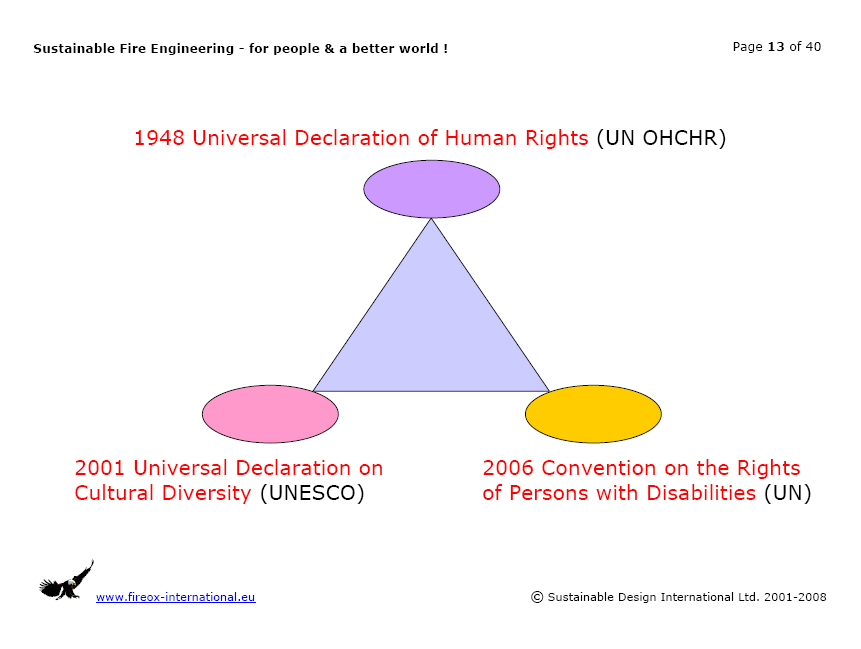
Yes, indeed there is … the 1948 Universal Declaration of Human Rights (UN OHCHR) … and these needs, therefore, can also be described as being ‘responsible’.
Reading through the 1948 UDHR, it might be helpful if a distinction is made between human rights and social rights …
Social Rights:
Rights to which an individual person is legally entitled, e.g. the right to free elementary education (Art.26(1), UDHR), but which are only exercised in a social context with other people, and with the active support of a competent legal authority, e.g. a Nation State.
Commentary: In contrast to Human Rights, it is not protection from the State which is desired or achieved, but freedom with the State’s help.
Social Rights, as distinguished here, include and extend beyond current understandings of civil, political, economic, social and cultural rights.
This is why, almost a generation after the 1987 WCED/Brundtland Definition of Sustainable Development …
… Sustainable Design International, has defined Sustainable Human & Social Development as follows …
Development which meets the responsible needs, i.e. the Human & Social Rights*, of this generation – without stealing the life and living resources from future generations, especially our children … and their children.
* As defined in the 1948 Universal Declaration of Human Rights (UN OHCHR).
Furthermore … for a sizeable group of people in all of our societies, the sole route of access to the human and social rights set down in the 1948 Universal Declaration of Human Rights … is the 2006 UN Convention on the Rights of Persons with Disabilities … which became an International Legal Instrument on 3rd May 2008 … just short of 60 Years after the UDHR was adopted on 10th December 1948 !
A 3rd International Instrument to be placed at the top of this Framework of Basic & Responsible Needs, i.e. Rights … is the 2001 Universal Declaration on Cultural Diversity (UNESCO) … adopted in Paris, on 2nd November 2001 … and which came into being shortly after the World Trade Center (9-11) Incident in New York, on 11th September 2001.
The Universal Declaration on Cultural Diversity raises cultural diversity to the level of the common heritage of humanity … as necessary for humankind as biodiversity is for nature … and makes its defence an ethical imperative which is robustly linked to, and cannot be separated from, respect for the dignity of each individual person.
Paris, at the end of 2001, presented the world with a valuable opportunity …
- to reaffirm the unshakable conviction that intercultural dialogue is the best guarantee of peace ; and
- to reject outright the theory of the inevitable clash of cultures and civilizations.
So … once it is possible to construct an initial, robust framework of International Human & Social Rights Instruments … specifying the ‘basic needs of all’ … which underpins and cuts down to the core of a far more elaborate and hard-edged, 2nd Generation Definition of Sustainable Human & Social Development …

Colour image showing an extract from CJ Walsh's Presentation: 'Sustainable Fire Engineering', at a Building Seminar in Dubayy(UAE) towards the end of October 2008. The Initial Framework of International Human & Social Rights Instruments underpinning Sustainable Human & Social Development. Click to enlarge.
… we can roll out the ‘Sustainability’ Agenda … and begin the serious task of transforming our Human Environment (see a previous post) by gradually improving and monitoring ‘real’ Sustainability Performance … using …
- Sustainability Impact Assessment (SIA) … see a previous post ;
and
- Performance Indicators ;
- Target Setting ;
- Benchmarking ;
- Performance Evaluation & Independent Verification ;
- Etc.
Search
Recent Comments
- therese on Accessible Toilet Room in a Japanese Public Place – Kanazawa
- noel on Fixing ‘Priory Hall’ in Dublin – Practical Solutions Needed Now !
- dt on Beautiful Sunset – Turgutreis, Bodrum Peninsula, Turkey
- Cathy on A More Balanced Presentation of Recent UN Gaza Flotilla Report
- Jolyn on New EU Construction Product Regulation 305/2011 – Halleluiah !
Categories
- architecture
- art
- built environment
- cinema
- climate change
- design
- economic environment
- eu law
- european union
- fire
- human & social rights
- human environment
- human health & safety
- institutional environment
- international law
- judicial
- media
- national law
- natural environment
- photography
- political environment
- regulations & standards
- social environment
- sustainability
- technical control
- travel
- virtual environment
| S | M | T | W | T | F | S |
|---|---|---|---|---|---|---|
| « Jan | ||||||
| 1 | 2 | 3 | 4 | |||
| 5 | 6 | 7 | 8 | 9 | 10 | 11 |
| 12 | 13 | 14 | 15 | 16 | 17 | 18 |
| 19 | 20 | 21 | 22 | 23 | 24 | 25 |
| 26 | 27 | 28 | 29 | |||
Links
- 'Spirit of Ireland' Project – National Energy Independence. At last … some 'real' Innovation in this country !
- 2bscene Web Design & Development – Dublin, Ireland.
- AL JAZEERA – News & Views from the ARAB WORLD (1431 H)
- ALBA – Alianza Bolivariana para los Pueblos de Nuestra América / Bolivarian Alliance for the Peoples of Our America
- Amnesty International – Irish Section
- CJ Walsh: Architectural, Design & Technical Control Practice (Ireland, Italy & Turkey)
- Contact Us – Sustainable Design International Ltd. (Ireland, Italy & Turkey)
- Cuba Support Group – Ireland
- Department of the Environment, Heritage & Local Government (DEHLG) – Ireland
- E-PRTR – European Pollutant Release and Transfer Register … a Europe-wide register providing easily accessible key environmental data from industrial facilities in EU Member States and in Iceland, Liechtenstein & Norway.
- EL NACIONAL – News & Views from VENEZUELA
- EU Fundamental Rights Agency – The Agency focuses on the situation of fundamental rights in the European Union (EU) and its 27 Member States.
- EUR-Lex – Full, direct and free access to all European Union (EU) Legislation
- European Consumer Centres' Network (ECC-Net) – European Union (EU) wide network of Consumer Protection Centres, co-sponsored by the European Commission and the Member States. The network comprises 29 Centres … one in each of the 27 EU Member States
- EUROPEANA – Access to Europe’s Cultural & Scientific Heritage though a Cross-Domain Digital Portal
- FireOx International: Fire Engineering Consultancy, Research & Design Practice (Ireland, Italy & Turkey)
- GRANMA INTERNACIONAL – News & Views from CUBA
- HÜRRİYET – News & Views from TURKEY
- Ireland – Information about our Public Institutions, including Pretty Pictures of our green countryside !
- Irish Seed Savers Association … Working to Conserve Irish Biodiversity. They research, locate, preserve & use traditional varieties, cultivars of fruit, vegetables, potatoes & grains.
- James Taylor – Singer & Songwriter
- JOURNAL DE BRASÍLIA – News & Views from BRAZIL
- Kanchi (Ireland) – Changing Society's View of Disability for the Better
- NAVBHARAT TIMES – News & Views (in Hindi) from INDIA
- PRAVDA – News & Views from RUSSIA
- Robert F Kennedy Centre for Justice & Human Rights (USA)
- Rocky Mountain Institute (USA) – Super Energy Efficiency by Design
- RTE Lyric FM – Classical (in its widest meaning !) Music on Irish Radio
- Senator Shane Ross – Ireland's Principal Economics Troubleshooter. What happened to George ?
- Survivors of Institutional Abuse Ireland [SOIAI] – WE (collectively) did not cherish all the children of OUR nation equally !
- Sustainable Design International: Experts in the Theory & Implementation of Sustainable Human & Social Development (Ireland, Italy & Turkey)
- Tom Doyle's Blog :: TALK
- UNFCCC (United Nations Framework Convention on Climate Change) + Kyoto Protocol + COP-15
- United Nations Human Rights Council – Established 15 March 2006
- WikiLeaks – A non-profit media organization dedicated to bringing important news and information to the public.
- WISE – Water Information System for Europe … a single location (portal) where geographically-mapped information on water-related issues can be found for the whole of Europe.
- XINHUA News Agency – News & Views from CHINA
Archives
- January 2012
- December 2011
- November 2011
- October 2011
- September 2011
- July 2011
- May 2011
- April 2011
- March 2011
- February 2011
- January 2011
- December 2010
- November 2010
- October 2010
- June 2010
- May 2010
- April 2010
- March 2010
- February 2010
- January 2010
- December 2009
- November 2009
- October 2009
- September 2009
- July 2009
- June 2009
- May 2009
- April 2009
- March 2009
- February 2009
- January 2009
- December 2008