Ar C.J. Walsh – Registered Architect, Fire Engineer & Independent Technical Controller …… International Expert on Accessibility for All (including Fire Safety) + 'Real' Sustainability Implementation !
2020-09-22: Adopted at the International Fire Conference: SFE 2016 DUBLIN (www.sfe-fire.eu) …
Many years have passed since the 1972 UN Stockholm Declaration on the Human Environment and the 1992 Rio Declaration on Environment and Development. In 2016, Sustainable Development remains an intricate, open, dynamic and continually evolving concept. The guide and driver for frontline practitioners, policy and decision makers must be a personal Code of Ethics … an integrated and inter-related whole which cannot be reduced to fixed rules inviting game playing and ‘trade-offs’. After working with this Code, it may be necessary to expand on and discuss its principles and/or some of the issues raised … not to narrow its focus, but to broaden interpretation.
The realization of a Safe, Inclusive, Resilient & Sustainable Built Environment demands a concerted, collaborative, very creative and widely trans-disciplinary effort at national, local, regional and international levels across the whole planet – Our Common Home. The informed operation of appropriate legislation, administrative procedures, performance monitoring and targeting, and incentives/disincentives, at all of these levels, will facilitate initial progress towards this objective … but not the quantity, quality or speed of progress necessary. Our time is running out !
This Code of Ethics applies … for those who subscribe to its values … to policy and decision makers, and the many different individuals and organizations directly and indirectly involved in the design, engineering, construction, and operation (management and maintenance) of a Safe, Resilient & Sustainable Built Environment for ALL.
The Purpose of this Code of Ethics is to guide the work of competent individuals and organizations in a context where incomplete or inadequate legislation, administrative procedures and incentives/disincentives exist … but, more importantly, where they do not exist at all … and, amid much confusion and obfuscation of the terms, to ensure that implementation is authentically ‘sustainable’, and reliably ‘safe’ and ‘resilient’ for every person in the receiving community, society or culture … before it is too late !
2020-07-23: Time is fast running out. You have to ask yourself: “Do I feel lucky ? Am I a GreenWasher“ – do I enjoy playing with numbers, relaxing with estimates having tenuous links to reality, cheating the ‘system’ (just like Germany’s Dieselgate), or convincing myself (and everybody else) that progress is being made when the evidence clearly shows that things are getting worse … “or an Implementor ??” – establishing meaningful Benchmarks, setting (and iteratively re-setting) ambitious Performance Targets using reliable, up-to-date data and statistics, then closely monitoring Positive Progress, and reporting Real Verifiable Results …
.
Are you a GreenWasher … or an Implementor ????
.
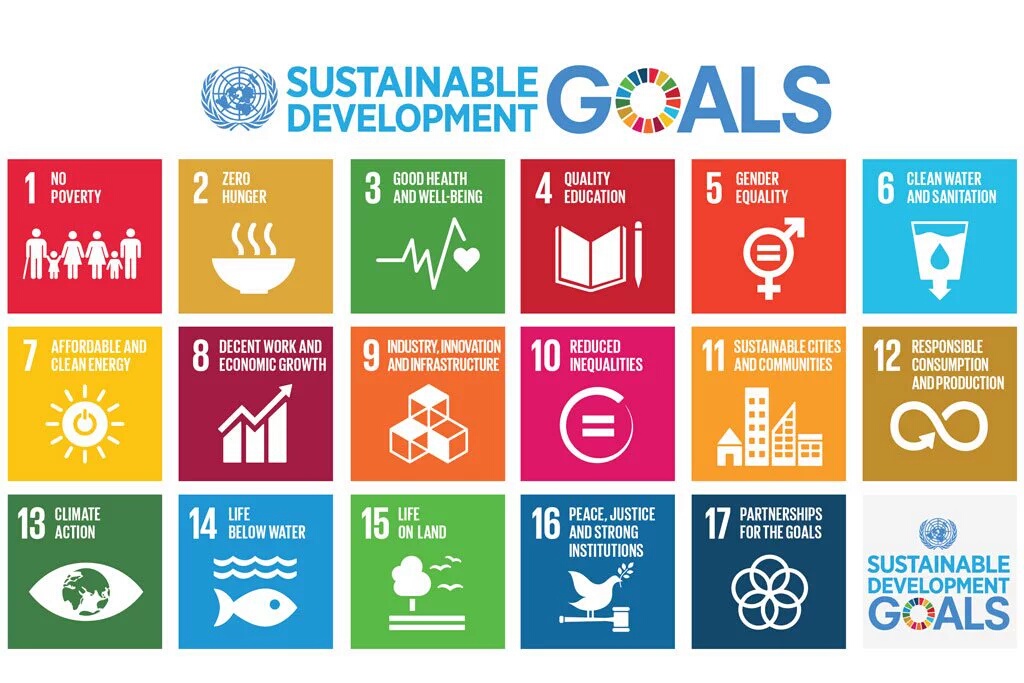
In 2015 … 193 World Leaders, representing all of the United Nations’ Member States, adopted a set of 17 Sustainable Development Goals (SDG’s) … placing our world, i.e. its people, environment and limited resources, on a path towards a more sustainable future … more specifically, aiming to ‘free humanity from poverty, secure a healthy planet for future generations, and build peaceful, inclusive societies as a foundation for ensuring lives of dignity for all’.
To properly track the implementation of these consensus goals … reliable, quality, and timely data is vital. Yet, five years later too much of the data is still out-of-date or unavailable, and too many people are being left behind in the numbers. Half of the data used to measure the SDG Target Performance Indicators are missing. Two-thirds of poverty data from Sub-Saharan Africa and global deforestation figures are five years out-of-date. Only 100 countries in the world have nationally-representative data on violence against women, and more than 25 million refugees around the world go uncounted in national statistics.
.
Colour image showing the 17 Sustainable Development Goals (#SDG’s) unanimously adopted in U.N. Resolution A/RES/70/1: Transforming Our World – 2030 Agenda for Sustainable Development, by the United Nations General Assembly on 25 September 2015. Click image to enlarge.
.
With only 10 years left to achieve the SDG Targets, there is a critical need NOW for a Data Platform which makes quality and timely data for the SDG’s Accessible to All, improves knowledge of geospatial tools and Geographic Information Systems (#GIS), and builds capacity to use these tools to support global policy and decision making …
In partnership with the Environmental Systems Research Institute (#ESRI) and National Geographic … SDG’s Today: Global Portal for Real-Time Data … is a platform developed by the Sustainable Development Solutions Network (#SDSN). This one-of-a-kind open access data platform has the potential to revolutionize how we understand and communicate the urgency of the SDG’s and how solutions are developed, by providing a much-needed virtual space where key stakeholders from around the world can access and engage with timely data (updated annually or in more frequent intervals) on the SDG’s, and learn how to use the data effectively to push Agenda 2030 forward. The platform also houses GIS training and education resources and supports countries and other institutions to produce, share, and engage with the data to help ensure that, together, we meet the global goals by 2030.
.
Using Data To Effectively Implement The UN 2030 Agenda for Sustainable Development …
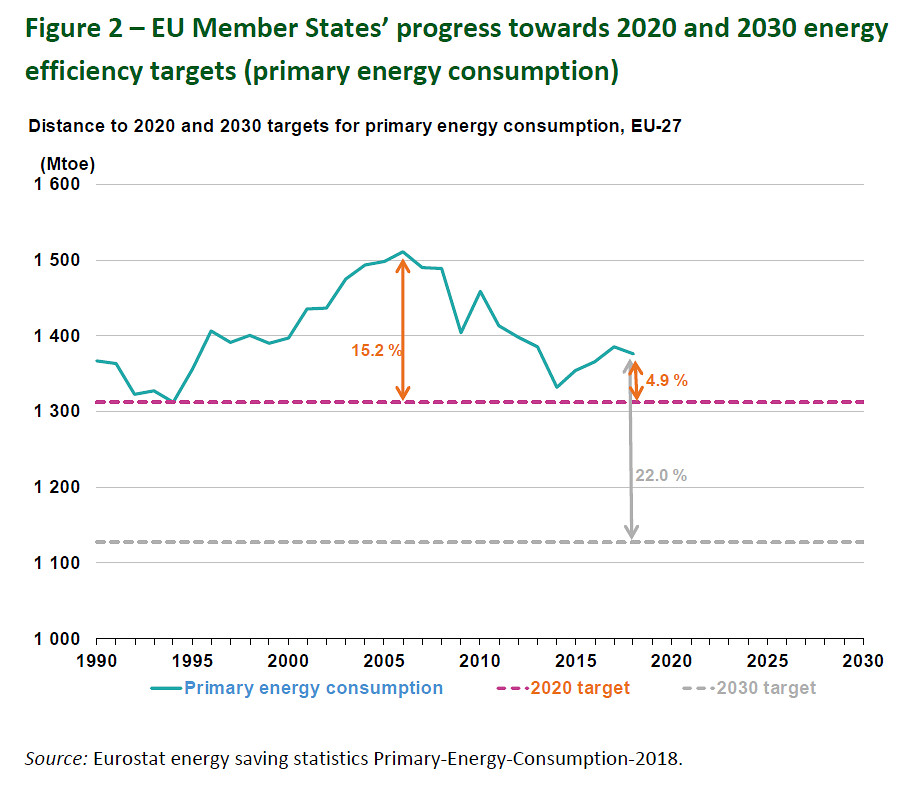
The Court of Auditors assessed whether EU co-funded energy efficiency investments in buildings had cost-effectively helped the EU towards meeting its 2020 energy saving target. The Auditors concluded that operational programmes and project selection were not driven by a cost-effectiveness rationale. While Member States required buildings to be renovated to save a minimum of energy and improve their energy rating, this sometimes happened at a high cost. Because of a lack of comparative assessment of project merits and of minimum/maximum thresholds for cost-effectiveness, projects delivering higher energy savings or other benefits at lower cost were not prioritised. In overly-polite language, they recommend improving the planning, selection and monitoring of investments to improve the cost-effectiveness of spending.
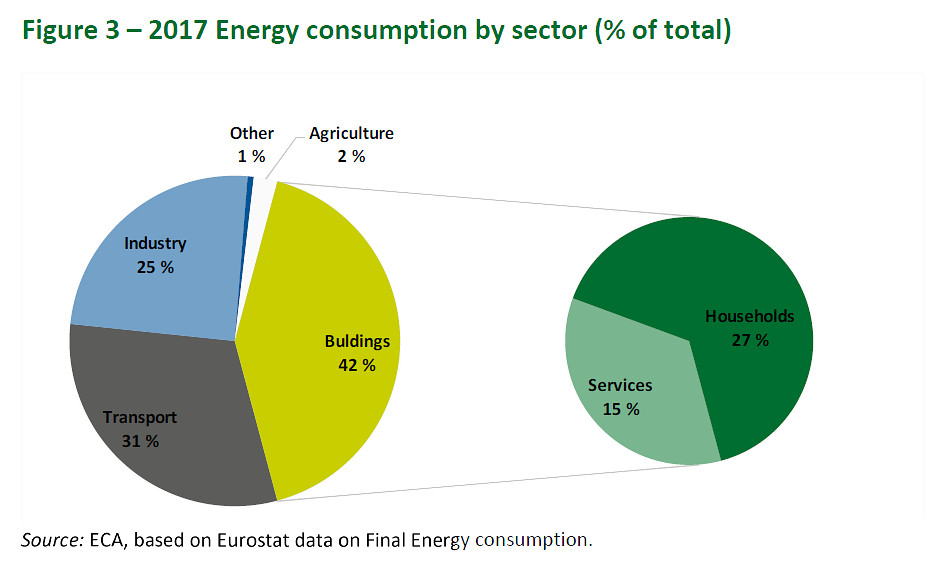
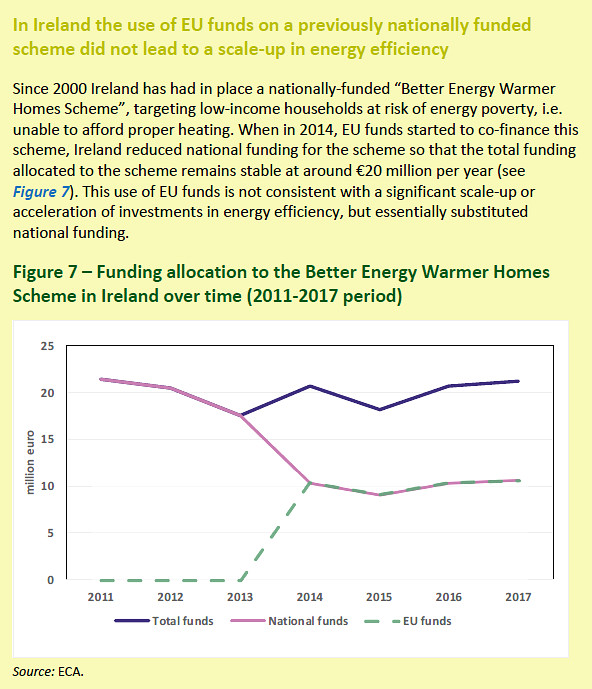
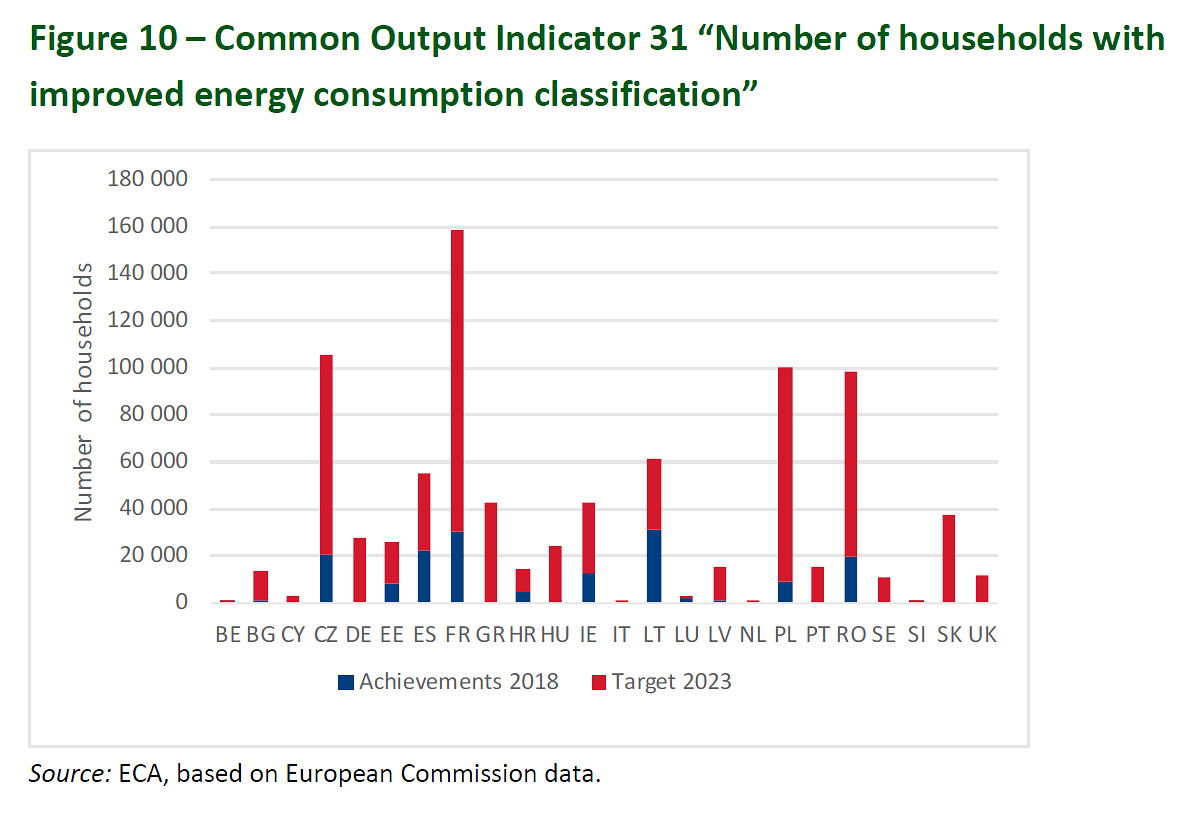
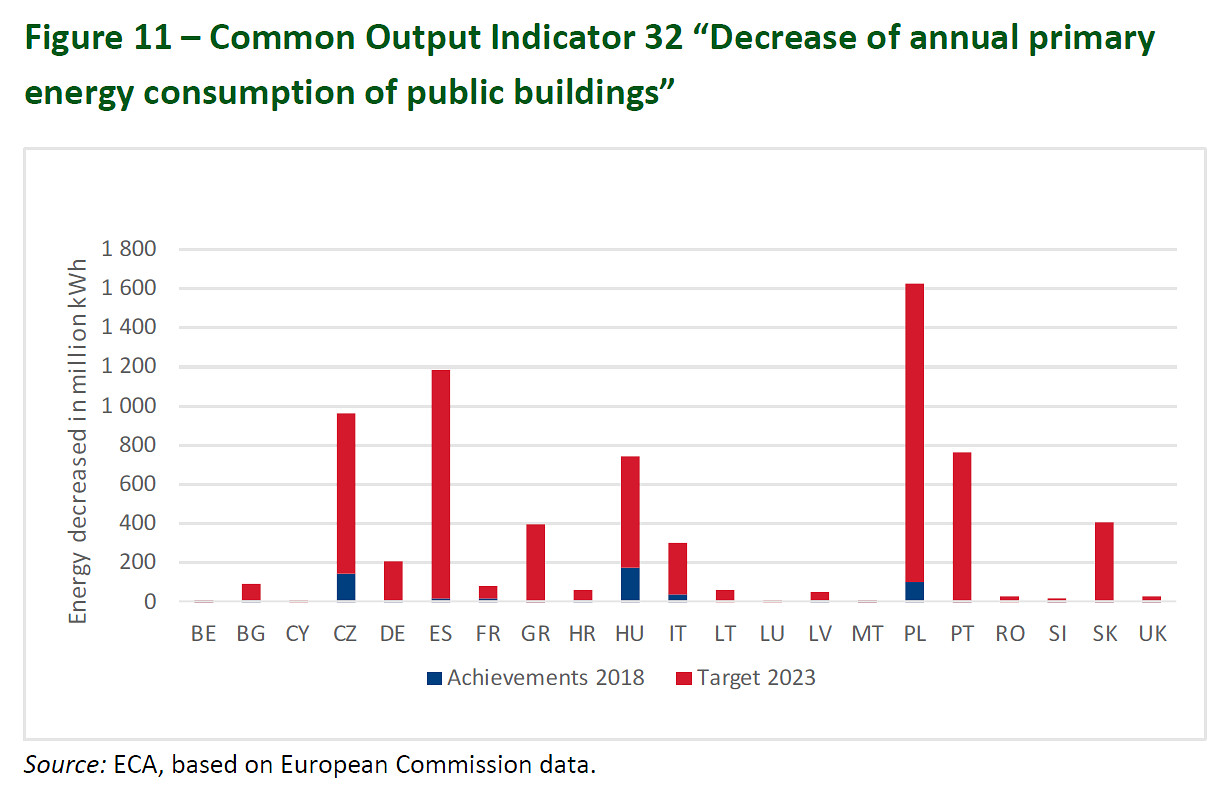
With all of the Hot Air and Ridiculous Hoopla about improving Energy Conservation and Efficiency in New Buildings (Green, BREEAM, PassivHaus, LEED, nZEB, etc., etc.) … by far the biggest Energy Problem is with Europe’s Existing Building Stock. This Auditor’s Report shows that Progress in Meeting Agreed EU Targets is dismal, and there is still a cynical approach in Member States to the use of EU Funding …
Coloured Image / Graph showing distance by the EU-27 to Agreed 2020 and 2030 Targets for primary energy consumption. Click image to enlarge.
.
Coloured Image / Pie Chart showing final energy consumption by EU Sector for 2017. Click image to enlarge.
.
Coloured Image / Graph showing how EU Funds were used merely to substitute national funding in Ireland’s Better Energy Warmer Homes Scheme. Consequently, there was no scale-up in Energy Efficiency Projects. Click image to enlarge.
.
Coloured Image / Graph showing 2018 Actual Achievements and 2023 Targets for the number of EU Households with an improved energy consumption classification. Progress is worse than dismal ! Click image to enlarge.
.
Coloured Image / Graph showing 2018 Actual Achievements and 2023 Targets for the number of EU Public Buildings with decreased primary energy consumption. Progress is abysmal ! Click image to enlarge.
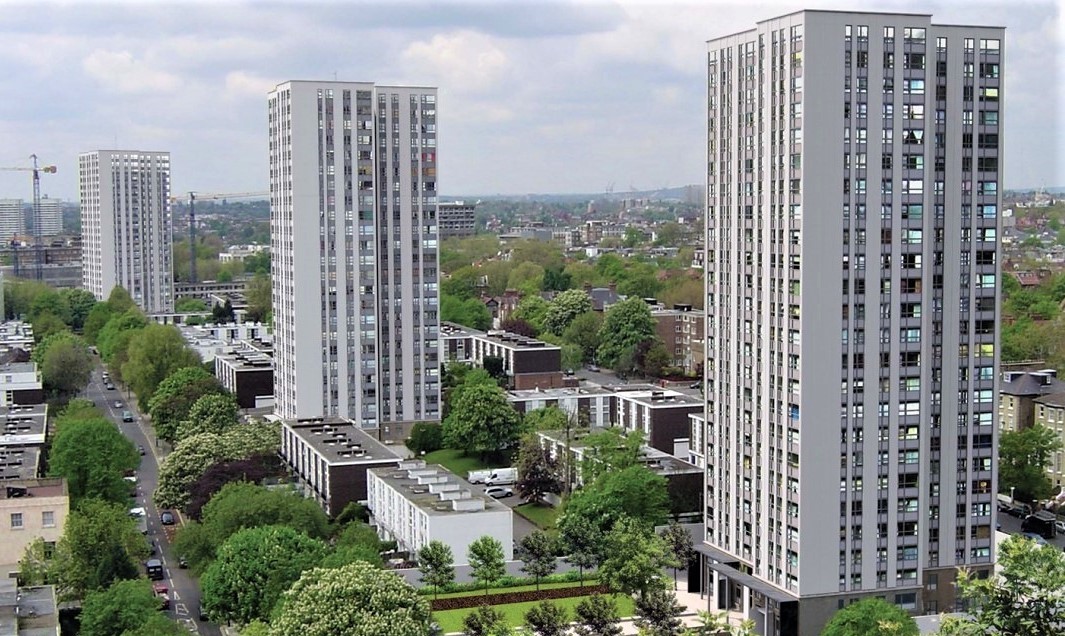
Update 2020-09-01: Although the term ‘Vulnerable People’ remains unaltered, I considered it wise, and very necessary bearing in mind the obvious myopia in the mainstream health, safety and design worlds … clearly demonstrated by the 2017 Grenfell Tower Fire in England, and this current CoronaVirus / CoVID-19 Global Pandemic … to include references to specific social groups …
Vulnerable People: Those people – in a community, society or culture – who are most at risk of being physically, psychologically or sociologically wounded, hurt, damaged, injured, or killed … and include, for example, people with disabilities, young children, people with health conditions, frail older people, women in late pregnancy, refugees, migrants, prisoners, the poor, and homeless.
.
2020-07-20: So many diverse design disciplines and interested groups are involved in the realization, operation and maintenance of a Safe, Inclusive, Resilient and Sustainable Human Environment (built, social, economic, virtual, and institutional) … that the use of simple, easily assimilated language and precise, harmonized technical terminology must be widely exercised. For the effective application of Building Information Modelling (BIM), this is particularly important.
And concerning Fire Engineering, it is not clear when the practice began, but defining a concept simply in terms of performance in a ‘standard test fire’ is entirely inadequate, and fails to explain the actual meaning of the concept.
This Terminology … a body of particular terms, each explaining and defining a single concept, covering inter-related building requirements, e.g. human health, accessibility and fire safety for all, firefighting, social rights, design, performance monitoring, and facility management … takes account of:
Sustainability Impact Assessment (SIA)
WHO International Classification of Functioning, Disability and Health (ICF)
Universal Declaration of Human Rights (UDHR)
U.N. Convention on the Rights of Persons with Disabilities (CRPD)
Environmental Impact.
Fire Engineering Terms … take account of the ‘realistic’ end condition, i.e. a real fire in a real building which is occupied or used by real people with varying behaviour and abilities in relation to self-protection, independent evacuation to an external place of safety remote from a fire building, and active participation in a building’s Fire Emergency Management Plan.
General Terms … are also included in order to facilitate a better understanding of:
the complexity of human behaviour and perception (visual, auditory, olfactory, gustatory, tactile and proprioceptive) ;
the wide range of health conditions ; and, more specifically
2020-04-28: A look back at a Benchmark Document, and an Introduction written nearly 16 years ago. So many years, so much valuable time has been wasted …
The words ‘green’, ‘environmental’, ‘ecological’ and ‘sustainable’ are becoming part of everyday language in the Developed World, but are frequently interchanged without understanding. To date, however, the concept of Sustainable Development has been hijacked by Environmentalists. For example, no connection at all may be seen between a ‘sustainable’ building and ensuring that it can be safely and conveniently entered and used by ordinary people.
In other parts of the World, the ambiguous WCED / Brundtland Definition of Sustainable Development is being systematically rejected ; the concept is viewed as an unaffordable luxury and/or as a means of continued domination and control by the ‘North’. Yet, sustainability must be a global compact.
In this intolerant and more fundamentalist 21st Century, the United Nations System, International Law, and Social Justice continue to come under sustained attack. And the Beslan School Tragedy* demonstrates that it is far more hazardous for disadvantaged, vulnerable and indigenous peoples in every society.
Some specific objectives for the 2004 Rio Declaration were as follows …
To present a 2nd Generation Definition of Sustainable Development which is more acceptable to the Developing World ;
To restore primacy to the Social Aspects of Sustainable Development … and particularly the ethical values of Social Justice, Solidarity and Inclusion-for-All ;
To embed the concept of the ‘Person’ in Sustainable Development … rather than the fleeting reference to ‘People’ which too often results in Disadvantaged, Vulnerable and Indigenous Groups being left behind ;
To signal one of the main challenges of Sustainable Development ahead – which will be to establish a framework of horizontal co-ordination at the many institutional levels … and between the many actors and end users … in the human environment.
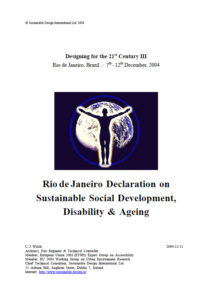
Adopted in December 2004, at the Brazil Designing for the 21st Century III Conference, the Rio Declaration consists of a Preamble, 10 Principles and 5 Appendices ; its central concern involves People with Activity Limitations (2001 WHO ICF).
This Declaration extols implementation, and the targeting and monitoring of ‘real’ performance – as opposed to ‘imagined’ or ‘paper’ performance.
2020-03-23: The Grenfell Fire Inquiry’s Phase 1 Recommendations (Part V in Volume 4 of the Phase 1 Report), were published on 30 October 2019. The initial issues covered in those Recommendations are fragmentary, lack depth and coherence … and in the case of Fire Alarms, with just one indirect reference to them in Paragraph #33.22 … they are in serious error …
.
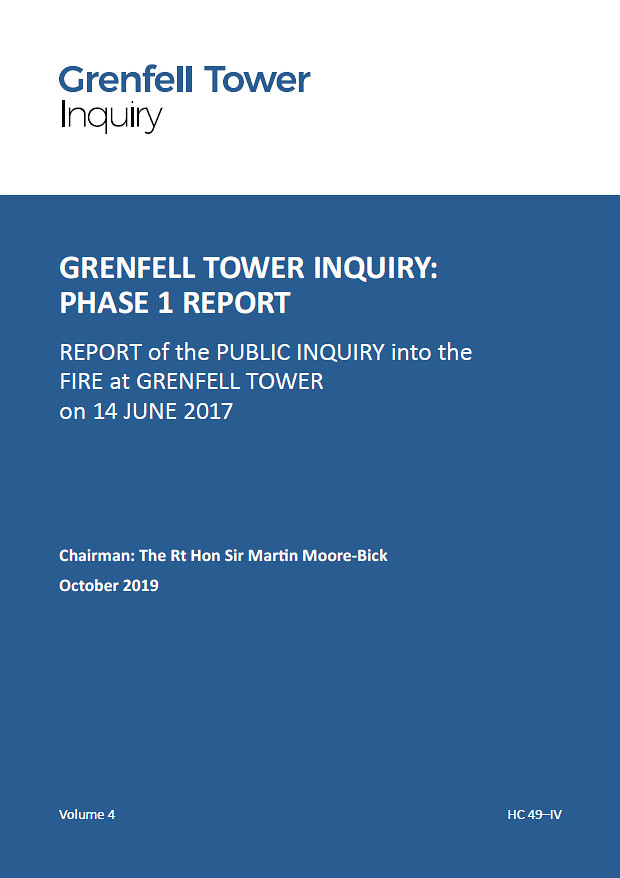
Colour image showing the Volume 4 Cover Page of the Grenfell Tower Inquiry Phase 1 Report. The Phase 1 Recommendations are contained in Chapter #33, on Pages 771-780. Click to enlarge.
[ Paragraph #33.22 ] There were no plans in place for evacuating Grenfell Tower should the need arise. I therefore recommend:
d. that all high-rise residential buildings (both those already in existence and those built in the future) be equipped with facilities for use by the fire and rescue services enabling them to send an evacuation signal to the whole or a selected part of the building by means of sounders or similar devices ;
.
FUNDAMENTALS OF A SOLUTION
1. A Fire Alarm (more precisely from here on, a Fire Detection & Warning System) is a critical safety feature in all buildings … ALL BUILDINGS … from the smallest and most simple, to the biggest and most complex … no exceptions !!
In order to survive in a fire emergency, Vulnerable Building Users need more time to react, and evacuate, than other occupants/users. The valuable time provided by early, accurate and precise detection is the only way to effectively facilitate this. The ‘Required Time’ to prepare for evacuation depends on many factors, e.g. building complexity, familiarity of users with evacuation routes, range and severity of user activity limitations, etc.
It follows, therefore, that if building occupants/users have to wait 15, or 20, or 30 minutes before firefighters arrive at the fire scene (Full Response Time*) and ‘an evacuation signal to the whole or a selected part of the building’ is only then sent by those firefighters … all of that valuable evacuation time for vulnerable building users has been lost. This is ridiculous, and makes no sense whatsoever. This Recommendation must be rejected out of hand, and ignored !
[ *Full Response Time: The time interval from the receipt of an emergency communication at the primary public safety answering point (#PSAP) to when emergency response units are initiating action or intervening to control a fire incident. ]
.
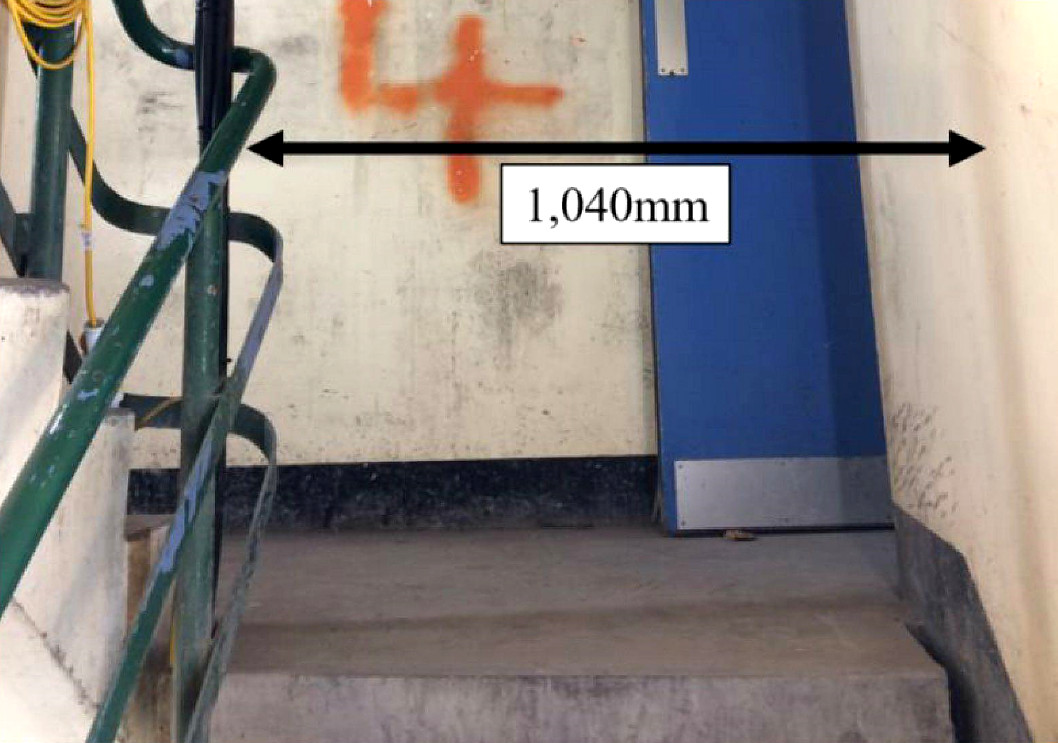
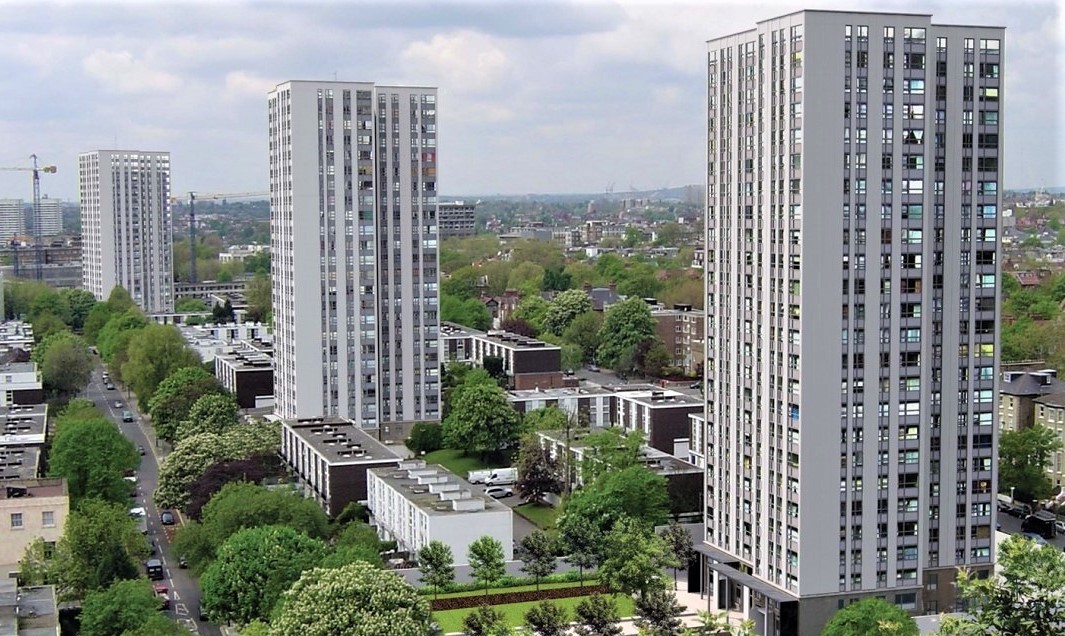
Colour photograph showing the Single, Narrow Staircase (1.040 metres in width between a handrail on one side of the staircase and a bare wall on the other side) in London’s Grenfell Residential Tower. This staircase, which was inadequately protected from fire, heat and smoke, was not wide enough to facilitate the ‘contraflow’ circulation of firefighters entering, while occupants evacuated at the same time. Without a Fire Alarm in the building, occupants could not have known that a serious Fire Emergency was in progress … especially Vulnerable Building Users accommodated high up in the Tower … and they remained in place (‘stayed put’). Once firefighters arrived at the scene, occupant evacuation using this staircase became impossible or extremely difficult. Click photograph to enlarge.
Important Note: In Chapter #34: ‘Looking Ahead to Phase 2’ of Moore-Bick’s Phase 1 Report, Volume 4 … Paragraph #34.14 states …
A question was raised about the width of the stairs, given that they provided the sole means of access to the upper floors of the tower for firefighters as well as the sole means of escape for the occupants. However, the stairs appear to have complied with requirements of the legislation in force at the time of their construction and the expert evidence supports the conclusion that they had sufficient capacity to enable all the occupants of the building to escape within a reasonable time. This aspect of the building will not, therefore, be the subject of further investigation in Phase 2.’
Astounding ! Absurd !! FUBAR !!!
.
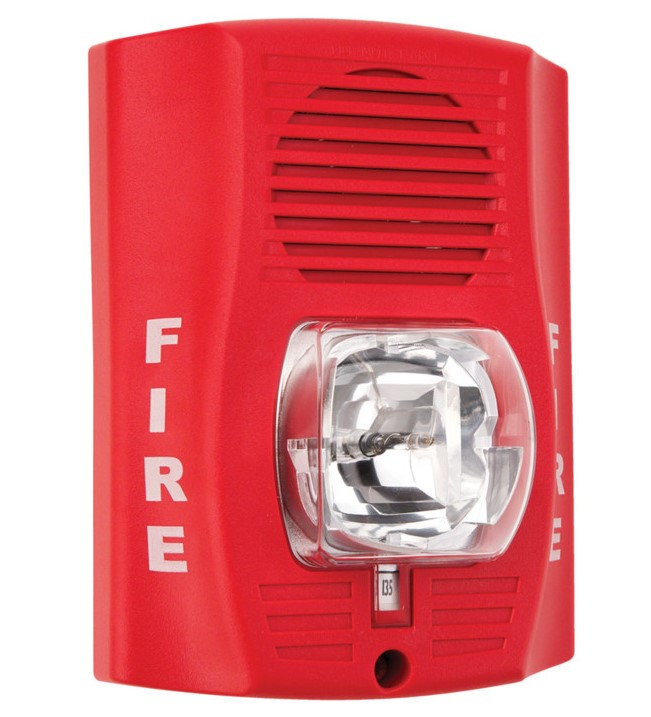
All Fire Emergency Warning Systems must be designed to accommodate People with Hearing Impairments. Audible and visual warning devices must be provided together, as a single combined unit. This is particularly important in noisy and isolated building spaces, e.g. bathrooms, small meeting rooms. Vibrating devices, such as pagers or mobile phones, can be integrated into a building’s fire emergency warning system in order to provide any individual with a tactile emergency alert.
Colour photograph showing a single combined visual-audible Fire Emergency Warning Device. Click to enlarge.
Important Note: Audible sounders, on their own, are never a sufficient Fire Emergency Warning !
.
2. The Purpose of a Fire Emergency Warning System is to provoke calm, efficient and adaptable evacuation movement by ALL building users/occupants at the earliest possible stage in a fire incident, without causing user confusion, disorientation or panic. In all building types, therefore, a reliable, informative and accessible fire emergency warning system must be installed, and such a system must always have a fire protected electrical supply.
Colour image showing the movement of building occupants and users. The purpose of a Fire Emergency Warning System is to provoke calm, efficient and adaptable evacuation movement by ALL building occupants at the earliest possible stage in a fire incident, without causing user confusion, disorientation or panic. During a Fire Emergency, STANDARD MOVEMENT TIMES DO NOT EXIST. Click image to enlarge.
.
3. To provoke a Calm Response from Building Users … the output from Fire Emergency Warning Devices, e.g. light, sound and messages, must be adapted to the local context of people and building surroundings.
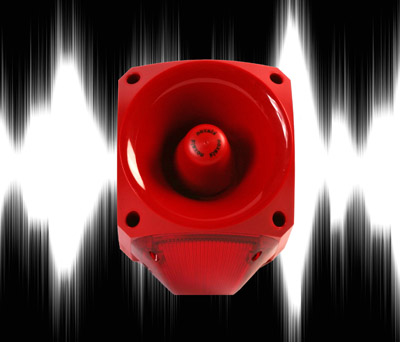
Fire Emergency Audible Warnings … A sufficient number of low-output audible sounders, i.e. between 60-80 dB, must be specified for effectiveness. Small numbers of sounders with high output (in order to reduce costs) should never be specified, as this can lead to confusion, disorientation and panic attacks among some building users/occupants. The output of sounders must be adapted to suit interior surroundings, e.g. in small spaces with hard surfaces a lower sound output will be adequate.
Colour image. The output from Fire Emergency Audible Sounders must be between 60-80 dB. Click image to enlarge.
Important Note: When they are asleep, hearing-able children (around ten years of age and under) … and hearing-able older people (around 65 years of age and over) are more difficult to wake and rouse sufficiently for evacuation when alerted by an audible signal alone.
Fire Emergency Visual Warnings … Light strobes/beacons must be clearly visible. To reinforce #1 above … light strobes/beacons must be placed in wash rooms and in other locations within buildings where people may be alone ; they must also be placed in noisy environments.
A sufficient number of low-output strobes/beacons must be specified for effectiveness. Small numbers of strobes/beacons with high output (in order to reduce costs) should never be specified, as these produce a glare which may cause confusion, disorientation and panic attacks among some building users/occupants. The light output of strobes/beacons must be adapted to suit interior surroundings, e.g. in dark rooms.
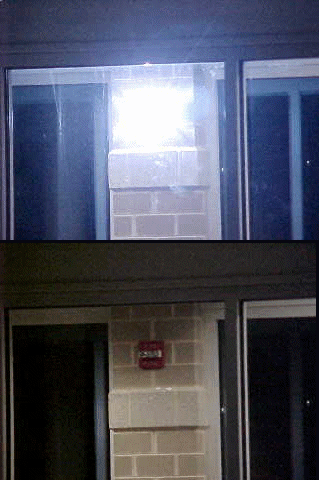
For light strobes/beacons, a slow rate of flash is important, i.e. no faster than once every two or three seconds, in order to encourage a calm response from building users/occupants and to avoid photosensitivity seizures. Most importantly, the flash of one strobe/beacon must be synchronized with the flashes of all other light strobes/beacons in view.
.
Colour video clip (.gif). The output from Fire Emergency Visual Strobes / Beacons must be no faster than one flash every two or three seconds. The flash rate shown above is too fast ! Click to run video clip.
Fire Emergency Voice Message Warnings … Are essential to improve Warning Credibility. In other words, building users are far less likely to sit around wondering, waiting to see whether this is a ‘real’ fire emergency, a false alarm, a practice evacuation, or an electrical error. Verbal or voice messages must be short and contain appropriate warning information which is easily assimilated. The speaker should be distinct and easy to understand. Live messaging during a fire emergency is preferred over pre-recorded, standard messages. In today’s multi-cultural social environment, messages must be transmitted in at least two to three different languages, as appropriate.
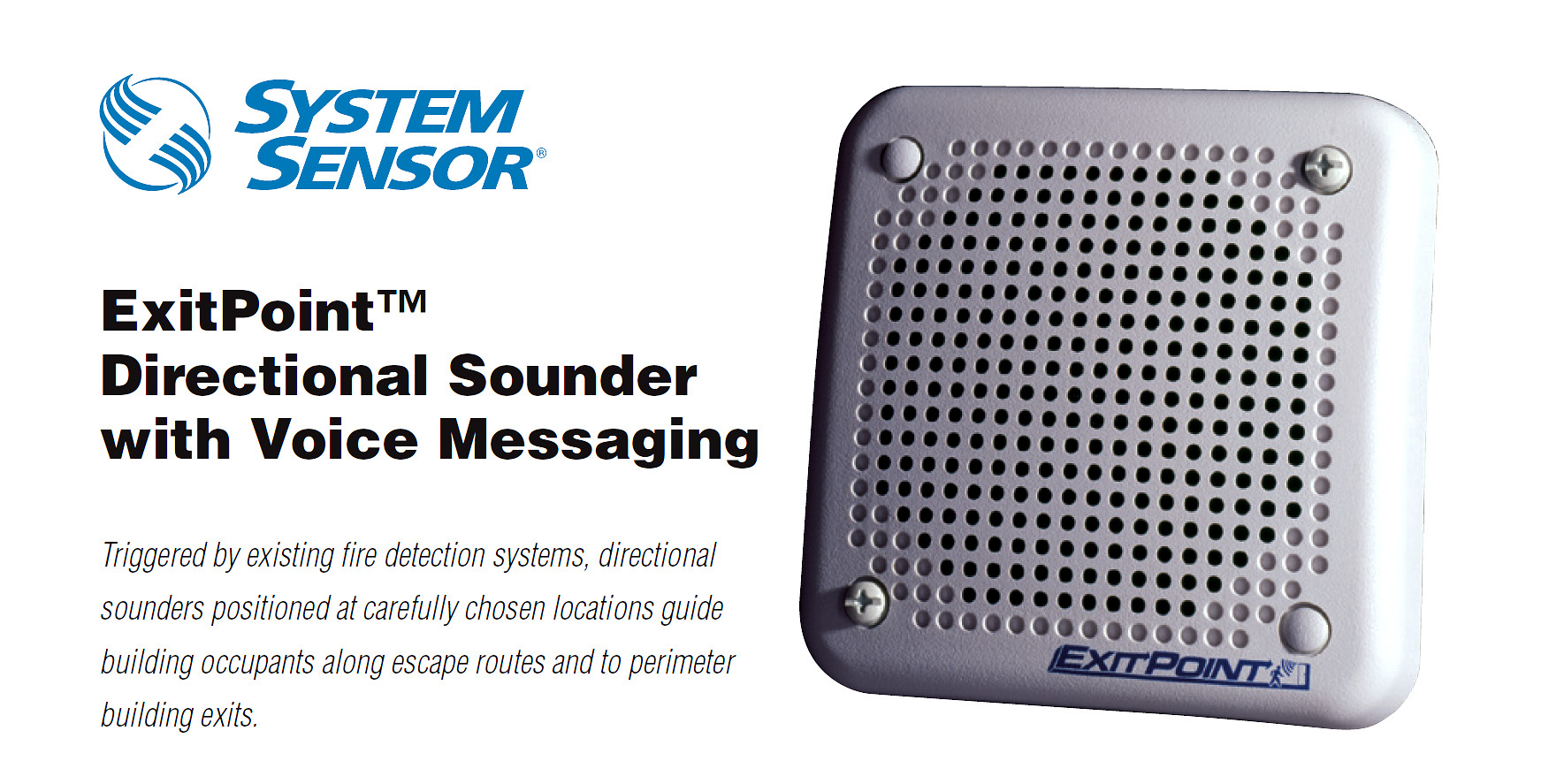
Fire Emergency Directional Warnings … Combination sounder, visible strobe/beacon, and voice messaging Fire Emergency Warning Devices are now a mainstream technology, are readily available, and are being specified in new and existing buildings.
.
Colour image showing a combination Fire Emergency Directional Audible Sounder, with Voice Messaging capability. Click image to enlarge.
Audible directional signalling must be installed when dealing with difficult building configurations, e.g. in large open office layouts/spaces with minimal signage … where building users/occupants are unfamiliar with their surroundings in modern shopping centres/malls and other complex building types … or visibility of high-level signage may be reduced because of smoke logging.
Directional sounders, which guide building users during a Fire Evacuation towards Exits, Areas of Rescue Assistance and Lift/Elevator Lobbies, must be positioned at carefully chosen, suitable locations. Once reached, a directional sounder must also have a voice messaging capability in order to inform people about the next phase of evacuation.
4. Fire Emergency Warning Systems must be Accessible (for People with Activity Limitations), i.e. capable of transmitting a warning in many formats in order to ensure that all users/occupants perceive and act upon the warning in a calm manner and, thereafter, that effective evacuation movement commences without delay. Warning Credibility improves in direct relation to the type and number of different warning formats.
.
As well as indirectly referring to Fire Detection and Warning Systems, Paragraph #33.22 in Moore-Bick’s Phase 1 Recommendations has some other things to say about Evacuation. So this is an opportune moment to discuss some practical and human issues concerning Fire Emergency Evacuation … and, straight away, to deal with an unexpected consequence arising from the current CoronaVirus/CoVID-19 Emergency …
CoronaVIRUS / CoVID-19 PANDEMIC
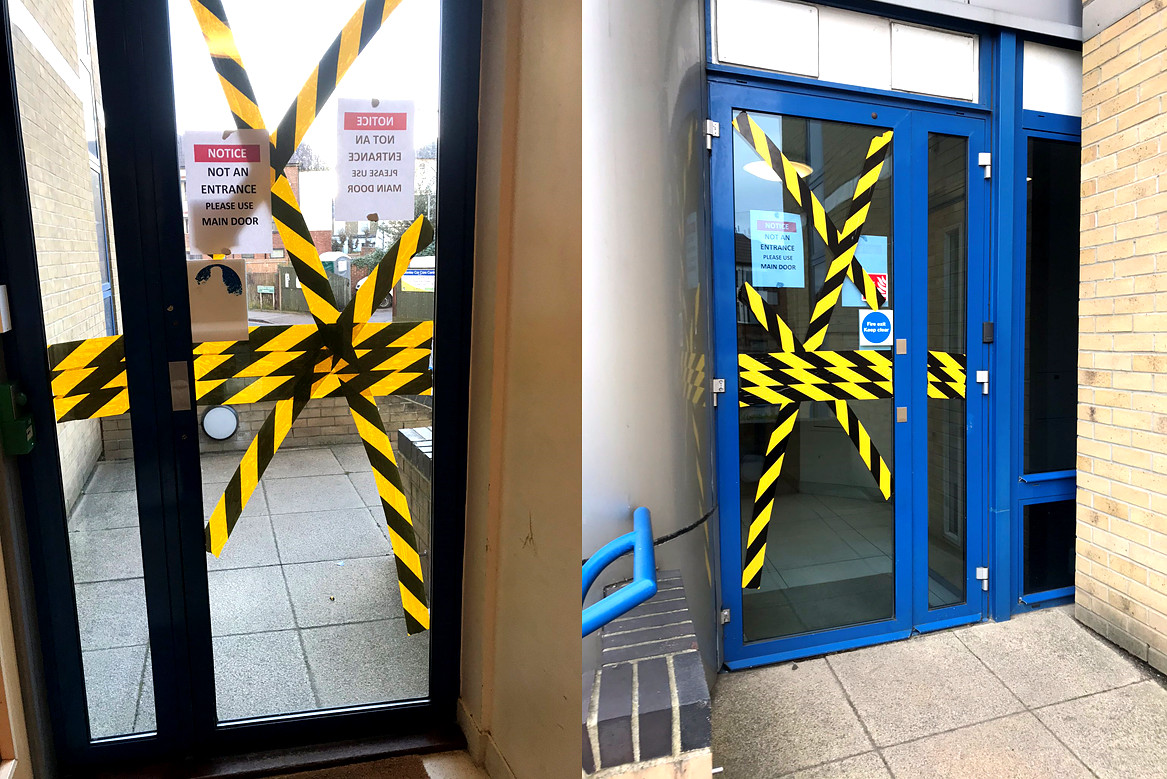
There have been widely reported instances, in many countries, of panic buying in shops because of the 2020 CoronaVirus/CoVID-19 Emergency … but the photograph below illustrates an example of a panic reaction by building management. This appears to be a crime scene … the yellow and black tape is so dramatic. In a real Fire Emergency, many building users/occupants will be reluctant to use this final fire exit ; they will not have the time to read the small print on a notice ; they will attempt to re-trace their path of evacuation and find another exit.
Colour photographs showing how, as a panic reaction to the 2020 CoronaVirus/CoVID-19 Emergency, a Final Fire Exit has been blocked off from normal, everyday use. Click to enlarge.
This panic reaction by building management IS a serious impediment to Fire Evacuation !
Whatever the Motives of Building Management …
in countries which have Fire Codes / Regulations, this action is illegal ; and
in these days, when a wide range of ‘smart’ technologies is readily available … this action is inexcusable.
.
SOME PRACTICAL FIRE EVACUATION ISSUES
A Skill is the ability of a person, resulting from competent training and regular practice, to carry out complex, well-organized patterns of behaviour efficiently and adaptively, in order to achieve some end or goal. All building occupants/users must be skilled for evacuation to an external ‘place of safety’, which is at a safe and remote distance from the fire building. Practice fire evacuations must be carried out sufficiently often to equip building users, particularly vulnerable users, with this skill, i.e. at least once every six months ; in complex building types, practices should be carried out more often. Prior notification to occupants/users, and regular scheduling of practice evacuations should be avoided.
Familiarity with Fire Evacuation Routes will be fostered and greatly improved by means of normal, everyday use by occupants/users. This is an important task for pro-active Building Management in existing buildings … and an important aspect of new building design for Architects and Fire Engineers.
While the transmission of fire emergency warnings in many formats will increase Warning Credibility, close observation of past tragic ‘real’ fire events, e.g. the WTC 9-11 Attacks in New York City, shows that initiation of evacuation and the actual process of evacuation itself can be problematic. An interesting, easily assimilated and user-targeted skills programme of training should incorporate practical solutions to deal with the following typical problems:
Fire Emergency Preparedness: Irregular attendance of building occupants/users at fire prevention and safety training sessions, and participation in practice fire evacuations. Users not being familiar with a building’s fire emergency management plan and not knowing who is in charge … not using a building’s fire evacuation route(s), particularly staircases, during practices … or having no information about where to assemble after evacuating … or, once at a place of safety, not having any head count or identification process ;
Delaying Activities Inside The Fire Building: Once building occupants/users decide to evacuate, but before moving to evacuate, they gather personal effects … seek out friends/co-workers … search for others … make phone calls/send tweets … finish tasks/turn off computers … wait around for instructions … change shoes … and try to obtain permission to leave ;
Delaying Activities Outside The Fire Building: Once outside the building’s final fire exit, but before moving directly to a place of safety, building occupants/users stop to see what is happening … look for friends/co-workers … look for a phone … do not know where to go … or, within the ‘danger zone’ of the fire building, stop to receive medical attention.
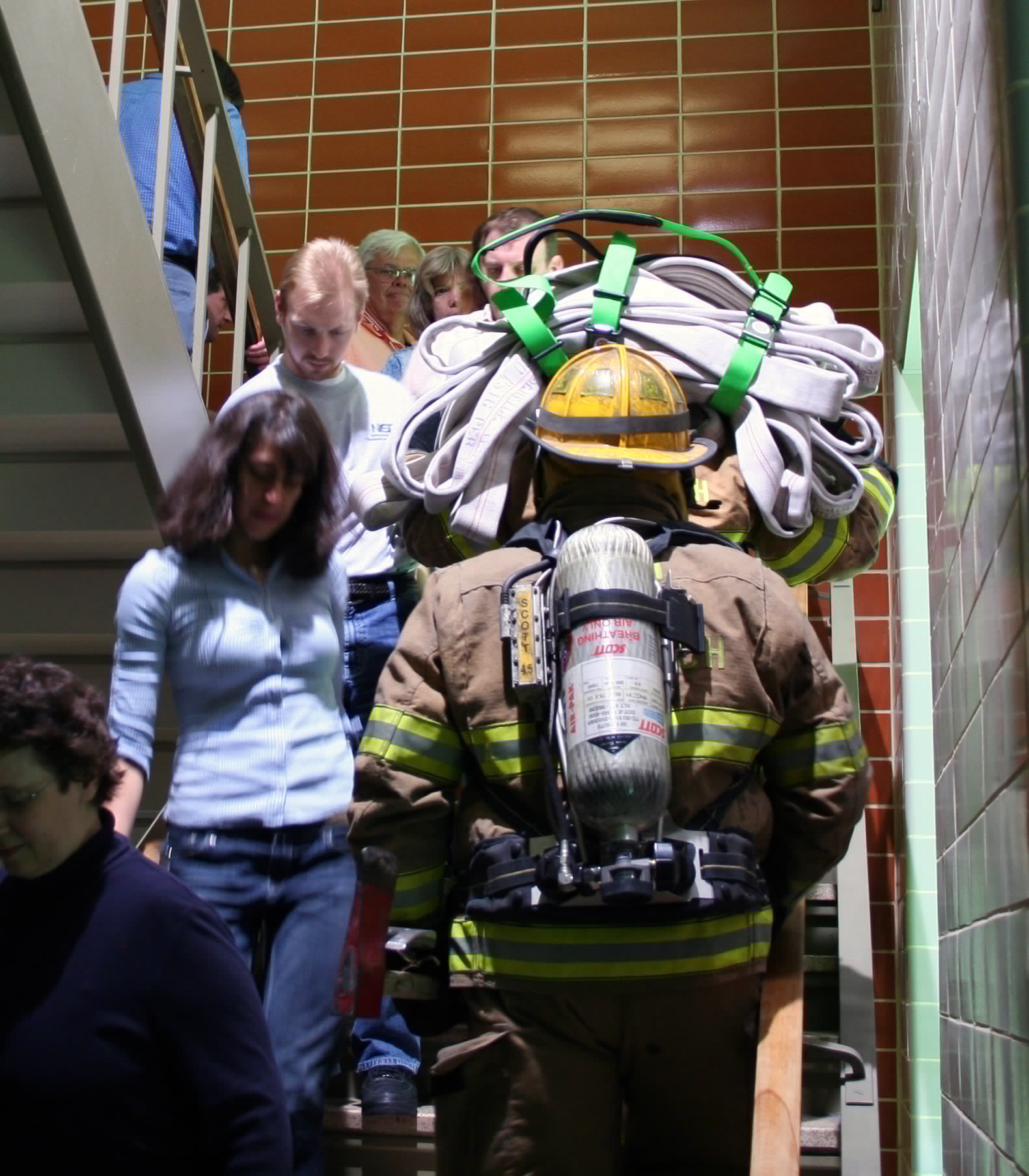
It may seem obvious that Fire Evacuation Routes must also be Accessible (for People with Activity Limitations), which also makes routes much safer for every other building user … and sufficiently wide to accommodate Contraflow (emergency access by firefighters or rescue teams into a building and towards a real fire, while building users are still moving away from the fire and evacuating the building) … a harsh lesson learned from the 2001 WTC 9-11 Attacks and the 2017 Grenfell Tower Fire. Since they are new, strange and unusual for many building designers, and most fire engineers … these aspects of building performance are overlooked in nearly every building.
Practice Evacuations should include exercise of the buddy system ; fire safety fittings, e.g. portable fire extinguishers ; and fire evacuation devices intended for use by people with activity limitations which will require more intensive training.
.
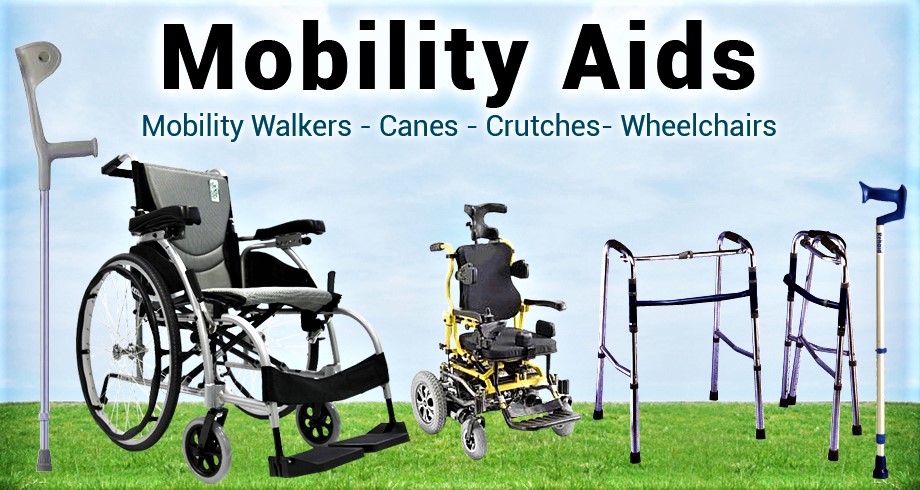
Colour image showing a range of personal Facilitation / Mobility Aids. People with Activity Limitations must be allowed, and positively encouraged, to keep these Aids during practice and real fire evacuations. Prior meaningful consultation (see below) is essential. Click to enlarge.
Important Note: During fire emergencies, People with Activity Limitations must be permitted to keep possession of their own personal Facilitation / Mobility Aids.
.
SOME HUMAN FIRE EVACUATION ISSUES
The actual people who use and occupy buildings are individuals. They are different from each other, and they each have a different range of abilities (in relation to self-protection, independent evacuation to an external place of safety remote from a fire building, and active participation in a building’s fire emergency management plan), behaviour and manner of perceiving their surroundings. Two apparently similar people will also show variations in how they react to and behave in any specific situation, particularly a fire emergency.
Ability / Disability is a Continuum – a gentle gradient on which every person functions and acts at different levels due to personal and environmental, i.e. external, factors.
In situations of severe stress, e.g. during a fire emergency in a building, where there is a lack of preparedness for such an event, a lack of familiarity with evacuation routes, lack of reliable evacuation information, lack of competent leadership and clear direction, and the presence of smoke, user/occupant confusion, disorientation and panic will occur. Standard evacuation movement times will also be non-existent. In addition, people with activity limitations must then deal with many physical barriers which routinely impede their evacuation from buildings, e.g. fire resisting doorsets which are difficult to open, steps along evacuation routes and at final fire exits.
In the case of people with a mental or cognitive impairment, there is a particular need to encourage, foster and regularly practice the adaptive thinking which will be necessary during evacuation a real fire incident.
People with respiratory health conditions will not be able to enter or pass through smoke. People with visual impairments will require continuous, linked tactile and/or voice information during the whole process of fire evacuation. People with psychological impairments, i.e. vertigo and agoraphobia, will be unable to use fire evacuation staircases with glass walls in high-rise buildings. Because of the stigma still associated with disability in many countries, some users/occupants who will need assistance during a fire emergency will be reluctant to self-identify beforehand. Other people may not even be able to recognize that they have an activity limitation or a health condition.
Meaningful Consultation with a person known to occupy or use a building, for the purposes of receiving his/her active co-operation and informed consent (involving a personal representative, if necessary), is an essential component of adequate pre-planning and preparation for a fire emergency.
Building Designers, Fire Engineers and Firefighters should be aware of the following human conditions:
Agoraphobia: A fear of open spaces.
Commentary: Agoraphobia is one of the most commonly cited phobic disorders of people seeking psychiatric or psychological treatment. It has a variety of manifestations, e.g. a deep fear of leaving a building, or of being caught alone in some public place. When placed in threatening situations, agoraphobics may experience a panic attack.
Anosognosia: A neurological disorder marked by the inability of a person to recognize that he/she has an activity limitation or a health condition.
Dementia: Any degenerative loss of intellectual capacity, to the extent that normal and occupational activities can no longer be carried out.
Panic: A sudden overwhelming feeling of anxiety, which may be of momentary or prolonged duration.
Panic Attack: A momentary period of intense fear or discomfort, accompanied by various symptoms which may include shortness of breath, dizziness, palpitations, trembling, sweating, nausea, and often a fear by a person that he/she is going mad.
2019-12-21: Recapping with regard to Vulnerable Building Users … the Grenfell Inquiry Phase 1 Recommendations are pathetically and disgracefully inadequate ! At a later stage and in order to make amends for this serious error … Inquiry Chairperson, Sir Martin Moore-Bick must direct that Proper Consideration – not just Token Consideration – be given, in Law, to the Fire Safety of Vulnerable Building Users, who include people with activity limitations, children under 5 years of age, frail older people (not ALL older people !), women in late stage pregnancy, people with disabilities, refugees, migrants, the poor, and people who do not understand the local culture or cannot speak the local language … OR, to put it another way and to remove any ambiguity … any person who may be vulnerable in a fire emergency, i.e. those with limited abilities in relation to self-protection, independent evacuation to an external place of safety remote from the building, and active participation in the building’s fire emergency procedures.
Do you care that Vulnerable People also use Your Building ?People with Activity Limitations. Click to enlarge.
.
Now, Over 2.5 Years After The Grenfell Tower Fire … London Fire Brigade Commissioner (#LFB), Dany Cotton, has recently stated that she will retire at the end of December 2019.
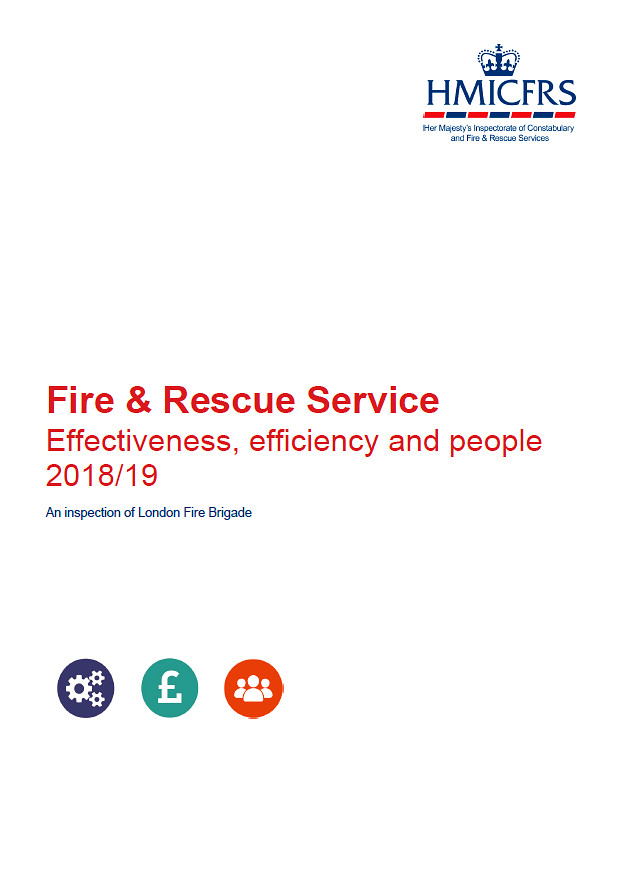
On 17 December 2019 … The National Inspectorate in Britain for Police and Fire Services (#HMICFRS … www.justiceinspectorates.gov.uk/hmicfrs) published a report into the performance of London Fire Brigade. Some extracts from that document …
‘ We have concluded there is a long way to go before London Fire Brigade is as efficient as it could be. We have criticised both the way it uses resources and makes its services affordable now and in future. In some areas it is wasteful. While it has made savings, these are not of the level made in other services.
Worryingly, the Brigade is inadequate at getting the right people with the right skills. It also needs to improve how it promotes the right values and culture, ensuring fairness and promoting diversity as well as managing performance and developing leaders.
The tragic fire at Grenfell Tower in 2017 was one of the biggest challenges London Fire Brigade has ever had to face. The incident has had a profound effect on how the Brigade now performs. Although our findings are broadly consistent with those of the Grenfell Tower Inquiry, it must be emphasised that this was an inspection of the Brigade in 2019. We found that while the Brigade has learned lessons from Grenfell, it has been slow to implement the changes needed. This is unfortunately typical of the Brigade’s approach to organisational change.’
Title Page of GB’s National Inspectorate (HMICFRS) Report, published on 17 December 2019.
If Dany Cotton is the only person to go at the end of December 2019, this is very obviously political scapegoating !
Very Quickly … the entire Culture and Value System of London Fire Brigade must change for the better. And to ensure that this transformation is Immediate and Fully Effective … ALL of Dany Cotton’s Senior Commanders must also go, or be fired … including Dany’s intended replacement, Andy Roe !
In addition … because it is still attempting to defend the criminal ‘Stay Put’ Policy … the National Fire Chiefs Council (#NFCC … www.nationalfirechiefs.org.uk/) in Britain must be held accountable. Its Chair, Vice Chairs and those Lead Officers with responsibility for fire safety in buildings must ALL be replaced NOW !
.
FIRE EMERGENCY MANAGEMENT PLANNING
The Grenfell Fire Inquiry’s Phase 1 Recommendations were published on 30 October 2019. Under the initial topics covered … they are far from being comprehensive … they are fragmentary, lack depth and any sort of coherence …
[ Paragraph #33.10 ] I therefore recommend:
a. that the owner and manager of every high-rise residential building be required by law to provide their local fire and rescue service with information about the design of its external walls together with details of the materials of which they are constructed and to inform the fire and rescue service of any material changes made to them ;
[ Paragraph #33.12 ] I therefore recommend that the owner and manager of every high-rise residential building be required by law:
a. to provide their local fire and rescue services with up-to-date plans in both paper and electronic form of every floor of the building identifying the location of key fire safety systems ;
b. to ensure that the building contains a premises information box, the contents of which must include a copy of the up-to-date floor plans and information about the nature of any lift intended for use by the fire and rescue services.
I also recommend, insofar as it is not already the case, that all fire and rescue services be equipped to receive and store electronic plans and to make them available to incident commanders and control room managers.
[ Paragraph #33.13 ] I therefore recommend:
a. that the owner and manager of every high-rise residential building be required by law to carry out regular inspections of any lifts that are designed to be used by firefighters in an emergency and to report the results of such inspections to their local fire and rescue service at monthly intervals ;
b. that the owner and manager of every high-rise residential building be required by law to carry out regular tests of the mechanism which allows firefighters to take control of the lifts and to inform their local fire and rescue service at monthly intervals that they have done so.
[ Paragraph #33.22 ] I therefore recommend:
a. that the government develop national guidelines for carrying out partial or total evacuations of high-rise residential buildings, such guidelines to include the means of protecting fire exit routes and procedures for evacuating persons who are unable to use the stairs in an emergency, or who may require assistance (such as disabled people, older people and young children) ;
b. that fire and rescue services develop policies for partial and total evacuation of high-rise residential buildings and training to support them ;
c. that the owner and manager of every high-rise residential building be required by law to draw up and keep under regular review evacuation plans, copies of which are to be provided in electronic and paper form to their local fire and rescue service and placed in an information box on the premises ;
d. that all high-rise residential buildings (both those already in existence and those built in the future) be equipped with facilities for use by the fire and rescue services enabling them to send an evacuation signal to the whole or a selected part of the building by means of sounders or similar devices ;
e. that the owner and manager of every high-rise residential building be required by law to prepare personal emergency evacuation plans (PEEP’s) for all residents whose ability to self-evacuate may be compromised (such as persons with reduced mobility or cognition) ;
f. that the owner and manager of every high-rise residential building be required by law to include up-to-date information about persons with reduced mobility and their associated PEEP’s in the premises information box ;
g. that all fire and rescue services be equipped with smoke hoods to assist in the evacuation of occupants through smoke-filled exit routes.
.
Residents in High-Rise Buildings, whether public or private, must no longer wait in vain for a saviour, or to be saved by the ‘system’. Instead, the time has arrived to become proactive, and to immediately initiate their own comprehensive programmes of Self-Protection In Case Of Fire … which go far beyond the Recommendations in Moore-Bick’s Phase 1 Report.
.
Fire Emergency Management Planning begins very early in the long life cycle of a building. The following framework should be scaled up or down, depending on the size and extent of a project …
Fire Defence Plan (FDP)
A Fire Defence Plan (#FDP) elaborates the particular fire engineering strategy which has been developed for a specific building at design stage. It is usually in electronic format and/or hard copy … and comprises fire engineering drawings, descriptive text (including a clear statement of the project’s fire engineering design objectives), a full construction specification (including façade cladding systems), fire safety related product/system information, with supporting calculations and the fire test/approval data which demonstrates their ‘fitness for intended use’.
A Fire Defence Plan must demonstrate a proper consideration for the fire safety, protection and evacuation of all building occupants/users, with a particular and integrated focus on vulnerable building users, especially people with activity limitations. Refer to Personal Emergency Evacuation Plans (PEEP’s) in my previous post.
In ‘real’ everyday practice, as opposed to academic theorizing … effective fire compartmentation is very difficult to achieve. Passive/active fire protection measures are never 100% reliable … sometimes nowhere near 100%. Building management systems are very far from being reliable. For these reasons, ‘Stay Put’ Policies must be completely avoided !
[ In the specific case of Health Care Facilities, e.g. hospitals, it is highly hazardous to patients and unacceptable with regard to their welfare that they be evacuated during a fire emergency to a place of safety which is remote from the building. Instead, the optimal fire engineering strategy here is to ‘protect in place’ … which requires a very high level of independently monitored competence, quality and reliability in design, construction, management, operation, and servicing. ]
Fire Defence Plans become ‘live’ during Construction.
A hard copy of the Fire Defence Plan for a building must always be available for inspection on-site. A copy of the fire defence plan must also be retained at a remote, safe and secure location off-site.
Fire Emergency Planning Committee (FEPC)
Immediately after the completion of construction and occupation of a building, a Fire Emergency Planning Committee (#FEPC) must be established by the building owner(s), in consultation with building occupants/users. Membership of the FEPC must comprise representatives of the building owner(s), building occupants, and regular users of the building. The Committee’s task must be to develop, implement and maintain a Fire Emergency Management Plan, consisting of the emergency response procedures and related training and regular practices, which are essential for the effective and efficient management of any fire emergency in the building. Sufficient resources must be allocated to the FEPC, by the building owner(s), to ensure that it can satisfactorily complete this task.
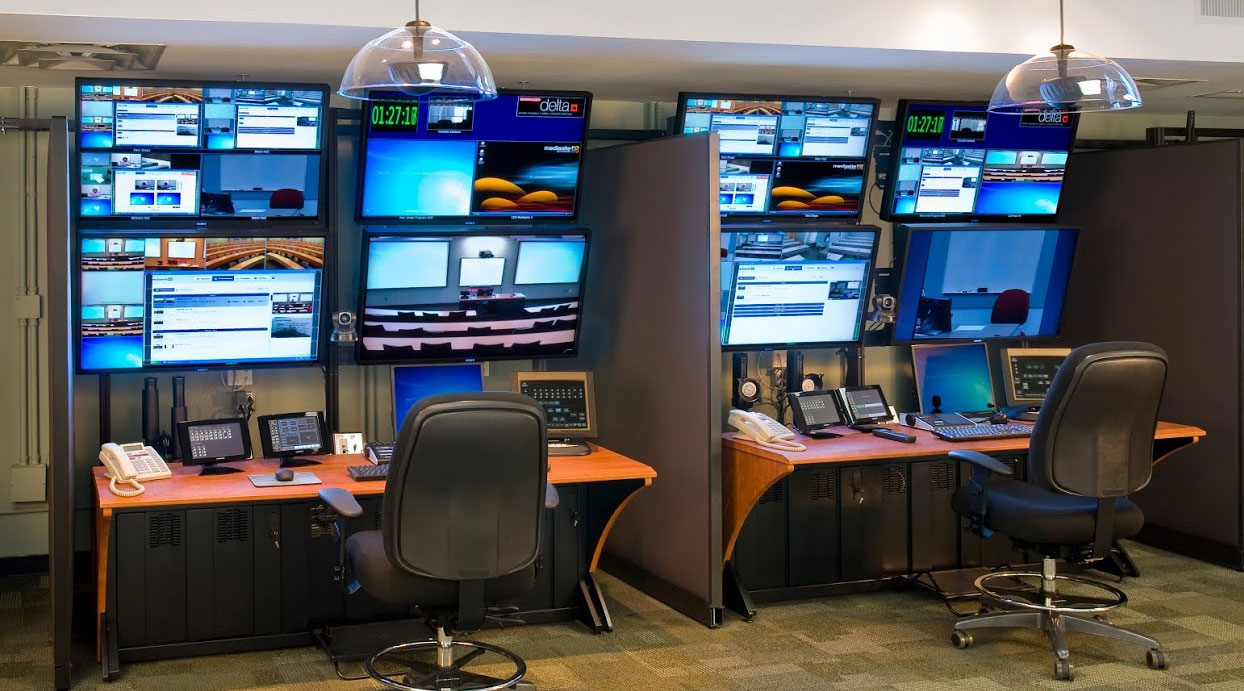
Fire Emergency Control Room. Click to enlarge.
The FEPC must ensure that all relevant legislative requirements are met and must examine, if necessary, the need for the appointment of competent, specialist advisors and support. Special attention must be paid by the FEPC to the fire safety of vulnerable building occupants/users. The FEPC must establish a Fire Emergency Control Room (#FECR), which must be fitted-out and competently operated – 24/7/365 – in accordance with the Fire Emergency Management Plan. The FEPC must also appoint a competent Fire Emergency Control Unit Manager.
Fire Emergency Management Plan (FEMP)
The Fire Defence Plan is the basis for, and main component of, a building’s Fire Emergency Management Plan (#FEMP). This document elaborates the fire emergency response procedures for an occupied building and is produced by the Fire Emergency Control Unit Manager, in liaison with the Local Fire Service. It contains relevant information about the fire safety preparedness and prevention/protection/recovery measures in the building, and includes the pre-emergency, emergency and post-emergency roles, duties and responsibilities assigned to individuals and, in the case of their absence, nominated deputies.
The Fire Emergency Control Unit Manager liaising with the Local Fire Service.
The objective of a Fire Emergency Management Plan is to ensure that, in the event of a fire emergency, the health and safety of every building occupant/user is protected, including visitors to the building, contractors, and product/service suppliers … and access for, and the safety of, firefighters is assured. Particular attention must be paid to those occupants with activity limitations. All Personal Emergency Evacuation Plans (#PEEP’s) must be fully integrated into the overall Fire Emergency Management Plan for the building. Documented procedures must accurately reflect reality, and real behaviour, in the building.
The Fire Emergency Management Plan must include the procedures, chosen methods of warning to be used during a fire emergency, management control and co-ordination during the fire emergency, communications between each member of the Fire Emergency Control Unit and the building’s occupants/users and with the Fire Service Incident Commander at the scene, emergency response equipment in the building, evacuation actions, arrangements for occupants/users with activity limitations, first-aid personnel, evacuation by lift/elevator fire evacuation assemblies, escalators, travellators and staircases, use and fitting-out of areas of rescue assistance (including visual monitoring and the provision of smoke hoods), lift/elevator lobbies (including visual monitoring and provision of smoke hoods) and floors of temporary refuge, up-to-date emergency contact details, etc.
The Fire Emergency Management Plan must always be available for inspection, in hard copy format, at a convenient location in the building. A copy must be provided to all building occupants, as they request, in hard copy, electronic and/or alternative formats. A further copy of the Fire Emergency Management Plan must be provided to the Local Fire Service, as they request, in hard copy and/or electronic formats.
To ensure its effectiveness, the Fire Emergency Management Plan must be regularly practiced at least every three months, tested and reviewed. If necessary, e.g. in the case of large/complex building types or existing buildings having suspect levels of fire safety, the establishment of an on-site, permanent, competent/specialist Fire Emergency First Response Team (#FEFRT) must be considered.
Fire Emergency Control Unit (FECU)
The Fire Emergency Control Unit (#FECU) must be established by the Fire Emergency Planning Committee to implement, manage, and recommend improvements to the Fire Emergency Management Plan.
In the event of a Fire Emergency, instructions given by the Fire Emergency Control Unit Manager, or his/her Deputy, must take precedence over normal management structures and procedures in the building; and it shall be his/her duty to inform the Local Fire Service, immediately upon their arrival at the scene, about the number/locations of people still in the building, and the number/locations of vulnerable people who may need to be rescued.
Other members of the Fire Emergency Control Unit must accompany occupants/users as they evacuate to place(s) of safety, remote from the building. Once there, a head count must immediately be taken by those members – now the Person in Charge at a place of safety – to establish the following:
That everybody is present, and that nobody has been left behind ;
That everybody is uninjured … or if anybody is injured, what appropriate Medical Aid is rendered and/or summoned.
Communications during a fire emergency between all of the interested parties involved can be fraught with difficulty … lack of discipline will cause misunderstandings and confusion … signal strengths may suffer interference because of the building’s construction. If necessary, Repeater Units must be installed in the building at any signal ‘drop-zones’ … and the development of a Fire Emergency Management Communications ‘App’, for use on FECU/occupant/user smartphones, must also be considered.
The Fire Emergency Control Unit Manager must prepare for the swift and orderly transfer of the Fire Emergency Control Room and its personnel to a safe location off-site, in the unlikely event of a severe fire emergency in the building.
Fire Safety Training & Regular Practice Evacuations
The objective of fire safety training and regular practice evacuations, which are held at least every 3 months, is to ensure that everybody in the building is skilled for evacuation during a fire incident, using safe accessible routes to an external place/places of safety which is/are remote from the building.
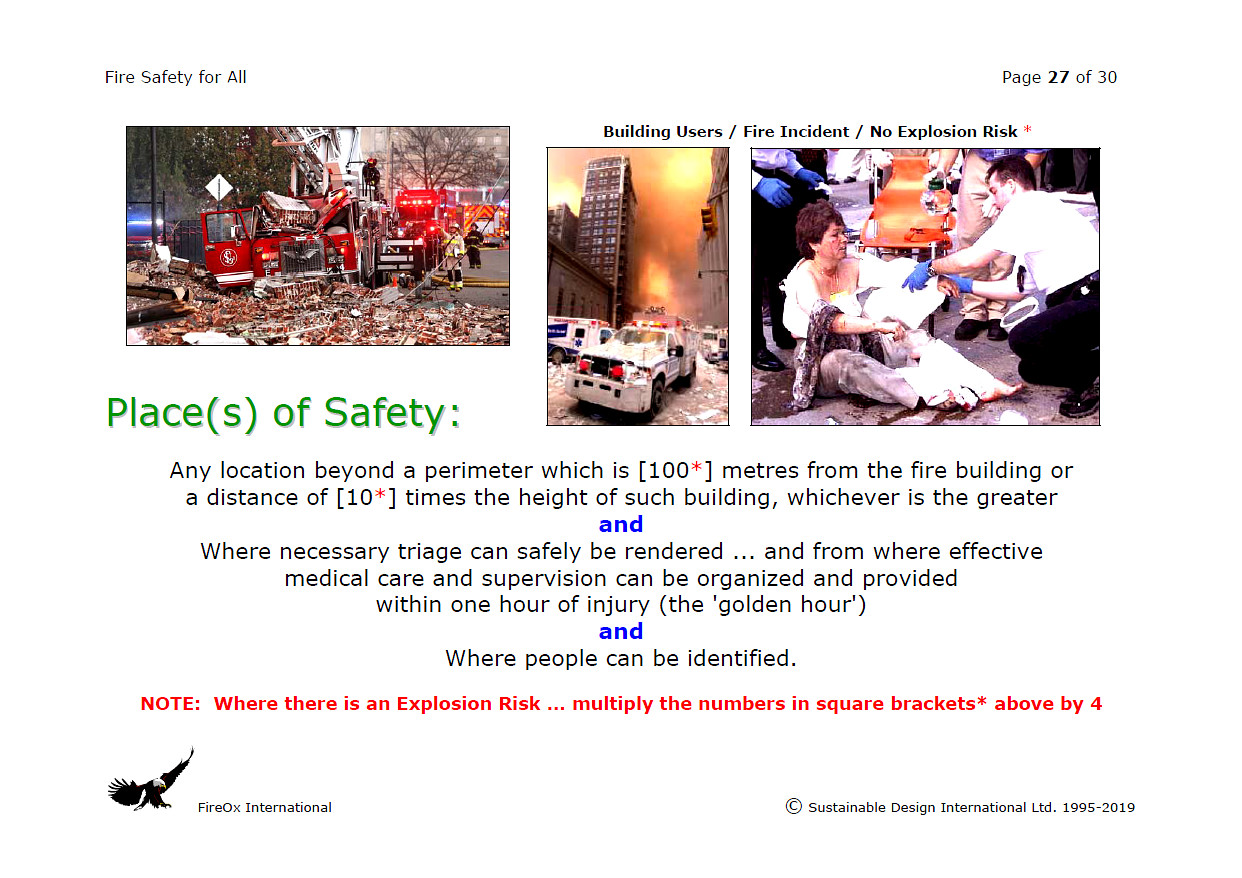
Place(s) of Safety. Click to enlarge.
Fire safety training and regular practice evacuations must be conducted by the Fire Emergency Control Unit Manager for all building occupants and regular visitors to the building, including FECU personnel. Fire safety training material used, e.g. brochures, hand0outs and fact sheets, must be site-specific, appropriate to an individual’s role and responsibilities, and easily assimilated, i.e. can be comprehended by everyone, including people with activity limitations and those who are illiterate or may use different languages.
A programme of site-specific practice fire evacuations must be developed, in collaboration with the Local Fire Service, by the Fire Emergency Control Unit Manager.
Skill: The ability of a person – resulting from proper training and sufficient regular practice – to carry out complex, well-organized patterns of behaviour efficiently and adaptively, in order to achieve some end or goal.
Routine Fire Safety/Evacuation Inspections & Maintenance
The Fire Emergency Control Unit Manager must ensure that all fire safety and evacuation related aspects of the Fire Emergency Management Plan, including systems, products and fittings, are routinely inspected, tested and maintained/serviced. Any deficiencies must be reported to the Fire Emergency Planning Committee at the completion of an inspection and/or test, and must be rectified as soon as it is reasonably practicable. Records of all activities must be regularly updated and safely/securely stored in the building, with a duplicate copy provided to the Local Fire Service.
Fire Evacuation Performance Indicators (Metrics)
Performance indicators/metrics must be formulated by the Fire Emergency Control Unit Manager in order to evaluate the effectiveness of the fire emergency response procedures in the building. During practice evacuations, the time between warning communications and first occupant/user movement, the time taken for evacuation to an external place/places of safety remote from the building, the evacuation routes chosen by occupants/users, and the time required to identify everyone who participated in the practice evacuation at the place/places of safety, including those occupants/users who did not participate, must all be recorded.
The Local Fire Service has two functions: a) to suppress and control a fire in the building, and to confirm extinguishment ; and b) to rescue people in the building who are injured, trapped, or otherwise unable to independently evacuate, e.g. people waiting in areas of rescue assistance and lift/elevator lobbies. In addition, therefore, the time taken for the first fire service vehicle to arrive on-site and, more importantly, the time taken for the fire services to arrive in sufficient strength to deal effectively with a fire emergency in the building must be recorded. In the event that either or both of these times are inordinately long, an on-site specialist Fire Emergency First Response Team (FEFRT) must be established by the Fire Emergency Planning Committee. The FEFRT must work under the control of, and report directly to, the Fire Emergency Control Unit Manager.
‘Contraflow’ movement in Building Circulation Routes. Click to enlarge.
During the process of evaluation, generous allowance must be made for contraflow circulation during a real fire incident, i.e. emergency access by firefighters into a building and towards a fire, while building occupants/users are still moving away from the fire and evacuating the building.
The Fire Emergency Control Unit Manager must report, in full, the recorded performance and his/her evaluation of practice evacuations to the Fire Emergency Planning Committee.
.
Addendum 2020-04-14: For business application … the National Fire Protection Association (#NFPA) issued a very useful Emergency Preparedness Checklist in September 2018 …… which also covers Business Continuity and Recovery …
2019-10-21: Following the very successful Rehabilitation International Asia-Pacific (AP) Conference in Macau, at the end of June 2019 … https://www.rimacau2019.org/ … I was invited by the United Nations Economic & Social Commission for Asia and the Pacific (UNESCAP – https://www.unescap.org/) to submit an Article on ‘Fire Safety for All’ to one of their upcoming publications.
Fire Safety for All … for vulnerable building users, including people with disabilities, young children, frail older people, people with health conditions, and women in late-stage pregnancy … is a critical component of Accessibility & Usability for All … the key factor in facilitating full social participation and inclusion.
Consistent with the philosophy and principles of Sustainable Human & Social Development, a concept which continues to evolve with robust resilience (despite many challenges) … and the 2015-2030 Sustainable Development Framework Agenda … implementation is most effective if carried out at Regional Level … adapted to a Local Context.
Full and effective implementation, in each separate jurisdiction, then requires:
a robust legal base ;
determined political will to implement ‘fire safety for all’ ;
sufficient public financial resources for implementation – ‘fire safety for all’ is a social*, as distinct from a human, right ;
a compassionate and understanding bureaucracy, at all institutional levels ;
competent spatial planners, architects, structural engineers, fire engineers, quantity surveyors, technical controllers, industrial designers, building/facility managers, and crafts/trades people at all levels in construction organizations ;
independent monitoring of ‘fire safety for all’ performance – self-regulation is NO regulation ;
innovative, well-designed fire safety related products, systems and fittings which can be shown to be ‘fit for their intended use’.
[ *Social Rights: Rights to which an individual person is legally entitled, e.g. the right to free elementary education [Art.26(1), UDHR], but which are only exercised in a social context with other people, and with the active support of a competent legal authority, e.g. a nation state.
Commentary: In contrast to human rights, it is not protection from the state which is desired or achieved, but freedom with the state’s help.]
If Policy and Decision Makers are serious, therefore, about meeting the Safety Needs of Vulnerable People in Fire Emergencies … This Is An Absolutely Minimum Threshold Of Practical Action To Bring About Urgent Change …
Article for UNESCAP
Fire Safety for All – Nobody Left Behind !
The rising 21st Century Cities of the Asia-Pacific Region each encompass:
a) an interwoven, densely constructed core ;
b) a very large and widely diverse resident population ;
c) a supporting hinterland of lands, waters and other natural resources ;
together functioning, under the freedoms and protection of law, as …
a complex living system ; and
a synergetic community capable of providing a high level of social wellbeing* for all of its inhabitants.
[ *Social Wellbeing for All: A general condition – for every person in a community, society or culture – of health, happiness, creativity, responsible fulfilment, and sustainable development. ]
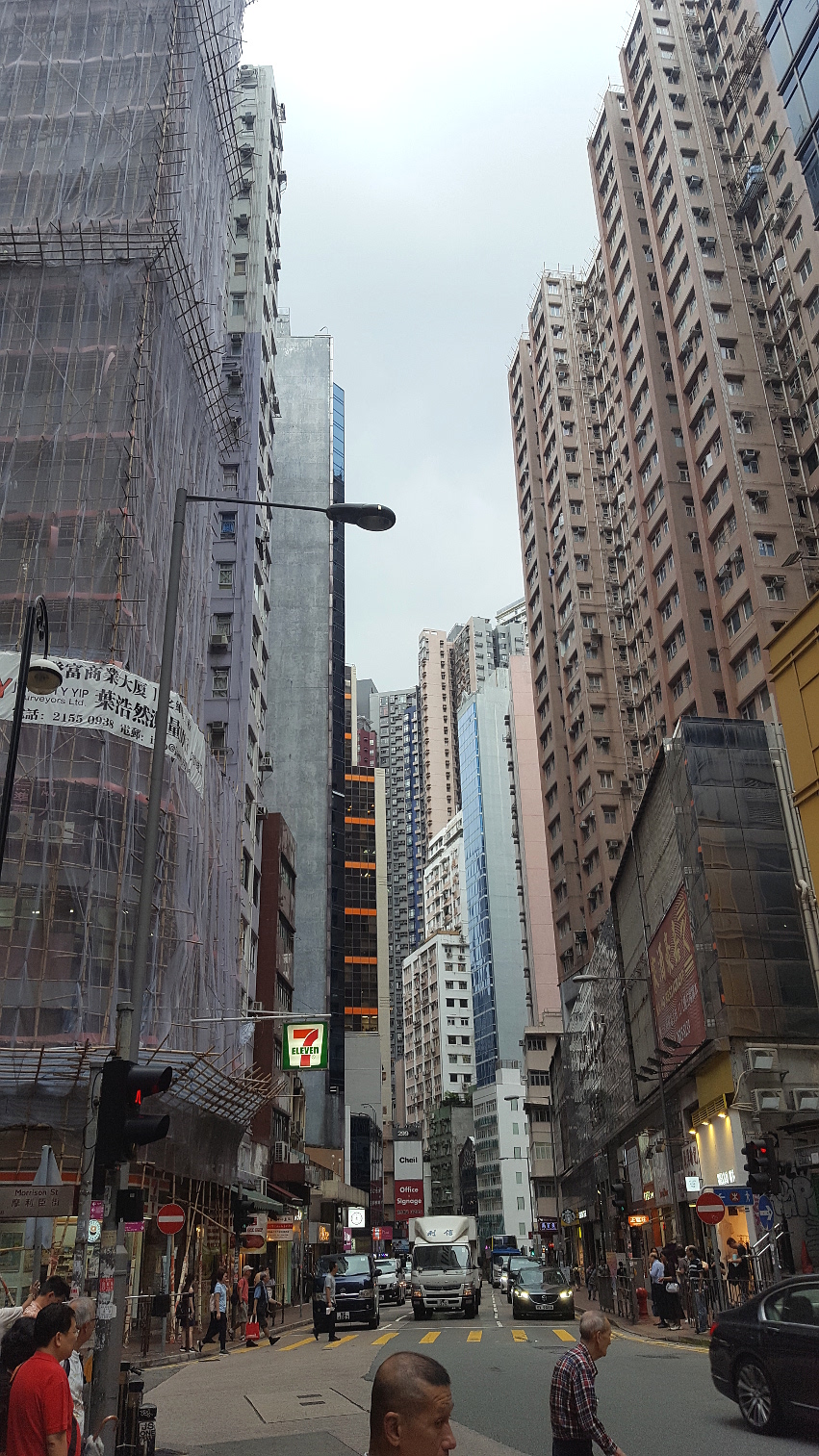
Colour photograph showing one of the oldest districts in Hong Kong … Sheung Wan … very high-rise development, with mixed commercial and residential activity. Click to enlarge. Photograph taken by CJ Walsh. 2019-06-24.
In all areas of life and living in this City Community, every person is equal before the law and is entitled, without any discrimination, to equal protection of the law*. When they are in a building, for example, all of its occupants and users have an equal right to feel ‘fire safe’ as required by law. This must also include vulnerable building users, particularly people with disabilities.
[ *Refer to Article 12 in the 2006 United Nations Convention on the Rights of Persons with Disabilities, which has been ratified by nearly every country in the world, including the European Union … and Article 7 in the 1948 Universal Declaration of Human Rights.]
Current national building codes – where they exist – do not protect vulnerable people in fire emergencies: many countries have no legal provisions answering this crucial need, while a small group of countries offer only token, i.e. inadequate, protection. An ethical*, technical response is urgently required, therefore, at regional level in Asia-Pacific. The social, political and institutional challenges blocking effective implementation are immense.
[ *Refer to the 2016 Dublin Code of Ethics: Design, Engineering, Construction & Operation of a Safe, Resilient & Sustainable Built Environment for All. Download from: www.sfe-fire.eu ]
Note: A Regional Implementation Strategy is already in the course of being developed for Asia-Pacific (AP).
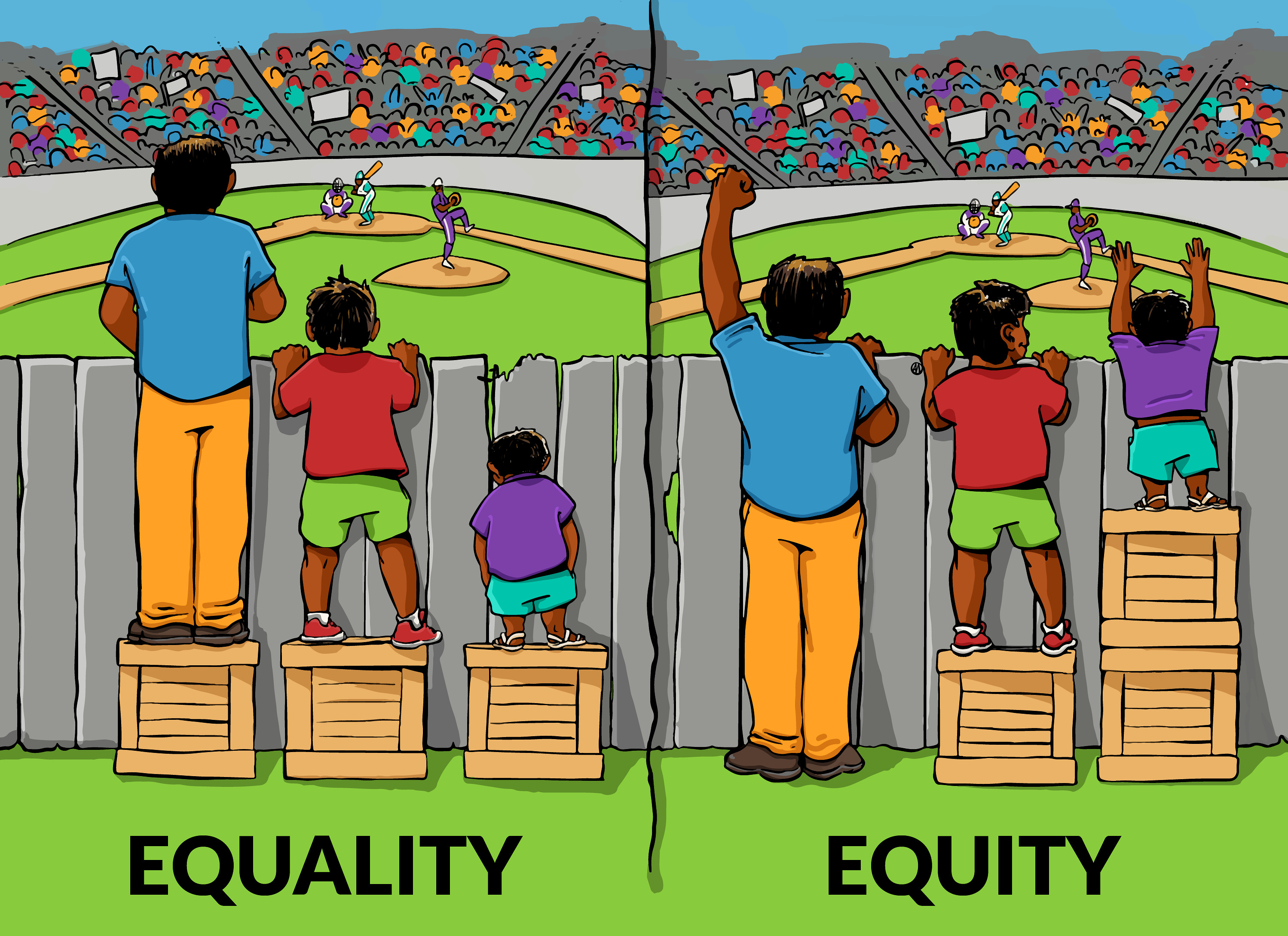
Colour image illustrating the two concepts of social ‘equality’ and ‘equity’ … and, most importantly, the difference between the two. Mainstream society must fully accept these concepts … and understand how, in order to achieve equality, the process of implementation must be equitable. Click to enlarge.
Fire Safety for All … for vulnerable building users, including people with disabilities, young children, frail older people, people with health conditions, and women in late-stage pregnancy … is a critical component of Accessibility & Usability for All … the key factor in facilitating full social participation and inclusion. This design objective is achieved by equitable fire prevention and fire protection measures, essential occupant/user practices, independent fire evacuation procedures, proactive management and, as a last but necessary resort, reliable assisted evacuation and/or firefighter rescue.
In the Smart City, nobody must be left behind !
During the first critical 10-15 minutes in a fire emergency – the time between when a fire is first accurately detected, warnings are transmitted, and firefighters arrive at the building – many people with disabilities are more than capable of independent evacuation using reliably functioning lift/elevator fire evacuation assemblies. Independent use of lifts/elevators by people with disabilities is essential during a fire emergency … and must be facilitated.
The enormous benefit for those vulnerable individuals who are capable of negotiating horizontal and vertical circulation routes by themselves is being able to evacuate a building and reach a ‘place of safety’ in the company of other building occupants/users. They remain independent, in control of their own evacuation, and able to leave without waiting for someone else to rescue them or render assistance.
Buildings must remain structurally ‘serviceable’ until all building occupants/users and firefighters have reached a remote ‘place of safety’.
Management systems and fire protection measures in buildings are never 100% reliable. People with disabilities must, therefore, be trained to be self-aware in situations of risk, particularly in fire emergencies, and actively encouraged to develop the skills of self-protection and adaptive self-evacuation.
Essential Features At Building Design Stage
Fire Safety for All must be carefully considered at the initial stages of building design. To be effective, however, the following essential passive and active fire protection measures must be incorporated in buildings …
A. A smart ‘whole building’ fire emergency detection and multi-format warning system is an essential fire safety feature in all building types, new and existing. Vulnerable building occupants/users need much more time to react, and evacuate, than other users during a fire incident.
B. All building occupants/users must be provided with alternative, intuitive and obvious evacuation routes away from a fire outbreak in a building. A significant number of building users will never pass through the smoke generated by fire.
C. All fire evacuation routes in a building must be accessible for building occupants/users, and be sufficiently wide to accommodate contraflow, i.e. building users evacuating while firefighters enter the building at the same time. Under no circumstances must ‘stay put’ policies be normalized, or practiced.
D. Phased horizontal evacuation must be facilitated, in design, by providing ‘buffer zones’ around fire compartments, and adjacent ‘places of relative safety’.
E. All lifts/elevators in a building must be capable of being used during a fire emergency. This is already the case, in most countries, with firefighter lifts.
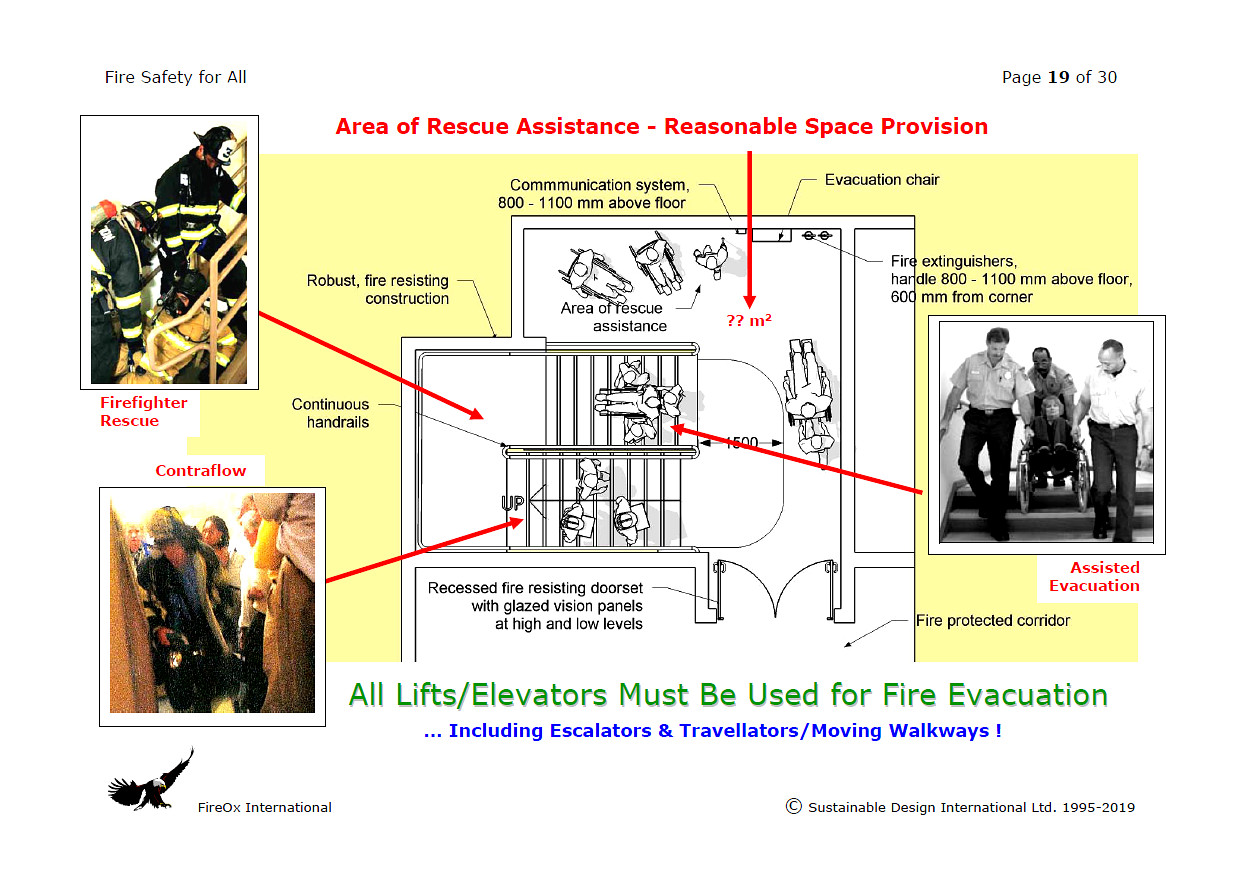
F. Fire protected evacuation staircases must be sufficiently wide (1.5m between leading handrail edges) to facilitate contraflow and the assisted evacuation of manual wheelchair users; they must open into fire protected lift/elevator lobbies at every floor/storey level, and open directly to the exterior at ground level.
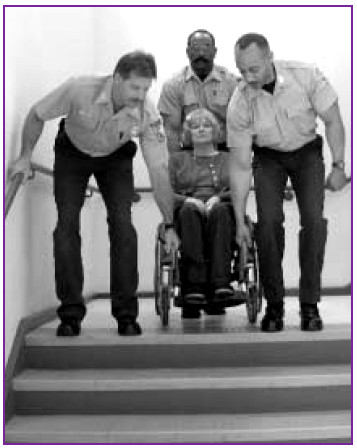
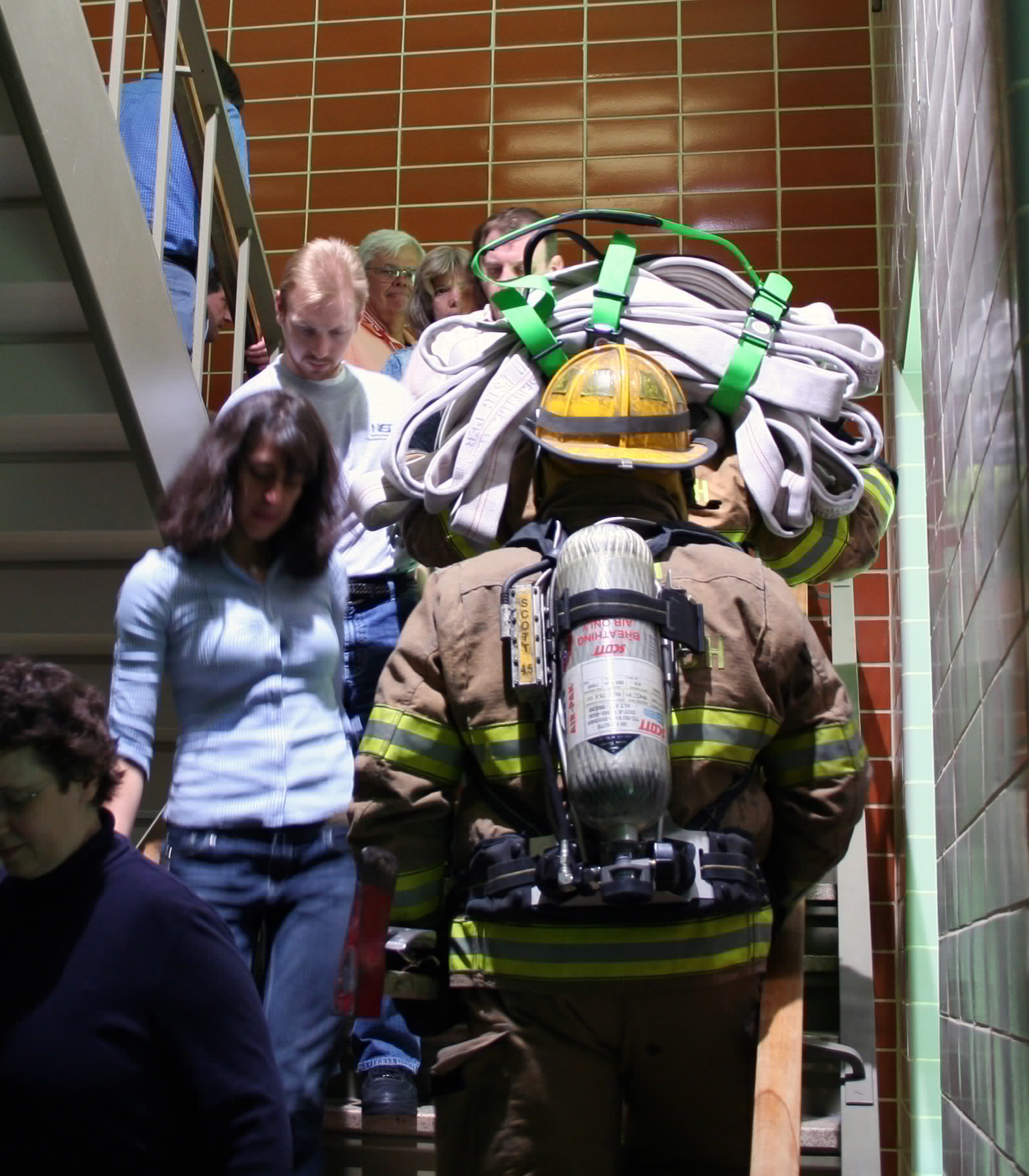
Black and white photograph showing the correct and best assisted evacuation technique for carrying a person in a manual wheelchair down a fire protected staircase, with handrails on both sides … 1 person behind the wheelchair and 2 other people at each side. This illustration is from the Orientation Manual for First Responders on the Evacuation of People with Disabilities. Federal Emergency Management Agency (USA). Document Reference FA-235. August 2002. Click to enlarge.Colour photograph showing the ‘contraflow’ circulation which must be facilitated during a fire emergency … as building occupants/users evacuate away from the fire towards a place of safety located a remote distance from the building … while heavily equipped firefighters are able to enter the building, unhindered, at the same time. This ensures that firefighters can quickly locate people waiting in areas of rescue assistance and lift/elevator lobbies. Click to enlarge.
G. Sufficiently large, fire protected ‘areas of rescue assistance’, where people can safely wait during a fire emergency, must adjoin each evacuation staircase on every floor/storey above ground level. When calculating space provision for evacuation and waiting areas in buildings, the minimum reasonable provision for people with disabilities must be 10% of the design building occupant/user population; for people with activity limitations, minimum space provision must rise to 15% of the design occupant/user population.
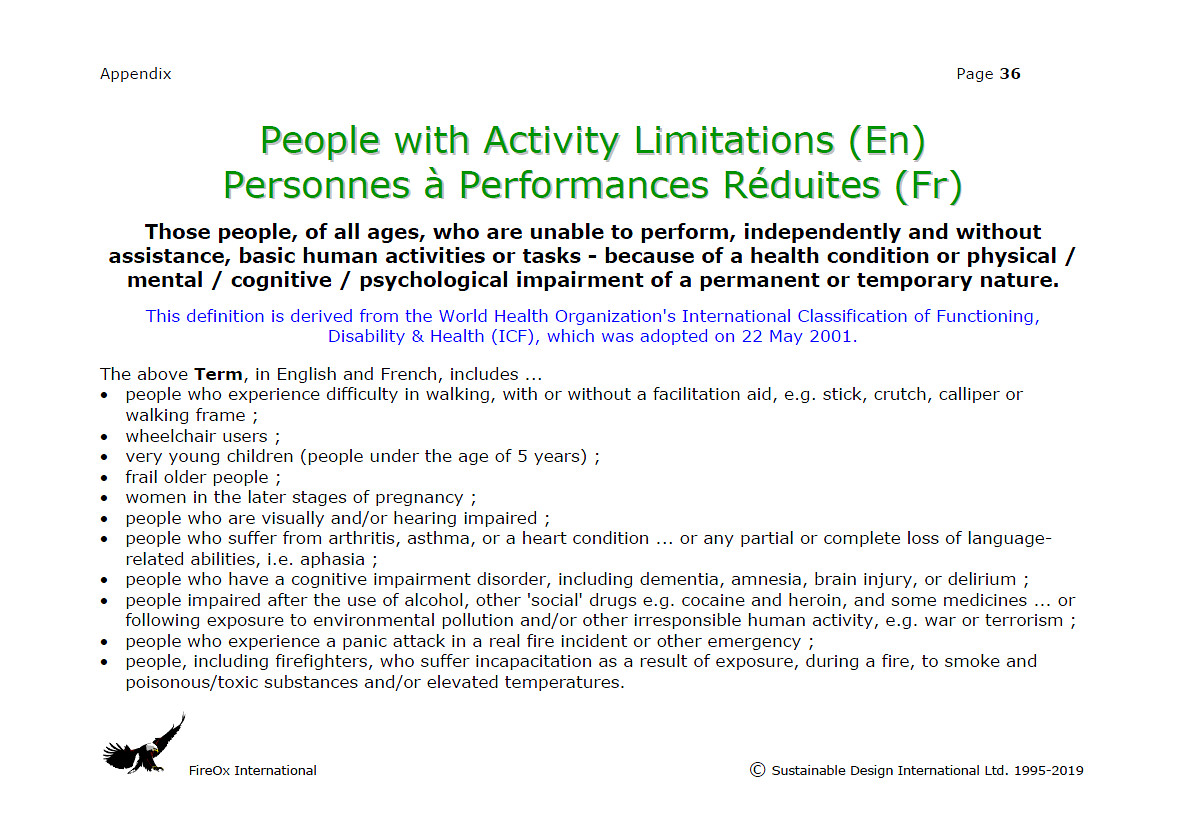
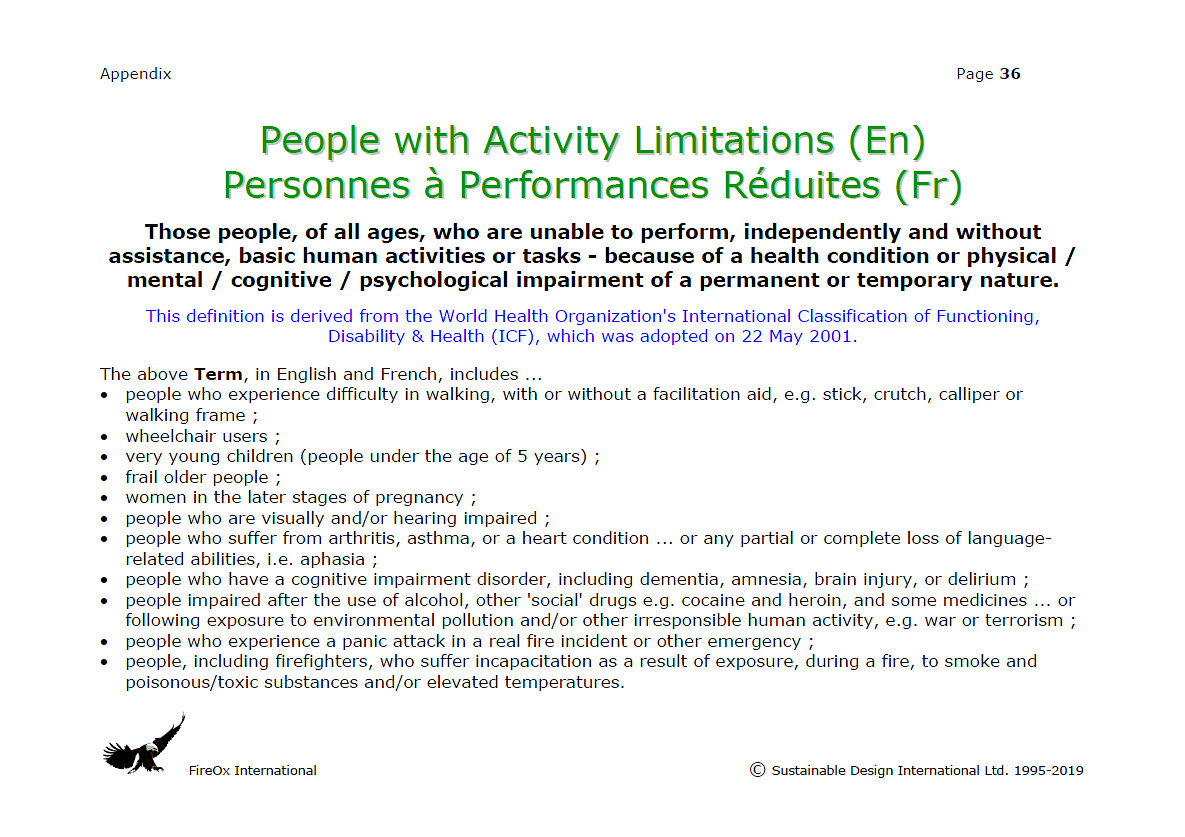
Colour illustration of a sufficiently wide fire evacuation staircase, which will accommodate contraflow and the assisted evacuation of people in wheelchairs … with a sufficiently large, directly adjoining ‘area of rescue assistance’ … which will accommodate people unable to independently evacuate during a fire emergency. The space provided in an area of rescue assistance, on each floor/storey, is calculated in relation to the design occupant/user population of a building. Even if a building is fully sprinklered, an area of rescue assistance must adjoin every fire evacuation staircase. Click to enlarge. Staircase design by CJ Walsh.Image of text showing the definition for ‘people with activity limitations’, with its equivalent French translation … also showing from where this term is derived … and who this term includes. During a fire emergency, confused and/or confusing disability-related language costs lives ! Click to enlarge.
H. Such is the universal level of fire compartment unreliability, that lift/elevator lobbies and ‘areas of rescue assistance’ must be fitted with an active fire suppression system, i.e. water mist … an environmentally clean suppression medium which is person-friendly, and will not greatly interfere with visibility.
I. In tall, super-tall and mega-tall buildings, every 20th floor/storey must be an accessible ‘floor of temporary refuge’ … and the roofs of those buildings must be capable of being used for aerial evacuation.
J. In health care facilities, e.g. hospitals, the fire safety strategy must always be to ‘protect in place’. Patient evacuation is highly hazardous, and unacceptable.
K. Fire defence plans* must demonstrate a proper consideration for the fire safety, protection and evacuation of all building users/occupants, with a particular and integrated focus on people with activity limitations.
[ *Fire Defence Plan: A pre-determined and co-ordinated use of available human and material means in order to maintain an adequate level of fire safety and protection within a building and, in the event of an outbreak of fire, to ensure that it is brought speedily under control and extinguished … with the aim of minimizing any adverse or harmful environmental impacts caused by the fire.
Commentary 1: A Fire Defence Plan is developed for a specific building at design stage. It later becomes the basis for an occupied building’s Fire Emergency Management Plan.
Commentary 2: A Fire Defence Plan is usually in electronic format and/or hard copy and comprises fire engineering drawings, descriptive text, fire safety related product/system information, with supporting calculations, and the fire test/approval data to demonstrate ‘fitness for intended use’.]
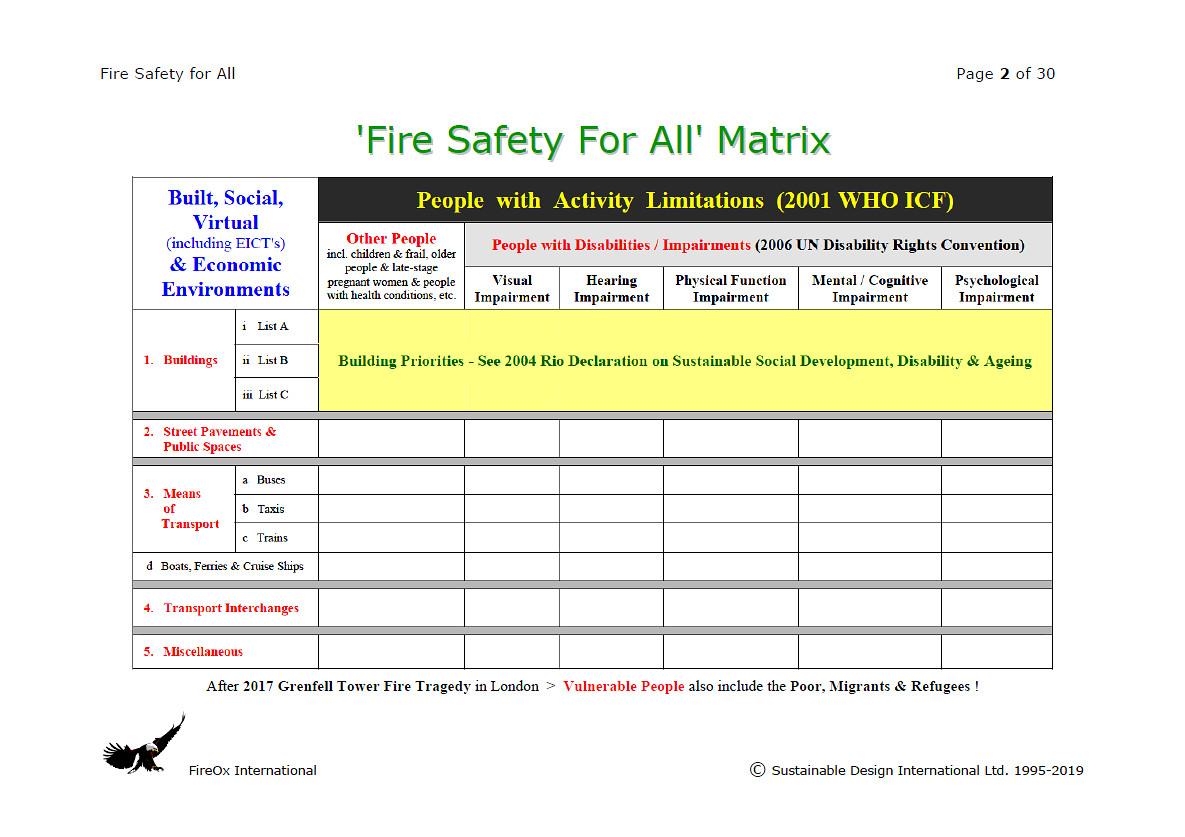
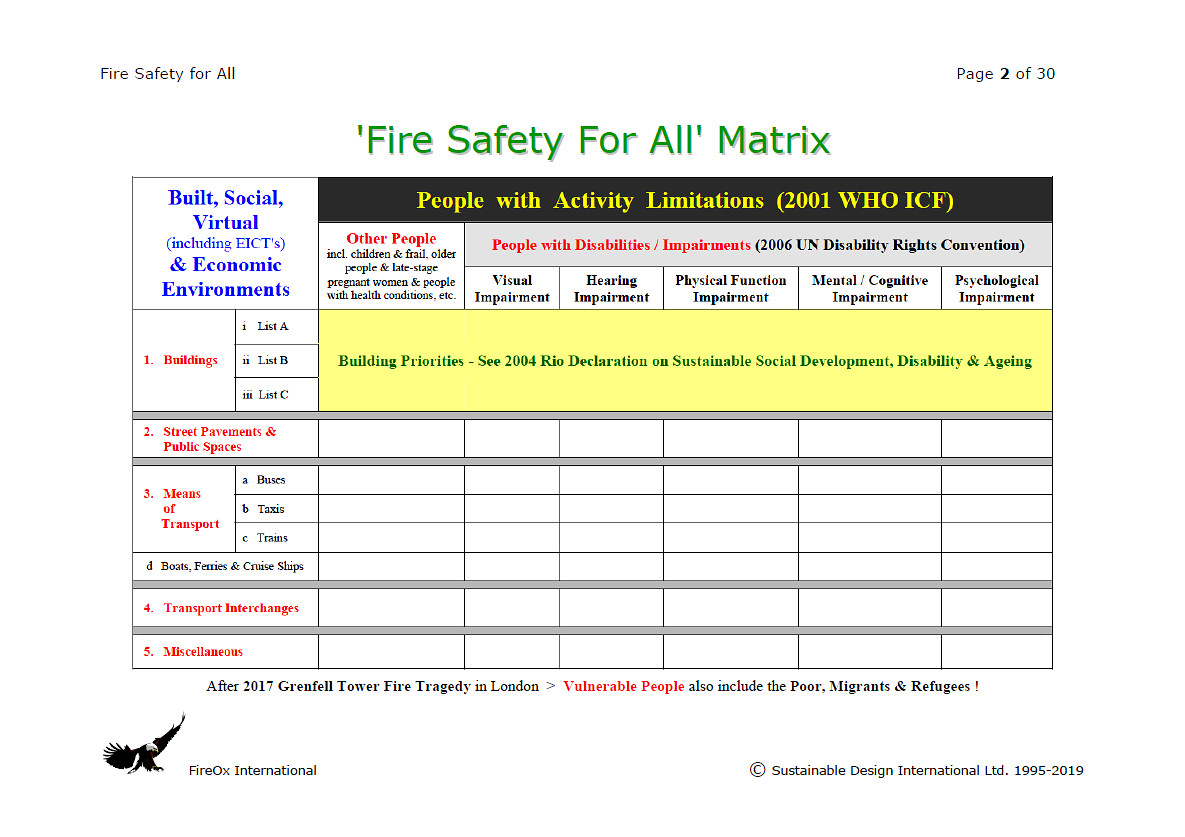
Colour illustration showing the ‘Fire Safety for All’ Matrix, which outlines the scope of its application in the Human Environment and the different social groups to be targeted. Balanced consideration must be given to people who use wheelchairs (physical function impairment) … and to people with visual, hearing, psychological, and mental/cognitive impairments … and to other vulnerable building users, e.g. people with health conditions. Click to enlarge. Matrix developed by CJ Walsh.
2019-07-26: This time last month, in June … I was visiting a hot and humid Hong Kong and Macau, only 1 hour apart on a sea ferry, in China’s Bay Area … to make a Keynote CPD Presentation on Fire Safety for All – Nobody Left Behind ! in the Hong Kong Institute of Architects … and following that up with a full morning Workshop and an afternoon Plenary Presentation at the large 2019 Rehabilitation International Asia-Pacific Region Conference, in Macau, later in the week.
2019 Rehabilitation International Asia-Pacific Conference (Macau) – 26 to 28 June
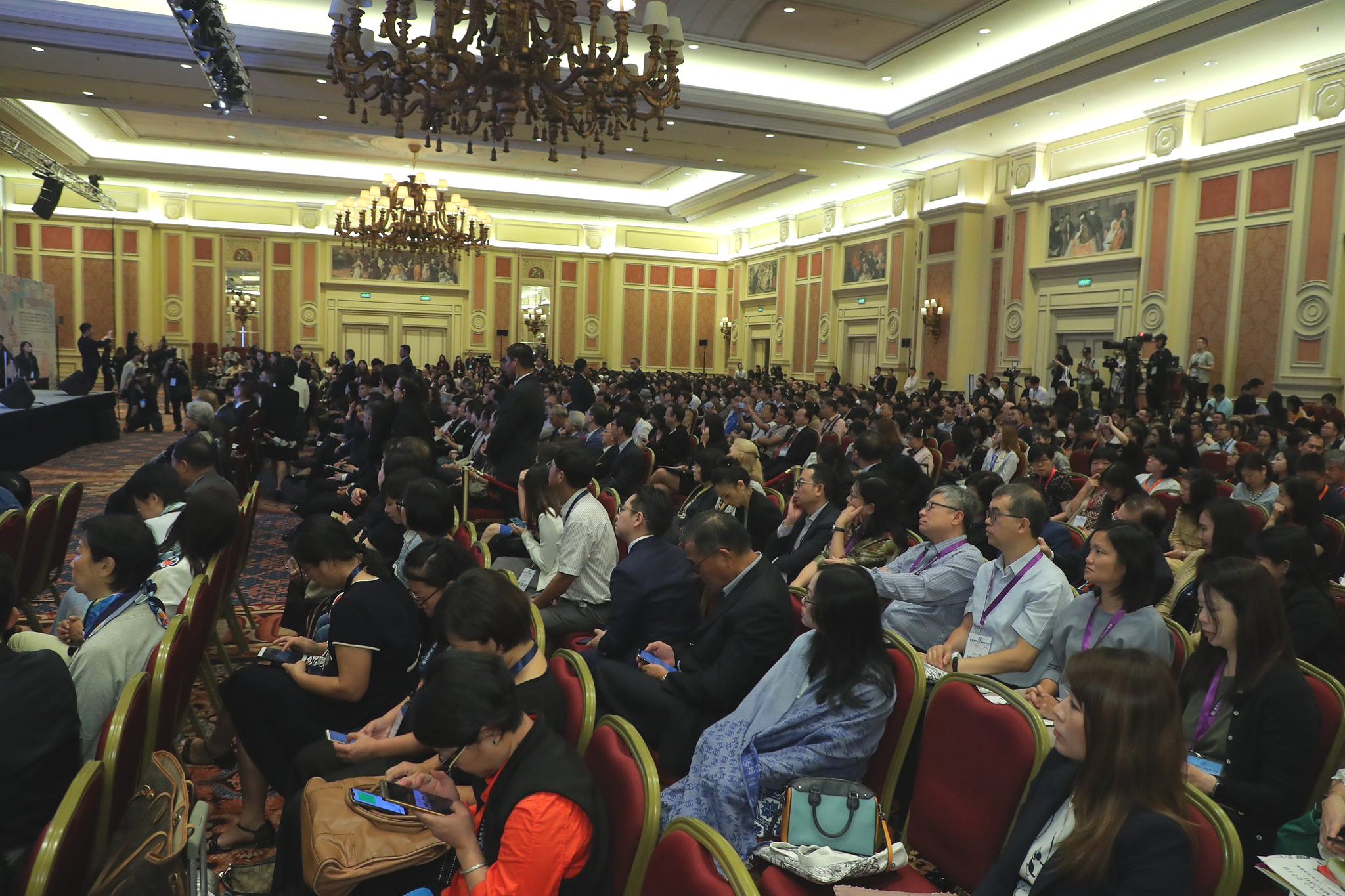
The Theme of this 3-Day Conference, in #Macau, was Together, Leaving No One Behind, In Disability-Inclusive & Rights-Based Progress. Attended by 1,500 delegates from 30 different countries, the event also gathered together more than 250 international experts, practitioners, academics and researchers from all over the world.
Two Exhibitions, visited by 6,000 people, were organized alongside the Conference: 1) ‘Facilitation and Mobility Aids + Assistive Technologies’ … and 2) ‘Art’.
It is worthwhile noting that #China ratified the U.N. Convention on the Rights of Persons with Disabilities (#CRPD) on 1 August 2008 … but has not yet signed, never mind ratified, the Convention’s Optional Protocol … a clear signal of current political intent which, hopefully, will change in the not-too-distant future. Every year, Hong Kong and Macau submit reports to Beijing regarding CRPD compliance status and implementation.
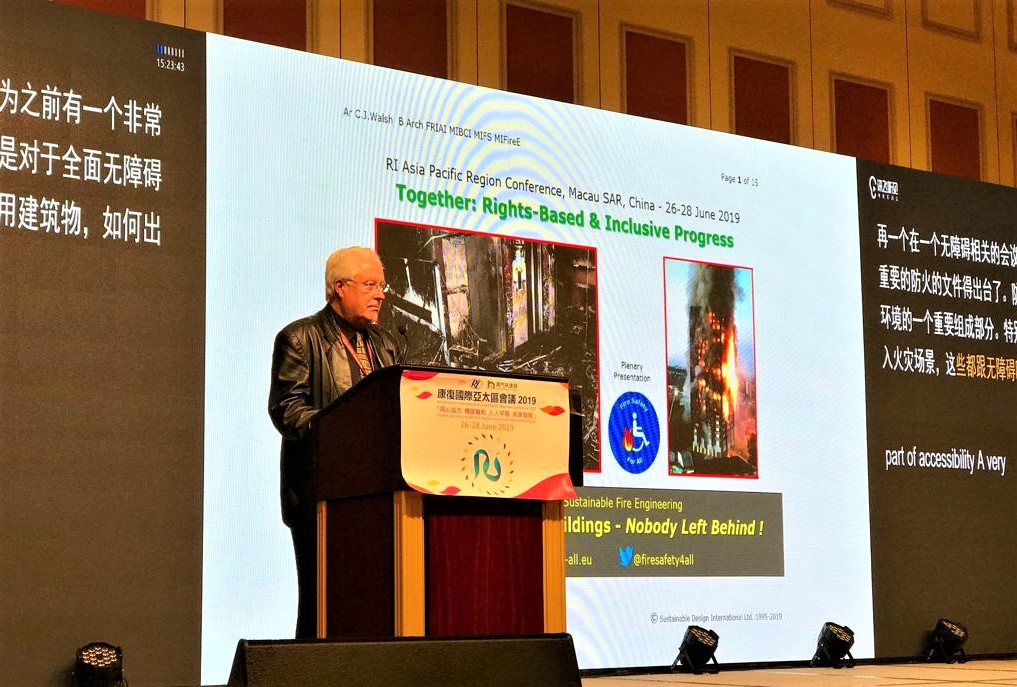
Colour photograph showing CJ Walsh, as he addresses a Plenary Session on Fire Safety for All – Nobody Left Behind ! at the 2019 Rehabilitation International Asia-Pacific Region Conference, in Macau. Click to enlarge.
.
Colour image showing the Matrix of ‘Fire Safety for All’ … a Priority Theme of Sustainable Fire Engineering … which is particularly concerned with the fire safety of #PwAL’s (People with Activity Limitations), but also with #PwD’s (People with Disabilities). After the 2017 Grenfell Tower Fire, in London, it is important that these concerns stretch to include the #Poor, #Refugees and #Migrants. Click to enlarge.
Without being able to use a #Lift/#Elevator for Fire Evacuation in a building … there is No Fire Safety for All !
In a developing fire incident, People with Activity Limitations must be provided with a safe, alternative evacuation route – just like all other building users – which is a Fundamental Principle of all Fire Engineering. However … just one #User/#Occupant Fire Evacuation Lift/Elevator in a building is an empty, meaningless, Token Gesture !
Colour photograph showing the participants from 30 different countries who attended the 2019 Rehabilitation International Asia-Pacific Region Conference. The venue was The Venetian Macau Hotel. Click to enlarge.
.
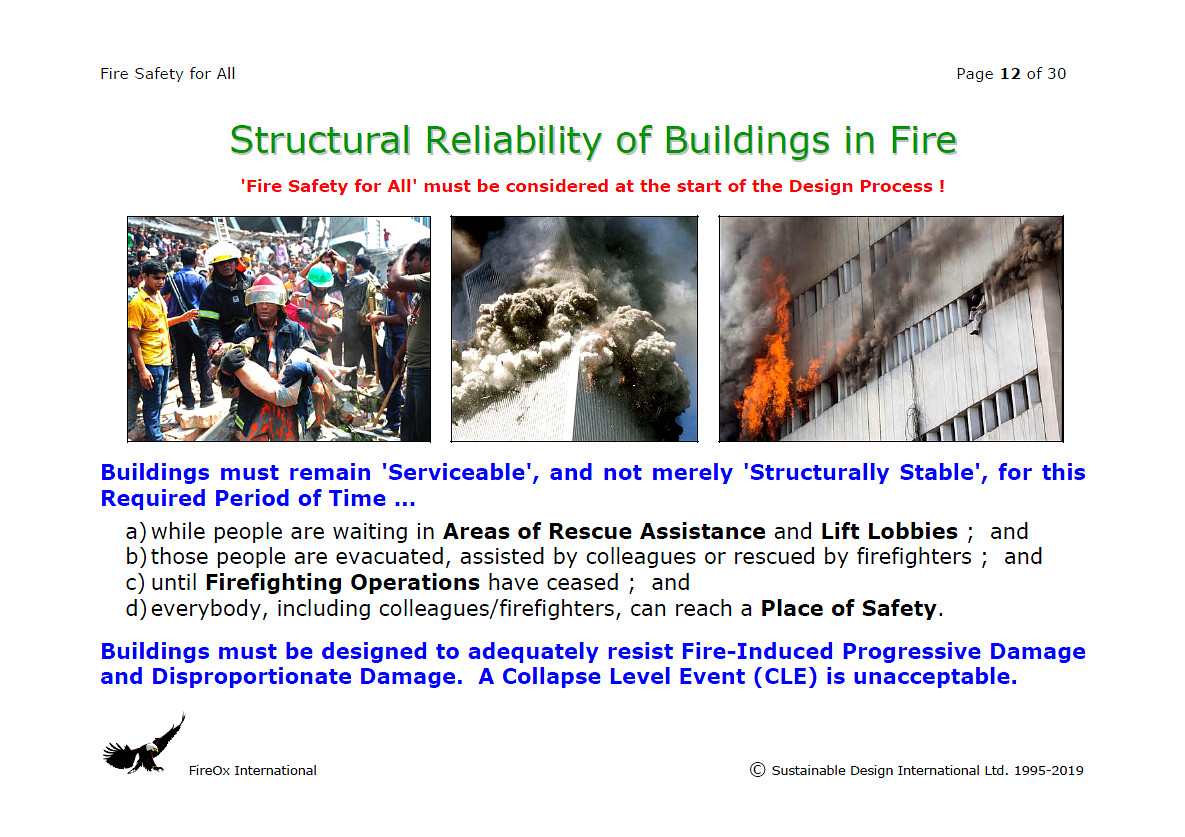
Fire Safety for All must be considered at the start of the Design Process. Colour image explaining how #Buildings must remain #Serviceable, not merely Structurally Stable, for a minimum Required Period of Time. Click to enlarge.
.
‘Fire Safety for All’ on Macau TV News … Friday night, 28 June 2019 … my friend and colleague, Ar Joseph Kwan (Architect & Accessibility Consultant based in Hong Kong), is the person being interviewed …
.
.
Hong Kong Institute of Architects CPD Seminar – 24 June 2019
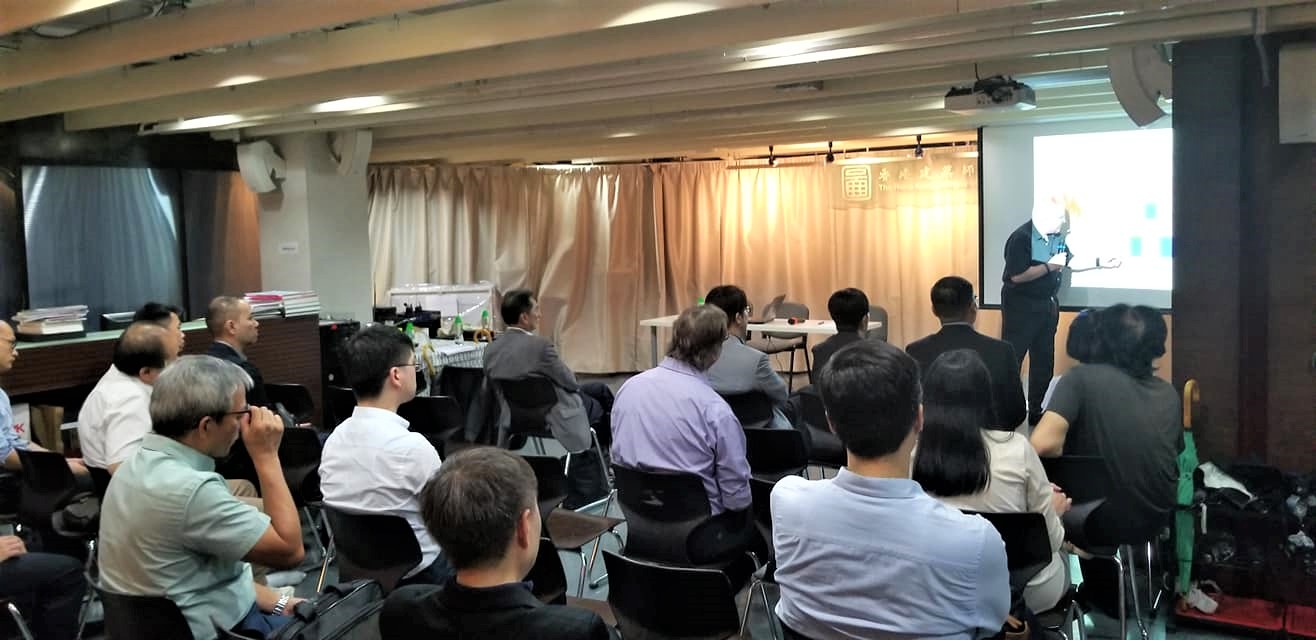
Continuing Professional Development (#CPD) is an important aspect of Ethical Architectural Practice. Arriving drenched in a heavy rain downpour on the Monday evening … I was not surprised, therefore, to find that this Seminar was well attended by local architects. Representatives of HK Authorities Having Jurisdiction (#AHJ’s), and Local Fire Services, as well as senior personnel involved in the development of the HK Code of Practice for Fire Safety in Buildings and the HK Barrier Free Design Manual were active participants in the panel discussion afterwards.
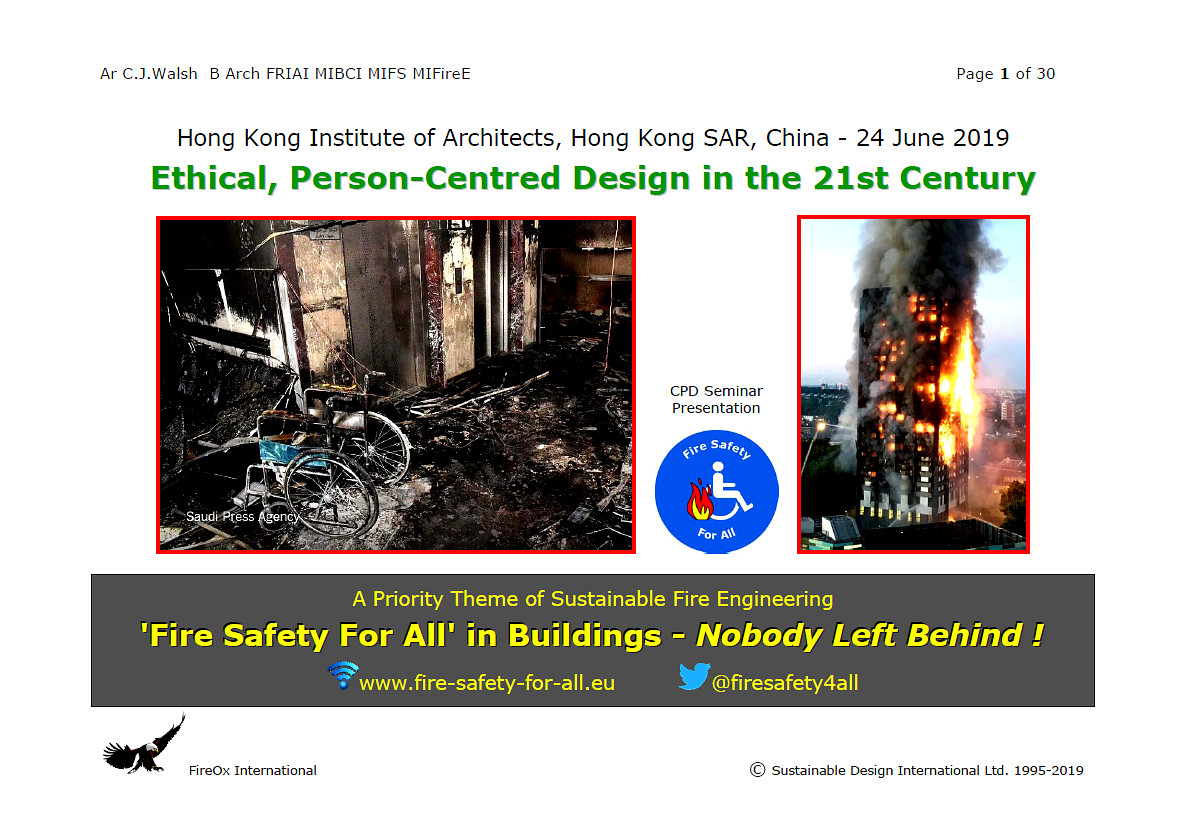
Colour image showing the Title Page of CJ Walsh’s Keynote CPD Presentation on ‘Fire Safety for All – Nobody Left Behind !’. This Page also signals how ‘Fire Safety for All’ is integrated into the wider context of Sustainable Design. Click to enlarge.
.
Colour photograph showing CJ Walsh, as he makes a Keynote CPD Presentation on ‘Fire Safety for All – Nobody Left Behind !’ in the offices of the Hong Kong Institute of Architects. Click to enlarge.
.
‘Fire Safety for All’ on Twitter … @firesafety4all
2019-04-08: A much needed ‘quickie’ for these worrisome times … a reminder for spineless politicians and an introduction for mindless citizens !
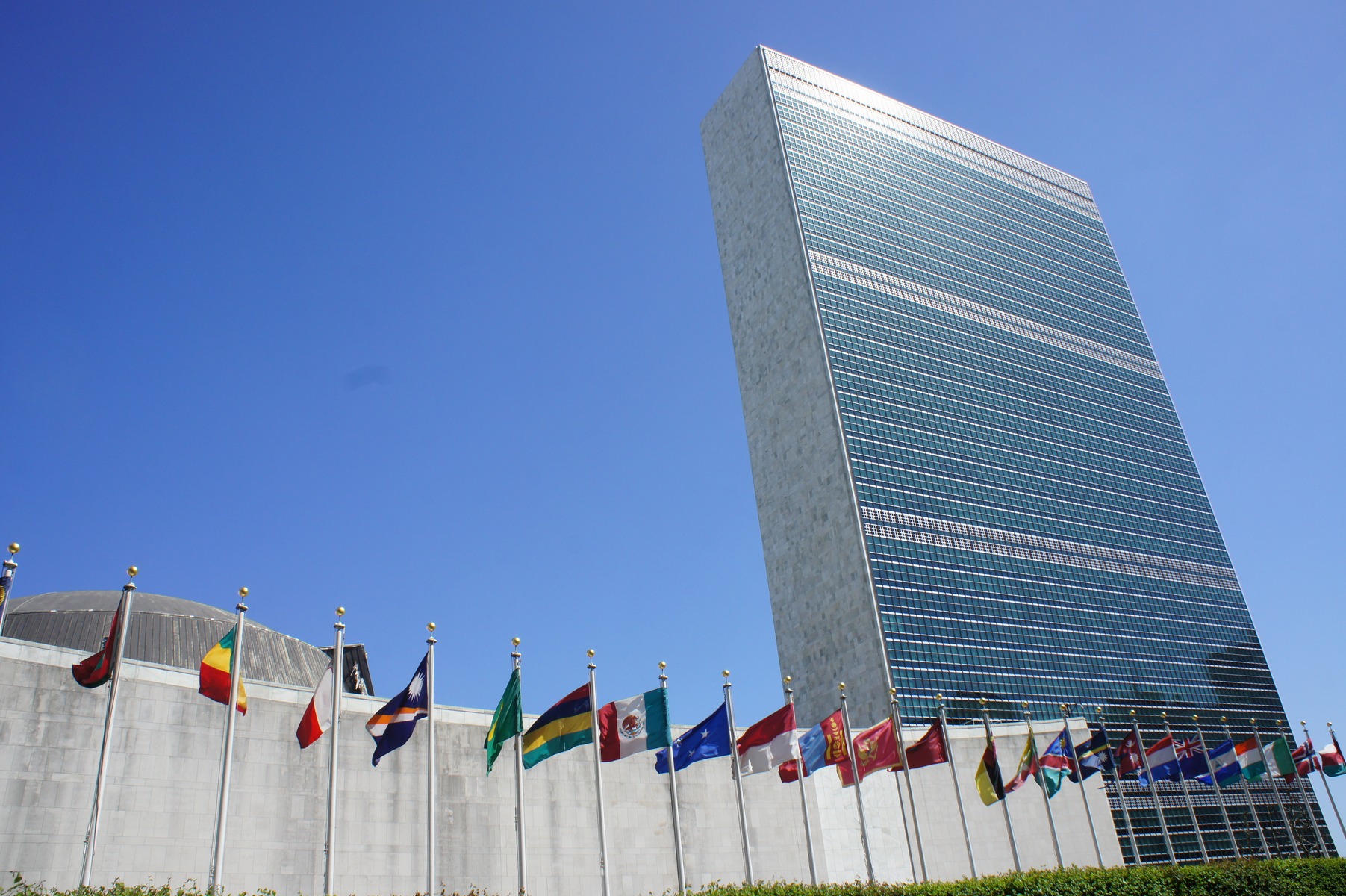
This is the United Nations …
Colour photograph showing the Headquarters Building of the United Nations, in New York City. Click to enlarge.
And these are Articles 13, 14 and 15 of the Universal Declaration of Human Rights … a fundamental constitutive document of the United Nations … which was adopted by the U.N. General Assembly, on 10 December 1948:
Article 13
Everyone has the right to freedom of movement and residence within the borders of each State.
Everyone has the right to leave any country, including his/her own, and to return to his/her country.
Article 14
Everyone has the right to seek and to enjoy in other countries asylum from persecution.
This right may not be invoked in the case of prosecutions genuinely arising from non-political crimes or from acts contrary to the purposes and principles of the United Nations.
Article 15
Everyone has the right to a nationality.
No one shall be arbitrarily deprived of his/her nationality, nor denied the right to change his/her nationality.
 .
.


 … which also covers