Ar C.J. Walsh – Registered Architect, Fire Engineer & Independent Technical Controller …… International Expert on Accessibility for All (including Fire Safety) + 'Real' Sustainability Implementation !
2024-03-22:The United Nation’s 4th Global e-Waste Monitor (#GEM) Report has revealed that the world’s generation of Electronic Waste is rising five times faster than documented e-Waste Recycling.
The 62 Million Tonnes of e-Waste generated in 2022 would fill 1.55 million 40-tonne trucks, roughly enough trucks to form a bumper-to-bumper chain encircling the equator.
.
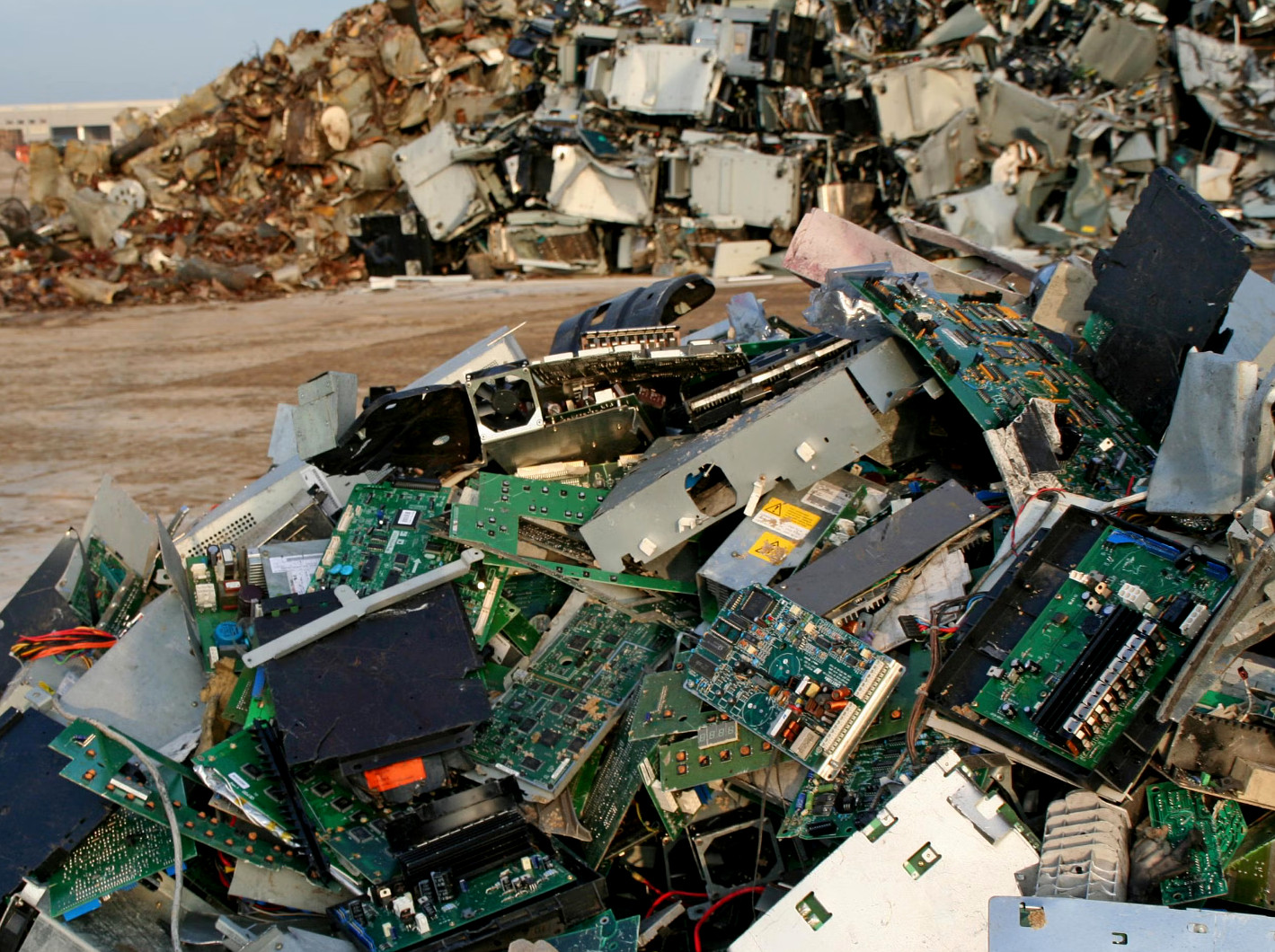
Colour Photograph showing various types of e-Waste … a typical scene at a Recycling Centre. Not every Centre is properly managed. And there are many parts of the world where there are no Centres at all, and e-Waste goes straight to landfill causing serious health and environmental problems for local communities. Click to enlarge.
.
Less than one quarter (22.3%) of the year’s e-Waste Mass was documented as having been properly collected and recycled in 2022, leaving over Euro €57 Billion worth of recoverable natural resources unaccounted for, and increasing pollution risks to local communities. Worldwide, the annual generation of e-Waste is rising by 2.6 Million Tonnes annually, on track to reach 82 Million Tonnes by 2030, a further 33% increase from the 2022 figure.
E-waste, any discarded product with a plug or battery, is a health and environmental hazard, containing toxic additives or hazardous substances such as mercury, which can damage the human brain and co-ordination system.
.
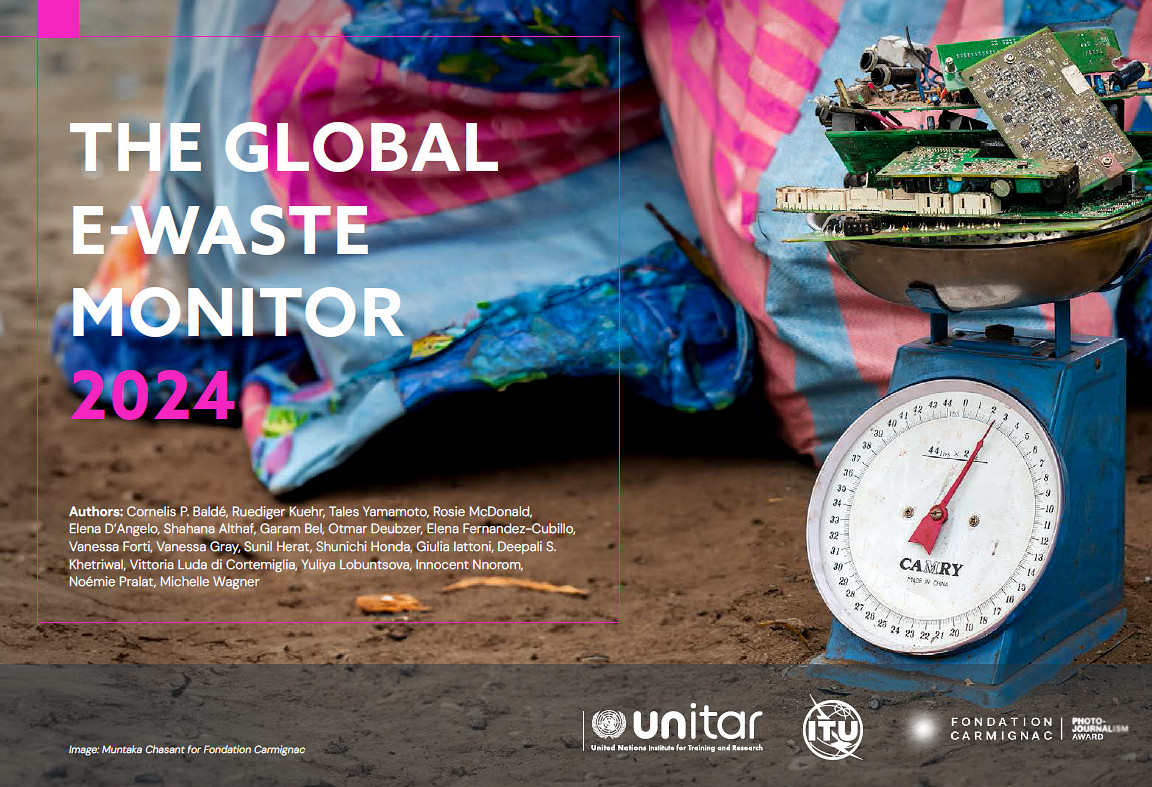
Colour Image showing the Title Page of the United Nation’s 4th Global e-Waste Monitor (GEM) Report. Click to enlarge.
The Report foresees a drop in the documented collection and recycling rate from 22.3% in 2022 to 20% by 2030 due to the widening difference in recycling efforts relative to the staggering growth of e-Waste generation worldwide. Challenges contributing to the widening gap include technological progress, higher consumption, limited repair options, shorter product life cycles, society’s growing ‘smartness’, design shortcomings, and inadequate e-Waste management infrastructure.
The Report also notes that the world ‘remains stunningly dependent’ on a few countries for rare earth elements, despite their unique properties crucial for future technologies, including renewable energy generation and e-Mobility.
.
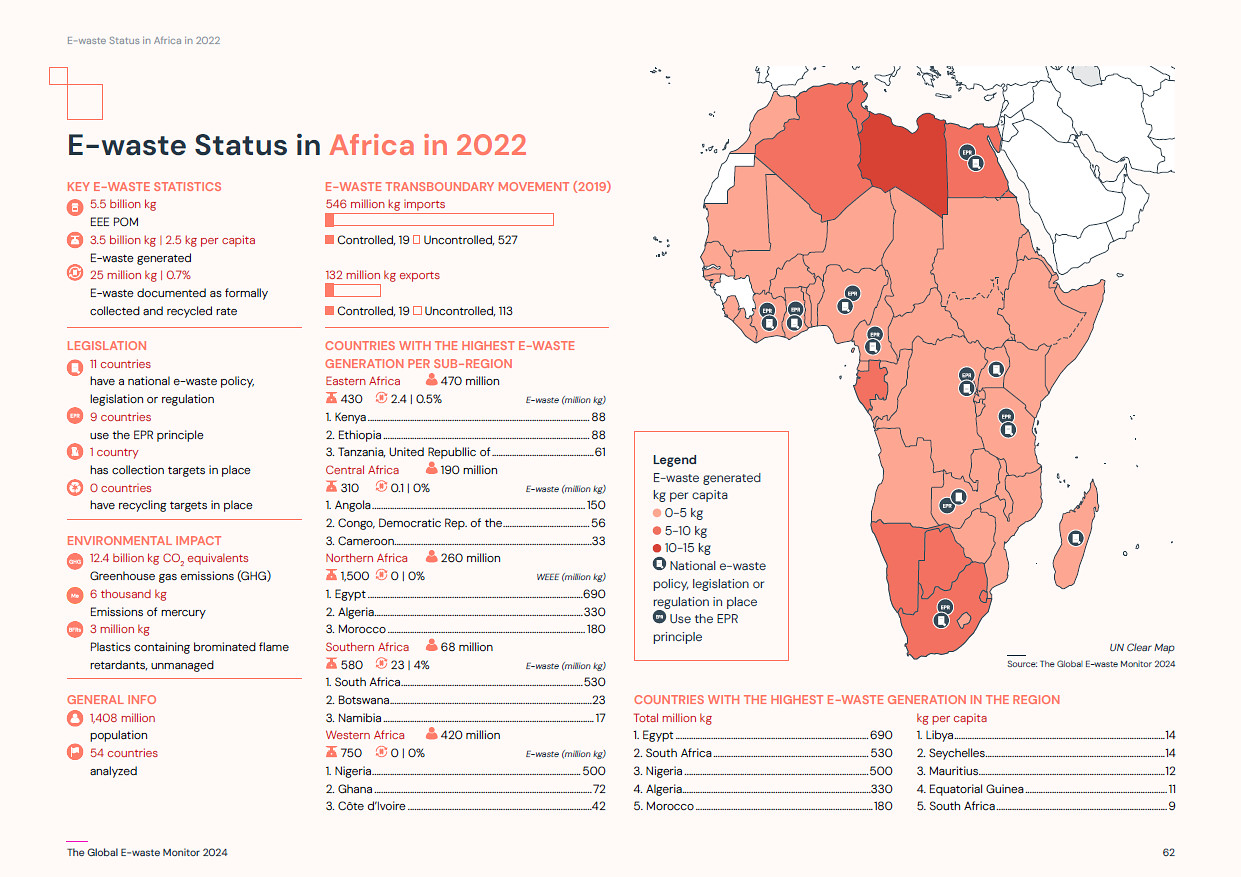
Colour Image showing the e-Waste Status of Africa in 2022. Click to enlarge.
.
31 Million Tonnes … Estimated weight of metals embedded in e-Waste in 2022, along with 17 Million Tonnes of plastics and 14 Million Tonnes of other materials (minerals, glass, composite materials, etc.)
17.6 Kg … Per Capita e-Waste generation in Europe, followed by Oceania (16.1 kg) and the Americas (14.1 kg)
5.1 Million Tonnes (8.2% of Global Total) … e-Waste shipped across borders in 2022, of which approximately 3.3 Million Tonnes (65%) was shipped from high-income to middle/low-income countries through uncontrolled, undocumented movements
NOTE: Cross national border ‘exporting’ of e-Waste – ANY Waste – Is NOT Recycling !
33% (20.4 Million Tonnes) … Proportion of e-waste made up of small devices (e.g. toys, microwave ovens, vacuum cleaners, e-cigarettes), of which 12% are recycled
Sustainability Impact Assessment (#SIA): A continual evaluation and optimization process – informing initial decision-making, design, shaping activity / product / service realization, useful life, and termination or final disposal – of the interrelated positive and negative social, environmental, economic, institutional, political and legal impacts on balanced and equitable implementation of Sustainable Human & Social Development.
2024-03-22: In this balanced documentary, October 7 … Al Jazeera’s Investigative Unit (I-Unit) carried out a forensic analysis of the extreme events on 7 October 2023 … a day which transformed politics throughout the Eastern Mediterranean Region. By examining hours of footage from Closed Circuit TV (CCTV), dash-cams, personal phones and the head-cams of dead Hamas fighters, and listening to the testimonies of hundreds of survivors … the I-Unit reveals human rights abuses by Hamas fighters, and Gazan civilians who later followed after the early morning co-ordinated and multi-pronged attacks into Israel. But the investigation also found that many of the horrific stories presented by Israeli individuals and authorities in the weeks following the attacks were glaringly false.
Also revealed are the severe Israeli intelligence and military failures, and the callous implementation of the Hannibal Directive.
.
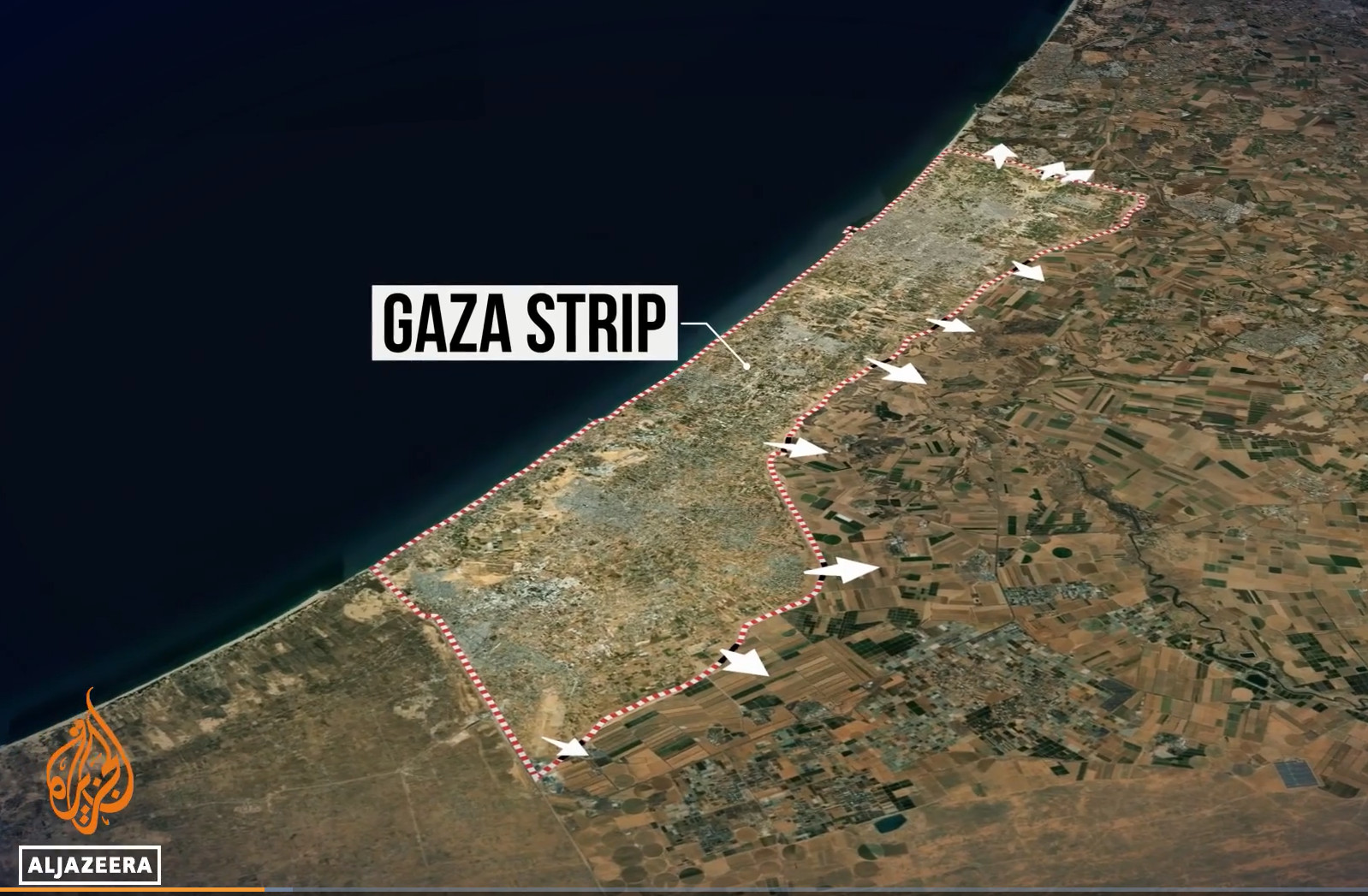
Colour Image – a screen grab from the Al Jazeera Documentary: ‘October7’ – showing the 10 breach points in the eastern and northern high-walled security barrier which separates the Occupied Gaza Ghetto from Israel. These Hamas attacks took place on 7 October 2023. Click to enlarge.
October 7 is a detailed examination of events which led to the deaths of tens of thousands of people … the significance of which will reverberate, in the Arab world and the Global South, for decades to come.
2024-03-01: Too many strategic mistakes are being made, and too much uninformed ‘group-think’ is evident, in the – NOW – frantic human scramble to head off Climate Disruption … and attain Sustainable Human & Social Development … an intricate, open, dynamic and continuously evolving concept which is still not properly understood.
In a Split Human Personality which is clearly observed amid today’s geopolitical turmoil … much of one ‘personality’ is involved in this positive, yet arduous Ecological Rescue Attempt … while the other ‘personality’ stubbornly ignores the enormous negative impacts on that Task by: (i) the #USA #UK #NATO Proxy War in #Ukraine ; (ii) the ongoing Extermination of the Palestinian People & Culture in Illegally Occupied Territories by #Zionists intent on establishing a Greater Israel ; and (iii) the growing Hostility of the Global South towards the #West caused by (i) and (ii), just when global unified and concerted action on climate disruption is urgently required.
.
Uninformed Group-Think …
Sustainability Impact Assessment of Electric Vehicles
Rowan’s well-reasoned conclusion … “Sadly, keeping your old petrol car may be better than buying an Electric Vehicle (#EV). There are sound environmental reasons not to jump just yet.”
EV’s should properly be evaluated using Full Life Cycle Sustainability Impact Assessment … not just checking one, very beneficial but isolated, type of performance, i.e. zero exhaust emissions.
.
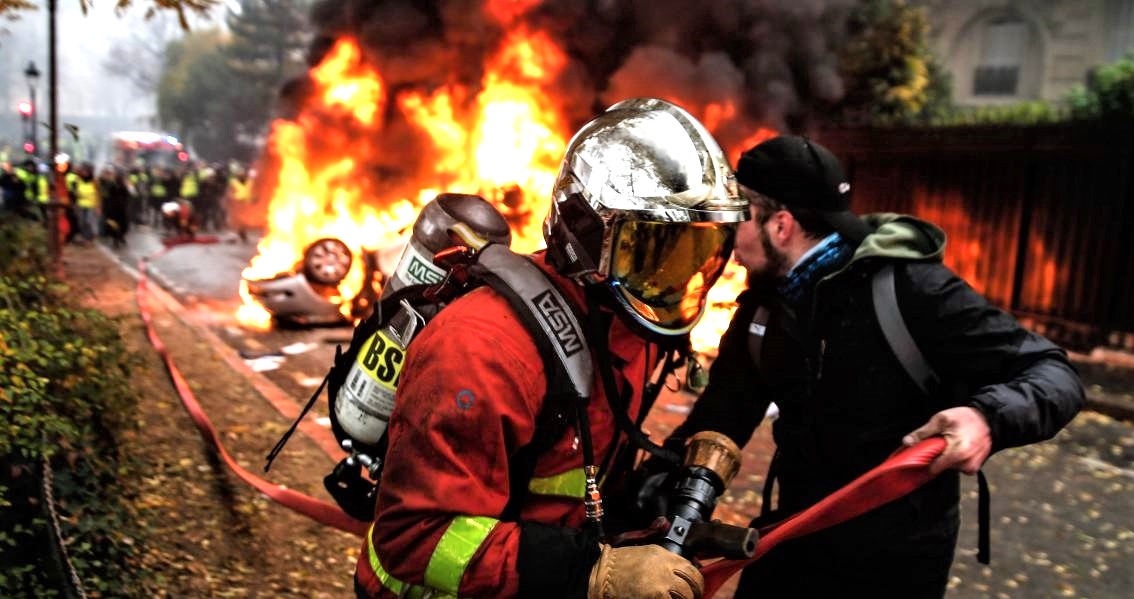
Colour photograph showing a raging Electric Vehicle / Car Fire on a narrow road. The car is turned upside down. The photograph shows the scene after the initial Lithium-Ion Battery related explosion, and when the fire is being attended to by Fire Services. In the far background, a large group of onlookers has gathered to view these strange events. Click to enlarge.
Without even mentioning the #FireSafety Issues associated with Lithium-Ion Batteries in e-Cars (and e-Scooters, e-Bikes, e-Wheelchairs, etc.) … Rowan was / is correct … yet he was swamped with a ‘tonne of abuse’ for daring to voice an unfashionable opinion … to question the current majoritarian group-think on EV’s.
.
Mining Cobalt for Lithium-Ion Batteries – Serious Rights Violations in DRC
‘ Our world is increasingly powered by Lithium-Ion Batteries, ranging from the ones found in everyday mobile technologies, such as smartphones and laptop computers, to those in electric vehicles. There is also a growing interest in using super-sized rechargeable batteries to help store electricity generated from solar and wind sources and deliver it to consumers more efficiently. These technologies are attractive because of their perceived sustainability. But as their use becomes more and more widespread, in what some are calling the ‘clean energy revolution’, it is necessary to ask whether the energy powering this revolution is as ‘clean’ as it is claimed to be.
Cobalt is an element critical for powering the clean energy revolution. More than 50% of the world’s cobalt supply originates in the Democratic Republic of Congo (#DRC).’
The 2017 Report builds on an earlier report: ‘This is What We Die For’, first published by Amnesty International and #Afrewatch in 2016, which showed how #Cobalt mined by young children and adults – in very hazardous conditions and in serious violation of their Human Rights – entered the supply chains of many of the world’s biggest brands. The new report assesses the policies and practices of 29 companies and how much their cobalt-sourcing practices have improved since then.
Did anybody really care that these Human Rights Violations were taking place in #Africa ? NO.
Was the strength and pace of mushrooming world Lithium-Ion Battery production in any way affected by the 2017 AI Report ?? NO.
.
Sustainability Impact Assessment (SIA)
Important Policy and Decision Making Mistakes can be attributed to the lack of rigorous Sustainability Impact Assessment. ( Environmental Impact Assessment ignores the other important aspects of Sustainable Development … and therefore is limited, inadequate, and out-of-date.) Instead, #SIA should be deeply embedded in both processes as a matter of regular routine …
Sustainability Impact Assessment: A continual evaluation and optimization process – informing initial decision-making, design, shaping activity / product / service realization, useful life, and termination or final disposal – of the interrelated positive and negative social, environmental, economic, institutional, political and legal impacts on balanced and equitable implementation of Sustainable Human & Social Development.
.
Signs & Symptoms
Environmental Signs of Planet Breakdown include: Climate Disruption, Biodiversity Loss, Ocean Acidification, Coral Reef Destruction, Extreme Heatwaves and Droughts, Intense Wildfires, Polar Ice Cap Retreat and Collapse, Amazon Forest Dieback, etc., etc.
The example of Electric Vehicles above is a small indication that something more serious is wrong with Human Behaviour generally. It is a Human Symptom … one which opens up the potential of exploring a different approach to solving the World’s Ecological Overshoot.
This very interesting Paper points to the start, and elaborates a beginning – not the end – of an innovative Human Behaviour Research Path … with the practical aim of effectively heading off Climate Disruption and attaining Sustainable Human and Social Development.
Scientific Paper’s Abstract
Previously, Anthropogenic Ecological Overshoot has been identified as a fundamental cause of the myriad signs we see around the globe today from biodiversity loss and ocean acidification to the disturbing rise in novel entities and climate disruption. In the present paper, we have examined this more deeply, and explore the human behavioural drivers of overshoot, providing evidence that overshoot is itself a symptom of a deeper, more subversive modern crisis of human behaviour. We work to name and frame this crisis as the Human Behavioural Crisis and propose the crisis be recognised globally as a critical intervention point for tackling ecological overshoot. We demonstrate how current interventions are largely physical, resource intensive, slow-moving and focused on addressing the signs of ecological overshoot (such as climate disruption) rather than the real cause (maladaptive behaviours). We argue that even in the best-case scenarios, sign level interventions are unlikely to avoid catastrophe or achieve more than ephemeral progress.
We explore three Drivers of the Behavioural Crisis in depth: (a) Economic Growth ; (b) Marketing & Advertising ; and (c) Pro-Natalism. These three drivers directly impact the three Levers of Ecological Overshoot: 1.Over Consumption ; 2.Excessive Waste ; and 3.Population Growth. We demonstrate how the maladaptive behaviours of overshoot stemming from these three drivers have been catalysed and perpetuated by the intentional exploitation of previously adaptive human impulses.
In the final sections of this paper, we propose an Interdisciplinary Emergency Response to the behavioural crisis by, amongst other things, the shifting of social norms relating to reproduction, consumption and waste. We seek to highlight a critical disconnect that is an ongoing societal gulf in communication between those that know, such as scientists working within limits to growth … and those members of the citizenry, largely influenced by social scientists and industry, that must act.
Paper Conclusion
In summary, the evidence indicates that Anthropogenic Ecological Overshoot stems from a crisis of maladaptive human behaviours. While the behaviours generating overshoot were once adaptive for Homo Sapiens, they have been distorted and extended to the point where they now threaten the fabric of complex life on Earth. Simply, we are trapped in a system built to encourage growth and appetites that will end us.
The current emphasis for overshoot intervention is Resource Intensive (e.g. the global transition to renewable energy), and Single Environmental Sign Focused. Indeed, most mainstream attention and investment is directed towards mitigating and adapting to climate disruption. Even if this narrow intervention is successful, it will not resolve the meta-crisis of ecological overshoot. In fact, with many of the current resource-intensive interventions, it is likely to make matters worse. Psychological interventions are likely to prove far less resource-intensive and more effective than physical ones.
We call for increased attention on the behavioural crisis as a critical intervention point for addressing overshoot and its myriad signs ;
We advocate increased interdisciplinary collaboration between the social and behavioural science theorists and practitioners, advised by scientists working on limits to growth and planetary boundaries ;
We call for additional research to develop a full understanding of the many dimensions of the behavioural crisis (including the overwhelming influence of power structures) and how we can best address it ;
We call for an emergency, concerted, multidisciplinary effort to target the populations and value levers most likely to produce rapid global adoption of new consumption, reproduction and waste norms congruent with the survival of complex life on Earth ;
We call for increased interdisciplinary work to be carried out in directing, understanding and policing widespread behaviour manipulation.
The Clock Is Ticking not only because the health of the natural systems upon which we are utterly dependent is deteriorating, but also because broad sweep interventions are only possible when a society holds together and is capable of coherent action. As the effects of overshoot worsen, the likelihood of societal breakdown increases. We still have an opportunity to be proactive and utilise the intact systems we have in place to deliver a framework for shifting social norms and other necessities for addressing the behavioural crisis. However, the day may come when societal breakdown will make intervention impossible, locking the planet into an unguided recovery that may salvage much of Nature but be inhospitable to human life.
.
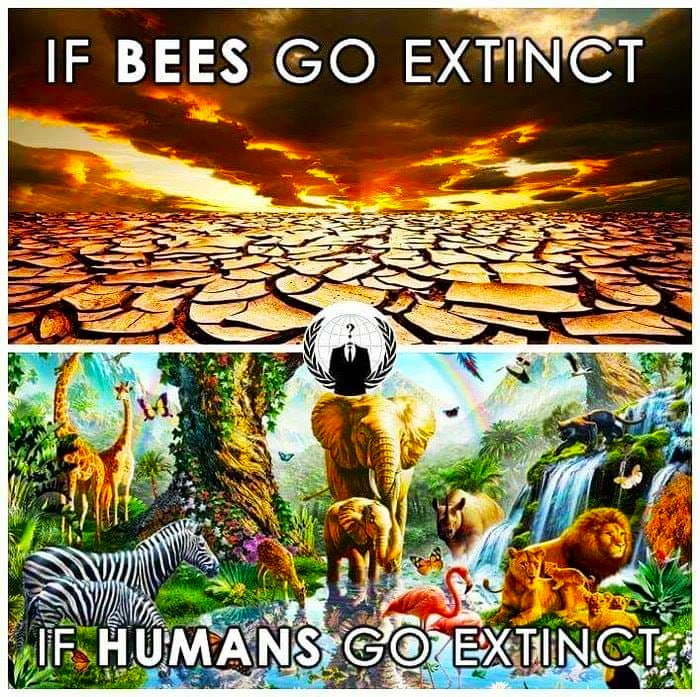
Are We Trapped in a System built to encourage growth and appetites that will end us ?
OR …Are Humans a Virus intent on devouring the last of this Planet’s Limited Resources (as postulated by Agent Smith) ??
2024-02-21: On this day in 1965 … Malcolm X … was Assassinated at an Organization of Afro-American Unity (#OAAU) Rally in the Audubon Ballroom, Harlem, New York City …
.
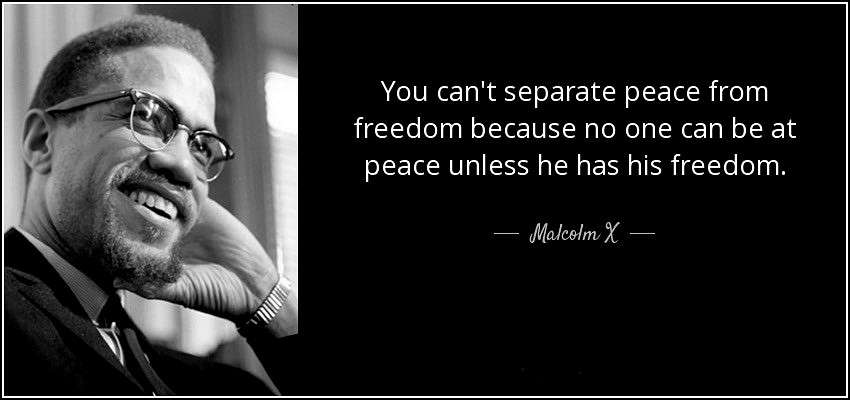
Black and white image combining a photograph of Malcolm X on the left … with one of his quotations on the right: “You can’t separate peace from freedom because no one can be at peace unless he has his freedom”. Still directly relevant today. Click to enlarge.
Malcolm X … later known as el-Hajj Malik el-Shabazz … was born on 19 May 1925.
.
Black and white photograph showing Malcolm X addressing a crowd. Click to enlarge.
.
Black and white image showing a USA Postage Stamp, issued 1999, in honour of Malcolm X … who is seen in pensive mood. Click to enlarge.
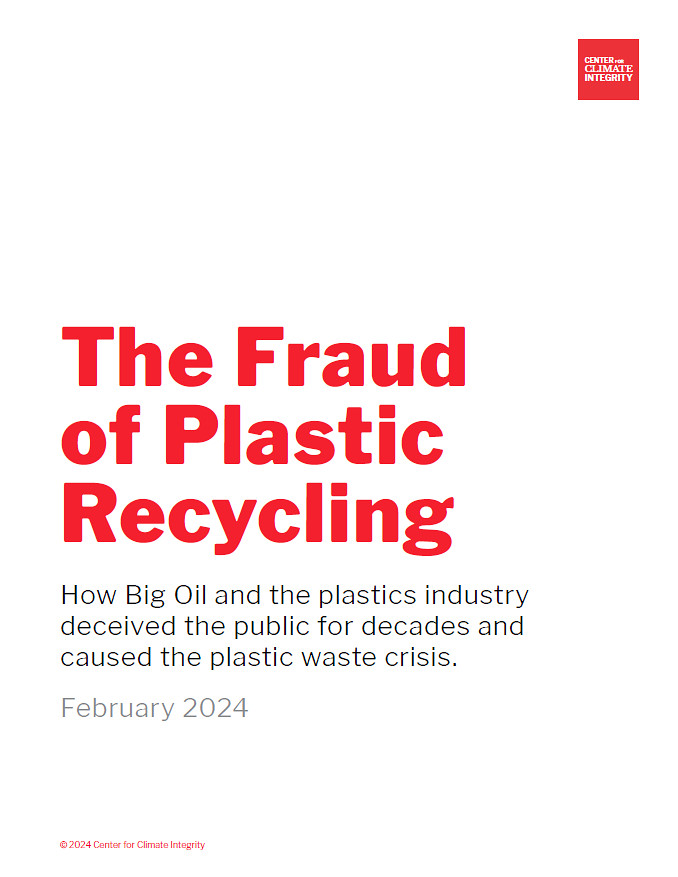
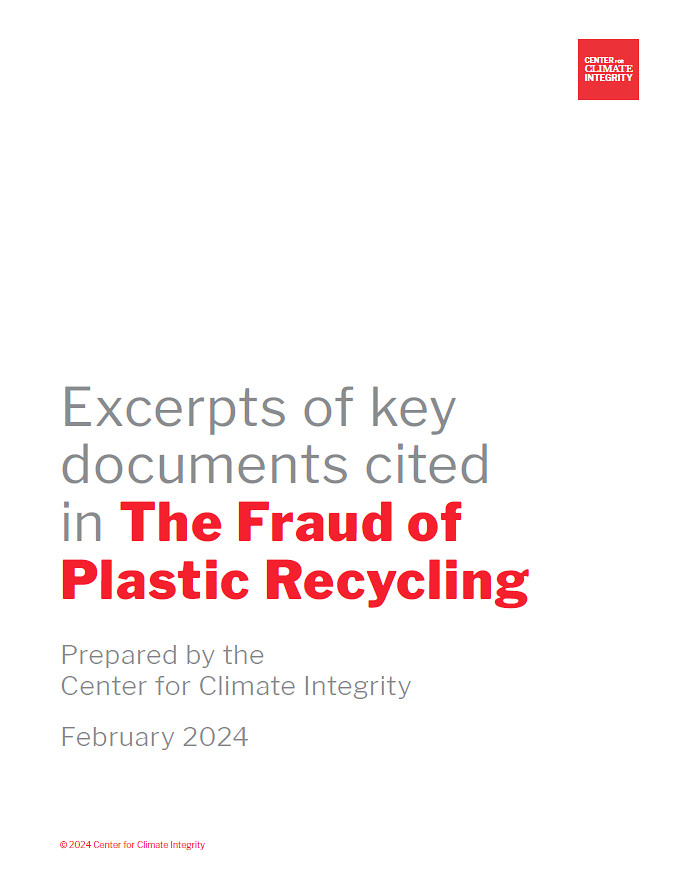
2024-02-17: A very recent Report: The Fraud of Plastic Recycling – How Big Oil and the Plastics Industry Deceived the Public for Decades and Caused the Plastic Waste Crisis … published by the Centre for Climate Integrity ( www.climateintegrity,org ), in Washington D.C., #USA … raises serious issues about whether Any Plastic Recycling is technically or economically viable at scale … and serious questions, by implication, about Statistical Reliability in the European Union (#EU) concerning Recycling generally, and Plastics Recycling in particular.
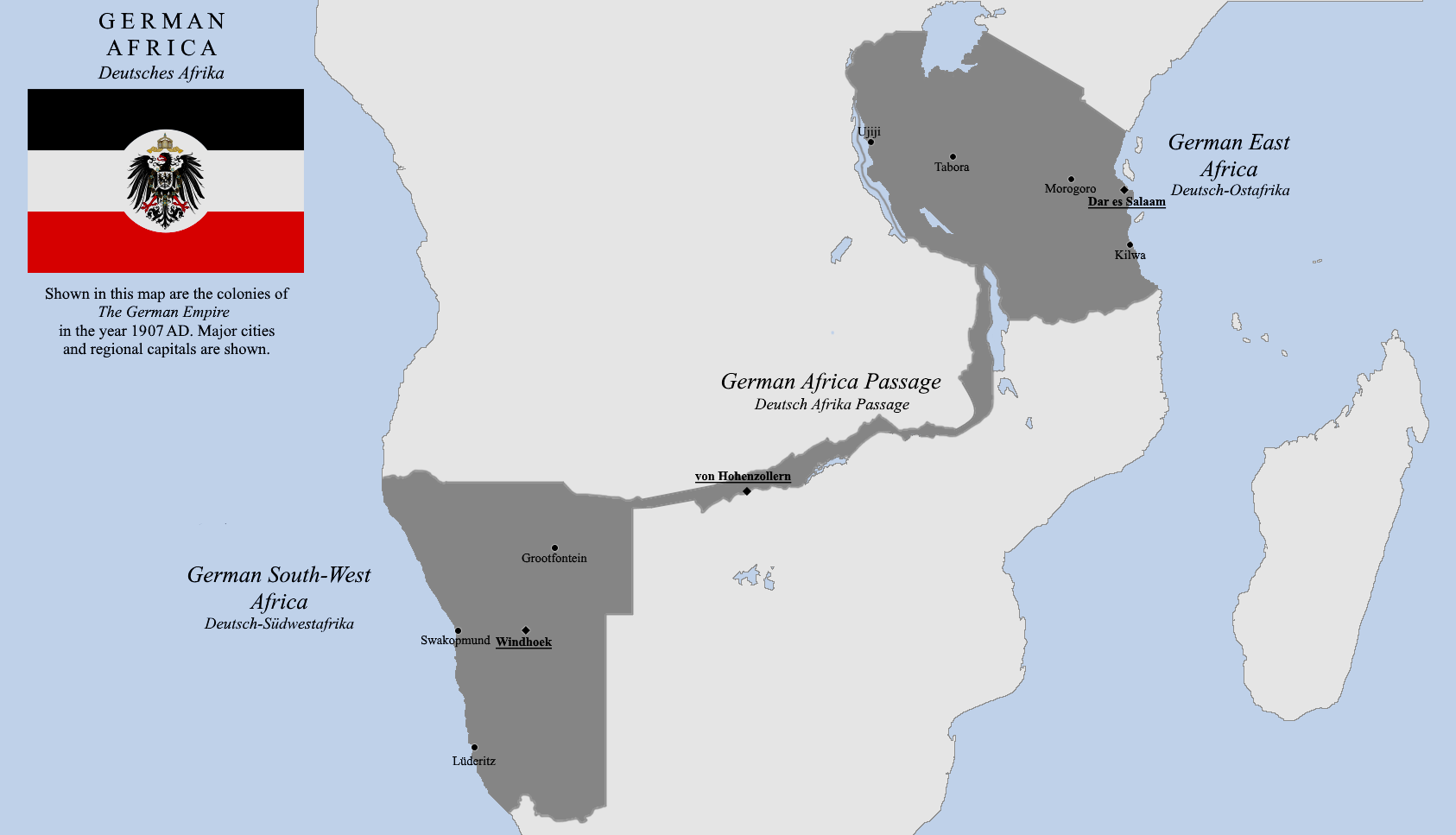
Could this also be the Reason why the Global North is so busy dumping Un-Recyclable Plastics in the previously colonized territories of the Global South ???
.
Short Extract From This Report’s Introduction …
Plastic Pollution is one of the most serious Environmental Crises facing the world today. Between 1950 and 2015, over 90% of plastics were landfilled, incinerated, or leaked into the environment. Plastic Waste is ubiquitous – from our rivers, lakes, and oceans to roadways and coastlines. It is in ‘the air we breathe, the food we eat, and the water we drink’. One study estimates that humans ingest up to five grams, or the equivalent of one credit card worth of plastic per week. Some of the largest Oil and Gas Companies are among the 20 petrochemical companies responsible for more than half of all single-use plastics generated globally. #ExxonMobil, for example, is the world’s top producer of single-use plastic polymers.
Underpinning this Plastic Waste Crisis is a decades-long campaign of #Fraud and #Deception about the #Recyclability of #Plastics. Despite their long-standing knowledge that recycling plastic is neither technically nor economically viable, petrochemical companies – independently and through their industry trade associations and front groups – have engaged in fraudulent marketing and public education campaigns designed to mislead the public about the viability of plastic recycling as a solution to Plastic Waste.
By deceiving consumers, policymakers, and regulators about the viability of Plastic Recycling, petrochemical companies have ensured the continued expansion of plastic production, which has led to a Plastic Waste and Pollution Crisis for communities across the country. The costs of managing and cleaning up Plastic Waste are largely borne by municipal and state governments – and those costs are projected to increase exponentially in the coming decades, given that Plastic Waste generation in the United States of America is expected to increase from 73 million metric tonnes in 2019 to more than 140 million metric tonnes by 2060.
If not for the Big Oil and the plastic industry’s lies and deception, municipalities and states would not have invested in plastic recycling programmes and facilities – many of which have been shut down due to foreseeable economic losses. The industry not only misled municipal and state agencies to believe that Plastic Recycling was a viable solution to Plastic Waste but also discouraged them from pursuing other, more Sustainable Waste Management Strategies (e.g., waste reduction, reuse, bans, alternative materials) in favour of plastic recycling.
Fossil fuel and other petrochemical companies should now be held accountable for their deliberate campaign of deception and the resulting harms, much like tobacco and opioid companies that employed a similar playbook. Based on the growing body of evidence, municipalities and states are likely to pursue litigation, which could put an end to the industry’s deception, make the companies pay for the devastating harms they have caused to communities, and open the door to real solutions that are currently out of reach.
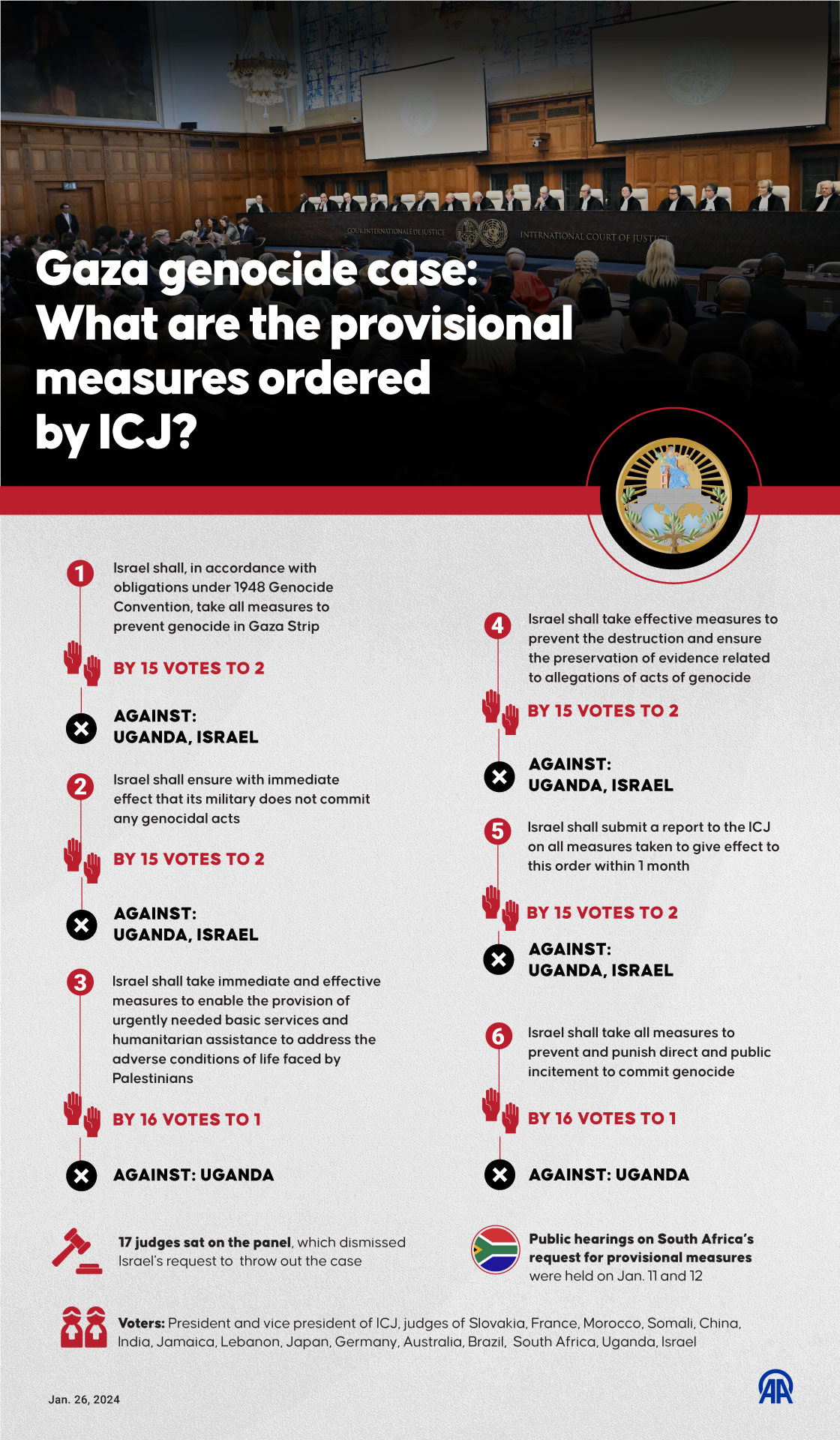
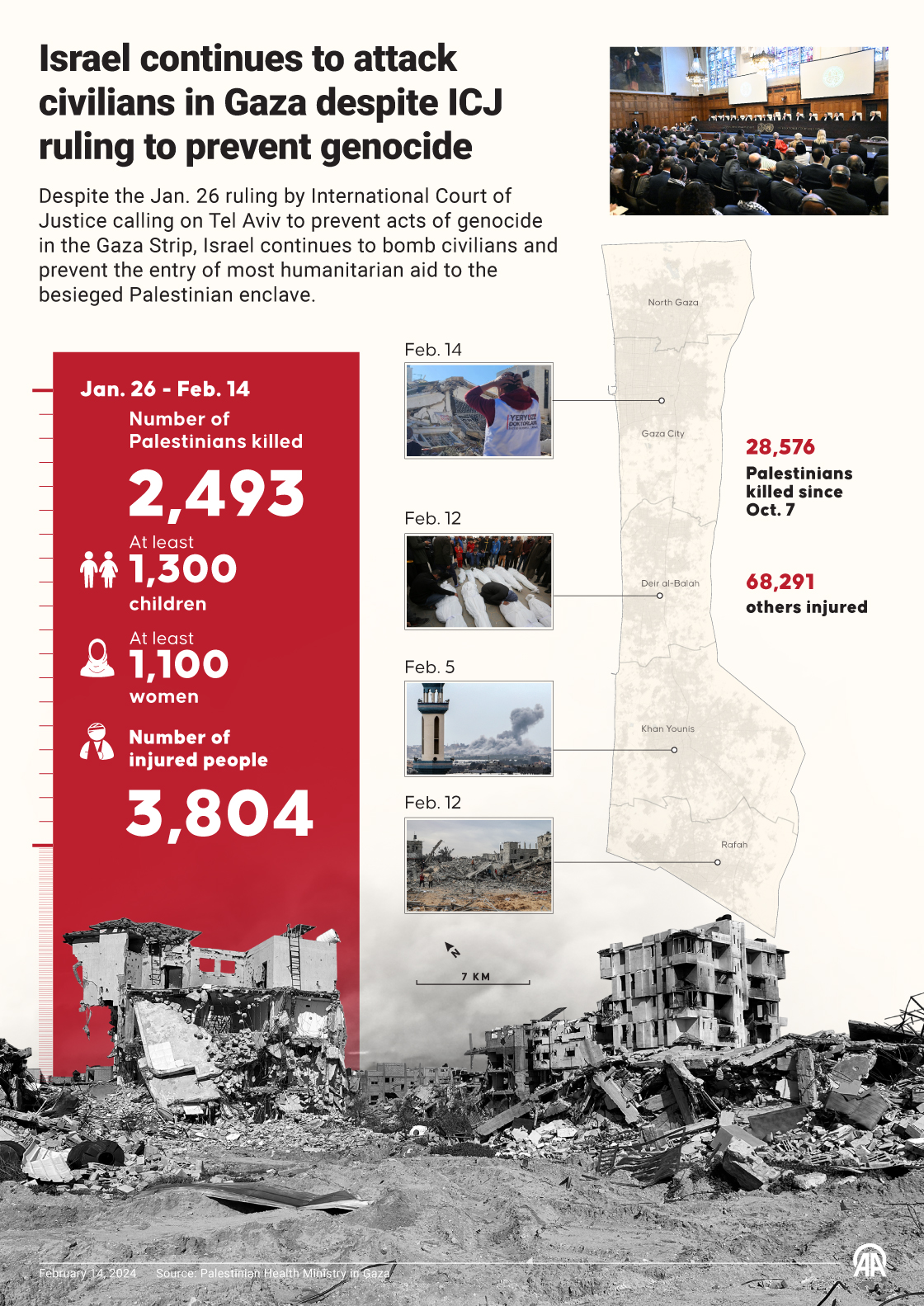
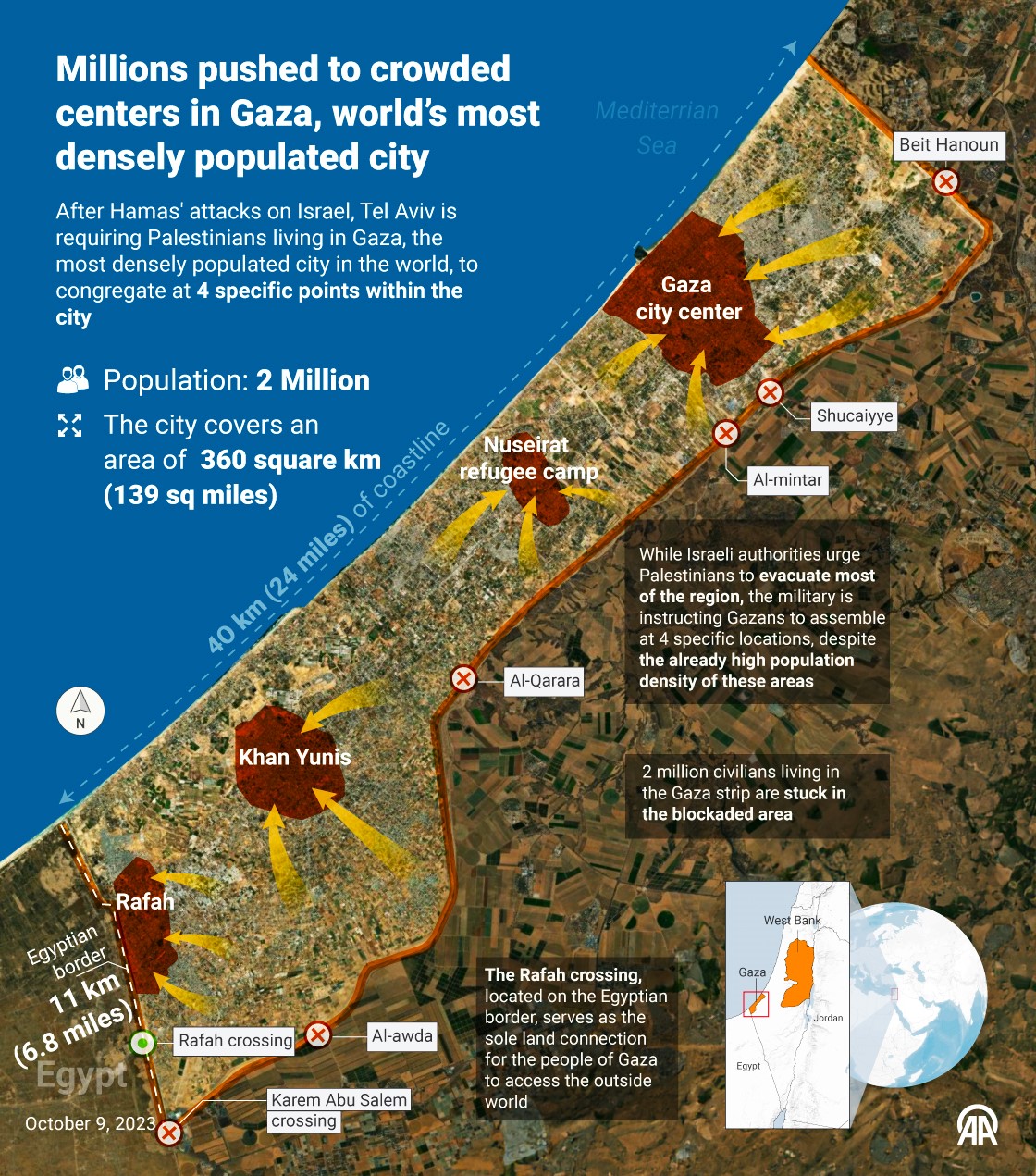
[ Approved and proposed for signature, and ratification or accession, by U.N. General Assembly Resolution 260 A (III) of 9 December 1948. Entry into force: 12 January 1951, in accordance with article XIII. ]
The Contracting Parties,
Having considered the declaration made by the General Assembly of the United Nations in its Resolution 96 (I), dated 11 December 1946, that Genocide is a crime under international law, contrary to the spirit and aims of the United Nations and condemned by the civilized world,
Recognizing that at all periods of history, Genocide has inflicted great losses on humanity, and
Being convinced that, in order to liberate mankind from such an odious scourge, international co-operation is required,
Hereby agree as hereinafter provided:
.
Article I
The Contracting Parties confirm that Genocide, whether committed in time of peace or in time of war, is a crime under international law which they undertake to prevent and to punish.
Article II
In the present Convention, Genocide means any of the following acts committed with intent to destroy, in whole or in part, a national, ethnical, racial or religious group, as such:
(a) Killing members of the group ;
(b) Causing serious bodily or mental harm to members of the group ;
(c) Deliberately inflicting on the group conditions of life calculated to bring about its physical destruction in whole or in part ;
(d) Imposing measures intended to prevent births within the group ;
(e) Forcibly transferring children of the group to another group.
Article III
The following acts shall be punishable:
(a) Genocide ;
(b) Conspiracy to commit Genocide ;
(c) Direct and public incitement to commit Genocide ;
(d) Attempt to commit Genocide ;
(e) Complicity in Genocide.
Article IV
Persons committing Genocide or any of the other acts enumerated in article III shall be punished, whether they are constitutionally responsible rulers, public officials or private individuals.
Article V
The Contracting Parties undertake to enact, in accordance with their respective Constitutions, the necessary legislation to give effect to the provisions of the present Convention, and, in particular, to provide effective penalties for persons guilty of Genocide or any of the other acts enumerated in article III.
Article VI
Persons charged with Genocide or any of the other acts enumerated in article III shall be tried by a competent tribunal of the State in the territory of which the act was committed, or by such international penal tribunal as may have jurisdiction with respect to those Contracting Parties which shall have accepted its jurisdiction.
Article VII
Genocide and the other acts enumerated in article III shall not be considered as political crimes for the purpose of extradition.
The Contracting Parties pledge themselves in such cases to grant extradition in accordance with their laws and treaties in force.
Article VIII
Any Contracting Party may call upon the competent organs of the United Nations to take such action under the Charter of the United Nations as they consider appropriate for the prevention and suppression of acts of Genocide or any of the other acts enumerated in article III.
Article IX
Disputes between the Contracting Parties relating to the interpretation, application or fulfilment of the present Convention, including those relating to the responsibility of a State for Genocide or for any of the other acts enumerated in article III, shall be submitted to the International Court of Justice at the request of any of the parties to the dispute.
Article X
The present Convention, of which the Chinese, English, French, Russian and Spanish texts are equally authentic, shall bear the date of 9 December 1948.
Article XI
The present Convention shall be open until 31 December 1949 for signature on behalf of any Member of the United Nations and of any non-member State to which an invitation to sign has been addressed by the General Assembly.
The present Convention shall be ratified, and the instruments of ratification shall be deposited with the Secretary-General of the United Nations.
After 1 January 1950, the present Convention may be acceded to on behalf of any Member of the United Nations and of any non-member State which has received an invitation as aforesaid.
Instruments of accession shall be deposited with the Secretary-General of the United Nations.
Article XII
Any Contracting Party may at any time, by notification addressed to the Secretary-General of the United Nations, extend the application of the present Convention to all or any of the territories for the conduct of whose foreign relations that Contracting Party is responsible.
Article XIII
On the day when the first twenty instruments of ratification or accession have been deposited, the Secretary-General shall draw up a procès-verbal, and transmit a copy thereof to each Member of the United Nations and to each of the non-member States contemplated in article XI.
The present Convention shall come into force on the ninetieth day following the date of deposit of the twentieth instrument of ratification or accession.
Any ratification or accession effected subsequent to the latter date shall become effective on the ninetieth day following the deposit of the instrument of ratification or accession.
Article XIV
The present Convention shall remain in effect for a period of ten years as from the date of its coming into force.
It shall thereafter remain in force for successive periods of five years for such Contracting Parties as have not denounced it at least six months before the expiration of the current period.
Denunciation shall be effected by a written notification addressed to the Secretary-General of the United Nations.
Article XV
If, as a result of denunciations, the number of Parties to the present Convention should become less than sixteen, the Convention shall cease to be in force as from the date on which the last of these denunciations shall become effective.
Article XVI
A request for the revision of the present Convention may be made at any time by any Contracting Party by means of a notification in writing addressed to the Secretary-General.
The General Assembly shall decide upon the steps, if any, to be taken in respect of such request.
Article XVII
The Secretary-General of the United Nations shall notify all Members of the United Nations and the non-member States contemplated in article XI of the following:
(a) Signatures, ratifications and accessions received in accordance with article XI ;
(b) Notifications received in accordance with article XII ;
(c) The date upon which the present Convention comes into force in accordance with article XIII ;
(d) Denunciations received in accordance with article XIV ;
(e) The abrogation of the Convention in accordance with article XV ;
(f) Notifications received in accordance with article XVI.
Article XVIII
The original of the present Convention shall be deposited in the archives of the United Nations.
A certified copy of the Convention shall be transmitted to each Member of the United Nations and to each of the non-member States contemplated in article XI.
Article XIX
The present Convention shall be registered by the Secretary-General of the United Nations on the date of its coming into force.
2023-10-11: Theory is one thing, but the practical working out and implementation of Sustainable Fire Engineering Design is something else …
The (Sustainable) Fire Engineer will already be an active, contributing member of a collaborative Project Design Team. So, very early on in the Design Process for a Simple Building / Complex Building / Innovative Building / High-Rise Building / Tall Building or Group of Buildings (whatever) … he or she has a relatively mature sketch design on which to work, and major elements of the design can still be modified, without cost implications, based on her or his Creative Solutions which positively support and aid – not hinder, weaken or dilute – the Project Team’s Design Intent.
The Sustainable Fire Engineer should always / must, therefore, have a minimum competence with regard to Building Design and Construction in order to effectively communicate and creatively collaborate in these Design Teams.
[ Recommendation: Instead of looking down on, or discriminating against, Architects … they should be warmly welcomed into the International Community of Fire Engineering … where their particular expertise is badly needed.]
A blank sheet of paper, pencil in hand … or, if you prefer, an empty monitor screen, with mouse poised to move … and how to proceed … should it be this fire safety strategy (?) … or a different, more appropriate fire safety strategy (?)
Incorporate Ease & Reasonable Cost of Post-Fire Reconstruction.
At this early stage in the Design Process … treat Conventional Fire Codes as an irrelevancy in the context of the above Design Objectives … question the adequacy of out-dated, simple prescriptive solutions … and forget about European and North American biases with regard to Passive and Active Fire Protection Measures. Investigate new Sustainable Building Materials & Smart Technologies. Incorporate Factors of Safety throughout the Fire Engineering Design Process. Always remember Defence in Depth and Redundancy. Prioritize Construction Reliability.
.
Sustainable Design: Green Walls & Fire ?
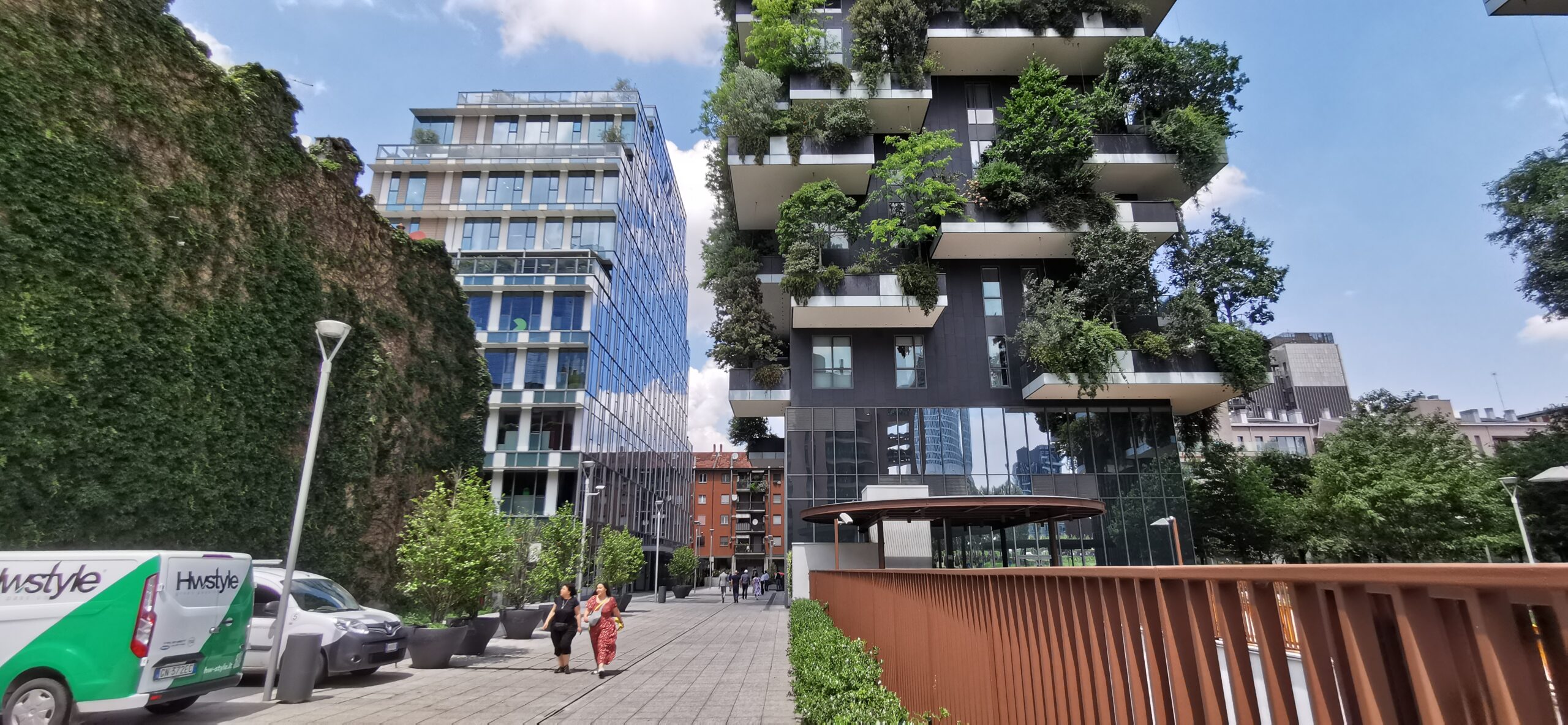
‘Green Walls’ (also known as Planted Facades, Living Walls, Vertical Gardens, and Vertical Landscapes) is a general term which covers the architectural use of natural vegetation as a vertical element in buildings, both externally and/or internally ; intrinsically, each ‘Wall’ is different. To be absolutely clear from a fire engineering viewpoint, there is no such thing as a ‘standard’ green wall which can be fire tested in a laboratory. There are many benefits and advantages to these Walls … but, in future, they will play an important role in dealing with Climate Disruption, particularly the Urban Heat Island Effect in cities and large towns.
If properly installed and maintained … properly nourished and watered depending on local environmental conditions … Green Walls will not pose a fire hazard. But those are a lot of ‘ifs’ !
Remembering Defence in Depth … the installed ‘sub-soil’ watering system for a Green Wall may be interrupted or break down, so a Smart Water Mist System will help with hydration of the vegetation, and cooling for building occupants/users, as Climate Disruption intensifies. Some of the trees, shrubs or plants may wither and die, so a Water Sprinkler/Deluge (as appropriate) Fire Suppression System will deal with any accidental or intentional outbreaks of fire.
.
Photograph, in colour, showing a street view at the rear of the Twin Tower, Multi-Storey Bosco Verticale Project in Milan, Italy. In the view shown, ‘Green Wall’ covers a wide range, from a simple planted façade on the left to a vertical forest (Italian: bosco verticale) on the right. With natural vegetation, similar types of ‘Wall’ can be very different. Photograph by CJ Walsh 2023-06-07. Click to enlarge.
Colour Photograph showing the Twin Tower, Multi-Storey Bosco Verticale Project in Milan, Italy. Designed by Ar.Stefano Boeri, it was completed in late 2014. Early research based on an examination of the 900 trees (23 species) in the Project revealed that some adapted better to a challenging high-level environment than others, and trees on the upper floors were more stressed, requiring 20 percent more water. Photograph by CJ Walsh 2023-06-07. Click to enlarge.
2023-10-10: Referencing only those texts in United Nations General Assembly Resolution 38/17 of 1983 (previously UN A/RES 37/43 of 1982), which specifically mention, and directly/indirectly relate to, Palestine …
.
The General Assembly,
.
Reaffirming the obligation of all Member States to comply with the principles of the Charter of the United Nations and the resolutions of the United Nations regarding the exercise of the right to self-determination by peoples under colonial and foreign domination,
.
Recalling further its relevant resolutions on the question of Palestine, in particular resolutions 3236 (XXIX) and 3237 (XXIX) of 22 November 1974, 36/120 of 10 December 1981, ES-7/6 of 19 August 1982 and 37/86 of 10 December 1982,
Recalling the Geneva Declaration on Palestine and the Programme of Action for the Achievement of Palestinian Rights, adopted by the International Conference on the Question of Palestine, held at Geneva from 29 August to 7 September 1983,
Considering that the denial of the inalienable rights of the Palestinian people to self-determination, sovereignty, independence and return to Palestine and the repeated acts of aggression by Israel against the people of the region constitute a serious threat to international peace and security,
Deeply shocked and alarmed at the deplorable consequences of the Israeli invasion of Lebanon and recalling all the relevant resolutions of the Security Council, in particular resolutions 508 (1982) of 5 June 1982, 509 (1982) of 6 June 1982, 520 (1982) of 17 September 1982 and 521 (1982) of 19 September 1982,
Calls upon all States to implement fully and faithfully all the resolutions of the United Nations regarding the exercise of the right to self-determination and independence by peoples under colonial and foreign domination ;
Reaffirms the legitimacy of the struggle of peoples for their independence, territorial integrity, national unity and liberation from colonial domination, apartheid and foreign occupation by all available means, including armed struggle ;
Reaffirms the inalienable right of the Namibian people, the Palestinian people and all peoples under foreign and colonial domination to self-determination, national unity and sovereignty without foreign interference ;
Strongly condemns those Governments that do not recognize the right to self-determination and independence of all peoples still under colonial domination and alien subjugation, notably the peoples of Africa and the Palestinian people ;
Endorses the declarations and programmes of action on Namibia and Palestine adopted respectively by the international conferences on these questions and calls for their immediate implementation ;
.
Reaffirms that the practice of using mercenaries against sovereign States and national liberation movements constitutes a criminal act and calls upon the Governments of all countries to enact legislation declaring the recruitment, financing and training of mercenaries in their territories and the transit of mercenaries through their territories to be punishable offences, and prohibiting their nationals from serving as mercenaries, and to report on such legislation to the Secretary-General ;
Strongly condemns the continued violations of the human rights of the peoples still under colonial domination and alien subjugation, the continuation of the illegal occupation of Namibia, and South Africa’s attempts to dismember its Territory, the perpetuation of the racist minority régime in southern Africa, and the denial to the Palestinian people of their inalienable national rights ;
.
Strongly condemns the constant and deliberate violations of the fundamental rights of the Palestinian people, as well as the expansionist activities of Israel in the Middle East, which constitute an obstacle to the achievement of self-determination and independence by the Palestinian people and a threat to peace and stability in the region ;
Further strongly condemns the massacre of Palestinians and other civilians at Beirut and the Israeli aggression against Lebanon which endangers stability, peace and security in the region ;
Demands the immediate and unconditional release of all persons detained or imprisoned as a result of their struggle for self-determination and independence, full respect for their fundamental individual rights and compliance with article 5 of the Universal Declaration of Human Rights under which no one shall be subjected to torture or to cruel, inhuman or degrading treatment ;
Urges all States, specialized agencies, competent organizations of the United Nations system and other international organizations to extend their support to the Palestinian people through its sole and legitimate representative, the Palestine Liberation Organization, in its struggle to regain its right to self-determination and independence in accordance with the Charter ;
Reiterates its satisfaction at the material and other forms of assistance that peoples under colonial régimes continue to receive from Governments, organizations of the United Nations system and intergovernmental organizations and calls for a substantial increase in this assistance ;
Urges all States, specialized agencies and other competent organizations of the United Nations system to do their utmost to ensure the full implementation of the Declaration on the Granting of Independence to Colonial Countries and Peoples and to intensify their efforts to support peoples under colonial, foreign and racist domination in their just struggle for self-determination and independence ;
Requests the Secretary-General to give maximum publicity to the Declaration on the Granting of Independence to Colonial Countries and Peoples and to give the widest possible publicity to the struggle of oppressed peoples for the achievement of their self-determination and national independence and to report periodically to the General Assembly on his activities ;
2017 Speech at the National Press Club, Washington D.C., by Prof. John J. Mearsheimer, Political Scientist & International Relations Scholar: Changes in the Israel Lobby & American Policy – Washington Report on Middle East Affairs ( www.wrmea.org ) … https://www.youtube.com/watch?v=k8Mgdm_6-e0
2023-09-26: At the time of writing, the 78th Session of the United Nations General Assembly is taking place in New York City. Midway through the U.N. Sustainable Development Framework Agenda 2015-2030 … News about its failing progress is very discouraging …
> Amid growing geo-political crises and war, Multi-Lateralism has little chance to operate successfully and there is a growing stalemate within the Security Council ;
> Extreme Weather Events (e.g. heatwaves, droughts, severe storms and rainfall, flooding) are becoming a regular occurrence across the Globe, and their impacts are already devastating ;
> Only 15% of the Sustainable Development Goals are barely on track, while development gains in other SDG’s have reversed ;
> Not only are Climate Disruption Targets not being met, but global greenhouse gas emissions are actually increasing.
Earlier this month (September 2023), the #UN published a Report: United in Science 2023 – Sustainable Development Edition … https://library.wmo.int/idurl/4/68235
Compiled by the World Meteorological Organization (#WMO) under the direction of the U.N. Secretary-General, it brings together the latest updates from key U.N. Partner Organizations with a focus on weather-, climate-, and water-related sciences, research and services in support of realizing Sustainable Human & Social Development:
Climate Disruption …
Total Carbon Dioxide (CO2) Emissions from fossil fuels and land use change remained high in 2022 and the first half of 2023. Fossil fuel CO2 emissions increased 1% globally in 2022 compared to 2021, and global average concentrations continued rising through 2022 and the first half of 2023.
The years from 2015 to 2022 were the eight warmest on record, and the chance of at least one year exceeding the warmest year on record in the next five years is 98%.
It is estimated that current mitigation policies will lead to global warming of around 2.8 °C over the course of this century compared to pre-industrial levels. Immediate and unprecedented reductions in Greenhouse Gas Emissions are needed to achieve the goals of the 2015 Paris Agreement, i.e. 1.5 °C.
.
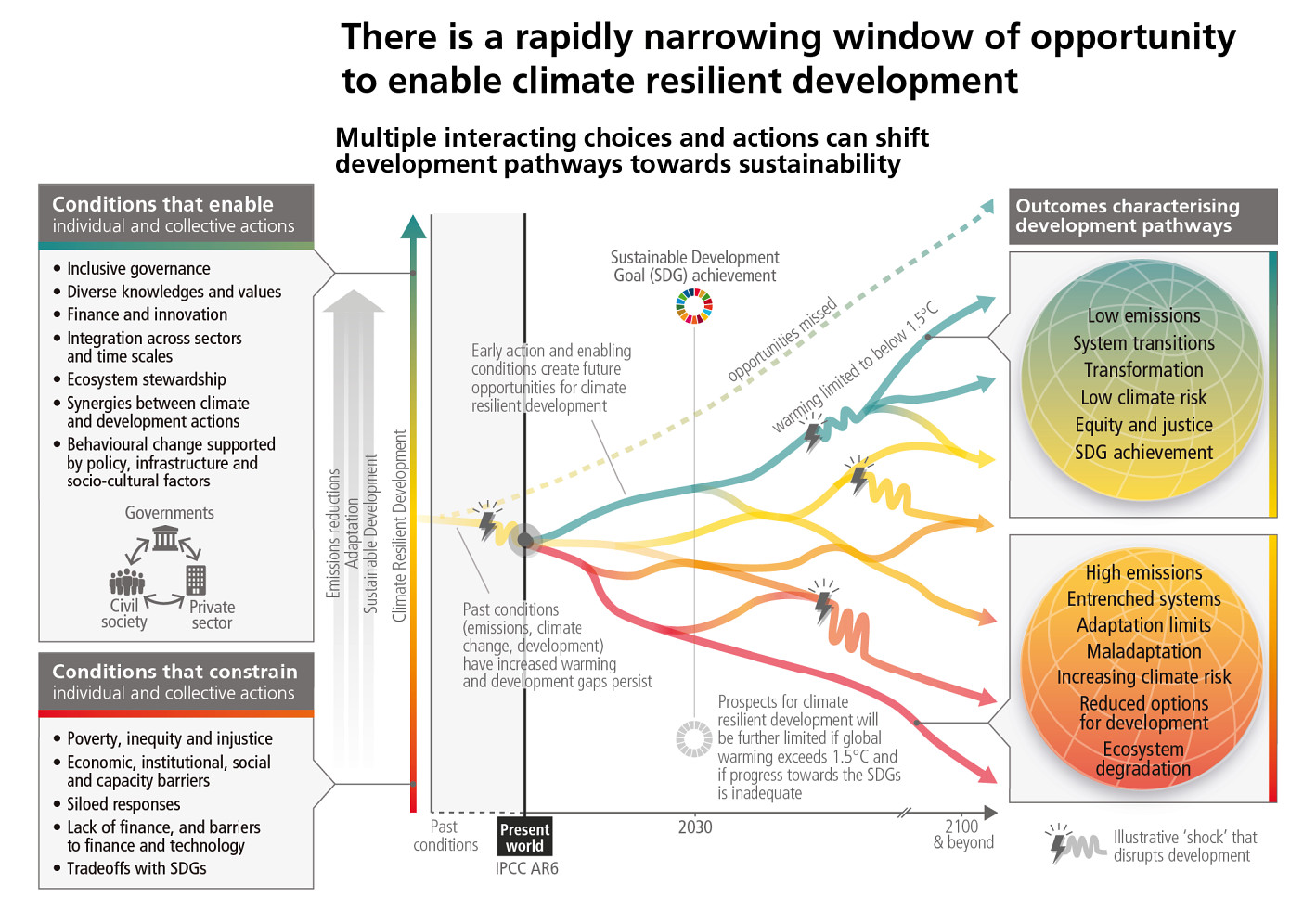
Graphic Image, Figure 6 in colour, from the InterGovernmental Panel on Climate Change (#IPCC) 6th Assessment Report’s 2023 Summary for Policy-Makers. It shows that there is a rapidly narrowing window of opportunity to realize climate resilient development, and how multiple interacting choices and actions can shift development pathways towards Sustainability. Click to enlarge.
.
Sustainable Cities & Communities …
Cities are responsible for a high proportion of global GHG Emissions and are highly vulnerable to the impacts of climate disruption and extreme weather events, which threaten the achievement of Sustainable Development Goal 11.
Integrated urban weather, climate, water and environmental services, grounded in best-available science and research, are helping Cities to achieve SDG 11.
Observations, high-resolution forecasting models and multi-hazard early warning systems are the fundamental basis for integrated urban services.
Good Human Health & Social Wellbeing …
Trans-Disciplinary Research is fundamental to analysing, monitoring and addressing climate-sensitive health risks and climate impacts on the health sector.
Climate disruption and extreme events are projected to significantly increase ill-health and premature deaths, as well as population exposure to heatwaves and heat-related morbidity and mortality.
Scaling up investments in climate-resilient and low-carbon health systems, and progress towards universal health coverage (#UHC) are critical for the achievement of Sustainable Development Goal 3.
.
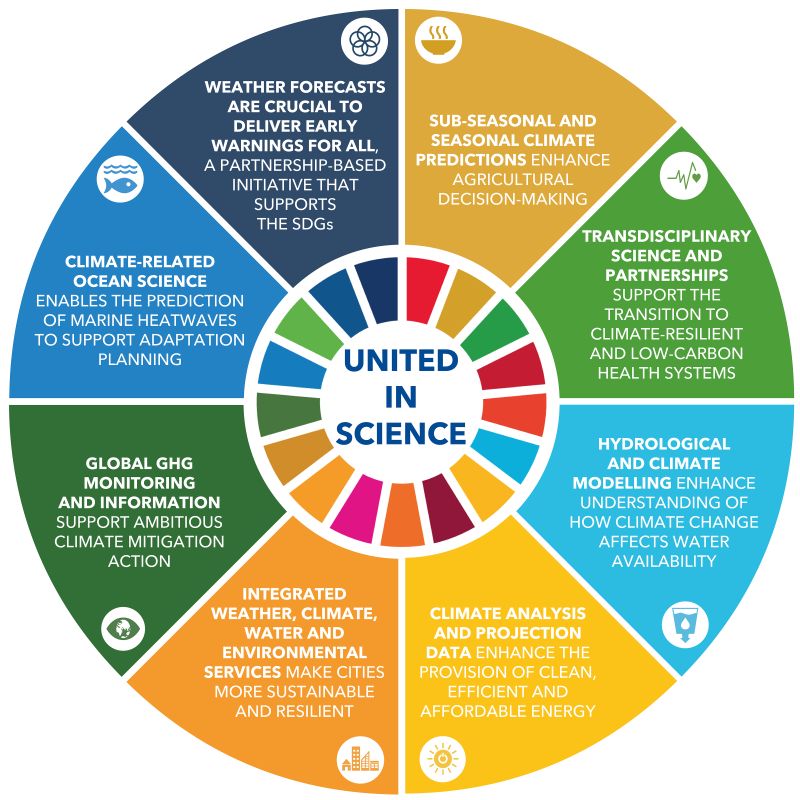
Graphic Image, Figure 1 in colour, from the recently published UN WMO Report: ‘United in Science 2023 – Sustainable Development Edition’. It shows how genuinely collaborative weather-, climate-, and water-related sciences, research and services – together – support the achievement of the United Nations (#UN) Sustainable Development Goals (#SDG). Click to enlarge.
Deep & Genuine Construction Sector Collaboration …
[ Institutional Transformation ]
It is inevitable, therefore, that enormous pressures – social, economic, political, legal, and institutional – are being brought to bear on Building Design Professions, Engineers (all disciplines) and Construction Organizations to rapidly, reliably and creatively transform our existing Built Environment ; new buildings, which constitute just a small part of that workload, will be required to carry the heaviest burden. To properly realize a Safe, Resilient and Sustainable Built Environment for ALL, however, Genuine Collaboration must be fostered … between each actor in the construction sector … between practitioners and scientists/researchers … and between different industrial sectors … silos broken apart and traditional barriers transcended.
.
Sustainable Buildings – Reality vs. Superficial Impressions …
The minimum Life Cycle for a Sustainable Building is 100 years.
To be capable of later #Adaptation, a Sustainable Building must possess a sufficient/appropriate, level of #Redundancy. Lean construction ignores this issue.
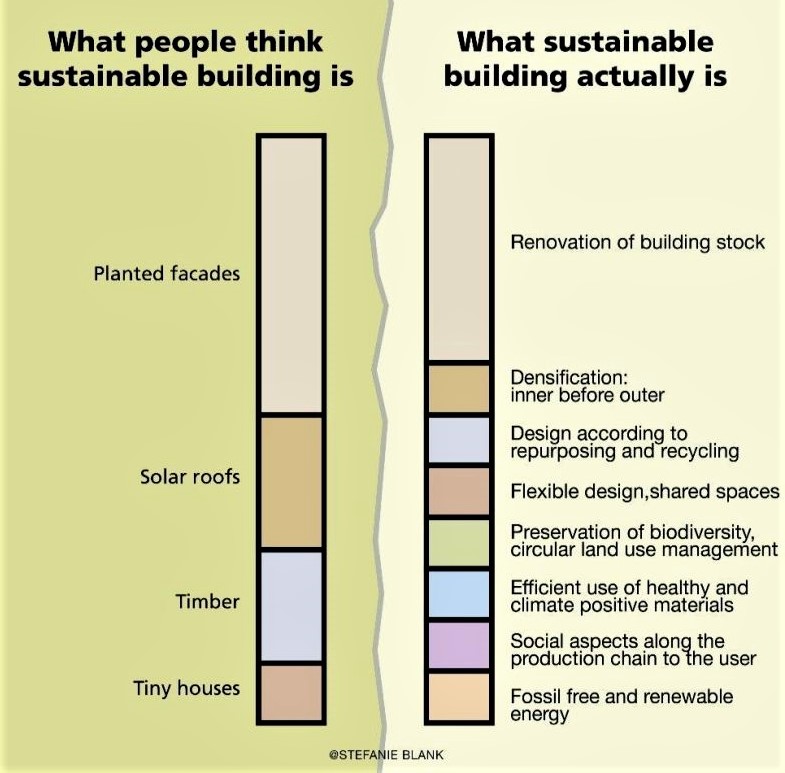
Far too many people appear to be still ‘wrestling’ with an obsolete understanding of #Sustainability. It has many more than just 3 Aspects (social, environmental, economic). Time for everyone to cop on and catch up !
The International Fire Engineering Community, in particular, has a fixation with low-hanging fruit … ‘PV Panels’, ‘Timber Buildings’ … and ‘Performance-Based Fire Codes’, which are a hybrid of prescription (rather than Functional Fire Codes, which offer a more free, more open, and flexible option for designers).
So … before moving on in my next Post to look at the potential for Green Walls being a fire hazard, and comparing a top-down Sustainable Fire Engineering Design Approach with a bottom-up Conventional Fire Safety Approach … here is an interesting graphic image, developed by an architectural colleague in Berlin, Ar.Stefanie Blank, showing the difference between all-too-common superficial impressions and the reality of Sustainable Buildings …
.
Graphic Image, in colour, which compares ‘What people think Sustainable Building is’ with ‘What Sustainable Building actually is’. There is a world of difference between ‘reality’ and ‘superficial impressions’. The immediate and unprecedented challenge is the poor performance of existing buildings. Click to enlarge.
As I have written many times before, the concept of Sustainable Human & Social Development is intricate, open, and dynamic … and it is also continuously evolving. So too, the #SFE #RoadMap must continuously evolve.
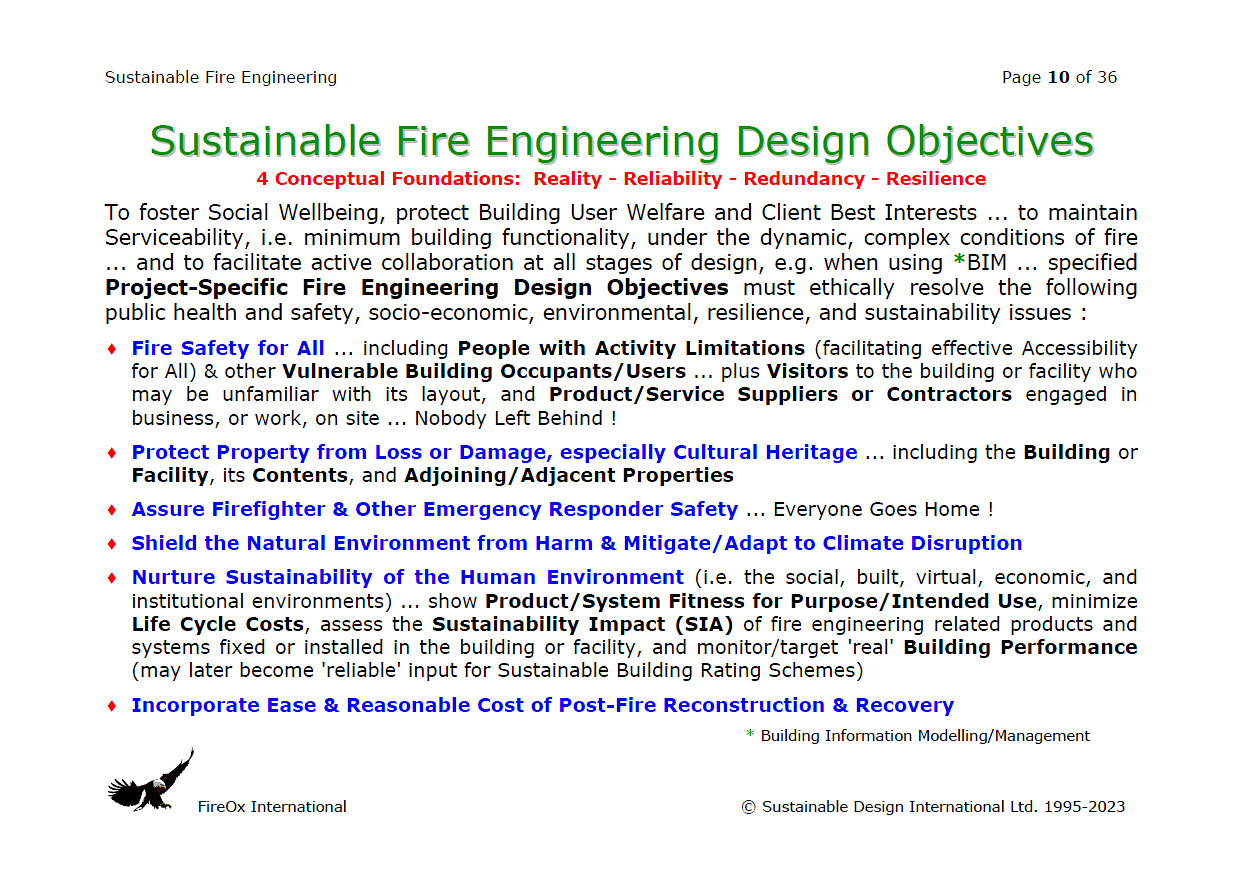
Fully reflecting the content and views expressed above, it is necessary to further expand the Sustainable Fire Engineering Design Objectives on Page 10 of the Road Map … in order to clearly and directly integrate the issue of Climate Disruption …
.
Graphic Image, in colour, which lists SFE’s revised Project-Specific Fire Engineering Design Objectives … which cover the safety of building users and firefighters, protection of property and the environment, mitigation/adaptation to climate disruption, and finally, sustainability. This revision is dated May 2023. Click to enlarge.