Accessibility-for-All
Buildings & Firefighters Not Yet Safer ! – 10 Years After 9-11 (II)
2011-09-20: Continuing on from where I left off on 11 September 2011 …
Applying the Recommendations contained in the 2005 & 2008 National Institute of Standards & Technology (NIST – USA) Reports on the 9-11 WTC Buildings 1, 2 & 7 Collapses to the everyday practice of Architecture and Fire Engineering has been a central part of our work for many years. Long discussions on this subject have taken place within CIB (International Council for Building Research) Working Commission 14: ‘Fire Safety’ … and I also chair Commission 14′s Research Working Group IV on ‘Fire-Induced Progressive Collapse’.
My particular interest in Disproportionate Damage and Progressive Collapse reaches back as far as the late 1980′s !
So I was intrigued, amused … and at the same time, highly concerned … to read the following Letter to the Editor of the Irish Times Newspaper, on Saturday 10 September 2011 …
Recalling 9/11
Sir, – One of the most important factors in the tragedy of 9/11, and one that has received scant attention, was the mode of failure of the towers.
They were struck high up on their structures and failed via progressive collapse. Had they been designed this side of the Atlantic, they would not have collapsed. These were flimsy structures. -
Yours, etc,
Jim Ryan, Chartered Structural Engineer,
Waterfall, Cork.
.
JIM … If the WTC Towers (which were not flimsy structures !) had been designed on this side of the Atlantic … they would have collapsed.
Furthermore … If the Towers had only been completed last week in the USA, Ireland, England & Wales, India or China … they would still collapse, if a similar event were to occur next year.
To be crystal clear … What we witnessed, on Tuesday 11 September 2001, was a Collapse Level Event (CLE) which exposed, very harshly and cruelly, a catastrophic failure in all of our common Design and Construction Practices and Procedures used in/by/as …
- Architectural Design | (Ambient) Structural Engineering | Fire Engineering ;
- Building Management Systems ;
- Emergency Responders | Firefighters | Rescue Teams ;
- Technical Control Organizations Having Authority (AHJ’s) or Jurisdiction ;
- Fire Safety Objectives in Building Legislation, Codes and Standards.
To the average ‘person in the street’ … Whether he/she lives in Manhattan or Chicago in the USA, Dublin or Cork in Ireland, Cardiff or London in Britain, Dilli or Mumbai in India, Beijing or Shanghai or Hong Kong in China … it is unacceptable that buildings collapse … entirely unacceptable !!
.
COLLAPSE OF WTC BUILDINGS 1, 2 & 7
JIM … Unless you believe in conspiracy theories, please study the 2005 & 2008 NIST(USA) Reports on the 9-11 WTC Buildings 1, 2 & 7 Collapses. The 2 Final Reports can be downloaded from this Page on Sustainable Design International’s Corporate WebSite … http://www.sustainable-design.ie/fire/structdesfire.htm … along with other key documents and links.
Some indication of the enormous quantity of 9-11 WTC Incident Documentation issued by NIST(USA) can be seen below …

Colour photograph showing the enormous quantity of 9-11 WTC Incident Documentation, issued by the U.S. National Institute of Standards & Technology, which is still readily available for the public to access and download.
.
PUBLIC SAFETY 10 YEARS AFTER 9-11 ?
If it is entirely unacceptable to the Public that buildings collapse … in how many National Building Codes does the following Critical Public Safety Equation appear today ? The answer is NONE !

Colour image showing Page 21 from my Overhead Presentation on 'Sustainable Fire Engineering' ... scheduled for this Thursday, 22 September 2011, at the ASFP Ireland Fire Seminar & Workshop ... to be held at the RDS, in Ballsbridge, Dublin. Click to enlarge.
.
Is there some fundamental reason why Levels of Safety for the Public should vary so much from one country to another ? NO, there is not !
Within Europe, and in relation to the New EU Construction Product Regulation 305/2011, which I discussed here a few days ago … the European Commission, in a discussion document dating back to the mid-1980′s, suggested that the only way to effectively realize a Single Market for Construction Products would be to introduce Harmonized EU Building Regulations in all of the EU Member States. Of course the Member States, at the time, went ballistic at the very mention of this idea … and it was quickly withdrawn. I take great pleasure in repeating that important idea today.
Jim … The Critical Public Safety Statement above is fully consistent with … and meets … the ‘Basic Requirements for Construction Works’ in Annex I of EU Regulation 305/2011.
.
However, in relation to any one EU Member State … let’s take Ireland as an example … compare a situation where, in a remote rural location, it might take almost an hour for a sufficient fire service presence to arrive at the scene of a building fire emergency … with a similar situation in the middle of a city, or large town, where the time required will not be greater than 15 minutes … then, although the Level of Safety for the Public can be / should be / must be the same in both situations … I would expect, in the remote rural location having a poor fire service support infrastructure, that the range of Fire Protection Measures to be employed in a typical building would be more extensive, and the performance expected of those Measures would be higher … in order to achieve an Equivalent Level of Safety in both rural and urban locations. Is that not a rational idea ??
Unfortunately, that’s not how the present systems work … National or European ! Levels of Public Safety differ from one country to the next … and from one region, within any one country, to the next … without any good reason … and without meaningful consultation and the full understanding of the Public.
.
BUILDINGS & FIREFIGHTERS ARE NOT YET SAFER
JIM … In spite of all of the spin coming from the other side of the Atlantic … and discounting criminality and fraud in construction practices … Buildings and Firefighters are not yet safer … because the large, difficult, complex flaws and failures in Conventional Fire Engineering have not yet been aggressively confronted … and properly solved.
In a post last year, on 18 October 2010 … I referred to the Cul-de-Sac of Current Fire Engineering … and illustrated a typical architectural detail in a Dublin Building – a common detail also to be found in India, China, USA, England & Wales, etc., etc – which demonstrates a Fundamental Flaw at the very core of conventional thinking and practice.
On Thursday next … 22 September 2011 … at the ASFP Ireland Fire Seminar and Workshop in the RDS, Dublin … I will present this flawed detail … and a solution which is fully compatible with … and answers … the NIST Recommendations !
BUT … would anybody like to show me where any National Building Codes have been revised and updated to solve this Fundamental Flaw ?

Colour image showing Page 33 from my Overhead Presentation on 'Sustainable Fire Engineering' ... scheduled for this Thursday, 22 September 2011, at the ASFP Ireland Fire Seminar & Workshop ... to be held at the RDS, in Ballsbridge, Dublin. Click to enlarge.
.

Colour image showing Page 35 from my Overhead Presentation on 'Sustainable Fire Engineering' ... scheduled for this Thursday, 22 September 2011, at the ASFP Ireland Fire Seminar & Workshop ... to be held at the RDS, in Ballsbridge, Dublin. Click to enlarge.
.

Colour image showing Page 36 from my Overhead Presentation on 'Sustainable Fire Engineering' ... scheduled for this Thursday, 22 September 2011, at the ASFP Ireland Fire Seminar & Workshop ... to be held at the RDS, in Ballsbridge, Dublin. Click to enlarge.
.

Colour image showing Page 37 from my Overhead Presentation on 'Sustainable Fire Engineering' ... scheduled for this Thursday, 22 September 2011, at the ASFP Ireland Fire Seminar & Workshop ... to be held at the RDS, in Ballsbridge, Dublin. Click to enlarge.
.

Colour image showing Page 38 from my Overhead Presentation on 'Sustainable Fire Engineering' ... scheduled for this Thursday, 22 September 2011, at the ASFP Ireland Fire Seminar & Workshop ... to be held at the RDS, in Ballsbridge, Dublin. Click to enlarge.
.
A CASE STUDY OF ENGLAND & WALES
10 years after 9-11 … there are two reasons for taking a closer look at England & Wales (Britain) …
- The Building Regulations for England & Wales were used as the model for the Irish Building Regulations, which were first introduced here in the early 1990′s. And, in the absence of Harmonized European Standards … British National Standards tend, with only a few exceptions, to become the default Irish National Standard ;
- British National Standards are being applied in many different parts of the world outside England & Wales … in most cases, without any proper consideration of content … or adaptation to local conditions.
.

Colour image showing the Cover Page of Approved Document B: 'Fire Safety' ... Volume 2 - Buildings Other Than Dwellinghouses ... from the Building Regulations for England & Wales. Click to enlarge.
.
The Institution of Fire Engineers (Ireland) Annual Fire Conference, which was held last year, on Wednesday 20th October 2010 … in the Dublin Fire Brigade Training Centre, Marino, Dublin … threw up some interesting ‘notions’ for consideration by a diverse range of participants.
One curious proposition … repeated quite often during the day … was that Approved Document B, in the British System of Building Regulations, was basically still a sound document … and that it should pass an upcoming major review with little difficulty.
I don’t agree … Approved Document B is inadequate and dysfunctional !
With regard to Structural Performance in Fire … instead of referring to Approved Document A – Structure … the reader is referred to Appendices at the back of Approved Document B, which only reinforce the erroneous concept of Single Structural Element Fire Protection …
And along with its many other major problems … see my post, dated 2009-06-14 … British Standard BS 9999 takes no account of any of the 2005 & 2008 NIST Recommendations, Fire-Induced Progressive Collapse or Disproportionate Damage … and, in fact, directly conflicts with aspects of the Building Regulations for England & Wales …

Colour image showing Page 51 in the Appendix of my Overhead Presentation on 'Sustainable Fire Engineering' ... scheduled for this Thursday, 22 September 2011, at the ASFP Ireland Fire Seminar & Workshop ... to be held at the RDS, in Ballsbridge, Dublin. Click to enlarge.
.
In order to take a close look at Approved Document B … I used the vehicle of a Notional Hotel Project in Cardiff, Wales … similar to the Early 1990′s Dublin Hotel Project shown above …

Colour image showing Page 52 in the Appendix of my Overhead Presentation on 'Sustainable Fire Engineering' ... scheduled for this Thursday, 22 September 2011, at the ASFP Ireland Fire Seminar & Workshop ... to be held at the RDS, in Ballsbridge, Dublin. Click to enlarge.
.
With regard to properly showing Fitness for Intended Use of Fire Protection related Products and Building Systems … instead of referring to Regulation 7 … the reader is again referred to Appendices at the back of Approved Document B … which explains why we have such serious problems, i.e. lack of Durability and very low Resistance to Mechanical Damage, with the Thermal Insulation Products used for the Fire Protection of Structural Steelwork …
I also had to quote from Part D of the Irish Building Regulations to fill a gap in the British Regulation 7 …

Colour image showing Page 53 in the Appendix of my Overhead Presentation on 'Sustainable Fire Engineering' ... scheduled for this Thursday, 22 September 2011, at the ASFP Ireland Fire Seminar & Workshop ... to be held at the RDS, in Ballsbridge, Dublin. Click to enlarge.
.
.
END
Disability Access Certificates (DAC’s) in Ireland – Confused ??
2011-09-01: To say, bluntly, that there is confusion out there … at every level … would be a mild understatement ! Yes, the Disability Access Certificate (DAC) & Revised DAC Process is new … but that cannot explain what is happening … or, more precisely, what is not happening.
BUT … before jumping in at the deep end and examining the existing and operative Part M of the Irish Building Regulations … let me just mention, very briefly, two wider legal ‘niceties’ concerning Accessibility of Buildings for People with Disabilities …
1. The Black Hole between Building Regulations and Equality Law
The definition of People with Disabilities in the existing Part M is limited. It is inadequate. Compare, now, that definition with the definition of Disability in Irish Equality Legislation … which is the complete opposite, being very wide in scope. A deep chasm exists between the two. Check each of them out for yourself ! And because few people are aware of this chasm … a better description of that large space might be a Black Hole.
However, the clear consequence of the Black Hole for building owners … and building designers alike … is that the ‘act’ of merely going through the motions with regard to compliance with Part M … and being satisfied with getting ‘the’ piece of paper, i.e. a Disability Access Certificate … will, without any shadow of a doubt, open the building owner to a complaint under Equality Law. And when a building owner encounters this sort of problem … who will he, or she, hunt down for an explanation ??
Client Organizations beware … prevention is a far better strategy !! Check out the Level of Accessibility Performance required to avoid complaints under Equality Legislation.
[ You should also consider the following ... the Health & Safety Authority in Ireland is doing absolutely nothing to ensure that Workplaces are Accessible ... a requirement contained in all of the European Union (EU) Safety at Work Directives and the Irish National Legislation implementing those Directives. So, also cross check the Level of Accessibility Performance required to comply with Safety at Work Legislation. Compliance with Part M is not sufficient ! ]
2. European Union Ratification of the 2006 United Nations Convention on the Rights of Persons with Disabilities (CRPD)
For a sizeable group of vulnerable people in every EU Member State, the sole route of access to many, if not most, of the Human and Social Rights set down in the 1948 Universal Declaration of Human Rights (UDHR) is the UN Convention on the Rights of Persons with Disabilities (CRPD) … which became an International Legal Instrument on 3 May 2008, and was ratified by the European Union on 23 December 2010. That is precisely why Accessibility is such a critical component of the 2006 UN Convention !
Articles 31 & 33 of the 2006 UN Convention on the Rights of Persons with Disabilities – together – mandate that Accessibility Implementation is taken seriously … that it is competent and effective … and, most importantly, that independent monitoring and verification is a fundamental part of the process.
Ireland has not yet ratified the UN CRPD. And, as far as our National Authorities Having Jurisdiction (AHJ’s) are concerned … everything in the garden is beautiful … Ireland is doing just great and nothing much needs to be altered in our laws, administrative provisions or resourcing … to allow Ireland to ratify the Convention, and then properly implement it. Nothing could be further from the truth !
In Order to Protect your Organization and its many interests … Your Policy and Decision Makers, in Ireland, should study the implications flowing directly from EU Ratification of the UN CRPD … and then, the various Articles of the UN Convention should be examined and properly implemented … insofar as those Articles are relevant to you and your organization’s activities. See my earlier post, dated 5 February 2011.
To date … the quality of Accessibility Implementation in Irish Buildings has been dreadful !! For important reasons … which all parties involved should fully understand … this situation is longer acceptable.
.

Colour photograph showing the front entrances to dwelling units in a New Inner City Housing Scheme in Dublin ... User Unfriendly ... Inaccessible for Many Vulnerable People in Our Society ... Dreadful Accessibility Implementation ! Photograph taken by CJ Walsh. 2003-09-13. Click to enlarge.
.
Disability Access Certificates (DAC’s) & Part M
The submission of sufficient, quality information, i.e. detailed design documentation, at Disability Access Certificate (DAC) Application Stage typically signals the following to an experienced technical controller …
- The intent of the Applicant, and the Agent(s) acting on his/her/their behalf, with regard to properly and satisfactorily complying with the relevant building legislation, i.e. Part M: ‘Access for People with Disabilities’ of the Second Schedule to the Irish Building Regulations ; and
- In the absence of an inspection by the Building Control Authority (BCA) during actual construction … whether or not it is likely that the completed works will match the DAC certified design documentation with regard to Accessibility Performance.
From the beginning, it is necessary to distinguish between Access and Accessibility.
To be written in stone when International Standard ISO 21542 is soon published … the components of Building Accessibility comprise …
- Approach to the building ;
- Entry ;
- Use of the building, its services and facilities ;
- Egress from the building (during normal conditions) ;
- Removal from the vicinity of the building (during normal conditions) ;
and
- Evacuation from the building (during, for example, a fire emergency) ;
- Safe Movement to a ‘place of safety’ (during, for example, a fire emergency), which is remote from the building.
This is also a useful guideline with regard to segregating those aspects of Accessibility Design which relate to Part M: ‘Access for People with Disabilities’ of the Second Schedule to the Irish Building Regulations, and which should be considered in any application for a Disability Access Certificate (DAC) … and those, after ‘and‘ … which relate to Part B: ‘Fire Safety’, and which should be considered in every application for a Fire Safety Certificate (FSC).
.
The 2000 Building Regulations (Amendment) Regulations … Statutory Instrument No. 179 of 2000 … elaborate the relevant Irish Building Legislation concerning building access, i.e. Part M: ‘Access for People with Disabilities’ of the Second Schedule to the Building Regulations …
“Access and Use
M1 Adequate provision shall be made to enable people with disabilities to safely and independently access and use a building.
Sanitary Conveniences
M2 If sanitary conveniences are provided in a building, adequate provision shall be made for people with disabilities.
Audience or Spectator Facilities
M3 If a building contains fixed seating for audience or spectators, adequate provision shall be made for people with disabilities.
Definition for This Part
M4 In this Part, ‘people with disabilities’ means people who have an impairment of hearing or sight or an impairment which limits their ability to walk, or which restricts them to a wheelchair.
Application of This Part
M5 Part M does not apply to works in connection with extensions to and the material alterations of existing dwellings, provided that such works do not create a new dwelling.”
My Note 1: In order to safely and independently use a building … it is also necessary, under normal conditions, to use the egress routes of a building.
My Note 2: The limited definition of ‘people with disabilities’ in Requirement M4 does not include, for example, a person without arms … or those people with a mental, cognitive or psychological impairment.
.
Technical Guidance Document M (2000, re-printed in 2005) provides guidance in relation to Part M: ‘Access for People with Disabilities’ of the Second Schedule to the Irish Building Regulations. TGD M was issued by the Department of the Environment, under Article 7 of the 1997 Building Regulations … Statutory Instrument No. 497 of 1997 … which states …
” 7. (1) The Minister may publish, or arrange to have published on his behalf, documents to be known as ‘technical guidance documents’ for the purpose of providing guidance with respect to compliance with the requirements of any of the provisions of the Second Schedule.
(2) Subject to the provisions of sub-article (3), where works or a building to which these Regulations apply is or are designed and constructed in accordance with any guidance contained in a technical guidance document, this shall, prima facie, indicate compliance with the relevant requirements of these Regulations.
(3) The provisions of any guidance contained in a technical guidance document published under sub-article (1) concerning the use of a particular material, method of construction or specification, shall not be construed as prohibiting compliance with a requirement of these Regulations by the use of any other suitable material, method of construction or specification.”
My Note 3: Since the introduction of national legal building legislation in the early 1990′s, the Irish Building Regulations have a Functional Format, as required by European Union (EU) Law. In other words, satisfactory compliance with short functional statements is mandated by law … and provided the requirements of those short statements are properly shown to be complied with, it is entirely optional as to which materials, methods of construction, standards and other specifications (including technical specifications) are used. In this way, the free movement of products and services within the EU is facilitated and encouraged while, at the same time, technical barriers to trade are avoided.
My Note 4: For the convenience of readers, the short functional statements mandated by law are reproduced, in a shaded box, at the beginning of each of the Technical Guidance Documents. The Guidance Texts in each Technical Guidance Document, however, are not Prescriptive Regulations. These texts are merely an indicator of what is likely to be suitable for the purposes of compliance with the Regulations … they are, prima facie (i.e. on ‘first appearance’ only), an indication of compliance ; they are not ‘deemed-to-satisfy’ the Requirements of Part M.
My Note 5: Where gaps are identified in the guidance texts of Technical Guidance Document M … and in the absence of an Irish National Standard on Building Access or Accessibility … a suggested hierarchy of approach should be to source an appropriate European Standard (EN) or, if such a standard does not yet exist, then an appropriate International Standard (ISO), or then a National Standard of any country which is a contracting party to the Agreement on the European Economic Area (EEA) which provides in use an appropriate level of Access/Accessibility Performance (refer to Part D of the Second Schedule to the Building Regulations). In the unlikely absence of any of the above, an appropriate Design Guidance Document – national or otherwise – should be referenced which provides in use an appropriate level of Access/Accessibility Performance.
.
Our Organization – Sustainable Design International – provides an independent (and confidential) Accessibility Monitoring and Verification Service.
.
.
END
2011 IFE International Fire Conference & AGM in Cardiff, Wales
2011-07-17: On 6th & 7th July last … in Cardiff, the Capital City of Wales … the Institution of Fire Engineers (IFE) held its Annual General Meeting (AGM), followed by a very well attended 1½ Day International Fire Conference. Participants came from as far away as Australia, New Zealand, Malaysia, Taiwan, Hong Kong (in China), Canada, U.S.A., Nigeria and Switzerland. A large, vocal group of delegates from The Netherlands also attended … and of course, there were many people from these islands … Ireland and Great Britain … the Irish Isles !
For me, it was an enjoyable few days in Cardiff.
The Immediate Past President of the IFE, Mr John Woodcock, had initiated an important programme of activities during his 2010/2011 Term of Office on the theme of ‘Fire Engineering & Sustainability’. The New IFE President for 2011/2012, Mr. H.G. (Hao-Giang) Tay, has stated that he will continue this work with enthusiasm.
This brings me very neatly to the reason for my attendance at the Cardiff ‘Gig’. I had been invited by HG Tay to make a presentation on ‘Sustainable Fire Engineering’. This, I was very pleased and honoured to do.
.
” The audience found the conference extremely valuable and I had many delegates who spoke to me specifically about how good the conference was and the high standard of the presentations. The number of questions on each presentation was a testament to the interest of the audience.
The subject is of such importance that we really need to make sure the voice of the profession is firmly planted in all decision-making on design, protection and management of buildings.”
[Short Extract, Letter from HG Tay, International IFE President, dated 27 July 2011]
.

Tremendous Injury was caused to the Local Environment in Buncefield ... but Our Planet can no longer suffer these Criminal Human Acts !
2011 IFE Cardiff Overhead Presentation
CJ Walsh: “Sustainable Fire Engineering IS THE FUTURE !”
Click the Link Above to read and/or download PDF File (3.98 Mb)
.
In order to properly protect the interests of Society and our Clients/Client Organizations … and to effectively realize a Safe and Sustainable Built Environment in the 21st Century … it is necessary, in designing a building for fire and its immediate aftermath, for the Fire Engineer to develop Project-Specific Fire Engineering Design Objectives … which must never be confused with the minimal Fire Safety Objectives mandated in Building and Fire Regulations and Codes.
Sustainable Fire Engineering is concerned with far more than compliance with Legislation ! For this reason, a Fire Engineering Code of Ethics is essential.
.
Ethically Based Sustainable Fire Engineering must also consider the following issues, which are relevant to Today’s Human Environment :
- Sustainable Human & Social Development.
- Adaptation to Climate Change and Severe Weather Events … not less than a recurrence interval of 100 years should be used in design, always bearing in mind that the minimum Building Life Cycle for a Sustainable Building is 100 years.
- Resistance to Fire-Induced Progressive Building Collapse and Disproportionate Damage.
- Sufficient attention and care for Vulnerable Building Users in ‘situations of risk’ – refer to Article 11 of the 2006 United Nations Convention on the Rights of Persons with Disabilities.
- Safety of Firefighters & Rescue Teams – refer to Essential Requirement 2 of the European Union’s Construction Products Directive 89/106/EEC.
.
In this Overhead Presentation …
- Clearly outlined is a Holistic Perspective of the much wider scope for Sustainable Fire Engineering in the Future … Fire Engineering which has an empirical and scientifically robust foundation … Fire Engineering which is not afraid to confront and absorb the lessons of the 9-11 WTC Incident (2001) in New York, or the 2008 Mumbai ‘Hive Attacks’ … Fire Engineering which discards its outrageously shameful disregard for People with Activity Limitations … Fire Engineering which understands Fire-Induced Progressive Collapse and Disproportionate Damage in Buildings and, most importantly, understands the difference between these two related structural concepts … Fire Engineering which is capable of full integration with the Mainstream Construction Sector ;
- Sustainable Human & Social Development is clearly defined, and the current widespread confusion about the far more limited concept of ‘Green’ is removed ;
- The UNESCO WFEO/FMOI Model Code of Ethics, updated by CJ Walsh in 2011, is proposed as a suitable and very necessary template for the Institution of Fire Engineers (IFE) ;
- As Sustainable Design Solutions are appropriate to Local Geography, Culture, Climate (and Climate Change), Economy, Social Need, Language/Dialect, etc … it is strongly recommended that the IFE should develop Global Regional Guidance Documents on Sustainable Fire Engineering, i.e. separate documents for Africa, Asia, Europe, South America, etc ;
- Finally … this Presentation initiates a fresh and entirely new dialogue within the International Fire Science and Engineering Community.
.
What are your views and comments ?
.
.
END
“April in Paris !” – Recent Meeting of CIB W14: Fire Safety
2011-04-29: A Meeting of CIB Working Commission 14: ‘Fire Safety’ took place at the Headquarters of Groupe AFNOR … Association Française de NORmalisation … which is located just outside the centre of Paris, France … on Monday, 11 April 2011.
These meetings are typically, though not always, co-ordinated with a long series of ISO Technical Committee 92: ‘Fire Safety’ Meetings at the same venue. Both technical bodies have a very good working relationship, and there is a strong interchange of membership between the two. The recent revision to the description and scope of CIB W14 will be of enormous benefit to all.

Colour photograph showing the CIB W14: 'Fire Safety' Meeting in Paris, on 11 April 2011, at the Groupe AFNOR Headquarters. Photograph by CJ Walsh. 2011-04-11. Click to enlarge.
.
Some Matters of Interest at the CIB W14: ‘Fire Safety’ Meeting – Presentations & Discussions about Two of the Current Pre-Normative Innovation & Research Projects …
1. CIB W14 Working Group IV: ‘Structural Reliability & Fire-Induced Progressive Collapse’
See the Dedicated Page on this Technical Web Log (Tech-BLOG) Site … http://www.cjwalsh.ie/progressive-collapse-fire/ … for the latest update on the Research Project … which has proposed the following, as a Rational Route Forward …
A. Mainstream the Language, Practices, Procedures and Design Methodologies of Fire Science & Engineering … so that other design disciplines can appreciate that Ethical Fire Science & Engineering also has a sound, modern, rational and empirical basis. [Task for CIB W14]
B. Raise awareness about the primacy, and encourage the wide acceptance, of Fire Serviceability Limit States in Structural Fire Engineering … and the universal requirement that buildings must resist Fire-Induced Progressive Collapse and, in addition, also resist Disproportionate Damage. [Task for CIB W14 Working Group IV]
C. Indicate the need for, and foster the development of, innovative Structural Thermal Insulation Fire Protection Systems which are durable, can resist mechanical damage in ambient and fire conditions, and can be properly shown to be ‘fit for their intended life-cycle use’. [Task for the Fire Industry]
D. In steel construction … depending on its location in a building and having designed sufficiently robust connections for fire conditions … show why, where and how Thermal Insulation must now be used to maintain a Lower Temperature in the Steel … in order to ensure that its deformations (+/- deflection, expansion and distortion, etc.) remain within design parameters … both during the fire and, for a minimum period afterwards, during the ‘cooling phase’. [Task for CIB W14 Working Group IV]
E. Encourage the development of Fire Engineering Design Guidelines for new and existing buildings, along with the Decision Support Tools needed for their use in practice … to support #2 and #4 above. And propose how Existing Code/Regulation Provisions and Standards should be suitably updated and revised. [Task for the International Fire Science & Engineering Community]
During the discussion which followed my presentation, and having reviewed progress … it was generally felt that the time was now ripe to prepare a Discussion Document for Comment. This will be circulated about a month before the next meeting of CIB W14 … to be held in October 2011.
2. CIB W14 Working Group 5: ‘Fire Incident Human Behaviour & Abilities’
The photograph above was actually taken during the presentation of this Research Project … at the time being given by Project Leader, Douglas Hillhouse, Organizer of the Fire Risk Engineering Programme at Glasgow Caledonian University, in Scotland.
Prior to the Paris Meeting, Douglas had circulated a Project Discussion Document for Comment … which was focused mainly on people with disabilities. The Co-Ordinator of CIB W14, Prof. Dr. George Hadjisophocleous, was pleased to see this Research Project develop and gather momentum.
During the discussion which followed the Presentation, I made the following points …
- The United Nations Convention on the Rights of Persons with Disabilities (CRPD) was adopted on 13 December 2006; it came into force, i.e. became an International Legal Instrument, on 3 May 2008; and it was ratified by a European Union (E.U.) having, for the first time after the Lisbon Treaty, its own separate legal personality … on 23 December 2010.
In February 2011 … the 2010 European Foundation Centre (EFC) Report: ‘Study on Challenges and Good Practices in the Implementation of the UN Convention on the Rights of Persons with Disabilities’, was approved for publication by the European Commission. Under a duty of loyal co-operation, which derives from Article 4.3 of the Treaty on European Union (TEU), each E.U. Member State is now obliged to properly implement the critical accessibility-related provisions of the UN CRPD, i.e. Preamble (g) and Articles 4.3, 9, 10, 11, with 31 & 33.
- The Final Draft of International Standard … ISO FDIS 21542: ‘Building Construction – Accessibility & Usability of the Built Environment’ … was registered with ISO Central Secretariat on 17 March 2011. In spite of the technically flawed submission from ISO Technical Committee 92 to ISO Technical Committee 59, which is responsible for the production of ISO 21542 … we had successfully managed to retain a substantive, and meaningful, body of text relating to Fire Safety for People with Activity Limitations.
- Our concern, throughout this CIB W14 Research Project, would be Fire Safety for All … including people with a wide range of behavioural responses and physical/mental/cognitive/psychological abilities during a fire incident … including people with activity limitations, not just people with disabilities … and firefighters. The user profile in a ‘real’ building must be viewed as a continuum.
- In attempting to provide better Fire Engineering Design Solutions for people with cognitive impairments, I had realized … many years ago … that the field of Cognitive Psychology offered huge potential for a paradigm shift in Fire Engineering Research. This potential will be identified in the Project.
- Amongst the International Fire Science and Engineering Community, there is widespread ignorance about Panic and Panic Attacks … this may help to explain the irrational fear about dealing with this important issue … a fear which the WG 5 Project will confront !
.
Of Unrelated Interest ?
During visits to Paris, I regularly ‘pop-in’ to Père Lachaise Cemetery … in the east of the city. Access is very convenient … the Père Lachaise Métro Station being directly served by Lines 2 & 3. Here are the last resting places (?) of Some Interesting Personalities …
A. Camille Pissarro (1830-1903) – Impressionist Painter
.
B. Jim Morrison (1943-1971) of ‘The DOORS’ – Lead Singer, Songwriter & Poet
.
C. Maria Callas (1923-1977) – Opera Singer & Diva
.
.
END
New Dublin Criminal Courts Building – Denying Human Rights !
2011-04-07: The United Nations Convention on the Rights of Persons with Disabilities (CRPD) is an issue, right here and now, for Architects in Ireland … and the Irish Built Environment, whoever designs, constructs, operates or manages it … not because this country has, or has not, ratified the Convention … but because the European Union has ratified this Convention ! And as we have all witnessed, on countless times since the early 1970′s … it has required a big stick from Europe to drag Ireland’s social legislation into the modern era.
UN CRPD Article 13 – Access to Justice
1. States Parties shall ensure effective access to justice for persons with disabilities on an equal basis with others, including through the provision of procedural and age-appropriate accommodations, in order to facilitate their effective role as direct and indirect participants, including as witnesses, in all legal proceedings, including at investigative and other preliminary stages.
2. In order to help to ensure effective access to justice for persons with disabilities, States Parties shall promote appropriate training for those working in the field of administration of justice, including police and prison staff.
Last week … from Monday, 28 March 2011 … until Thursday, 31 March 2011 … I attended as a Juror at the New Criminal Courts of Justice Building, which is located at the Main Gate to the Phoenix Park in Dublin … near the junction between Parkgate Street and Infirmary Road.
I was very curious to experience this new building as an ordinary user. However, I was not at all happy at the outcome … the accessibility performance was so inadequate.
In the case of this new building, it is clear that the Irish State has failed – is failing – to comply with Article 13 of the UN Convention on the Rights of Persons with Disabilities … and is thus denying a basic human right to many people in our society.

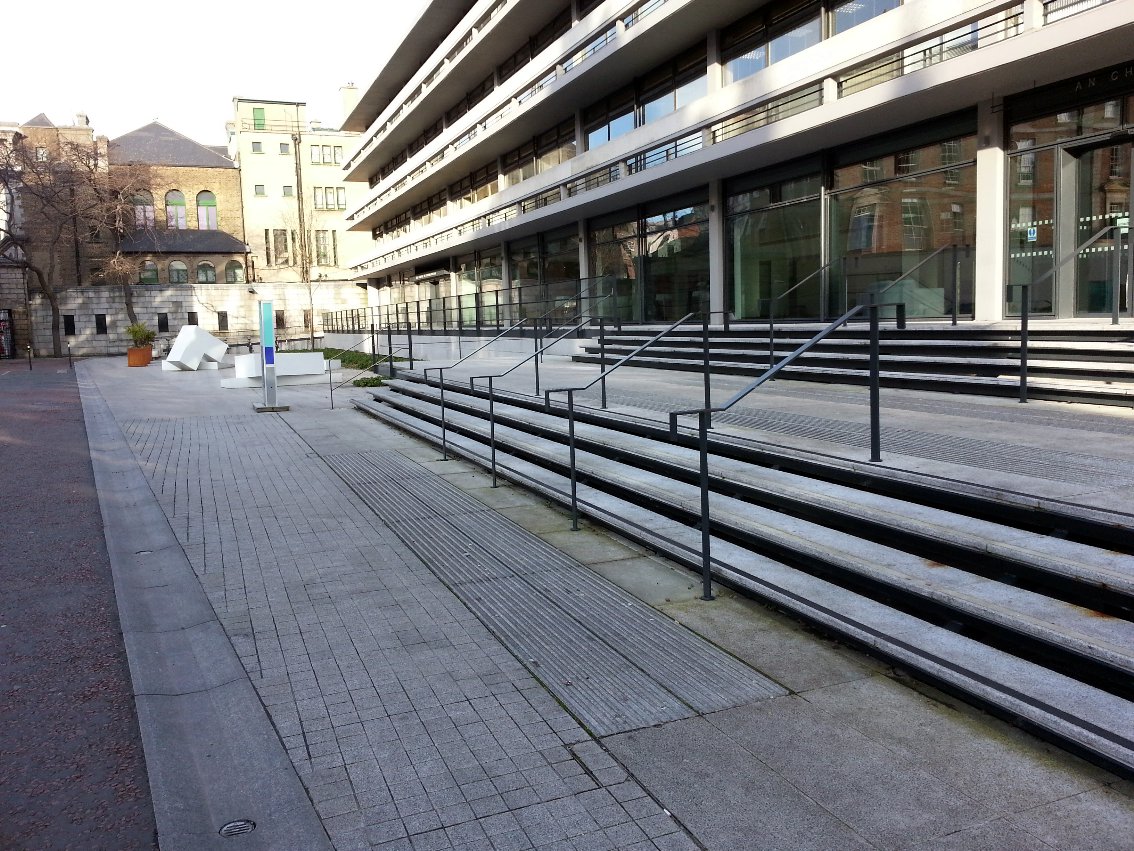
Colour photograph showing the Main Entrance to the New Criminal Courts of Justice Building in Dublin, with entrance steps in the foreground. Photograph taken by CJ Walsh. 2011-03-30. Click to enlarge.
.
Post Occupation Evaluation (POE) is not a well-known architectural concept among architects … and even when it is known, it is not the most favoured. This subject has, in my direct experience, been treated with light-hearted frivolity in 8 Merrion Square, Dublin ! Afterall, who wants to meet the failures of their cherished designs head-on … up-front and in their faces ?? To some architects, successes never seem to count as being of equal, or more, importance. But, they are both a vital tool in continuous learning.
POE, however, is a crucial part of work as a practicing architect. It is essential to feed previous design failures and successes … and ‘real’ information about building user/occupant behaviour … back into new projects ! This is ‘real’ CPD (Continuing Professional Development) in action … and a serious issue which is completely overlooked in the Royal Institute of the Architects of Ireland’s current approach to CPD !!
The reason so much of the built environment … so many buildings … is/are so inaccessible for many people … is not because designers have something against people with activity limitations … it is because designers just do not want human beings … anybody … to enter and use their buildings. People are so messy … and they always want to do silly things with a building which were never planned … or they want to change things around, spoiling ‘the design’ … etc., etc., etc.
This problem begins back in the architectural schools, and becomes a deeper problem on the professional practice courses organized by professional institutes … here, and in other countries. POE and building user/occupant behaviour is not covered … at all ! Can you believe that ?? I still can’t.
Tyranny of the Plan is another architectural concept. I will try to explain it this way. Take the photograph above. Why, for example, are there no handrails on the right hand side … the major part … of those steps ? Because of that Tyranny of the Plan Drawing ! It looked ‘right’ … beautiful, almost sexy … just to have handrails on that part of the steps leading from the main front doors … design movement was continued and controlled. This is not the same as people movement.
On Sunday morning last, I measured those steps myself … (riser) 150 mm in height x (going) 300 mm in depth … (2 x riser) + (1 x going) = 600 mm … ideal dimensions for steps inside a building … but not the most convenient, comfortable or safe dimensions for steps outside a building.
Handrails are definitely required throughout the full extent of the steps ! But, that would have looked very sloppy on the plan drawing. Now, however, take a closer look at those steps … looking down from above … and just imagine that you are a frail, older person and your sight may not be the greatest … that you are visually impaired in some manner …

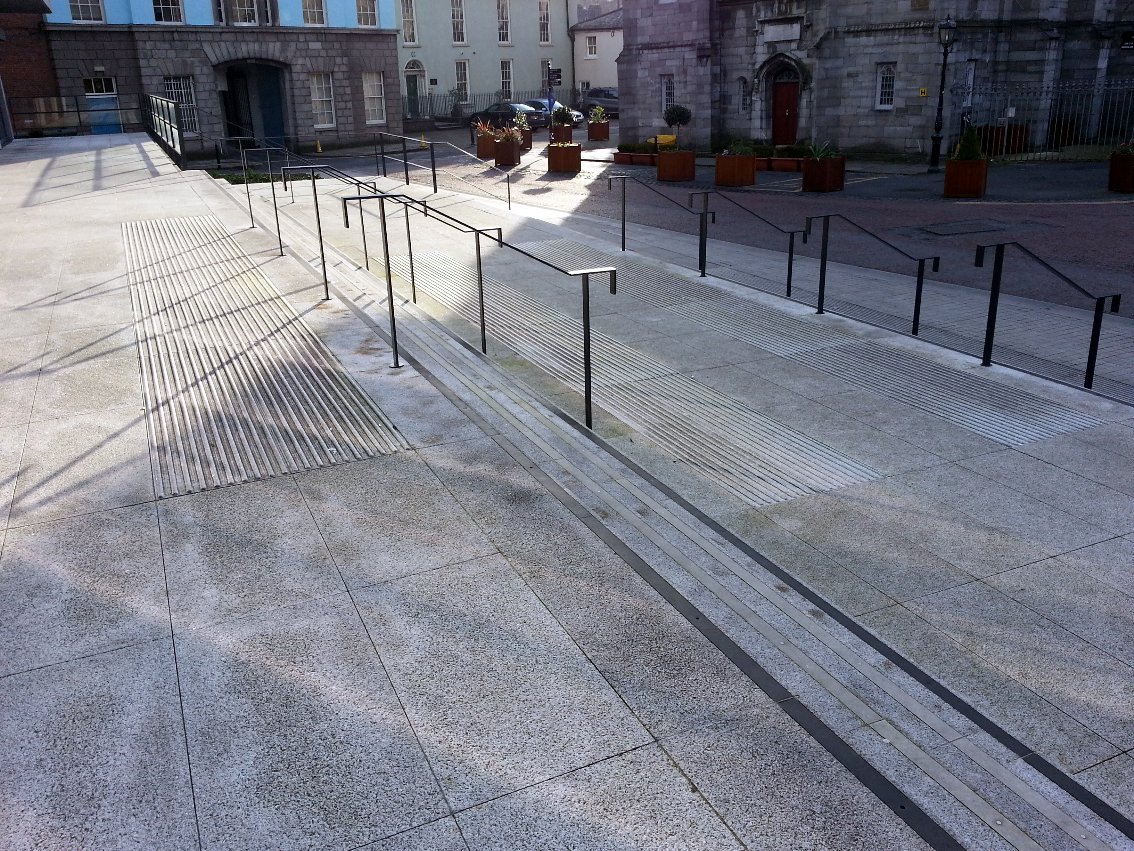
Colour photograph showing details of the steps, handrails and tactile ground surface indicators at the Main Entrance to the New Criminal Courts of Justice Building in Dublin, Ireland. Photograph taken by CJ Walsh. 2011-03-30. Click to enlarge.
The wrong type of tactile ground surface information is being given at the top and bottom of the steps … we would like to warn users of the hazard they are approaching, i.e. the steps, by using a ‘blister’ surface indicator … not direct them to turn left or right when they perceive those continuous ‘corduroy’ ridges. The horizontal handrail extensions at the top and bottom of the short flight of steps are insufficiently long. There is inadequate visual contrast at all of the step nosings (i.e. the leading top edges) which would have helped people to accurately locate those edges. And, as already referred to above, the step dimensions could have been greatly improved with a slight adjustment … for example, (riser) 125 mm in height x (going) 350 mm in depth … (2 x riser) + (1 x going) = 600 mm … much better altogether for steps outside a building ! Compare and contrast with the many Japanese photographs shown in earlier posts. There is no comparison ! This is sloppy work in Dublin.
Mies van der Rohe (1886-1969), the Master German Architect, is often quoted as having said: “God is in the details”. Right on, Ludwig … ride ‘em cowboy !!!
.
For security reasons, it was not possible to take any photographs inside the building. However, it was abundantly clear that accessibility for people with activity limitations, generally, was inadequate. While some small account had been taken of the needs of people using wheelchairs … people with a visual impairment would have a very difficult time using this building. Furthermore, when it came to the ‘swearing-in’ of Jurors at Court No.7, circulation was incredibly confined and restricted … I was having to squeeze myself forward in order to be ‘processed’. What a mess !
This was an unacceptable and very disappointing example of poor, misguided and minimalist accessibility implementation … making an ironclad case for effective independent verification of Accessibility Performance, as required by the United Nations Convention on the Rights of Persons with Disabilities … at the end of the design stage in a project, and especially during the actual process of construction … to ensure that an ‘informed’ design intention becomes reality.
UN CRPD Article 33 – National Implementation & Monitoring
1. States Parties, in accordance with their system of organization, shall designate one or more focal points within government for matters relating to the implementation of the present Convention, and shall give due consideration to the establishment or designation of a co-ordination mechanism within government to facilitate related action in different sectors and at different levels.
2. States Parties shall, in accordance with their legal and administrative systems, maintain, strengthen, designate or establish within the State Party, a framework, including one or more independent mechanisms, as appropriate, to promote, protect and monitor implementation of the present Convention. When designating or establishing such a mechanism, States Parties shall take into account the principles relating to the status and functioning of national institutions for protection and promotion of human rights.
3. Civil society, in particular persons with disabilities and their representative organizations, shall be involved and participate fully in the monitoring process.
.
And that is not the end of the story ! When construction of a building has been completed and it is then occupied, Competent Building Management is critical in maintaining an initial level of good accessibility performance throughout the life cycle of that building. Once again, however, the management of this building was sloppy … take a bow, the Courts Service of Ireland !
Symptoms of Larger Problems … Two Short Little Anecdotes …
a) Unheeded Building Evacuation Warning
In the middle of Roll Call, on the first morning that I attended as a Juror, a Voiced Stand-By Building Evacuation Warning was announced over the building’s public address system. It was explained that there had been ‘an incident’. That’s all … no other information was given. This announcement was repeated again, and again, and again. It then stopped, momentarily, and then started again. It finally ended.
During the announcements … we all looked around … there were at least 150 people in the room … then looked at each other, shrugged our shoulders and smiled. We at least thought that the person in charge of the Roll Call would be in a position to quickly find out what was going on … but no, she also shrugged her shoulders and carried on calling out names.
Afterwards, I asked one of the many ushers what had happened … was it a serious incident ? He didn’t know, and just stated that ushers are generally told nothing.
This is entirely unacceptable ! Are clowns managing the New Criminal Courts of Justice Building in Dublin ??
b) Disrespectful ‘Swearing-In’ of Jurors
An Information Leaflet, produced by the Courts Service back in January 2010, entitled: ‘Attending for Jury Service’ … contains the following Introduction …
Jury Service is an important civic duty. It is a vital part of our criminal justice system. You must arrive on time to ensure trials are not delayed. To assist you we have prepared this leaflet which includes a map to guide you to (the) jury assembly area of the Criminal Courts of Justice.
Concerning ‘Swearing-In a Jury’ … it is stated in the Leaflet …
The court registrar calls out your name and asks you to take an oath on the Holy Book of your choice, or you may affirm.
From the beginning, nobody was informed about these options. On the final morning, when I was selected to be a Juror, the only Holy Book which was placed in front of Jurors was the Christian Bible. No other Holy Book was visible. Everyone was being processed in one way … without any consideration or respect for their dignity as an individual person.
With all of the stress of these occasions, and the formalities involved … the ‘Swearing-In’ Judge was even wearing a wig (I thought that those days were long gone !) … it would be all too easy for people … ‘automatically’, almost by reflex action, and not wanting to make a fuss … to go through a ‘standard’ processing procedure, which for them had little or no meaning. Is that the intended purpose of ‘Swearing-In’ ??
It may have escaped the attention of the Courts Service that Ireland is now a pluralist and richly varied multi-cultural society. Some people are religious, others are not … some people are Christians, others are Moslems, Jews or Buddhists, etc., etc … whatever !
A range of Holy Books must be visible to all Jurors … and they must all be informed about the option of ‘Affirming’ … before ‘Swearing-In’ commences !
.
.
END
‘Accessibility-for-All’ – Post EU Ratification of the 2006 UN CRPD
2011-02-28: Further to my posts, dated 15 January 2011 and 5 February 2011 …
There is an easy way to understand the 2006 United Nations Convention on the Rights of Persons with Disabilities (CRPD), which was ratified by the European Union (EU) just before Christmas Day 2010:
For a sizeable group of vulnerable people in all of our societies, the sole route of access to many, if not most, of the Human and Social Rights set down in the 1948 Universal Declaration of Human Rights (UDHR) … is the UN CRPD … which only became an International Legal Instrument on 3 May 2008 … just short of 60 Years after the UDHR was adopted on 10 December 1948 !
That is precisely why Accessibility is such a critical component of the 2006 UN Convention … which has already been described, here, as a ‘Mixed Agreement’ (see the post of 5 February 2011).
Accessibility is the principal, common ingredient in ‘fields that fall in part within the competence of the European Union, in part within that of the Member States and in part within the shared competence of the EU and its Member States’. Accessibility has an impact … and always will have an impact … on all of these fields.
Policy and Decision Makers at every level within the European Union and the EU Member States would need to become accustomed to this new concept very, very quickly.
It is also essential, therefore, for the EU and the Member States to closely co-operate in implementing legislation which stems from the UN CRPD in a coherent manner … and to ensure unity in the international representation of the Union.
.
APPROACHING THE TASK OF ACCESSIBILITY IMPLEMENTATION
1. Establishing an Initial Framework …
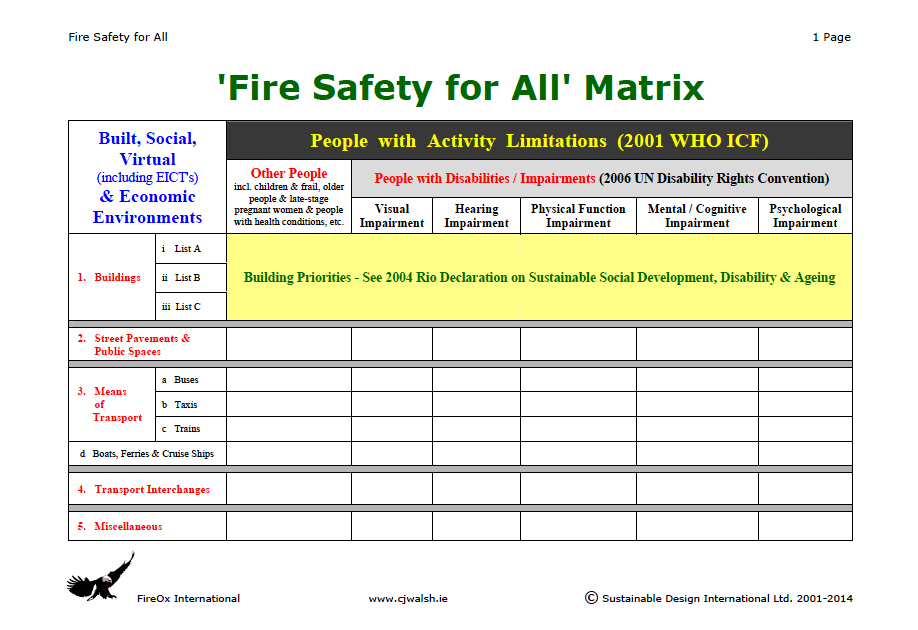
Exactly how should we make sense of … bring order and assign priorities to … the Accessibility-related Articles in the UN Convention … using the different terms ‘Accessibility’ and ‘Accessibility-for-All’ … ‘People/Persons with Disabilities’ and ‘People with Activity Limitations’ (2001 WHO ICF) … in relation to the different components of the Human Environment, i.e. the Built, Social, Virtual and Economic Environments ???
Our recommendation … SDI’s Recommendation … is to refer, in the first instance, to this ‘Accessibility-for-All’ Matrix … which we developed a few years ago … in preparation for this crucial period of implementation …

Colour image showing Sustainable Design International's 'Accessibility-for-All' Matrix. The Goal is a Sustainable Human Environment which is Accessible-for-All. Click to enlarge.
.
If we then drill down … in order to fully understand ‘Accessibility of a Building’, for example … this then comprises:
- Approach to the building ;
- Entry through principal entrance(s) ;
- Health, Safety, Convenience & Comfort in Use, including thermal comfort, indoor air quality, protection from fire, etc ;
- Egress from the building (during normal conditions) ;
- Removal from the vicinity of the building (during normal conditions) ;
and
- Evacuation from the building (during, for example, a fire emergency) ;
- Safe Movement to a ‘place of safety’ (during, for example, a fire emergency), which is remote from the building ;
and
- Each stage of a Work Process, at every level, in places of work ;
- Use of Electronic, Information & Communication Technologies (EICT’s) ;
and
- Management, Services, and Attitudes of People in the building ;
- Recruitment, Employment, Training & Promotion Practices.
.
2. Overlaying UN CRPD Article 9 – Accessibility …
Onto the Initial Framework outlined above … overlay Article 9 … and crosscheck in detail. Note well the strong language used … ‘States Parties shall’ … and do not forget that this is not a Wish List … but a clear delineation of the Scope of an Important Human and Social Right which now has a proper basis in both International and European Union Law !
1. To enable persons with disabilities to live independently and participate fully in all aspects of life, States Parties shall take appropriate measures to ensure to persons with disabilities access, on an equal basis with others, to the physical environment, to transportation, to information and communications, including information and communications technologies and systems, and to other facilities and services open or provided to the public, both in urban and in rural areas. These measures, which shall include the identification and elimination of obstacles and barriers to accessibility, shall apply to, inter alia:
(a) Buildings, roads, transportation and other indoor and outdoor facilities, including schools, housing, medical facilities and workplaces ;
(b) Information, communications and other services, including electronic services and emergency services.
2. States Parties shall also take appropriate measures:
(a) To develop, promulgate and monitor the implementation of minimum standards and guidelines for the accessibility of facilities and services open or provided to the public ;
(b) To ensure that private entities that offer facilities and services which are open or provided to the public take into account all aspects of accessibility for persons with disabilities ;
(c) To provide training for stakeholders on accessibility issues facing persons with disabilities ;
(d) To provide in buildings and other facilities open to the public signage in Braille and in easy to read and understand forms ;
(e) To provide forms of live assistance and intermediaries, including guides, readers and professional sign language interpreters, to facilitate accessibility to buildings and other facilities open to the public ;
(f) To promote other appropriate forms of assistance and support to persons with disabilities to ensure their access to information ;
(g) To promote access for persons with disabilities to new information and communications technologies and systems, including the Internet ;
(h) To promote the design, development, production and distribution of accessible information and communications technologies and systems at an early stage, so that these technologies and systems become accessible at minimum cost.
.
So … what is the situation in the Member States of the European Union ?
In an upcoming post … let’s take Ireland as a case in point, just for the hell of it … and discuss some of the consequences … stemming from the EU’s ratification of the UN CRPD … on the operation of the Building Regulations and Disability Access Certificates (DAC’s).
.
.
END
Personal Ethics – The Heart of Sustainability Implementation !
2011-02-15 …
Regular visitors, here, will have very little doubt about my understanding of Sustainable Human & Social Development … which is an intricate, open, dynamic and continuously evolving concept. And about my firm conviction that Sustainable Design involves far more than merely substituting the word ‘sustainable’ … for ‘green’, ‘ecological’ or ‘environment-friendly’ … or any number of insipid alternatives which still regularly appear in the popular and/or academic media ! Who, in their right minds, wouldn’t be confused ?!?
‘Sustainability’ is Not … and Cannot … be just another graft onto Conventional Design Practice … whether that be Spatial Planning, Architectural / Engineering / Industrial Design or e-Design !
Sustainable Design & Construction … is the ethical response, in built or wrought (worked) form, to the concept of ‘Sustainable Human & Social Development’.
.
SUSTAINABILITY IMPLEMENTATION
Opinion: At the Heart of Implementation which is Authentically ‘Sustainable’ … (a colleague of mine is very fond of using that word ‘authentic’) … must lie a Personal Code of Ethics. By that, I do Not mean … and I am Not referring to … a Professional Code of Conduct … which is mainly about the self-protection and self-preservation of a professional class !
Everyday Reality: If we examine, for a moment, two interesting examples … Climate Change Mitigation & Adaptation or the 9-11(2001) Collapses of World Trade Center Buildings 1, 2 & 7 in New York … such is the great timelag between general societal recognition of a critical design challenge … and then, the passing of relevant national legislation which can really only demarcate a minimal threshold of performance … and next, the associated production of standardized design guidelines … and finally, the imposition of effective monitoring and verification procedures … that the only practical approach is to base Sustainability Implementation on a robust Personal Code of Ethics … with an overt emphasis on Continuing Personal Development (CPD).
I hasten to add that this is not how we (society) are currently educating the design disciplines … and this is not how the professional institutes are operating.
.
PERSONAL CODE OF ETHICS
For many years, in my presentations around Europe, the Arab Gulf Region, India and South America … I have been actively promoting the WFEO/FMOI (UNESCO) Model Code of Ethics as a suitable template for use by all of the design-related disciplines. Recently, however, our Organization … Sustainable Design International … has undertaken a major review of this 2001 Code, and produced a 2011 Update which tackles the following matters of major concern in our world of shameful waste and socially inequality:
- Sustainable Human & Social Development ;
- Climate Change Mitigation & Adaptation ;
- Strengthening the Voice of Vulnerable Social Groups, particularly People with Activity Limitations.
.
WFEO/FMOI (UNESCO)
World Federation of Engineering Organizations – Fédération Mondiale des Organisations d’Ingénieurs
MODEL CODE OF ETHICS
Since 1990, WFEO/FMOI has worked to prepare a Code of Ethics under the supervision of Donald Laplante (Canada), David Thom (New Zealand), Bud Carroll (USA), and others. It is expected that the Model Code, adopted in 2001, will be used to define and support the creation of codes in member and related professional institutions. This version of the Model Code was updated by C.J. Walsh (Ireland) in 2011.
CONTENTS
I. BROAD PRINCIPLES
II. PRACTICE PROVISION ETHICS
III. ETHICS OF SUSTAINABLE ENGINEERING
IV. CONCLUSION
INTERPRETATION OF THE CODE
- Sustainable Development & Climate Change
- Protection of the Public, and the Natural Environment
- Faithful Agent of Clients and Employers
- Competence & Knowledge
- Fairness and Integrity in the Workplace
- Professional Accountability & Leadership
.
WFEO/FMOI MODEL CODE OF ETHICS
I. BROAD PRINCIPLES
Ethics is generally understood as the discipline or field of study dealing with moral duty or obligation. This typically gives rise to a set of governing principles or values, which in turn are used to judge the appropriateness of a particular conduct or behaviour. These principles are usually presented either as broad guiding principles of an idealistic or inspirational nature or, alternatively, as a detailed and specific set of rules couched in legalistic or imperative terms to make them more enforceable. Professions which have been given the privilege and responsibility of self regulation, including the engineering professions, have tended to opt for the first alternative, espousing sets of underlying principles as codes of professional ethics which form the basis and framework for responsible professional practice. Arising from this context, professional codes of ethics have sometimes been incorrectly interpreted as a set of ‘rules’ of conduct intended for passive observance. A more appropriate use by practicing professionals is to interpret the essence of the underlying principles within their daily decision-making situations in a dynamic manner, responsive to the needs of the situation. As a consequence, a code of professional ethics is more than a minimum standard of conduct ; rather, it is a set of principles which should guide professionals in their daily work.
In summary, the Model Code presented herein elaborates the expectations of engineers and society in discriminating engineers’ professional responsibilities. The Code is based on broad principles of truth, honesty and trustworthiness, respect for human life and social wellbeing, fairness, openness, competence and accountability. Some of these broader ethical principles or issues deemed more universally applicable are not specifically defined in the Code, although they are understood to be applicable as well. Only those tenets deemed to be particularly applicable to the practice of professional engineering are specified. Nevertheless, certain ethical principles or issues not commonly considered to be part of professional ethics should be implicitly accepted to judge the engineer’s professional performance.
Issues regarding protection of the natural environment, climate change mitigation and adaptation, and sustainable development know no geographical boundaries. The engineers and citizens of all nations should know and respect the ethics of sustainability. It is desirable, therefore, that engineers in each nation continue to observe the philosophy of the Principles of Sustainable Ethics, as delineated in Section III of this code.
II. PRACTICE PROVISION ETHICS
Professional engineers shall:
- hold paramount the safety, health and wellbeing of the public, particularly people with activity limitations, indigenous peoples and other vulnerable groups in society … and the protection of both the natural and the built environments in accordance with the Principles of Sustainable Human & Social Development ;
- promote health and safety within the workplace ;
- offer services, advise on or undertake engineering assignments only in areas of their competence, and practice in a careful and diligent manner ;
- act as faithful agents of their clients or employers, maintain confidentially and disclose conflicts of interest ;
- keep themselves informed in order to maintain their competence, strive to advance the body of knowledge within which they practice and provide opportunities for the professional development of their subordinates and fellow practitioners ;
- conduct themselves with fairness, and good faith towards clients, colleagues and others, give credit where it is due and accept, as well as give, honest and fair professional criticism ;
- be aware of and ensure that clients and employers are made aware of the environmental and socio-economic consequences of actions or projects, and endeavour to interpret engineering issues to the public in an objective and truthful manner ;
- present clearly to employers and clients the possible consequences of overruling or disregarding engineering decisions or judgment ;
- report to their association and/or appropriate agencies any illegal or unethical engineering decisions or practices of engineers or others.
III. ETHICS OF SUSTAINABLE ENGINEERING
Engineers, as they develop any professional activity, shall:
- try with the best of their ability, courage, enthusiasm and dedication, to obtain a superior technical achievement, which will contribute to and promote a healthy and agreeable surrounding for all people, including indigenous peoples and other vulnerable social groups, in open spaces as well as indoors ;
- strive to accomplish the beneficial objectives of their work with the lowest possible consumption of raw materials and energy and the lowest production of wastes and any kind of pollution ;
- discuss in particular the consequences of their proposals and actions, direct or indirect, immediate or long term, upon human health, social equity and the local culture and system of values ;
- study thoroughly the environment that will be affected, assess all the impacts that might arise in the structure, dynamics and aesthetics of the eco-systems involved, urbanized or natural, as well as in the pertinent socio-economic systems … and select the best alternative for development which is environmentally sound, resilient to climate change and sustainable ;
- promote a clear understanding of the actions required to restore and, if possible, to improve the environment that may be disturbed, and include them in their proposals ;
- reject any kind of commitment that involves unfair damages for human surroundings and nature, and aim for the best possible technical, socio-economic, and political solution ;
- be aware that the principles of eco-system interdependence, biodiversity maintenance, resource recovery and inter-relational harmony form the basis of humankind’s continued existence and that each of these bases poses a threshold of sustainability that should not be exceeded.
IV. CONCLUSION
Always remember that war, greed, misery and ignorance, plus natural disasters and human-induced pollution, climate change and destruction of resources, are the main causes for the progressive impairment of the environment and that engineers, as active members of society, deeply involved in the promotion of development, must use our talent, knowledge and imagination to assist society in removing those evils and improving the quality of life for all people, including indigenous peoples and other vulnerable groups.
.
INTERPRETATION OF THE WFEO/FMOI MODEL CODE
The interpretive articles which follow expand on and discuss some of the more difficult and inter-related components of the Code, especially with regard to the Practice Provisions. No attempt is made to expand on all clauses of the Code, nor is the elaboration presented on a clause-by-clause basis. The objective of this approach is to broaden the interpretation, rather than narrow its focus. The ethics of professional engineering is an integrated whole and cannot be reduced to fixed ‘rules’. Therefore, the issues and questions arising from the Code are discussed in a general framework, drawing on any and all portions of the Code to demonstrate their inter-relationship and to expand on the basic intent of the Code.
Sustainable Development & Climate Change
Engineers shall strive to enhance the quality, durability and climate change resilience of the Human Environment (including the built, social, economic and virtual environments), and to promote the Principles of Sustainable Human & Social Development.
Engineers shall seek opportunities to work for the enhancement of safety, health, and the social wellbeing of both their local community and the global community through the practice of sustainable development.
Engineers whose recommendations are overruled or ignored on issues of safety, health, social wellbeing, or sustainable development, shall inform their contractor or employer of the possible consequences.
Protection of the Public, and the Natural Environment
Professional Engineers shall hold paramount the safety, health and wellbeing of the public, including people with activity limitations, indigenous peoples and other vulnerable groups in society … and protection of the natural environment. This obligation to the safety, health and wellbeing of the general public, which includes his/her own work environment, is often dependent upon engineering judgments, risk assessments, decisions and practices incorporated into structures, machines, products, processes and devices. Therefore, engineers must control and ensure that what they are involved with is in conformity with accepted engineering practices, standards and applicable codes, and would be considered safe based on peer adjudication. This responsibility extends to include all and any situations which an engineer encounters, and includes an obligation to advise the appropriate authority if there is reason to believe that any engineering activity, or its products, processes, etc., do not conform with the above stated conditions.
The meaning of paramount in this basic tenet is that all other requirements of the Code are subordinate, if protection of public safety, the natural environment or other substantive public interests are involved.
Faithful Agent of Clients and Employers
Engineers shall act as faithful agents or trustees of their clients and employers with objectivity, fairness and justice to all parties. With respect to the handling of confidential or proprietary information, the concept of ownership of the information and protecting that party’s rights is appropriate. Engineers shall not reveal facts, data or information obtained in a professional capacity without the prior consent of its owner. The only exception to respecting confidentially and maintaining a trustee’s position is in instances where the public interest or the natural environment is at risk, as discussed in the preceding section ; but even in these circumstances, the engineer should endeavour to have the client and/or employer appropriately redress the situation, or at least, in the absence of a compelling reason to the contrary, should make every reasonable effort to contact them and explain clearly the potential risks, prior to informing the appropriate authority.
Professional Engineers shall avoid conflict of interest situations with employers and clients but, should such conflict arise, it is the engineer’s responsibility to fully disclose, without delay, the nature of the conflict to the party/parties with whom the conflict exists. In those circumstances where full disclosure is insufficient, or seen to be insufficient, to protect all parties’ interests, as well as the public, the engineer shall withdraw totally from the issue or use extraordinary means, involving independent parties if possible, to monitor the situation. For example, it is inappropriate to act simultaneously as agent for both the provider and the recipient of professional services. If a client’s and an employer’s interests are at odds, the engineer shall attempt to deal fairly with both. If the conflict of interest is between the intent of a corporate employer and a regulatory standard, the engineer must attempt to reconcile the difference, and if that is unsuccessful, it may become necessary to inform his/her association and the appropriate regulatory agency.
Being a faithful agent or trustee includes the obligation of engaging, or advising to engage, experts or specialists when such services are deemed to be in the client’s or employer’s best interests. It also means being accurate, objective and truthful in making public statements on behalf of the client or employer when required to do so, while respecting the client’s and employer’s rights of confidentiality and proprietary information.
Being a faithful agent includes not using a previous employer’s or client’s specific privileged or proprietary information and trade practices or process information, without the owner’s knowledge and consent. However, general technical knowledge, experience and expertise gained by the engineer through involvement with the previous work may be freely used without consent or subsequent undertakings.
Competence & Knowledge
Professional Engineers shall offer services, advise on or undertake engineering assignments only in areas of their competence by virtue of their training and experience. This includes exercising care and communicating clearly in accepting or interpreting assignments, and in setting expected outcomes. It also includes the responsibility to obtain the services of an expert if required or, if the knowledge is unknown, to proceed only with full disclosure of the circumstances and, if necessary, of the experimental nature of the activity to all parties involved. Hence, this requirement is more than simply duty to a standard of care, it also involves acting with honesty and integrity with one’s client or employer, and one’s self. Professional Engineers have the responsibility to remain abreast of developments and knowledge in their area of expertise, that is, to maintain their own competence. Should there be a technologically driven or individually motivated shift in the area of technical activity, it is the engineer’s duty to attain and maintain competence in all areas of involvement including being knowledgeable with the technical and legal framework and regulations governing their work. In effect, it requires a personal commitment to ongoing professional development, continuing education and self-testing.
In addition to maintaining their own competence, Professional Engineers have an obligation to strive to contribute to the advancement of the body of knowledge within which they practice, and to the profession in general. Moreover, within the framework of the practice of their profession, they are expected to participate in providing opportunities to further the professional development of their colleagues.
This competence requirement of the Code extends to include an obligation to the public, the profession and one’s peers, that opinions on engineering issues are expressed honestly and only in areas of one’s competence. It applies equally to reporting or advising on professional matters and to issuing public statements. This requires honesty with one’s self to present issues fairly, accurately and with appropriate qualifiers and disclaimers, and to avoid personal, political and other non-technical biases. The latter is particularly important for public statements or when involved in a technical forum.
Fairness and Integrity in the Workplace
Honesty, integrity, continuously updated competence, devotion to service and dedication to enhancing the life quality of society are cornerstones of professional responsibility. Within this framework, engineers shall be objective and truthful and include all known and pertinent information in professional reports, statements and testimony. They shall accurately and objectively represent their clients, employers, associates and themselves, consistent with their academic experience and professional qualifications. This tenet is more than ‘not misrepresenting’ ; it also implies disclosure of all relevant information and issues, especially when serving in an advisory capacity or as an expert witness. Similarly, fairness, honesty and accuracy in advertising are expected.
If called upon to verify another engineer’s work, there is an obligation to inform (or make every effort to inform) the other engineer, whether the other engineer is still actively involved or not. In this situation, and in any circumstance, engineers shall give proper recognition and credit where credit is due and accept, as well as give, honest and fair criticism on professional matters, all the while maintaining dignity and respect for everyone involved.
Engineers shall not accept, nor offer covert payment or other considerations for the purpose of securing, or as remuneration for, engineering assignments. Engineers should prevent their personal or political involvement from influencing or compromising their professional role or responsibility.
Consistent with the Code, and having attempted to remedy any situation within their organization, engineers are obligated to report to their association or other appropriate agency any illegal or unethical engineering decisions by engineers or others. Care must be taken not to enter into legal arrangements which compromise this obligation.
Professional Accountability & Leadership
Engineers have a duty to practice in a careful and diligent manner, and accept responsibility and be accountable for their actions. This duty is not limited to design, or its supervision and management, but applies to all areas of practice. For example, it includes construction supervision and management, preparation of drawings, engineering reports, feasibility studies, sustainability impact assessments, engineering developmental work, etc.
The signing and sealing of engineering documents indicates the taking of responsibility for the work. This practice is required for all types of engineering endeavour, regardless of where or for whom the work is done, including but not limited to, privately and publicly owned firms, large corporations, and government agencies or departments. There are no exceptions ; signing and sealing documents is appropriate whenever engineering principles have been used and public wellbeing may be at risk.
Taking responsibility for engineering activity includes being accountable for one’s own work and, in the case of a senior engineer, accepting responsibility for the work of a team. The latter implies responsible supervision where the engineer is actually in a position to review, modify and direct the entirety of the engineering work. This concept requires setting reasonable limits on the extent of activities, and the number of engineers and others, whose work can be supervised by the responsible engineer. The practice of a ‘symbolic’ responsibility or supervision is the situation where an engineer, say with the title of Chief Engineer, takes full responsibility for all engineering on behalf of a large corporation, utility or governmental agency, even though the engineer may not be aware of many of the engineering activities or decisions being made daily throughout the firm or agency. The essence of this approach is that the firm is taking the responsibility by default, whether engineering supervision or direction is applied or not.
Engineers have a duty to advise their employer and, if necessary, their clients and even their professional association, in that order, in situations when the overturning of an engineering decision may result in breaching their duty to safeguard the public, including people with activity limitations, indigenous peoples and other vulnerable social groups. The initial action is to discuss the problem with the supervisor/employer. If the employer does not adequately respond to the engineer’s concern, then the client must be advised in the case of a consultancy situation, or the most senior officer should be informed in the case of a manufacturing process plant or government agency. Failing this attempt to rectify the situation, the engineer must advise in confidence his/her professional association of his/her concerns.
In the same order as mentioned above, the engineer must report unethical engineering activity undertaken by other engineers, or by non-engineers. This extends to include, for example, situations in which senior officials of a firm make ‘executive’ decisions which clearly and substantially alter the engineering aspects of the work, or protection of public wellbeing or the natural environment arising from that work.
Because of developments in technology and the increasing ability of engineering activities to impact on the environment, engineers have an obligation to be mindful of the effect that their decisions will have on the environment and the wellbeing of society, and to report any concerns of this nature in the same manner as previously mentioned. Further to the above, with the rapid advancement of technology in today’s world and the possible social impacts on large populations of people, engineers must endeavour to foster the public’s understanding of technical issues and the role of Engineering more than ever before.
Sustainable development is the challenge of meeting current human needs for natural resources, industrial products, energy, food, transportation, shelter, and effective waste management while conserving and, if possible enhancing, the Earth’s environmental quality, natural resources, ethical, intellectual, working and affectionate capabilities of people and the socio-economic bases essential for the human needs of future generations. The proper observance of these principles will considerably help to eradicate world poverty.
.
WFEO/FMOI Model Code of Ethics, Adopted 2001.
This Version, Updated 2011 & Communicated to UNESCO.
[Footnote to the Code]
Sustainable Human & Social Development: Development which meets the responsible needs, i.e. the Human & Social Rights*, of this generation – without stealing the life and living resources from future generations, especially our children, their children, and the next five generations of children.
*As defined in the 1948 Universal Declaration of Human Rights
.
.
END
EU Ratification of UN Disability Convention – EFC Legal Study
2011-02-05: Further to my post, dated 15 January 2011 …
Many people directly or indirectly involved with Disability-Related Issues in Europe … may not yet know that, a few weeks ago, the European Union ratified the 2006 United Nations Convention on the Rights of Persons with Disabilities (UN CRPD). They may not even know that their own country, as a Member State of the European Union, had perhaps already ratified the UN Convention one or two years earlier.
At this time, the majority of Member States have proceeded, voluntarily, to ratify the Convention … with some of those, inexplicably, declining/refusing to ratify the Convention’s Optional Protocol.
Human & Social Rights can be a difficult subject area !
Ireland has not ratified the UN Convention … and, unfortunately, the attitude of many policy-makers and decision-makers within our Irish Institutions of State, large and small, is that it’s business as usual … no need to worry or fuss, or give a damn … until this country does actually sign on the Convention’s bottom line … an attitude which displays a magnificent ignorance of the changed reality, post Lisbon Treaty, which is the European Union’s Current Legal Environment !!
Please examine carefully, for yourselves, the findings of this Legal Study, recently approved for publication by the European Commission …
European Foundation Centre (EFC)
Brussels, October 2010
Click the Link Above to read and/or download PDF File (1.46 Mb)
.
EU RATIFICATION OF THE UN CRPD – ASPECTS OF EU LAW
The following are selected extracts from the EFC Study … my selection (!) … to answer specific issues relating to UN CRPD Implementation within the European Union. Typographical errors in the Study have also been corrected … and, post Lisbon Treaty, references to the EU Treaties have been properly updated …
The legal basis for the conclusion of the United Nations Convention on the Rights of Persons with Disabilities (UN CRPD) signals the appropriate legal basis for its implementation within the European Union (EU). In this respect, and in line with Article 4 of the UN Convention, implementation implies that instruments may be adopted or modified by the Union in order to comply with the Convention and give effect to its provisions and principles. Although the choice of the legal basis for the decision concluding an international agreement is very important, it is not decisive for implementation. In European Court of Justice Case C-178/0345, which concerned the implementation of the Rotterdam Convention on International Trade in Hazardous Chemicals, the Court stated that ” the fact that one or more provisions of the Treaty have been chosen as legal bases for the approval of an international agreement is not sufficient to show that those same provisions must also be used as legal bases for the adoption of measures intended to implement that agreement at Community level “. The latter statement means that EU Treaty provisions other than those mentioned in EU Council Decision 2010/48/EC to conclude the UN CRPD can be used as legal bases to implement UN CRPD obligations in specific fields.
.
The United Nations Convention on the Rights of Persons with Disabilities (UN CRPD) is an international human rights agreement where both the European Union (EU) and its Member States are contracting parties. The UN Convention is thus a Mixed Agreement. Mixed Agreements involve a Shared Contractual Relationship between the EU, its Member States and one or more third countries and/or international organisations. As a Mixed Agreement, the UN CRPD covers fields that fall in part within the competence of the EU, in part within that of the Member States and in part within the shared competence of the EU and its Member States. It is therefore essential for the EU and the Member States to closely co-operate, in order to implement legislation stemming from the Convention in a coherent manner and ensure unity in the international representation of the Union.
EU Member States, when participating in Mixed Agreements, do not act as entirely autonomous subjects of international law; they are subject to a Duty of Loyal Co-Operation between one another and the EU. This duty extends to each of the negotiation, conclusion and implementation phases. In this sense, there is a collective management of the obligations under international law. The duty of loyal co-operation, deriving from Article 4.3 of the Treaty on European Union (TEU), embraces two sets of obligations: first, Member States shall take appropriate measures, whether general or particular, to ensure fulfilment of the obligations arising out of the EC Treaty or resulting from action taken by the EU Institutions; and second: Member States shall facilitate the achievement of the Union’s tasks and shall abstain from any measure which could jeopardise the attainment of the Union’s objectives … which are set out in Article 3 of the Treaty on European Union (TEU).
Treaty on European Union (TEU) – Consolidated Version, as Amended by the Treaty of Lisbon
Article 4.3
Pursuant to the principle of sincere mutual co-operation, the Union and the Member States shall, in full mutual respect, assist each other in carrying out tasks which flow from the Treaties.
The Member States shall take any appropriate measure, general or particular, to ensure fulfilment of the obligations arising out of the Treaties or resulting from the acts of the institutions of the Union.
The Member States shall facilitate the achievement of the Union’s tasks and refrain from any measure which could jeopardise the attainment of the Union’s objectives.
.
In relation to EU Member States‘ Compliance with a Mixed Agreement concluded by the EU … the European Court of Justice has inferred that for matters falling within EU competence … the Member States fulfil, within the EU system, an obligation in relation to the Union which has assumed responsibility for due performance of the agreement. In other words, if a Member State fails to take all appropriate measures to implement provisions of the Mixed Agreement that fall within the competence of the EU … it not only fails to fulfil its international obligation, but is also acting in breach of EU Law. The European Commission may thus bring an infringement case against a Member State that has not properly fulfilled its duty. The principle underpinning such mechanisms is the ‘duty of loyal co-operation’, which provides the foundation for managing shared competence within Mixed Agreements.
The line dividing international responsibility for implementation of the International Mixed Agreement between the EU and its Member States depends on the obligations respectively assumed. The UN CRPD contains a clause setting out ‘separate’ responsibility. According to Article 44.1, Regional Integration Organisations acceding to the Convention shall declare, in their instruments of formal confirmation or accession, the extent of their competence. This division of responsibility for implementation implies that the European Union only bears responsibility for the breach of those obligations it has assumed.
EU Council Decision 2010/48/EC on the conclusion of the UN CRPD refers to EU competence in respect of those matters governed by the UN CRPD, and lists EU Instruments which demonstrate such competence.
.
STRUCTURE OF THE EFC REPORT
The main objective of the Study was to analyse the obligations set out in the UN CRPD and, in particular, to gather information about the various practices of the EU Member States and the European Union in implementing the UN CRPD.
The work was carried out by the European Foundation Centre (EFC), representing the European Consortium of Foundations on Human Rights and Disability … under Contract No. VC/2008/1214 … for the European Commission‘s Directorate-General for Employment, Social Affairs & Inclusion.
Section 1 of this Report sets the appropriate background for the analysis that will follow.
Section 2 of the Report provides an overview and general recommendations on the implementation of the social model of disability, and core obligations deriving from Article 1 and Preamble Paragraph (e) of the UN CRPD.
Section 3 of the Report provides an overview and general recommendations on the implementation of Article 3 (General Principles), Article 4 (General Obligations), Article 5 (Equality and Non-Discrimination), and Article 9 (Accessibility) of the UN CRPD. The section also reviews UN CRPD articles on Inter-Sectionality, namely Articles 6 (Women with Disabilities) and Article 7 (Children with Disabilities). It is worth noting that the articles addressed in this section are articles of general and crosscutting application, and therefore their application is relevant for the implementation of all articles of the Convention.
Section 4 of the Report provides an overview and general recommendations on the implementation of selected substantive provisions of the UN CRPD which apply existing civil, political, economic, social and cultural rights within the context of disability. Specifically, the section considers the implementation of Articles 16 (Freedom from Exploitation, Violence and Abuse) and 17 (Protecting the Integrity of the Person), which are seeking to assert protections that underscore the humanity of all persons with disabilities. The section also considers the implementation of Articles 12 (Equal Recognition before the Law) and 19 (Living Independently and Being Included in the Community), both of which aim at maintaining and safeguarding the autonomy of the person. Furthermore, articles on specific accessibility rights, namely Article 13 (Access to Justice) and Article 29 (Participation in Political and Public Life), are likewise addressed. Finally, the section considers the implementation of Articles 24 (Education) and 27 (Work and Employment).
Section 5 of the Report contains an overview and general recommendations on the implementation of articles which outline steps that are necessary to support reforms. Specifically, the section considers the implementation of Article 31 (Statistics and Data Collection), Article 32 (International Co-Operation), and Article 33 (National Implementation and Monitoring).
Section 6 of the Report suggests good practices for the EU and national policy-makers for the future and overall implementation of the Convention, and the effective achievement of its objectives.
It is worth noting that, while it is hard to be definitive, given that the UN Committee on the Rights of Persons with Disabilities is still in its infancy and has yet to pronounce on the obligations of the UN CRPD … it is nevertheless possible on the basis of the general principles of the Convention and interpretative tools, such as the Vienna Convention on the Law of Treaties, to identify illustrative challenges to the implementation of the UN CRPD. For the purposes of this Study, the review of EU and Member States policies and legal instruments is based on the analysis of the UN CRPD and checklists that were produced from this Study to measure progress.
Finally, for the purposes of the Study, a challenge is defined as a ‘difficulty’ posed by existing national or EU practice which may potentially hamper the full and effective implementation of the UN CRPD by the EU Member States and/or the European Union. In order to meet such challenges, it will be necessary, inter alia, for the EU (as appropriate) and/or its Member States to review legislation and/or policy with a view to full compliance. On the other hand, a practice is defined as good if it fulfils certain requirements of the Convention or mainstreams the general principles, consistent with Article 3 of the UN CRPD, and has an awareness-raising impact.
.
.
END
EU Accessibility & Ratification of UN Disability Rights Convention
2011-01-15: Recently, I was waiting … and waiting … for the first mention of this important news to pop up on any of the European Disability Networks … the Formal Ratification by the European Union (EU) of the 2006 United Nations Convention on the Rights of Persons with Disabilities … on 23 December 2010 last.
History in the making !!
This U.N. Convention was adopted on 13 December 2006 (2006-12-13), at the United Nations Headquarters in New York … and was opened for signature on 30 March 2007. It entered into force, i.e. became an International Legal Instrument, on 3 May 2008 (2008-05-03). A copy of the Convention can be downloaded, here, on this Site … in my post, dated 31 October 2009.
Finally, on Monday 10 January 2011 … via ICTA-Europe, EDeAN, and the EU Press Release below … it was announced …
EU Press Release IP/11/4 – Brussels, 5 January 2011
EU Ratifies UN Convention on Disability Rights
Click the Link Above to read and/or download PDF File (25kb)
So much for instant communication in our much-vaunted Information / Knowledge / Smart Society !!
.
Ordinarily, this news would be nothing to get excited about.
BUT … since the Lisbon Treaty entered into force on 1 January 2009 … the European Union now has a legal personality all of its own, separate from those of the individual EU Member States. See Article 47 in Title VI – Final Provisions – of the Treaty on European Union (consolidated version).
This is the first time that the EU has become a party to an international treaty.
The 2006 United Nations Convention on the Rights of Persons with Disabilities is now part of the European Union’s Acquis Communautaire, i.e. the extensive body of EU Law.
.
The consequential impacts flowing, therefore, from the EU’s Ratification of the U.N. Convention … at both European and Member State (National) levels … will be very, very interesting to observe during the immediate short term. [A note of caution ... be patient, and allow for a short period of 'bedding-in' at the start. See below.]
The European Commission, for example, must now take full account of the Convention in the drafting and implementation of any new legislation, policies and programmes … in fact, all of its activities.
The European Court of Justice must also take full account of the Convention in all of its work.
This will, inevitably, heavily influence what is … or is not … happening with regard to social and other policies at national level in the Member States. Many Member States (16) have already ratified the Convention … and more power to them ! BUT among these 16 … the Czech Republic and Denmark have not yet ratified the UN Convention’s Optional Protocol … how strange … and unacceptable !!
Some Member States … and I am thinking specifically of Ireland … will have to be dragged, screaming, to the point of ratification. And even when that position has been reached … proper implementation will always be an issue. Just consider, for a moment, Ireland’s uncaring and ham-fisted approach to implementation of the 1989 U.N. Convention on the Rights of the Child … which it did actually ratify way back on 28 September 1992 ! See my post, dated 30 November 2009.
.
Accessibility of the ‘Human Environment’ – A Harmonized EU Understanding !
As far as the European Union must now be concerned … and all of the EU Member States … Preamble Paragraph (g) and Articles 9, 10 & 11 of the 2006 United Nations Convention on the Rights of Persons with Disabilities – together – form the basis of a harmonized understanding for Accessibility of the ‘Human Environment’ … which includes the Built Environment, the Social Environment, the Economic Environment, and the Virtual Environment … concepts which I have defined, here, many times before.
Preamble Paragraph (g)
Emphasizing the importance of mainstreaming disability issues as an integral part of relevant strategies of sustainable development,
Article 9 – Accessibility
1. To enable persons with disabilities to live independently and participate fully in all aspects of life, States Parties shall take appropriate measures to ensure to persons with disabilities access, on an equal basis with others, to the physical environment, to transportation, to information and communications, including information and communications technologies and systems, and to other facilities and services open or provided to the public, both in urban and in rural areas. These measures, which shall include the identification and elimination of obstacles and barriers to accessibility, shall apply to, inter alia:
(a) Buildings, roads, transportation and other indoor and outdoor facilities, including schools, housing, medical facilities and workplaces ;
(b) Information, communications and other services, including electronic services and emergency services.
2. States Parties shall also take appropriate measures:
(a) To develop, promulgate and monitor the implementation of minimum standards and guidelines for the accessibility of facilities and services open or provided to the public ;
(b) To ensure that private entities that offer facilities and services which are open or provided to the public take into account all aspects of accessibility for persons with disabilities ;
(c) To provide training for stakeholders on accessibility issues facing persons with disabilities ;
(d) To provide in buildings and other facilities open to the public signage in Braille and in easy to read and understand forms ;
(e) To provide forms of live assistance and intermediaries, including guides, readers and professional sign language interpreters, to facilitate accessibility to buildings and other facilities open to the public ;
(f) To promote other appropriate forms of assistance and support to persons with disabilities to ensure their access to information ;
(g) To promote access for persons with disabilities to new information and communications technologies and systems, including the Internet ;
(h) To promote the design, development, production and distribution of accessible information and communications technologies and systems at an early stage, so that these technologies and systems become accessible at minimum cost.
Article 10 – Right to Life
States Parties reaffirm that every human being has the inherent right to life and shall take all necessary measures to ensure its effective enjoyment by persons with disabilities on an equal basis with others.
Article 11 – Situations of Risk & Humanitarian Emergencies
[My Note: An outbreak of fire in a building would be a situation of serious risk.]
States Parties shall take, in accordance with their obligations under international law, including international humanitarian law and international human rights law, all necessary measures to ensure the protection and safety of persons with disabilities in situations of risk, including situations of armed conflict, humanitarian emergencies and the occurrence of natural disasters.
.
Accessibility of the ‘Human Environment’ – Competent & Effective EU Implementation !
Within the European Union as a whole, because it is a party to the Convention in its own right … and also within the individual EU Member States … Articles 31 & 33 of the 2006 United Nations Convention on the Rights of Persons with Disabilities – together – mandate that implementation is taken seriously … that it is competent and effective … and, most importantly, that independent monitoring and verification is a fundamental part of the process.
Article 31 – Statistics & Data Collection
1. States Parties undertake to collect appropriate information, including statistical and research data, to enable them to formulate and implement policies to give effect to the present Convention. The process of collecting and maintaining this information shall:
(a) Comply with legally established safeguards, including legislation on data protection, to ensure confidentiality and respect for the privacy of persons with disabilities ;
(b) Comply with internationally accepted norms to protect human rights and fundamental freedoms and ethical principles in the collection and use of statistics.
2. The information collected in accordance with this article shall be disaggregated, as appropriate, and used to help assess the implementation of States Parties’ obligations under the present Convention and to identify and address the barriers faced by persons with disabilities in exercising their rights.
3. States Parties shall assume responsibility for the dissemination of these statistics and ensure their accessibility to persons with disabilities and others.
Article 32 – International Co-Operation
1. States Parties recognize the importance of international co-operation and its promotion, in support of national efforts for the realization of the purpose and objectives of the present Convention, and will undertake appropriate and effective measures in this regard, between and among States and, as appropriate, in partnership with relevant international and regional organizations and civil society, in particular organizations of persons with disabilities. Such measures could include, inter alia:
(a) Ensuring that international co-operation, including international development programmes, is inclusive of and accessible to persons with disabilities ;
(b) Facilitating and supporting capacity-building, including through the exchange and sharing of information, experiences, training programmes and best practices ;
(c) Facilitating co-operation in research and access to scientific and technical knowledge ;
(d) Providing, as appropriate, technical and economic assistance, including by facilitating access to and sharing of accessible and assistive technologies, and through the transfer of technologies.
2. The provisions of this article are without prejudice to the obligations of each State Party to fulfil its obligations under the present Convention.
Article 33 – National Implementation & Monitoring
1. States Parties, in accordance with their system of organization, shall designate one or more focal points within government for matters relating to the implementation of the present Convention, and shall give due consideration to the establishment or designation of a co-ordination mechanism within government to facilitate related action in different sectors and at different levels.
2. States Parties shall, in accordance with their legal and administrative systems, maintain, strengthen, designate or establish within the State Party, a framework, including one or more independent mechanisms, as appropriate, to promote, protect and monitor implementation of the present Convention. When designating or establishing such a mechanism, States Parties shall take into account the principles relating to the status and functioning of national institutions for protection and promotion of human rights.
3. Civil society, in particular persons with disabilities and their representative organizations, shall be involved and participate fully in the monitoring process.
.
The European Union’s Disability Strategy 2010-2020 [COM(2010) 636 final]
The general approach to, and the quality of, Accessibility Implementation in Europe … when compared, for example, with Japan … is pathetically inadequate.
It is quite amazing, therefore, that the texts which deal with Accessibility of the ‘Human Environment’ in the EU’s Disability Strategy Document 2010-2020 … are weak and far too vague … basically, meaningless claptrap drafted by desk jockeys / ‘suits who do not know’ ! We did not achieve a ‘Europe Accessible For All’ by 2010 (see below) … do you see it ?? And … at the current rate of progress, neither will we achieve a ‘Europe Accessible For All’ by 2020 !
The European Union’s Accessibility Strategy, related Policies and Programmes … and the monitoring, targeting and independent verification of Accessibility Implementation … all require a radical overhaul !
All those Officials in the European Commission who are involved, in any way, shape or form, with Accessibility of the ‘Human Environment’ would do well to RE-READ AND MEDITATE DEEPLY on the contents of the 2003 Final Report from the Group of Accessibility Experts, which was established by the European Commission itself …
EU 2003 (EYPD) Expert Group on Accessibility
October 2003
2010: A Europe Accessible For All
Click the Link Above to read and/or download PDF File (294kb)
I was a Member of that Expert Group !
.
AND SOME WIDER CONCERNS …
1. The European Union HAS NOT RATIFIED the UN Disability Rights Convention’s Optional Protocol. If the Union is so Open and Transparent … and so committed to Human and Social Rights for All EU Citizens … somebody, somewhere, has to scream out loud “Why is the EU Not Ratifying this Optional Protocol ???”. And … we demand an honest answer !!!
Optional Protocol – Article 1
1. A State Party to the present Protocol (‘State Party’) recognizes the competence of the Committee on the Rights of Persons with Disabilities (‘the Committee’) to receive and consider communications from or on behalf of individuals or groups of individuals subject to its jurisdiction who claim to be victims of a violation by that State Party of the provisions of the Convention.
2. No communication shall be received by the Committee if it concerns a State Party to the Convention that is not a party to the present Protocol.
2. The EU Code of Conduct between the Council, the Member States and the Commission setting out internal arrangements for the implementation by and representation of the European Union relating to the United Nations Convention on the Rights of Persons with Disabilities. Above, I talked about a short period of ‘bedding-in’. BUT … get your teeth into the ‘meat’ of this document … which indicates that it might be a much longer and more difficult process !?!
Official Journal of the European Union (15 December 2010) - 2010/C 340/08
EU Council – UN Disability Rights Convention – 2010 Internal Code of Conduct
Click the Link Above to read and/or download PDF File (729kb)
3. At EU Council … How Important is this Issue Considered ? In the 37 Page Report on the Justice and Home Affairs Council Meeting, which was held in Brussels from 2-3 December 2010 … the adoption of the above Internal Code of Conduct rated just a very brief mention on the last page. It was not mentioned, at all, among the Main Results of the Meeting !
4. Will Disability Networks, at both European and Member State (National) levels, have the stamina … and be sufficiently competent and focused … to rigorously monitor European Union Implementation of the UN Disability Rights Convention ?? And … will these Networks be courageous in challenging the EU Institutions … if Implementation is found to be Inadequate ??? I’m not so sure !
.
.
END
DAC’s & An Bord Pleanála (Ireland) – Brief SDI Announcement
The following ‘Warrant of Appointment’ as a Specialist Consultant to the Board … was signed on 17 December 2010 by Mr. John O’Connor, Chairperson of the Board …
Building Control Acts, 1990 to 2007 | Building Control Regulations, 1997 to 2009 | Building Regulations, 1997 to 2008
An Bord Pleanála hereby appoints C.J. Walsh - Sustainable Design International (SDI) to:
(a) carry out Inspections in relation to appeals against decisions of Building Control Authorities for applications for a Disability Access Certificate (DAC) ;
(b) conduct Meetings convened by the Board under Article 34 of the Building Control Regulations, 1997 ;
(c) make Written Reports (including Recommendations) to the Board in relation to such appeals ;
and
(d) be an Authorized Person, for the purposes of Section 11 of the Building Control Act, 1990.
.
.
The Functions of the Board in Ireland are …
An Bord Pleanála (Irish) … established in 1977, under the Local Government (Planning and Development) Act of 1976 … is responsible for the determination of appeals and certain other matters under the Planning and Development Acts, 2000 to 2010 … and the determination of applications for Strategic Infrastructure Development, including major road and railway projects. The Board is responsible for dealing with proposals for the compulsory acquisition of land by Local Authorities and other Agencies, under various legal enactments. The Board also has functions to determine appeals under Water and Air Pollution Acts, and the Building Control Act.
.
.
END
Search
Recent Comments
- therese on Accessible Toilet Room in a Japanese Public Place – Kanazawa
- noel on Fixing ‘Priory Hall’ in Dublin – Practical Solutions Needed Now !
- dt on Beautiful Sunset – Turgutreis, Bodrum Peninsula, Turkey
- Cathy on A More Balanced Presentation of Recent UN Gaza Flotilla Report
- Jolyn on New EU Construction Product Regulation 305/2011 – Halleluiah !
Categories
- architecture
- art
- built environment
- cinema
- climate change
- design
- economic environment
- eu law
- european union
- fire
- human & social rights
- human environment
- human health & safety
- institutional environment
- international law
- judicial
- media
- national law
- natural environment
- photography
- political environment
- regulations & standards
- social environment
- sustainability
- technical control
- travel
- virtual environment
Links
- 'Spirit of Ireland' Project – National Energy Independence. At last … some 'real' Innovation in this country !
- 2bscene Web Design & Development – Dublin, Ireland.
- AL JAZEERA – News & Views from the ARAB WORLD (1431 H)
- ALBA – Alianza Bolivariana para los Pueblos de Nuestra América / Bolivarian Alliance for the Peoples of Our America
- Amnesty International – Irish Section
- CJ Walsh: Architectural, Design & Technical Control Practice (Ireland, Italy & Turkey)
- Contact Us – Sustainable Design International Ltd. (Ireland, Italy & Turkey)
- Cuba Support Group – Ireland
- Department of the Environment, Heritage & Local Government (DEHLG) – Ireland
- E-PRTR – European Pollutant Release and Transfer Register … a Europe-wide register providing easily accessible key environmental data from industrial facilities in EU Member States and in Iceland, Liechtenstein & Norway.
- EL NACIONAL – News & Views from VENEZUELA
- EU Fundamental Rights Agency – The Agency focuses on the situation of fundamental rights in the European Union (EU) and its 27 Member States.
- EUR-Lex – Full, direct and free access to all European Union (EU) Legislation
- European Consumer Centres' Network (ECC-Net) – European Union (EU) wide network of Consumer Protection Centres, co-sponsored by the European Commission and the Member States. The network comprises 29 Centres … one in each of the 27 EU Member States
- EUROPEANA – Access to Europe’s Cultural & Scientific Heritage though a Cross-Domain Digital Portal
- FireOx International: Fire Engineering Consultancy, Research & Design Practice (Ireland, Italy & Turkey)
- GRANMA INTERNACIONAL – News & Views from CUBA
- HÜRRİYET – News & Views from TURKEY
- Ireland – Information about our Public Institutions, including Pretty Pictures of our green countryside !
- Irish Seed Savers Association … Working to Conserve Irish Biodiversity. They research, locate, preserve & use traditional varieties, cultivars of fruit, vegetables, potatoes & grains.
- James Taylor – Singer & Songwriter
- JOURNAL DE BRASÍLIA – News & Views from BRAZIL
- Kanchi (Ireland) – Changing Society's View of Disability for the Better
- NAVBHARAT TIMES – News & Views (in Hindi) from INDIA
- PRAVDA – News & Views from RUSSIA
- Robert F Kennedy Centre for Justice & Human Rights (USA)
- Rocky Mountain Institute (USA) – Super Energy Efficiency by Design
- RTE Lyric FM – Classical (in its widest meaning !) Music on Irish Radio
- Senator Shane Ross – Ireland's Principal Economics Troubleshooter. What happened to George ?
- Survivors of Institutional Abuse Ireland [SOIAI] – WE (collectively) did not cherish all the children of OUR nation equally !
- Sustainable Design International: Experts in the Theory & Implementation of Sustainable Human & Social Development (Ireland, Italy & Turkey)
- Tom Doyle's Blog :: TALK
- UNFCCC (United Nations Framework Convention on Climate Change) + Kyoto Protocol + COP-15
- United Nations Human Rights Council – Established 15 March 2006
- WikiLeaks – A non-profit media organization dedicated to bringing important news and information to the public.
- WISE – Water Information System for Europe … a single location (portal) where geographically-mapped information on water-related issues can be found for the whole of Europe.
- XINHUA News Agency – News & Views from CHINA
Archives
- May 2012
- April 2012
- March 2012
- February 2012
- January 2012
- December 2011
- November 2011
- October 2011
- September 2011
- July 2011
- May 2011
- April 2011
- March 2011
- February 2011
- January 2011
- December 2010
- November 2010
- October 2010
- June 2010
- May 2010
- April 2010
- March 2010
- February 2010
- January 2010
- December 2009
- November 2009
- October 2009
- September 2009
- July 2009
- June 2009
- May 2009
- April 2009
- March 2009
- February 2009
- January 2009
- December 2008