Ar C.J. Walsh – Registered Architect, Fire Engineer & Independent Technical Controller …… International Expert on Accessibility for All (including Fire Safety) + 'Real' Sustainability Implementation !
2024-03-22:The United Nation’s 4th Global e-Waste Monitor (#GEM) Report has revealed that the world’s generation of Electronic Waste is rising five times faster than documented e-Waste Recycling.
The 62 Million Tonnes of e-Waste generated in 2022 would fill 1.55 million 40-tonne trucks, roughly enough trucks to form a bumper-to-bumper chain encircling the equator.
.
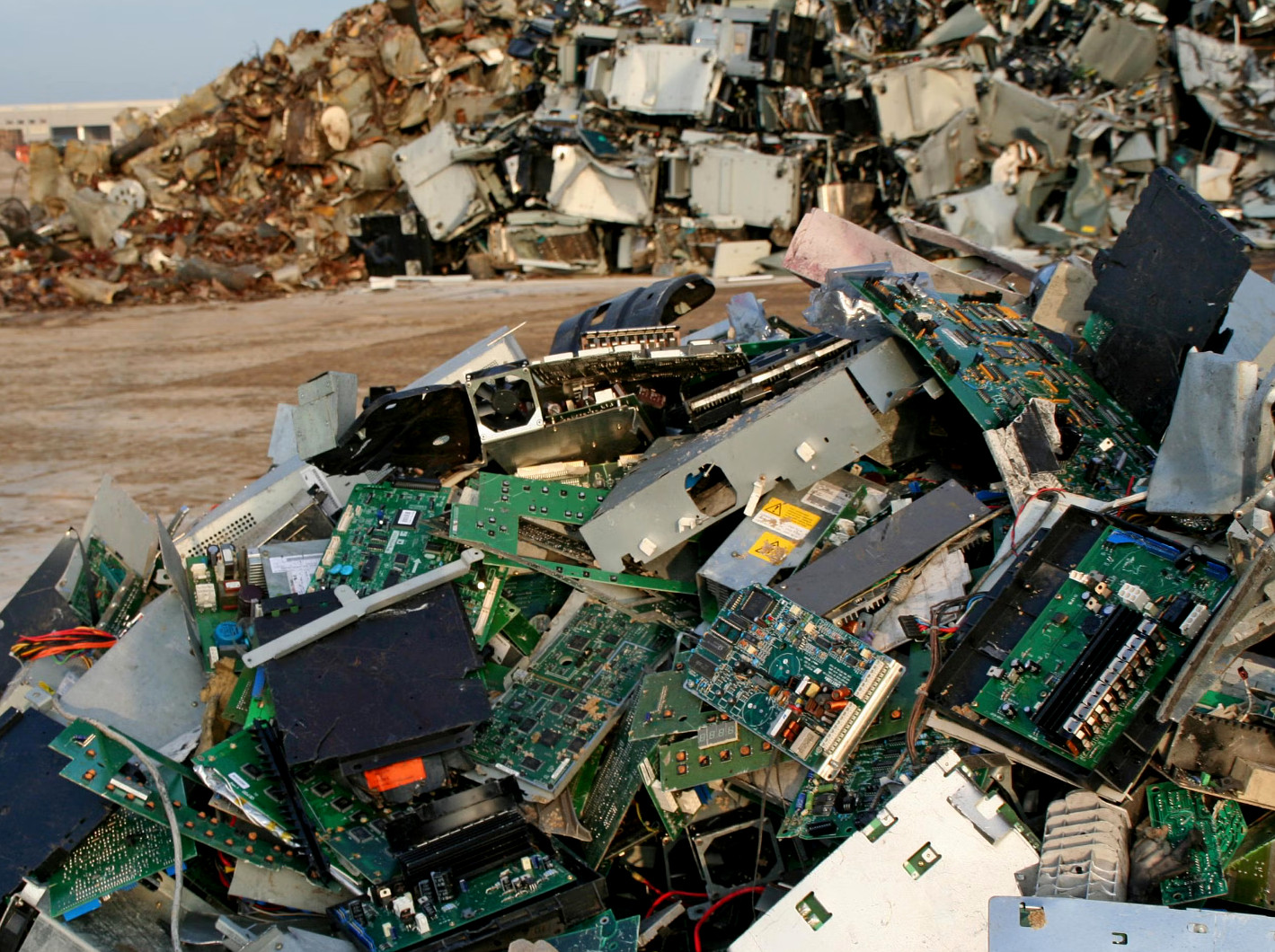
Colour Photograph showing various types of e-Waste … a typical scene at a Recycling Centre. Not every Centre is properly managed. And there are many parts of the world where there are no Centres at all, and e-Waste goes straight to landfill causing serious health and environmental problems for local communities. Click to enlarge.
.
Less than one quarter (22.3%) of the year’s e-Waste Mass was documented as having been properly collected and recycled in 2022, leaving over Euro €57 Billion worth of recoverable natural resources unaccounted for, and increasing pollution risks to local communities. Worldwide, the annual generation of e-Waste is rising by 2.6 Million Tonnes annually, on track to reach 82 Million Tonnes by 2030, a further 33% increase from the 2022 figure.
E-waste, any discarded product with a plug or battery, is a health and environmental hazard, containing toxic additives or hazardous substances such as mercury, which can damage the human brain and co-ordination system.
.
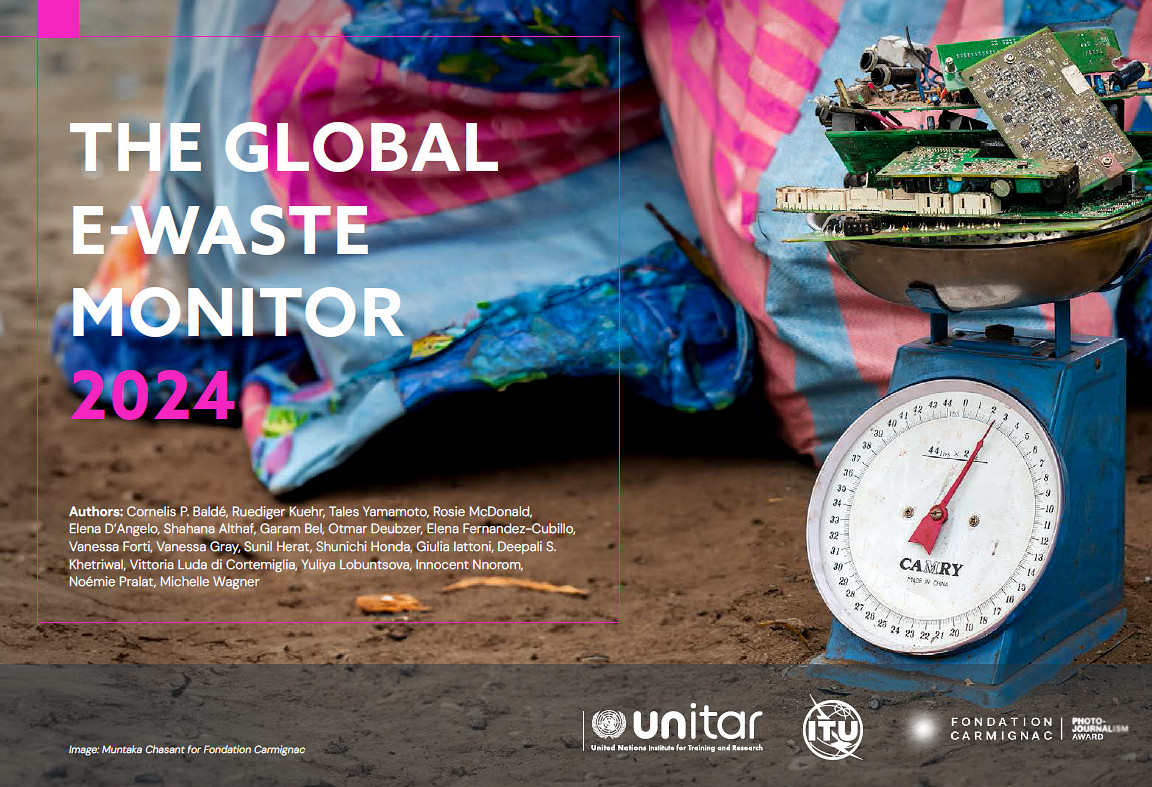
Colour Image showing the Title Page of the United Nation’s 4th Global e-Waste Monitor (GEM) Report. Click to enlarge.
The Report foresees a drop in the documented collection and recycling rate from 22.3% in 2022 to 20% by 2030 due to the widening difference in recycling efforts relative to the staggering growth of e-Waste generation worldwide. Challenges contributing to the widening gap include technological progress, higher consumption, limited repair options, shorter product life cycles, society’s growing ‘smartness’, design shortcomings, and inadequate e-Waste management infrastructure.
The Report also notes that the world ‘remains stunningly dependent’ on a few countries for rare earth elements, despite their unique properties crucial for future technologies, including renewable energy generation and e-Mobility.
.
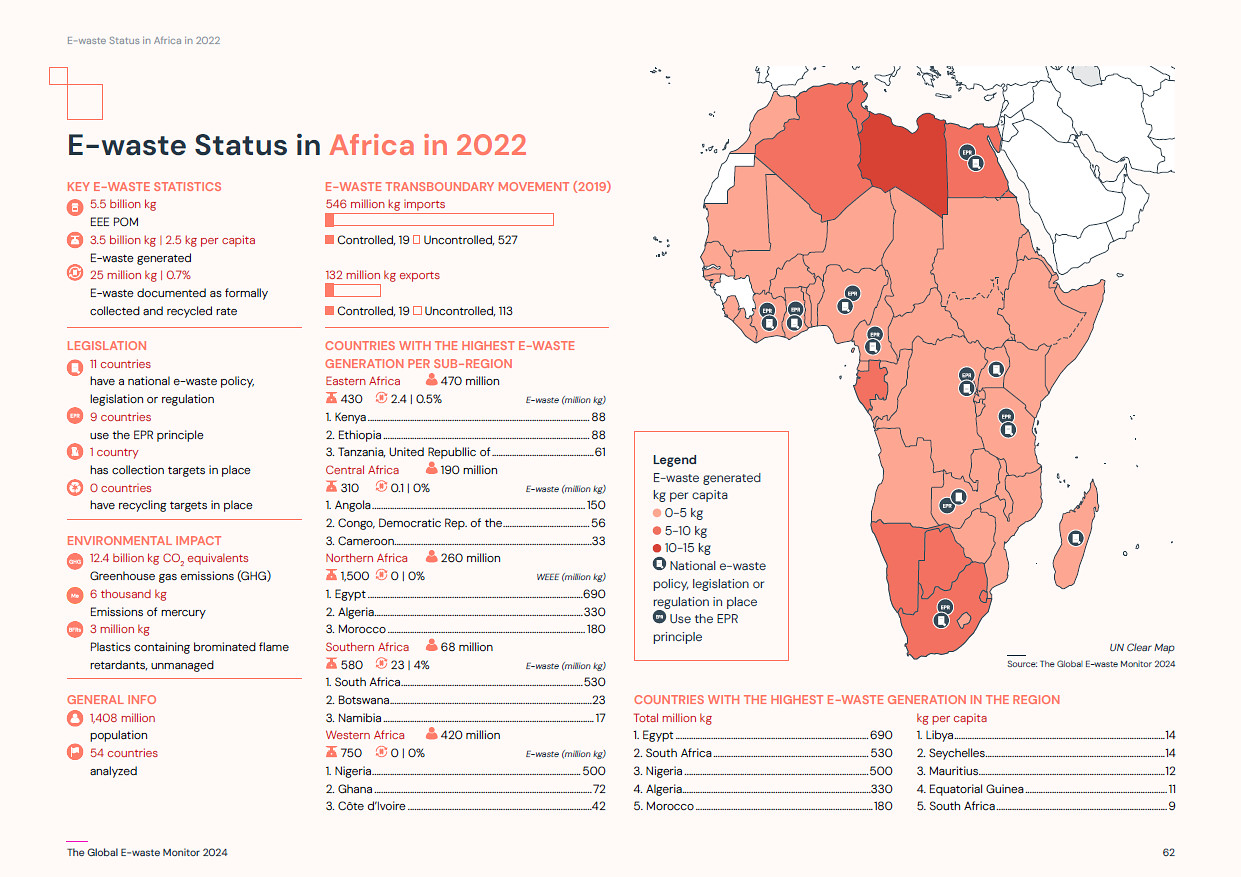
Colour Image showing the e-Waste Status of Africa in 2022. Click to enlarge.
.
31 Million Tonnes … Estimated weight of metals embedded in e-Waste in 2022, along with 17 Million Tonnes of plastics and 14 Million Tonnes of other materials (minerals, glass, composite materials, etc.)
17.6 Kg … Per Capita e-Waste generation in Europe, followed by Oceania (16.1 kg) and the Americas (14.1 kg)
5.1 Million Tonnes (8.2% of Global Total) … e-Waste shipped across borders in 2022, of which approximately 3.3 Million Tonnes (65%) was shipped from high-income to middle/low-income countries through uncontrolled, undocumented movements
NOTE: Cross national border ‘exporting’ of e-Waste – ANY Waste – Is NOT Recycling !
33% (20.4 Million Tonnes) … Proportion of e-waste made up of small devices (e.g. toys, microwave ovens, vacuum cleaners, e-cigarettes), of which 12% are recycled
Sustainability Impact Assessment (#SIA): A continual evaluation and optimization process – informing initial decision-making, design, shaping activity / product / service realization, useful life, and termination or final disposal – of the interrelated positive and negative social, environmental, economic, institutional, political and legal impacts on balanced and equitable implementation of Sustainable Human & Social Development.
2024-03-01: Too many strategic mistakes are being made, and too much uninformed ‘group-think’ is evident, in the – NOW – frantic human scramble to head off Climate Disruption … and attain Sustainable Human & Social Development … an intricate, open, dynamic and continuously evolving concept which is still not properly understood.
In a Split Human Personality which is clearly observed amid today’s geopolitical turmoil … much of one ‘personality’ is involved in this positive, yet arduous Ecological Rescue Attempt … while the other ‘personality’ stubbornly ignores the enormous negative impacts on that Task by: (i) the #USA #UK #NATO Proxy War in #Ukraine ; (ii) the ongoing Extermination of the Palestinian People & Culture in Illegally Occupied Territories by #Zionists intent on establishing a Greater Israel ; and (iii) the growing Hostility of the Global South towards the #West caused by (i) and (ii), just when global unified and concerted action on climate disruption is urgently required.
.
Uninformed Group-Think …
Sustainability Impact Assessment of Electric Vehicles
Rowan’s well-reasoned conclusion … “Sadly, keeping your old petrol car may be better than buying an Electric Vehicle (#EV). There are sound environmental reasons not to jump just yet.”
EV’s should properly be evaluated using Full Life Cycle Sustainability Impact Assessment … not just checking one, very beneficial but isolated, type of performance, i.e. zero exhaust emissions.
.
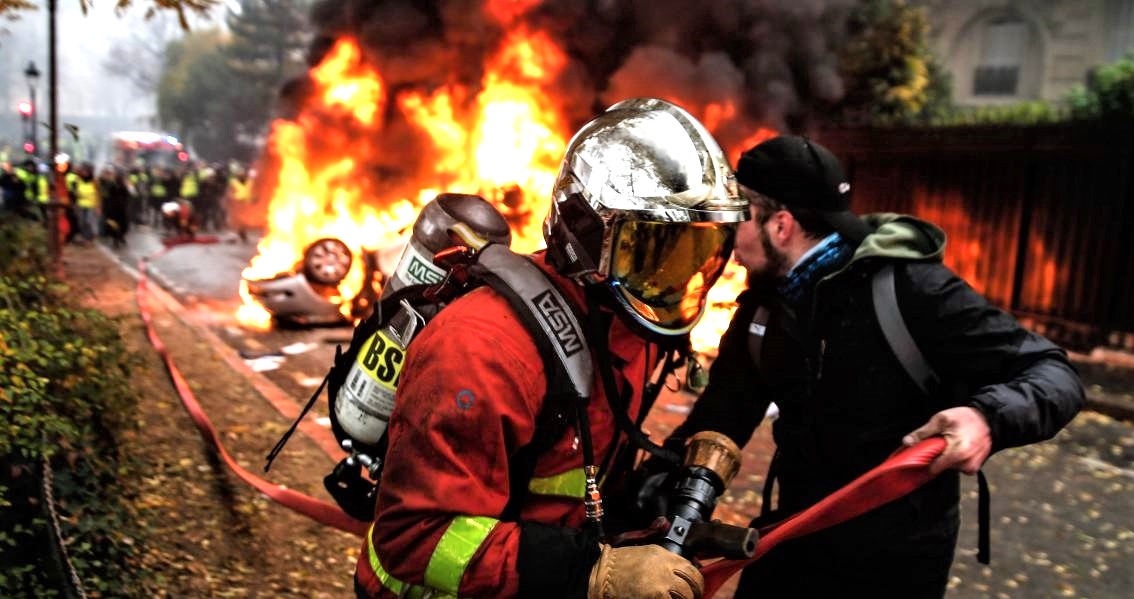
Colour photograph showing a raging Electric Vehicle / Car Fire on a narrow road. The car is turned upside down. The photograph shows the scene after the initial Lithium-Ion Battery related explosion, and when the fire is being attended to by Fire Services. In the far background, a large group of onlookers has gathered to view these strange events. Click to enlarge.
Without even mentioning the #FireSafety Issues associated with Lithium-Ion Batteries in e-Cars (and e-Scooters, e-Bikes, e-Wheelchairs, etc.) … Rowan was / is correct … yet he was swamped with a ‘tonne of abuse’ for daring to voice an unfashionable opinion … to question the current majoritarian group-think on EV’s.
.
Mining Cobalt for Lithium-Ion Batteries – Serious Rights Violations in DRC
‘ Our world is increasingly powered by Lithium-Ion Batteries, ranging from the ones found in everyday mobile technologies, such as smartphones and laptop computers, to those in electric vehicles. There is also a growing interest in using super-sized rechargeable batteries to help store electricity generated from solar and wind sources and deliver it to consumers more efficiently. These technologies are attractive because of their perceived sustainability. But as their use becomes more and more widespread, in what some are calling the ‘clean energy revolution’, it is necessary to ask whether the energy powering this revolution is as ‘clean’ as it is claimed to be.
Cobalt is an element critical for powering the clean energy revolution. More than 50% of the world’s cobalt supply originates in the Democratic Republic of Congo (#DRC).’
The 2017 Report builds on an earlier report: ‘This is What We Die For’, first published by Amnesty International and #Afrewatch in 2016, which showed how #Cobalt mined by young children and adults – in very hazardous conditions and in serious violation of their Human Rights – entered the supply chains of many of the world’s biggest brands. The new report assesses the policies and practices of 29 companies and how much their cobalt-sourcing practices have improved since then.
Did anybody really care that these Human Rights Violations were taking place in #Africa ? NO.
Was the strength and pace of mushrooming world Lithium-Ion Battery production in any way affected by the 2017 AI Report ?? NO.
.
Sustainability Impact Assessment (SIA)
Important Policy and Decision Making Mistakes can be attributed to the lack of rigorous Sustainability Impact Assessment. ( Environmental Impact Assessment ignores the other important aspects of Sustainable Development … and therefore is limited, inadequate, and out-of-date.) Instead, #SIA should be deeply embedded in both processes as a matter of regular routine …
Sustainability Impact Assessment: A continual evaluation and optimization process – informing initial decision-making, design, shaping activity / product / service realization, useful life, and termination or final disposal – of the interrelated positive and negative social, environmental, economic, institutional, political and legal impacts on balanced and equitable implementation of Sustainable Human & Social Development.
.
Signs & Symptoms
Environmental Signs of Planet Breakdown include: Climate Disruption, Biodiversity Loss, Ocean Acidification, Coral Reef Destruction, Extreme Heatwaves and Droughts, Intense Wildfires, Polar Ice Cap Retreat and Collapse, Amazon Forest Dieback, etc., etc.
The example of Electric Vehicles above is a small indication that something more serious is wrong with Human Behaviour generally. It is a Human Symptom … one which opens up the potential of exploring a different approach to solving the World’s Ecological Overshoot.
This very interesting Paper points to the start, and elaborates a beginning – not the end – of an innovative Human Behaviour Research Path … with the practical aim of effectively heading off Climate Disruption and attaining Sustainable Human and Social Development.
Scientific Paper’s Abstract
Previously, Anthropogenic Ecological Overshoot has been identified as a fundamental cause of the myriad signs we see around the globe today from biodiversity loss and ocean acidification to the disturbing rise in novel entities and climate disruption. In the present paper, we have examined this more deeply, and explore the human behavioural drivers of overshoot, providing evidence that overshoot is itself a symptom of a deeper, more subversive modern crisis of human behaviour. We work to name and frame this crisis as the Human Behavioural Crisis and propose the crisis be recognised globally as a critical intervention point for tackling ecological overshoot. We demonstrate how current interventions are largely physical, resource intensive, slow-moving and focused on addressing the signs of ecological overshoot (such as climate disruption) rather than the real cause (maladaptive behaviours). We argue that even in the best-case scenarios, sign level interventions are unlikely to avoid catastrophe or achieve more than ephemeral progress.
We explore three Drivers of the Behavioural Crisis in depth: (a) Economic Growth ; (b) Marketing & Advertising ; and (c) Pro-Natalism. These three drivers directly impact the three Levers of Ecological Overshoot: 1.Over Consumption ; 2.Excessive Waste ; and 3.Population Growth. We demonstrate how the maladaptive behaviours of overshoot stemming from these three drivers have been catalysed and perpetuated by the intentional exploitation of previously adaptive human impulses.
In the final sections of this paper, we propose an Interdisciplinary Emergency Response to the behavioural crisis by, amongst other things, the shifting of social norms relating to reproduction, consumption and waste. We seek to highlight a critical disconnect that is an ongoing societal gulf in communication between those that know, such as scientists working within limits to growth … and those members of the citizenry, largely influenced by social scientists and industry, that must act.
Paper Conclusion
In summary, the evidence indicates that Anthropogenic Ecological Overshoot stems from a crisis of maladaptive human behaviours. While the behaviours generating overshoot were once adaptive for Homo Sapiens, they have been distorted and extended to the point where they now threaten the fabric of complex life on Earth. Simply, we are trapped in a system built to encourage growth and appetites that will end us.
The current emphasis for overshoot intervention is Resource Intensive (e.g. the global transition to renewable energy), and Single Environmental Sign Focused. Indeed, most mainstream attention and investment is directed towards mitigating and adapting to climate disruption. Even if this narrow intervention is successful, it will not resolve the meta-crisis of ecological overshoot. In fact, with many of the current resource-intensive interventions, it is likely to make matters worse. Psychological interventions are likely to prove far less resource-intensive and more effective than physical ones.
We call for increased attention on the behavioural crisis as a critical intervention point for addressing overshoot and its myriad signs ;
We advocate increased interdisciplinary collaboration between the social and behavioural science theorists and practitioners, advised by scientists working on limits to growth and planetary boundaries ;
We call for additional research to develop a full understanding of the many dimensions of the behavioural crisis (including the overwhelming influence of power structures) and how we can best address it ;
We call for an emergency, concerted, multidisciplinary effort to target the populations and value levers most likely to produce rapid global adoption of new consumption, reproduction and waste norms congruent with the survival of complex life on Earth ;
We call for increased interdisciplinary work to be carried out in directing, understanding and policing widespread behaviour manipulation.
The Clock Is Ticking not only because the health of the natural systems upon which we are utterly dependent is deteriorating, but also because broad sweep interventions are only possible when a society holds together and is capable of coherent action. As the effects of overshoot worsen, the likelihood of societal breakdown increases. We still have an opportunity to be proactive and utilise the intact systems we have in place to deliver a framework for shifting social norms and other necessities for addressing the behavioural crisis. However, the day may come when societal breakdown will make intervention impossible, locking the planet into an unguided recovery that may salvage much of Nature but be inhospitable to human life.
.
Are We Trapped in a System built to encourage growth and appetites that will end us ?
OR …Are Humans a Virus intent on devouring the last of this Planet’s Limited Resources (as postulated by Agent Smith) ??
2023-09-26: At the time of writing, the 78th Session of the United Nations General Assembly is taking place in New York City. Midway through the U.N. Sustainable Development Framework Agenda 2015-2030 … News about its failing progress is very discouraging …
> Amid growing geo-political crises and war, Multi-Lateralism has little chance to operate successfully and there is a growing stalemate within the Security Council ;
> Extreme Weather Events (e.g. heatwaves, droughts, severe storms and rainfall, flooding) are becoming a regular occurrence across the Globe, and their impacts are already devastating ;
> Only 15% of the Sustainable Development Goals are barely on track, while development gains in other SDG’s have reversed ;
> Not only are Climate Disruption Targets not being met, but global greenhouse gas emissions are actually increasing.
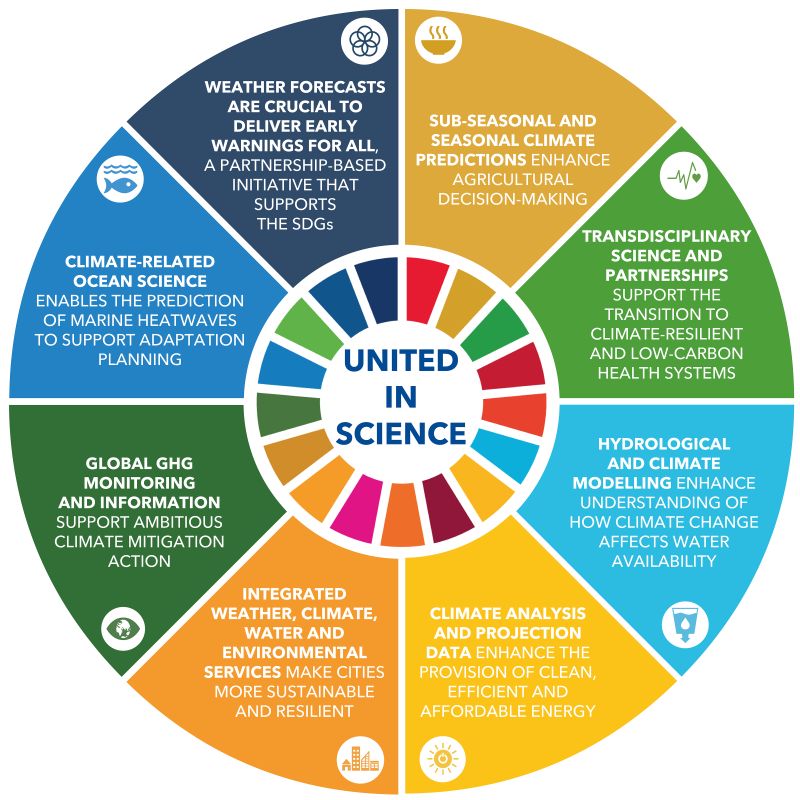
Earlier this month (September 2023), the #UN published a Report: United in Science 2023 – Sustainable Development Edition … https://library.wmo.int/idurl/4/68235
Compiled by the World Meteorological Organization (#WMO) under the direction of the U.N. Secretary-General, it brings together the latest updates from key U.N. Partner Organizations with a focus on weather-, climate-, and water-related sciences, research and services in support of realizing Sustainable Human & Social Development:
Climate Disruption …
Total Carbon Dioxide (CO2) Emissions from fossil fuels and land use change remained high in 2022 and the first half of 2023. Fossil fuel CO2 emissions increased 1% globally in 2022 compared to 2021, and global average concentrations continued rising through 2022 and the first half of 2023.
The years from 2015 to 2022 were the eight warmest on record, and the chance of at least one year exceeding the warmest year on record in the next five years is 98%.
It is estimated that current mitigation policies will lead to global warming of around 2.8 °C over the course of this century compared to pre-industrial levels. Immediate and unprecedented reductions in Greenhouse Gas Emissions are needed to achieve the goals of the 2015 Paris Agreement, i.e. 1.5 °C.
.
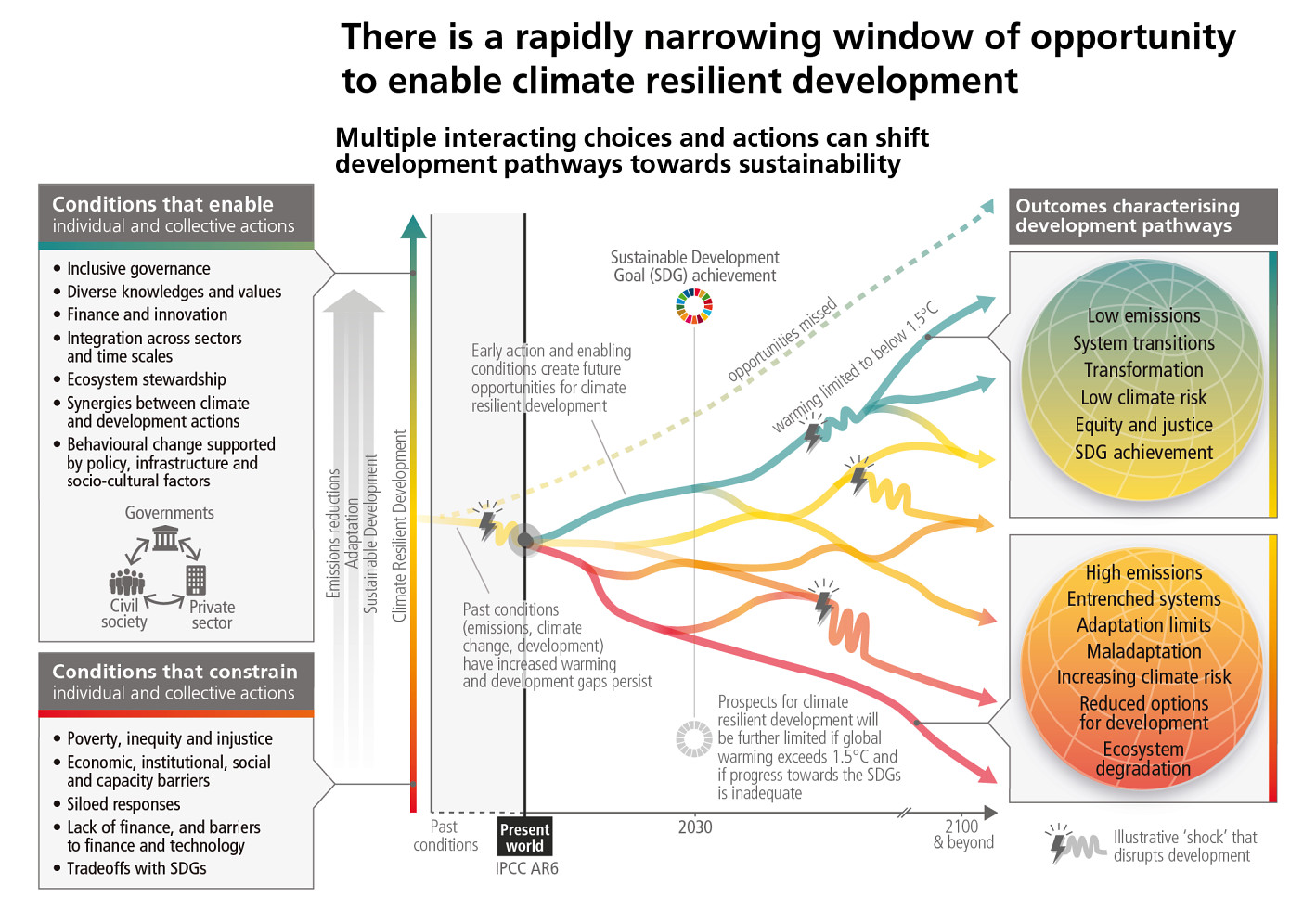
Graphic Image, Figure 6 in colour, from the InterGovernmental Panel on Climate Change (#IPCC) 6th Assessment Report’s 2023 Summary for Policy-Makers. It shows that there is a rapidly narrowing window of opportunity to realize climate resilient development, and how multiple interacting choices and actions can shift development pathways towards Sustainability. Click to enlarge.
.
Sustainable Cities & Communities …
Cities are responsible for a high proportion of global GHG Emissions and are highly vulnerable to the impacts of climate disruption and extreme weather events, which threaten the achievement of Sustainable Development Goal 11.
Integrated urban weather, climate, water and environmental services, grounded in best-available science and research, are helping Cities to achieve SDG 11.
Observations, high-resolution forecasting models and multi-hazard early warning systems are the fundamental basis for integrated urban services.
Good Human Health & Social Wellbeing …
Trans-Disciplinary Research is fundamental to analysing, monitoring and addressing climate-sensitive health risks and climate impacts on the health sector.
Climate disruption and extreme events are projected to significantly increase ill-health and premature deaths, as well as population exposure to heatwaves and heat-related morbidity and mortality.
Scaling up investments in climate-resilient and low-carbon health systems, and progress towards universal health coverage (#UHC) are critical for the achievement of Sustainable Development Goal 3.
.
Graphic Image, Figure 1 in colour, from the recently published UN WMO Report: ‘United in Science 2023 – Sustainable Development Edition’. It shows how genuinely collaborative weather-, climate-, and water-related sciences, research and services – together – support the achievement of the United Nations (#UN) Sustainable Development Goals (#SDG). Click to enlarge.
Deep & Genuine Construction Sector Collaboration …
[ Institutional Transformation ]
It is inevitable, therefore, that enormous pressures – social, economic, political, legal, and institutional – are being brought to bear on Building Design Professions, Engineers (all disciplines) and Construction Organizations to rapidly, reliably and creatively transform our existing Built Environment ; new buildings, which constitute just a small part of that workload, will be required to carry the heaviest burden. To properly realize a Safe, Resilient and Sustainable Built Environment for ALL, however, Genuine Collaboration must be fostered … between each actor in the construction sector … between practitioners and scientists/researchers … and between different industrial sectors … silos broken apart and traditional barriers transcended.
.
Sustainable Buildings – Reality vs. Superficial Impressions …
The minimum Life Cycle for a Sustainable Building is 100 years.
To be capable of later #Adaptation, a Sustainable Building must possess a sufficient/appropriate, level of #Redundancy. Lean construction ignores this issue.
Far too many people appear to be still ‘wrestling’ with an obsolete understanding of #Sustainability. It has many more than just 3 Aspects (social, environmental, economic). Time for everyone to cop on and catch up !
The International Fire Engineering Community, in particular, has a fixation with low-hanging fruit … ‘PV Panels’, ‘Timber Buildings’ … and ‘Performance-Based Fire Codes’, which are a hybrid of prescription (rather than Functional Fire Codes, which offer a more free, more open, and flexible option for designers).
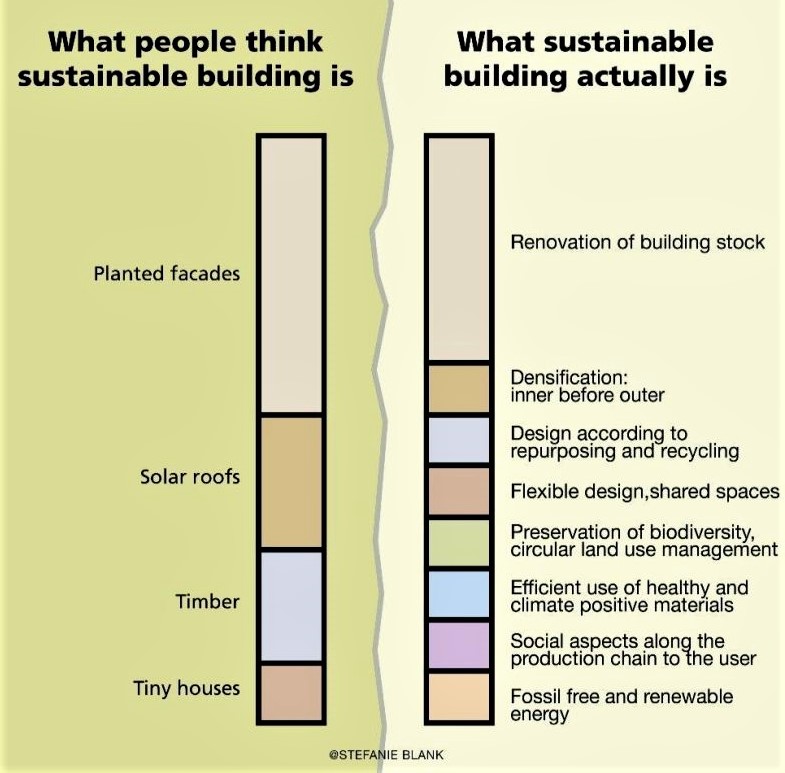
So … before moving on in my next Post to look at the potential for Green Walls being a fire hazard, and comparing a top-down Sustainable Fire Engineering Design Approach with a bottom-up Conventional Fire Safety Approach … here is an interesting graphic image, developed by an architectural colleague in Berlin, Ar.Stefanie Blank, showing the difference between all-too-common superficial impressions and the reality of Sustainable Buildings …
.
Graphic Image, in colour, which compares ‘What people think Sustainable Building is’ with ‘What Sustainable Building actually is’. There is a world of difference between ‘reality’ and ‘superficial impressions’. The immediate and unprecedented challenge is the poor performance of existing buildings. Click to enlarge.
As I have written many times before, the concept of Sustainable Human & Social Development is intricate, open, and dynamic … and it is also continuously evolving. So too, the #SFE #RoadMap must continuously evolve.
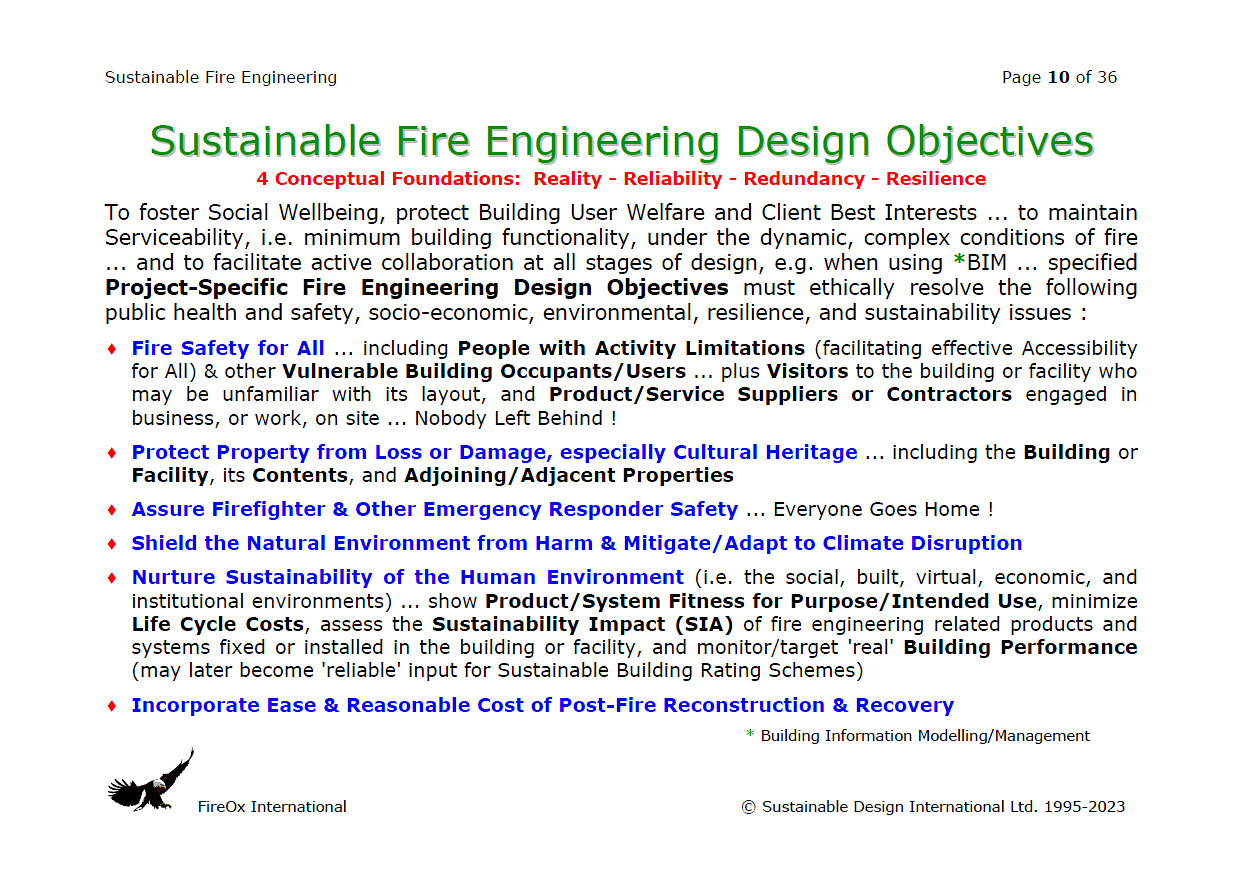
Fully reflecting the content and views expressed above, it is necessary to further expand the Sustainable Fire Engineering Design Objectives on Page 10 of the Road Map … in order to clearly and directly integrate the issue of Climate Disruption …
.
Graphic Image, in colour, which lists SFE’s revised Project-Specific Fire Engineering Design Objectives … which cover the safety of building users and firefighters, protection of property and the environment, mitigation/adaptation to climate disruption, and finally, sustainability. This revision is dated May 2023. Click to enlarge.
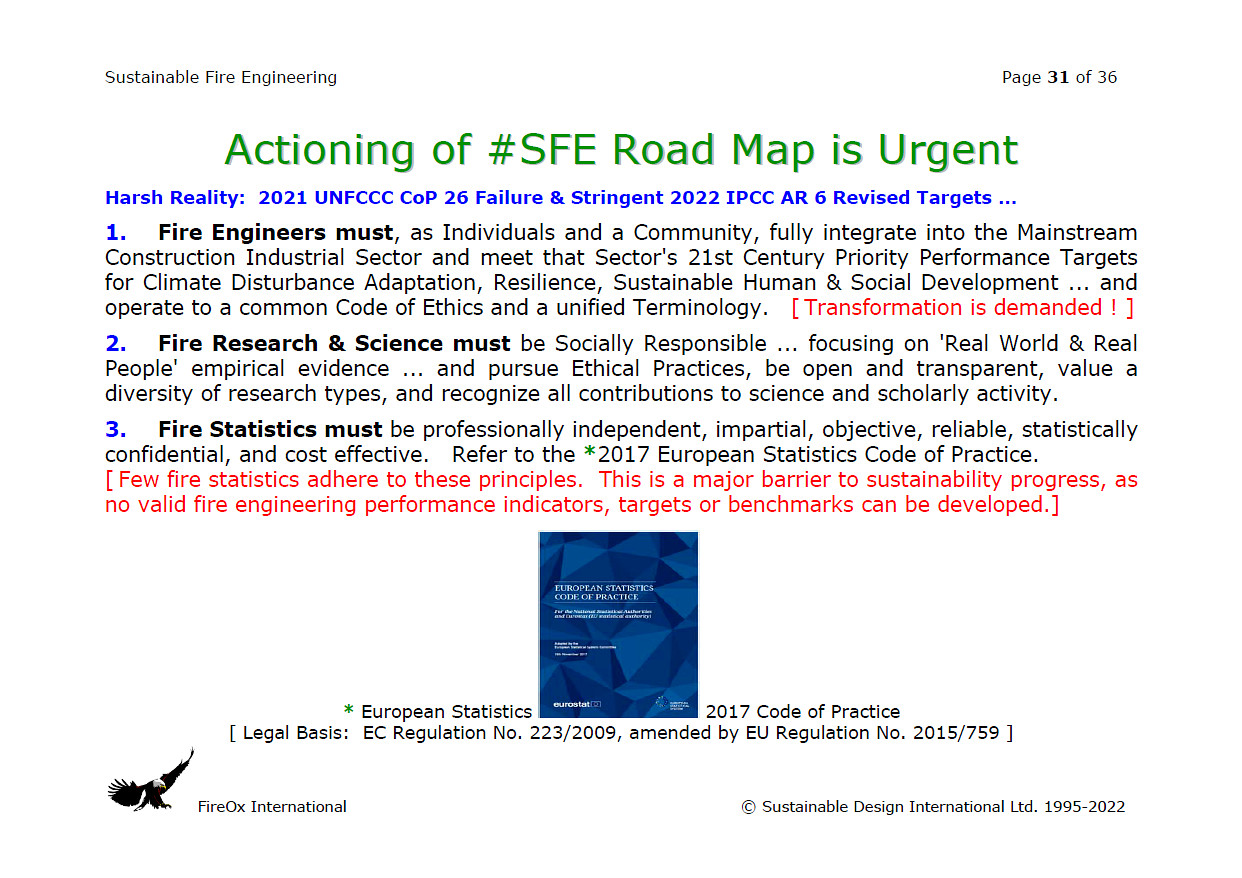
2023-08-21: In an earlier Post here, dated 2022-12-19, I presented a Road Map for Sustainable Fire Engineering (#SFE) … which finished on an Urgent Call to Action targeting three specific, fundamental aspects of a Creative Fire Engineering which is capable of answering the challenges of our Complex Built Environment in the 21st Century … under severe threats from Global Climate Disruption, Climate Synergies leading to near-term Climate Tipping Points … and a startling lack of Global Resilience, refer to the CoVID-19 Pandemic, and Supply Chain Chaos initiated by an old-fashioned Cold War I Warrior in Washington’s White House.
Mainstreaming a Transformed Fire Engineering
Ethical Practice of Fire Research and Science
Reliability of Fire Statistics …
Colour Image showing the #SFE Road Map’s Conclusion, Page 31 in a series of 36, from the updated (June 2022) Presentation on Sustainable Fire Engineering ~ its essential and critical role in realizing a Safe, Resilient and Sustainable Built Environment For ALL. Click to enlarge.
.
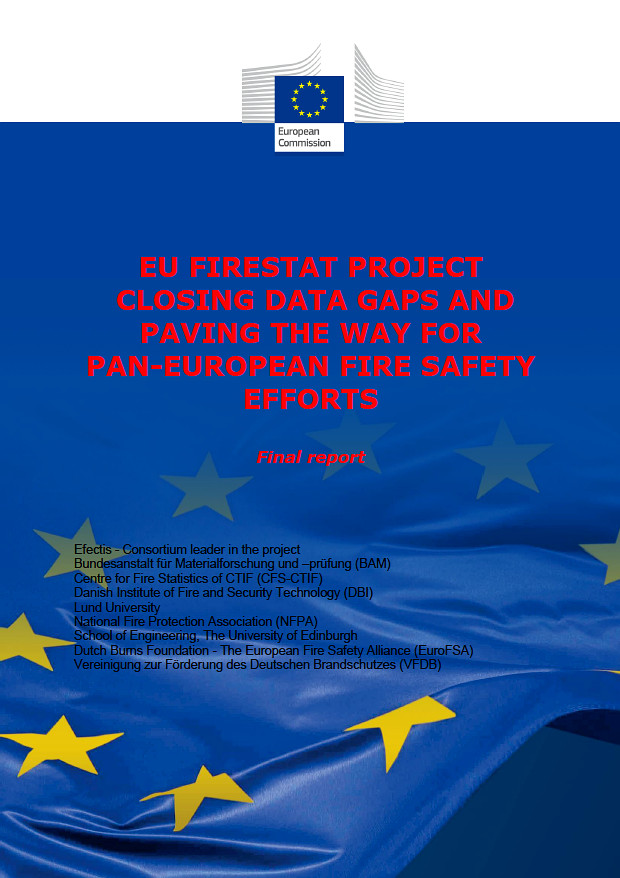
From Any Point Of View … the Final Report of ‘EU FIRESTAT’, a project financed by the European Parliament and commissioned by European Commission Directorate-General DG GROW, is a white elephant … a plodding hippopotamus … a retrograde step … a bitter disappointment !!! Completed in July 2022, it comes nowhere near outlining a viable system for the development of urgently needed Harmonized European Fire Statistics … which must be managed and co-ordinated by #Eurostat, in Luxembourg.
The #FIRESTAT Objectives were extremely limited …
‘ The review proceeds from the assumption that fire incident data can serve a number of important purposes – helping to reduce fires and losses, identifying opportunities for safety interventions and education programs, guiding the allocation of public resources to areas of greatest need and impact, and monitoring progress of safety initiatives.’
Nowhere, in this Report, is there any reference to Sustainable Human and Social Development. Where there are references to ‘sustainability’, these are specifically concerning the long-term financial resourcing of statistical systems.
And nowhere is there even the faintest understanding that Fire Engineering has an essential and critical role in the realization of a Safe, Resilient & Sustainable Built Environment For ALL. Fire Engineering Performance Indicators, Targets and Benchmarks must be developed to facilitate that realization ; and Reliable Fire Statistics are their starting point and basic ingredient.
The Report’s Executive Summary (in English, French, and German) covers the limited range of the Project pretty well … and it is almost easy to read. The ‘great and the good’ of Conventional Fire Engineering, both organizations and individuals, were involved in this Project …
.
Colour Image showing the cover of the EU Project ‘FIRESTAT’ Final Report, completed in July 2022, with the full title of the Project: ‘EU FIRESTAT – Closing Data Gaps & Paving The Way For Pan-European Fire Safety Efforts’ in the middle of the Page ; the European Commission Logo at the top of the Page ; and against a background of an EU Flag in the lower half of the Page, the list of 9 International Fire Safety Organizations in the Consortium which carried out the Project. Click to enlarge.
The Final Report’s Boxed Recommendation 3, on Page 8, lists 8 Variables / Statistics to be collected as a Tier 1 / 1st Priority across Europe, from Ireland all the way down to Türkiye :
Number of Fatalities ;
Number of Injuries ;
Age of Fatalities ;
Primary Causal Factor ;
Type of Building ;
Incident Location ;
Incident Date ;
Incident Time.
So, for instance … the only Fire Statistic related to the Human Condition of Fatalities and Injured which would have been gathered after the 2017 Grenfell Tower Fire in #London was … Age of Fatalities … which, in the context of what actually happened on that tragic night and knowing the very large numbers of People with Activity Limitations (2001 WHO ICF) and other Vulnerable Building Users who died, or were injured, in the fire … is a very serious error, and entirely ridiculous !!??!! FUBAR !!
Essential Variable / Statistic Correction: Age, Gender and Vulnerability of Victims (whether Fatality or Injured). This is critical information and, whatever the resource implications, must be collected.
And if that wasn’t bad enough … this cack-handed approach to the development of Harmonized European Fire Statistics opens up the probability of another Morán with a computer, after a similar fire incident, again showing that a similar High-Rise Residential Tower could be evacuated down a single, narrow, badly designed staircase in 7 minutes. Say no more !!!
.
J’Accuse / I Accuse the International Fire Engineering Community of being intentionally and maliciously Deaf, Dumb and Blind to the desperate Fire Safety Needs of People with Activity Limitations, including People with Disabilities, and other Vulnerable Building Users !
.
Concerning Incident Date … the Consortium appears to be completely unaware that the European Standard Short Format Date is … Year-Month-Day (YYYY-MM-DD) !! See 4.2.2. in the Final Report. Sloppy, Sloppy, Sloppy.
Generally concerning Tier 1 Statistics … where is there any serious consideration of the deep and substantial Green / Environmental / Climate Disruption Mitigation and Adaptation Measures being imposed on the Design and Operation of New and Existing Buildings … which are already causing serious fire safety problems ??? See many previous Posts on this Technical Blog.
.
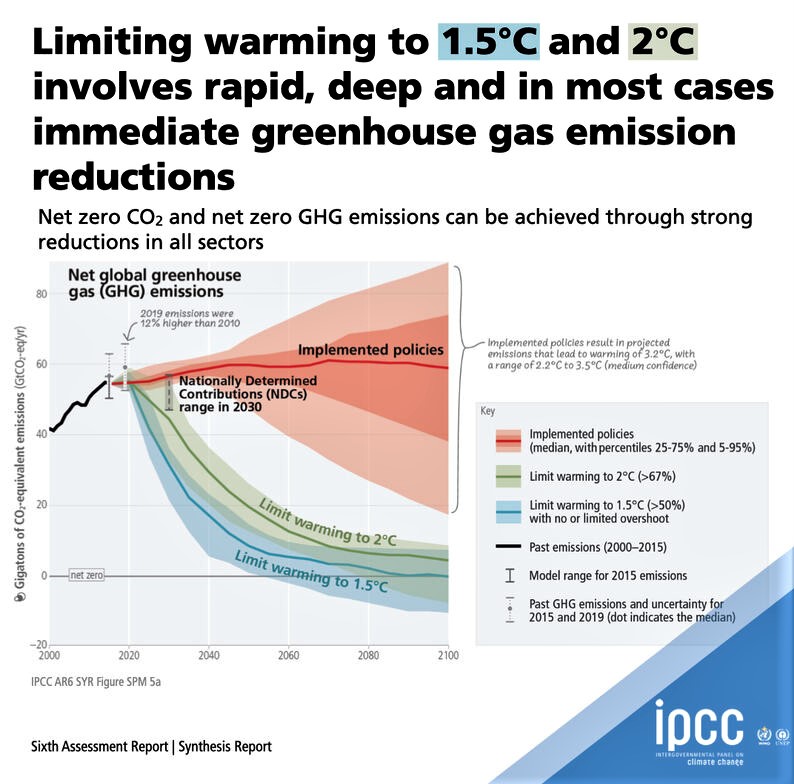
Colour Image showing #IPCC AR6 Synthesis Report Figure 5a: ‘Limiting warming to 1.5 C and 2 C involves rapid, deep and in most cases immediate greenhouse gas emission reductions’ … from the Intergovernmental Panel on Climate Change 6th Assessment Report. Current emission reduction policies will result in global warming of approximately 3.2 C, which is far off target. Click to enlarge.
.
The Final Report’s Boxed Recommendation 3, on Pages 8 & 9, goes on to list 6 Extra Variables / Statistics to be collected as a Tier 2 / 2nd Priority across Europe, from Portugal all the way up to Finland :
Number of Floors ;
Area of Origin ;
Heat Source ;
Item First Ignited ;
Articles Contributing to Fire Development ;
Fire Safety Measures Present.
Concerning Fire Safety Measures Present … my patience is at an end ! I am heartily sick and tired of pointing out that there is no such thing as a ‘Fire Door’ ; it does not exist !! It is ALWAYS a Fire Resisting Doorset !!! See 4.4.3.
.
This EU ‘FIRESTAT’ Report properly belongs to the Twilight Zone of the last Century … and in today’s Recycling Bin !
.
And Even More Worrying …
.
Concerted Resistance to answering the Fire Safety Needs of Vulnerable Building Users ;
The mistaken view that ‘Sustainability’ is merely a graft-on / optional extra to Conventional Fire Engineering ;
Constraining Building Fire Safety Performance within the boundaries of Current Fire Codes ;
.
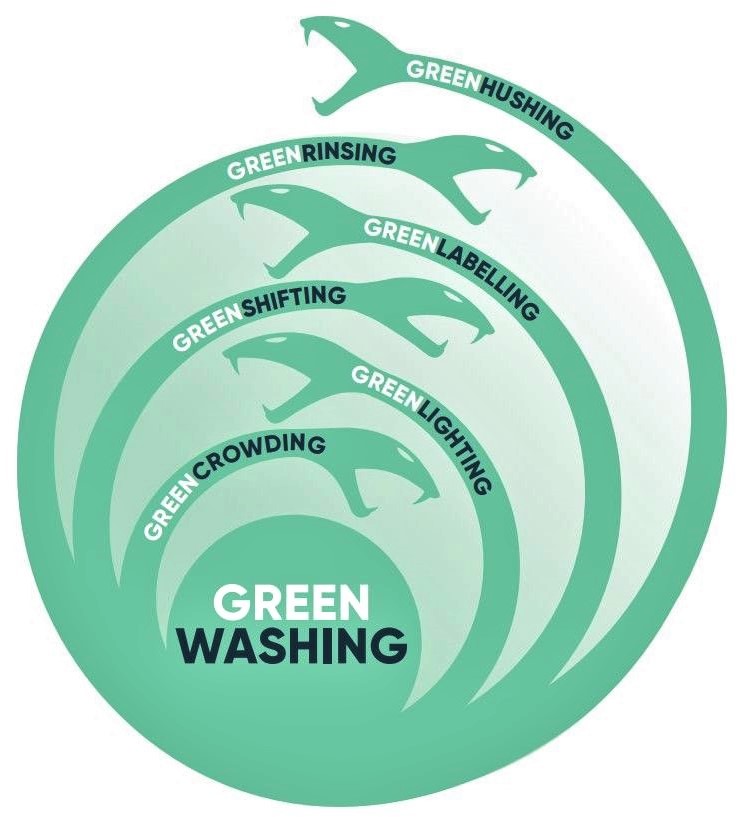
Is the EU ‘FIRESTAT’ Final Report another disturbing sign of the growing Trend towards #GREENWASHING in International Fire Engineering ?
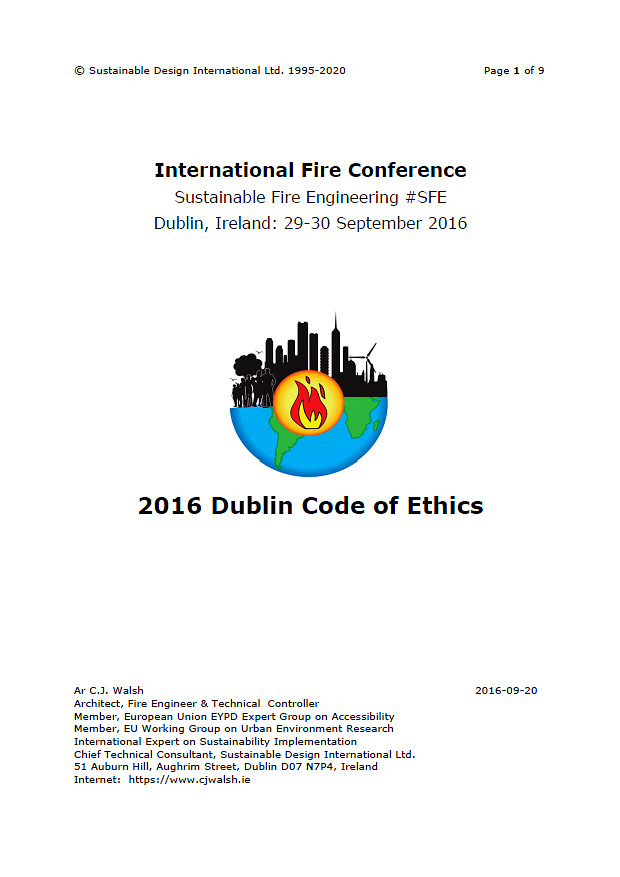
2020-09-22: Adopted at the International Fire Conference: SFE 2016 DUBLIN (www.sfe-fire.eu) …
Many years have passed since the 1972 UN Stockholm Declaration on the Human Environment and the 1992 Rio Declaration on Environment and Development. In 2016, Sustainable Development remains an intricate, open, dynamic and continually evolving concept. The guide and driver for frontline practitioners, policy and decision makers must be a personal Code of Ethics … an integrated and inter-related whole which cannot be reduced to fixed rules inviting game playing and ‘trade-offs’. After working with this Code, it may be necessary to expand on and discuss its principles and/or some of the issues raised … not to narrow its focus, but to broaden interpretation.
The realization of a Safe, Inclusive, Resilient & Sustainable Built Environment demands a concerted, collaborative, very creative and widely trans-disciplinary effort at national, local, regional and international levels across the whole planet – Our Common Home. The informed operation of appropriate legislation, administrative procedures, performance monitoring and targeting, and incentives/disincentives, at all of these levels, will facilitate initial progress towards this objective … but not the quantity, quality or speed of progress necessary. Our time is running out !
This Code of Ethics applies … for those who subscribe to its values … to policy and decision makers, and the many different individuals and organizations directly and indirectly involved in the design, engineering, construction, and operation (management and maintenance) of a Safe, Resilient & Sustainable Built Environment for ALL.
The Purpose of this Code of Ethics is to guide the work of competent individuals and organizations in a context where incomplete or inadequate legislation, administrative procedures and incentives/disincentives exist … but, more importantly, where they do not exist at all … and, amid much confusion and obfuscation of the terms, to ensure that implementation is authentically ‘sustainable’, and reliably ‘safe’ and ‘resilient’ for every person in the receiving community, society or culture … before it is too late !
2020-09-08: Ignoring Britain’s silly sabre-rattling, toothless threats and boorish blackmail attempts reported in the Media during this past weekend, yesterday and today … the actual state of play in the tortuous Brexit Negotiations can best be judged from the following sources …
Michel Barnier’s Presentation to the Institute for International and European Affairs (IIEA), on 2 September 2020 … View it Here on YouTube
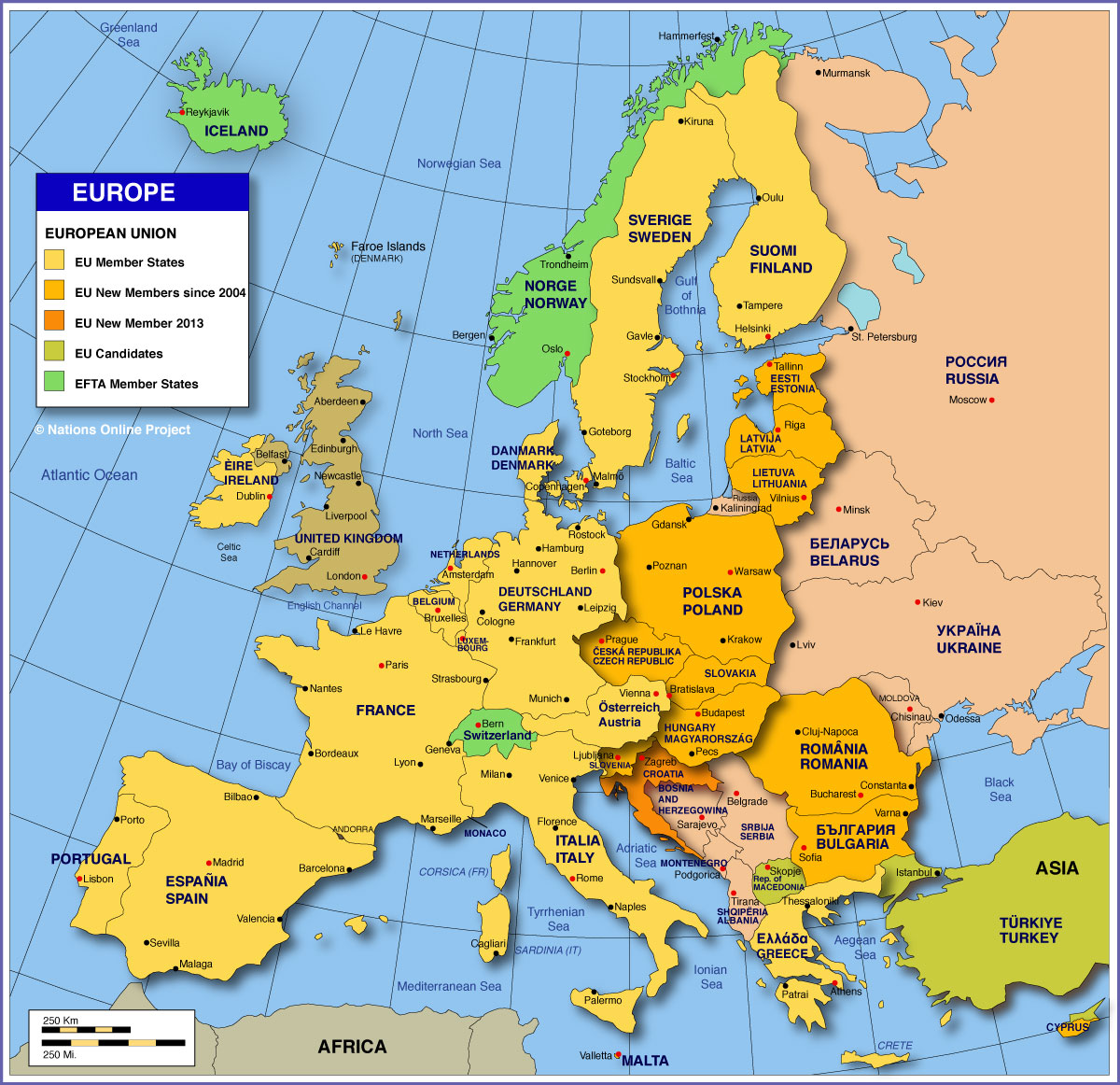
Map of Europe, in colour, showing the current extent of the European Union. Points to Note: a) Europe, as a continent, extends as far as the Ural Mountains in Russia; b) From 1 January 2021, after an implementation period of one year, Great Britain will be entirely outside the EU and the Single Market; c) The EU is not a Christian organization and as soon the political classes in certain countries (e.g. France and The Netherlands) get over their hysterical hatreds, Turkey will enter the EU as a full Member State; d) furthermore and eventually, an Independent Scotland will re-join the EU. Click map to enlarge.
This is the European Union (EU), a Single Market of approximately 450 Million consumers. The EU operates under the freedoms and protections of Codified / Written Law, i.e. EU Treaties ratified by all of the EU Member States, EU Secondary Legislation (Regulations and Directives), and EU Administrative Provisions.
.
A suite of EU Regulations and Directives covers Industrial Products. While there is some flexibility with regard to how Directives are implemented at national level in the Member States, no such flexibility exists with Regulations. Construction Products can only be placed on the EU Single Market if they can be shown to comply with the requirements of the EU’s Construction Products Regulation (CPR) Framework, or in other words, be shown to be ‘fit for their intended use’ in the European Union …
EU Regulation 305/2011. Article 13(2) Before placing a Construction Product on the market, Importers shall ensure that the assessment and the verification of constancy of performance has been carried out by the Manufacturer. They shall ensure that the Manufacturer has drawn up the Technical Documentation referred to in the second sub-paragraph of Article 11(1) and the Declaration of Performance in accordance with Articles 4 and 6. They shall also ensure that the Product, where required, bears the CE Marking, that the Product is accompanied by the required documents and that the Manufacturer has complied with the requirements set out in Article 11(4) and (5).
.
BREXIT ~ IMPLICATIONS FOR THE BRITISH FIRE INDUSTRY
Trade ‘No Deal’ or ‘Minimal Deal’ … from 1 January 2021, Great Britain will be completely outside the European Single Market, and the EU’s Construction Products Regulation Framework. The designation ‘Notified Body’ under that Framework will fall away from British Organizations. Construction Products/Systems manufactured in, or supplied from, Britain will then have to undergo an entirely new EU Testing and Approvals Programme in order to access the European Single Market. Fire Safety related Construction Products will have to be tested, and assessed or appraised, against all 7 Basic Requirements for Buildings together, during the same period of time (see Annex I, EU Regulation 305/2011) …
Mechanical Resistance and Stability
Safety in Case of Fire
Hygiene, Health and the Environment
Safety and Accessibility in Use
Protection against Noise
Energy Economy and Heat Retention
Sustainable Use of Natural Resources
… a process which will be very interesting to observe, since the Fire Industry (particularly England’s Fire Establishment, AHJ’s, etc) dislikes, with intensity, the whole idea of ‘environmental impact’ … the concept of ‘sustainable development’ is hardly understood … and no consideration is given to the reasonable fire safety and accessibility needs of ‘vulnerable building users’ (including people with activity limitations, refugees, migrants, etc).
The tragic 2017 Grenfell Tower Fire, and its sad aftermath, have demonstrated how dysfunctional, and rotten to the core, is the whole national system of Building Fire Safety in England. More than 3 years later … on the evidence to date of an ongoing, incompetent Inquiry and a series of shoddy responses from Government … will survivors and the victims’ families ever receive Justice, and find Peace ? cf. The 1981 Stardust Discotheque Fire in Dublin. Survivors and victims’ families are still waiting for the truth to be revealed.
In parallel, mutual recognition of British Professional Building Designers, e.g. Architects, Structural Engineers, Fire Engineers, etc., within the European Union will cease.
In parallel, British Fire Research involvement in EU Research Networks will also cease … unless a heavy price is paid to be involved as a 3rd Country. British Institutions should forget any notions they might have about Network Leadership.
In parallel, Information and Data Flows between Britain and the EU will be disrupted or cease altogether … unless Britain complies fully with the requirements of EU General Data Protection Regulation (GDPR) 2016/679. As a vassal state of the USA, this compliance may prove difficult for Britain !
.
EU Fire Safety Related Product/System Manufacturers ~ A Word of Caution !
Many EU Construction Product/System Manufacturers continue to use the services provided by British Fire Test Laboratories and/or Fire Consultancy Organizations located in Great Britain … some of which have already established EU-based dummy companies and letterheads. These British organizations must be avoided altogether. For example, the practice of fire testing in England and later adding a title page of a Full Test Report with an EU location address is entirely unacceptable !
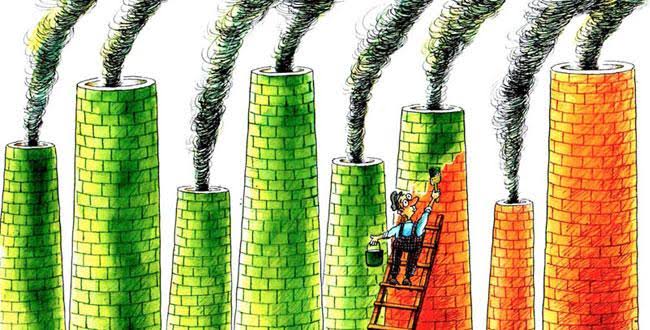
2020-07-23: Time is fast running out. You have to ask yourself: “Do I feel lucky ? Am I a GreenWasher“ – do I enjoy playing with numbers, relaxing with estimates having tenuous links to reality, cheating the ‘system’ (just like Germany’s Dieselgate), or convincing myself (and everybody else) that progress is being made when the evidence clearly shows that things are getting worse … “or an Implementor ??” – establishing meaningful Benchmarks, setting (and iteratively re-setting) ambitious Performance Targets using reliable, up-to-date data and statistics, then closely monitoring Positive Progress, and reporting Real Verifiable Results …
.
Are you a GreenWasher … or an Implementor ????
.
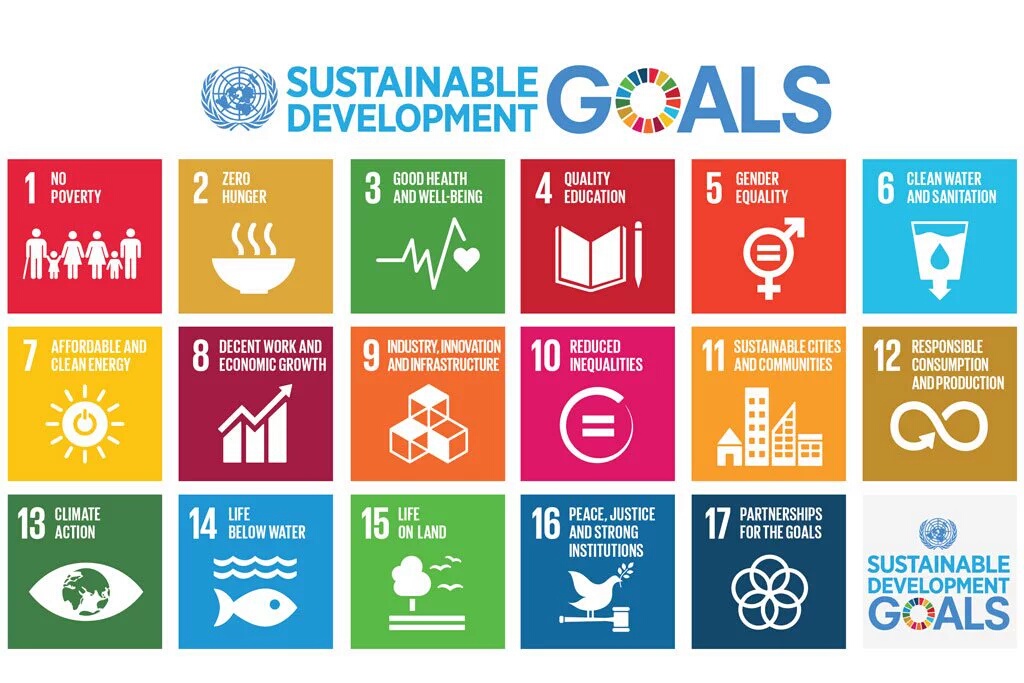
In 2015 … 193 World Leaders, representing all of the United Nations’ Member States, adopted a set of 17 Sustainable Development Goals (SDG’s) … placing our world, i.e. its people, environment and limited resources, on a path towards a more sustainable future … more specifically, aiming to ‘free humanity from poverty, secure a healthy planet for future generations, and build peaceful, inclusive societies as a foundation for ensuring lives of dignity for all’.
To properly track the implementation of these consensus goals … reliable, quality, and timely data is vital. Yet, five years later too much of the data is still out-of-date or unavailable, and too many people are being left behind in the numbers. Half of the data used to measure the SDG Target Performance Indicators are missing. Two-thirds of poverty data from Sub-Saharan Africa and global deforestation figures are five years out-of-date. Only 100 countries in the world have nationally-representative data on violence against women, and more than 25 million refugees around the world go uncounted in national statistics.
.
Colour image showing the 17 Sustainable Development Goals (#SDG’s) unanimously adopted in U.N. Resolution A/RES/70/1: Transforming Our World – 2030 Agenda for Sustainable Development, by the United Nations General Assembly on 25 September 2015. Click image to enlarge.
.
With only 10 years left to achieve the SDG Targets, there is a critical need NOW for a Data Platform which makes quality and timely data for the SDG’s Accessible to All, improves knowledge of geospatial tools and Geographic Information Systems (#GIS), and builds capacity to use these tools to support global policy and decision making …
In partnership with the Environmental Systems Research Institute (#ESRI) and National Geographic … SDG’s Today: Global Portal for Real-Time Data … is a platform developed by the Sustainable Development Solutions Network (#SDSN). This one-of-a-kind open access data platform has the potential to revolutionize how we understand and communicate the urgency of the SDG’s and how solutions are developed, by providing a much-needed virtual space where key stakeholders from around the world can access and engage with timely data (updated annually or in more frequent intervals) on the SDG’s, and learn how to use the data effectively to push Agenda 2030 forward. The platform also houses GIS training and education resources and supports countries and other institutions to produce, share, and engage with the data to help ensure that, together, we meet the global goals by 2030.
.
Using Data To Effectively Implement The UN 2030 Agenda for Sustainable Development …
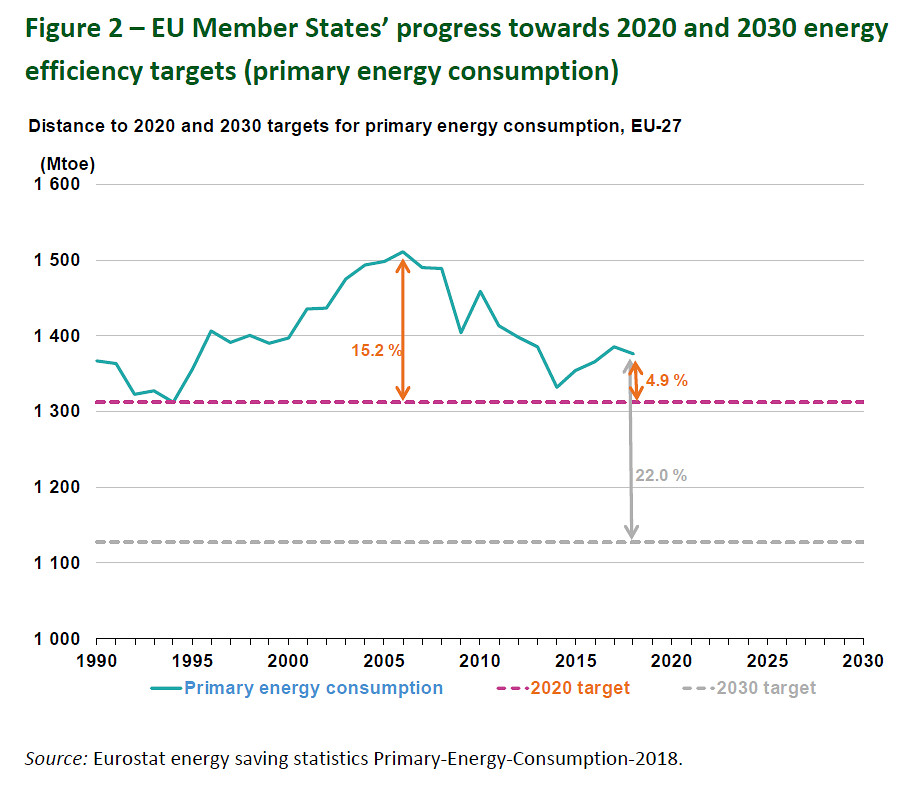
The Court of Auditors assessed whether EU co-funded energy efficiency investments in buildings had cost-effectively helped the EU towards meeting its 2020 energy saving target. The Auditors concluded that operational programmes and project selection were not driven by a cost-effectiveness rationale. While Member States required buildings to be renovated to save a minimum of energy and improve their energy rating, this sometimes happened at a high cost. Because of a lack of comparative assessment of project merits and of minimum/maximum thresholds for cost-effectiveness, projects delivering higher energy savings or other benefits at lower cost were not prioritised. In overly-polite language, they recommend improving the planning, selection and monitoring of investments to improve the cost-effectiveness of spending.
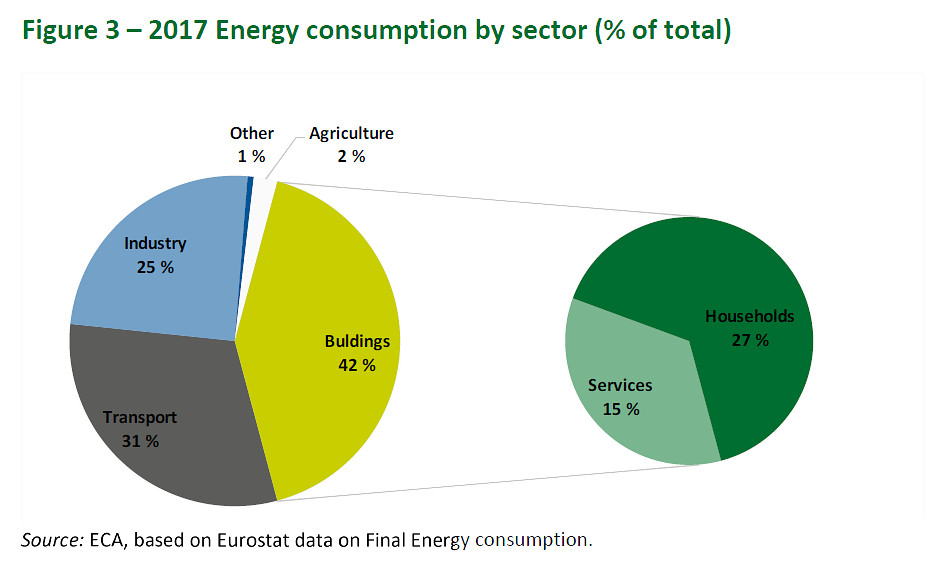
With all of the Hot Air and Ridiculous Hoopla about improving Energy Conservation and Efficiency in New Buildings (Green, BREEAM, PassivHaus, LEED, nZEB, etc., etc.) … by far the biggest Energy Problem is with Europe’s Existing Building Stock. This Auditor’s Report shows that Progress in Meeting Agreed EU Targets is dismal, and there is still a cynical approach in Member States to the use of EU Funding …
Coloured Image / Graph showing distance by the EU-27 to Agreed 2020 and 2030 Targets for primary energy consumption. Click image to enlarge.
.
Coloured Image / Pie Chart showing final energy consumption by EU Sector for 2017. Click image to enlarge.
.
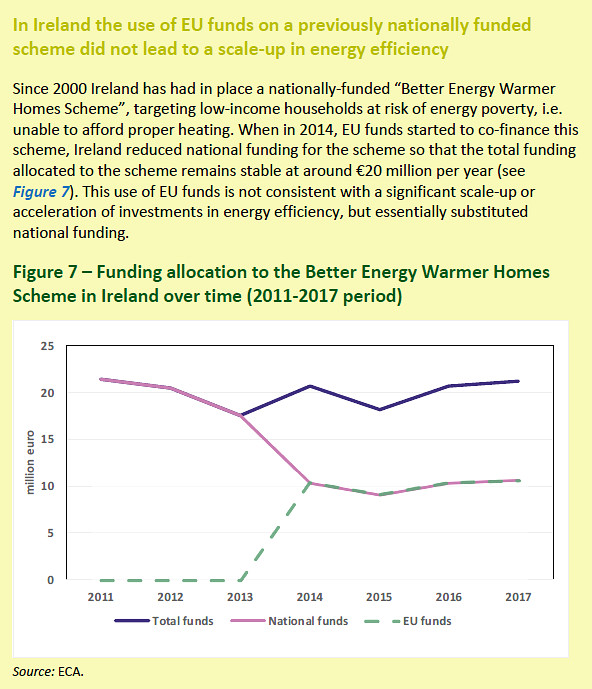
Coloured Image / Graph showing how EU Funds were used merely to substitute national funding in Ireland’s Better Energy Warmer Homes Scheme. Consequently, there was no scale-up in Energy Efficiency Projects. Click image to enlarge.
.
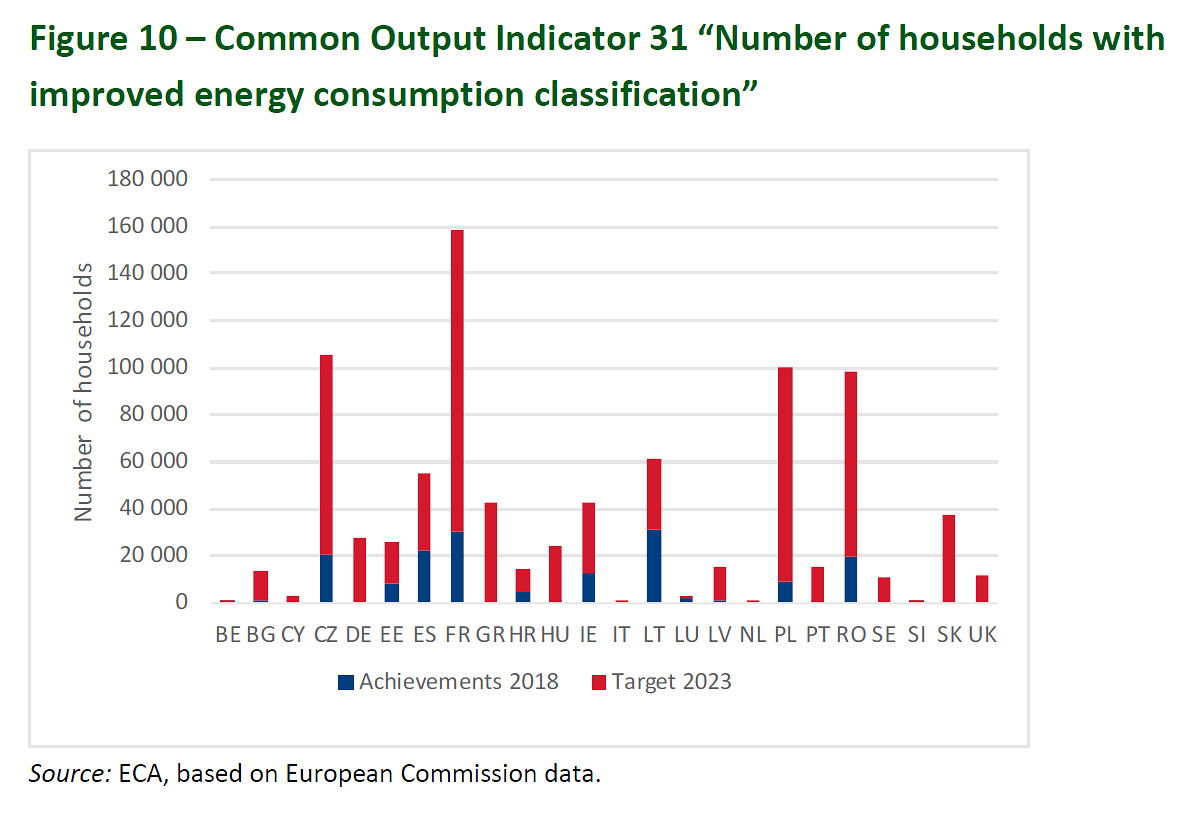
Coloured Image / Graph showing 2018 Actual Achievements and 2023 Targets for the number of EU Households with an improved energy consumption classification. Progress is worse than dismal ! Click image to enlarge.
.
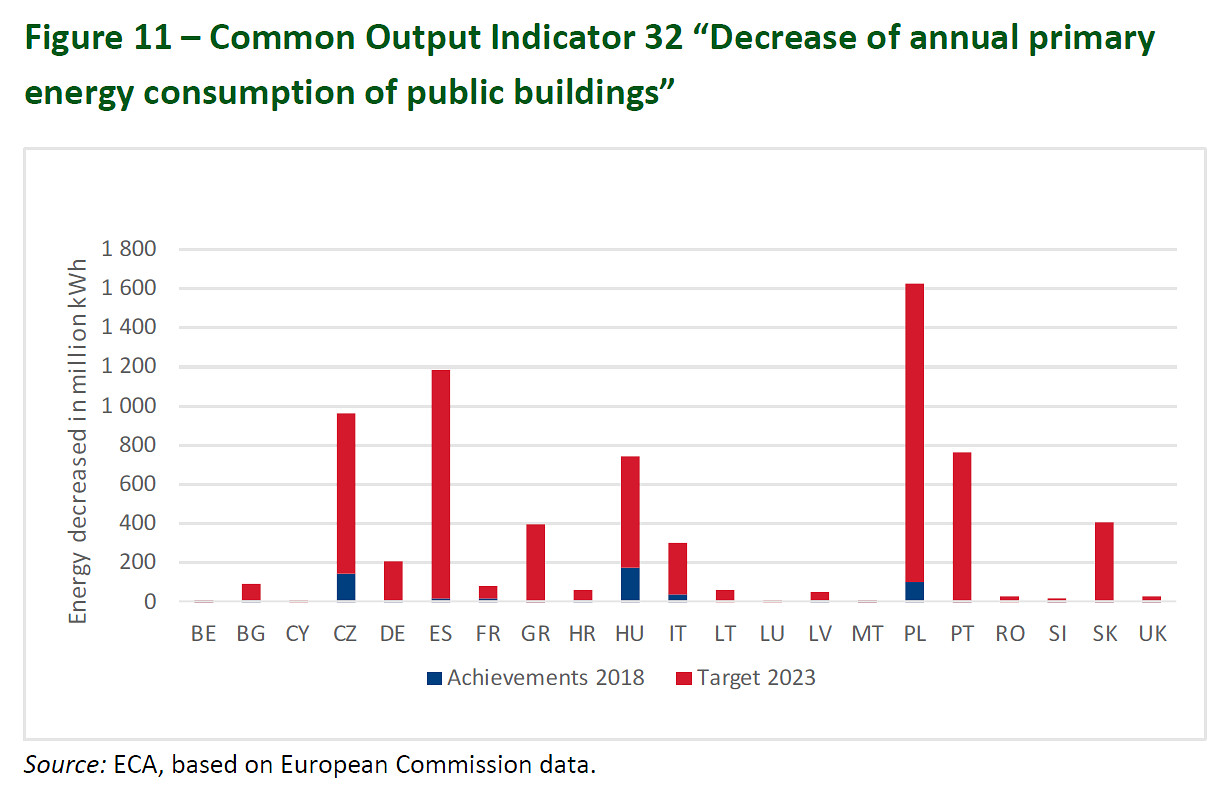
Coloured Image / Graph showing 2018 Actual Achievements and 2023 Targets for the number of EU Public Buildings with decreased primary energy consumption. Progress is abysmal ! Click image to enlarge.
Update 2020-09-01: Although the term ‘Vulnerable People’ remains unaltered, I considered it wise, and very necessary bearing in mind the obvious myopia in the mainstream health, safety and design worlds … clearly demonstrated by the 2017 Grenfell Tower Fire in England, and this current CoronaVirus / CoVID-19 Global Pandemic … to include references to specific social groups …
Vulnerable People: Those people – in a community, society or culture – who are most at risk of being physically, psychologically or sociologically wounded, hurt, damaged, injured, or killed … and include, for example, people with disabilities, young children, people with health conditions, frail older people, women in late pregnancy, refugees, migrants, prisoners, the poor, and homeless.
.
2020-07-20: So many diverse design disciplines and interested groups are involved in the realization, operation and maintenance of a Safe, Inclusive, Resilient and Sustainable Human Environment (built, social, economic, virtual, and institutional) … that the use of simple, easily assimilated language and precise, harmonized technical terminology must be widely exercised. For the effective application of Building Information Modelling (BIM), this is particularly important.
And concerning Fire Engineering, it is not clear when the practice began, but defining a concept simply in terms of performance in a ‘standard test fire’ is entirely inadequate, and fails to explain the actual meaning of the concept.
This Terminology … a body of particular terms, each explaining and defining a single concept, covering inter-related building requirements, e.g. human health, accessibility and fire safety for all, firefighting, social rights, design, performance monitoring, and facility management … takes account of:
Sustainability Impact Assessment (SIA)
WHO International Classification of Functioning, Disability and Health (ICF)
Universal Declaration of Human Rights (UDHR)
U.N. Convention on the Rights of Persons with Disabilities (CRPD)
Environmental Impact.
Fire Engineering Terms … take account of the ‘realistic’ end condition, i.e. a real fire in a real building which is occupied or used by real people with varying behaviour and abilities in relation to self-protection, independent evacuation to an external place of safety remote from a fire building, and active participation in a building’s Fire Emergency Management Plan.
General Terms … are also included in order to facilitate a better understanding of:
the complexity of human behaviour and perception (visual, auditory, olfactory, gustatory, tactile and proprioceptive) ;
the wide range of health conditions ; and, more specifically
Within the professional discipline of Fire Engineering … either a building is Fire Safe, or it is not ; the design philosophy of the Fire Engineer is irrelevant. Similarly, building designers must now begin to think and act in the simple terms of a building being either Accessible, or not. Too many pointless discussions, and too much petty squabbling, about constrained and constraining accessibility philosophies have wasted valuable time, energy and resources.
.
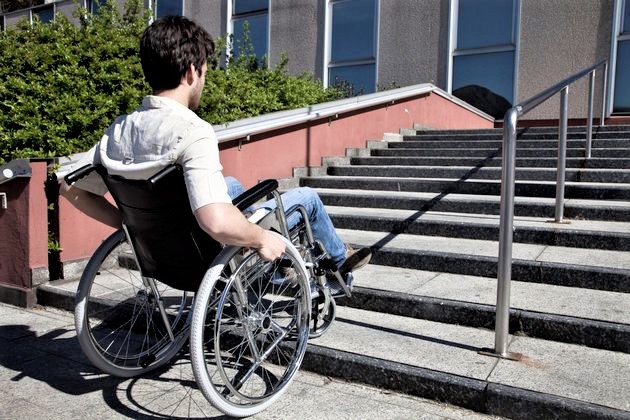
Colour photograph showing a typical, everyday scene in countries all over the world … a young person in a manual wheelchair, independently attempting to mount an external flight of steps in front of a building entrance. . Reality Check: A Universal, Dismally Inaccessible Built Environment ! . Click image to enlarge.
.
Building Accessibility encompasses the complete cycle of Independent Use, in a dignified manner and on an equal basis with others … and includes the approach, entry and use of a building, its facilities and information systems … Egress during normal / ambient conditions and removal from the vicinity of the building … and most importantly, safe Evacuation during a fire emergency to a Place of Safety which is remote from the building and reached by way of an accessible route.
.
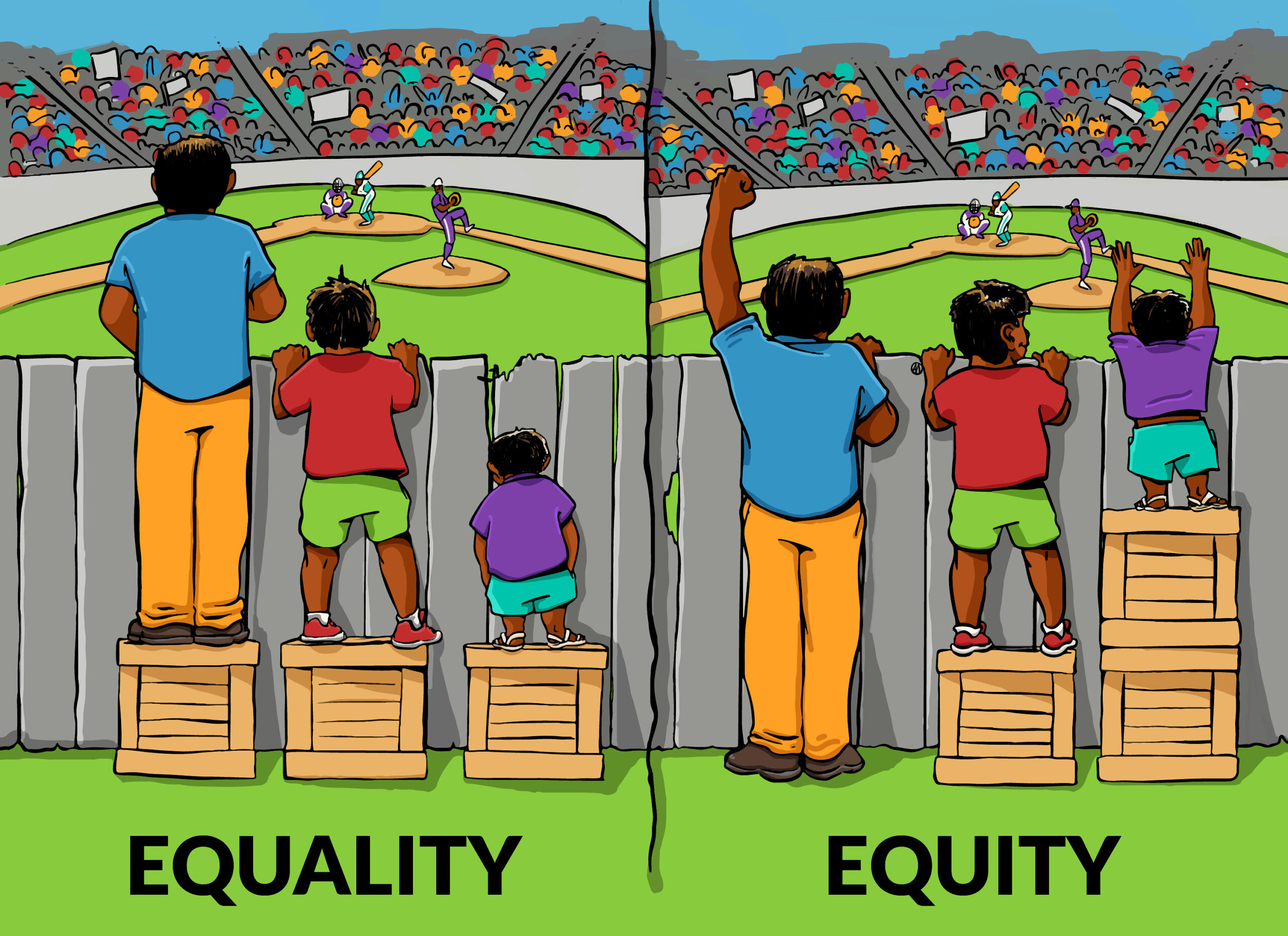
Colour image illustrating the difference between Equality and Equity. Everybody is equal, and must be treated equally … but the measures necessary to achieve this in real life must, in many cases, be equitable. . Human Ability and Behaviour is a continuum … a gentle gradient on which every person functions and acts at different levels due to Environmental and Personal Factors. . Click image to enlarge.
.
To be Accessible, a building must meet a long and complex list of inter-related Accessibility & Usability Design Criteria sufficiently well, i.e. the building must work properly for building occupants and users. The design target is Effective Accessibility … not half-baked accessibility, partial accessibility, the minimal accessibility required by building codes, or token accessibility.
On the other hand, and taking additional account of the current CoronaVirus / CoVID-19 Pandemic … the construction and operation target must be Successful Implementation, i.e. the finished building design, as constructed and operated, must provide a consistently high degree of safety, convenience and comfort for potential occupants and users during the lifetime of the building.
.
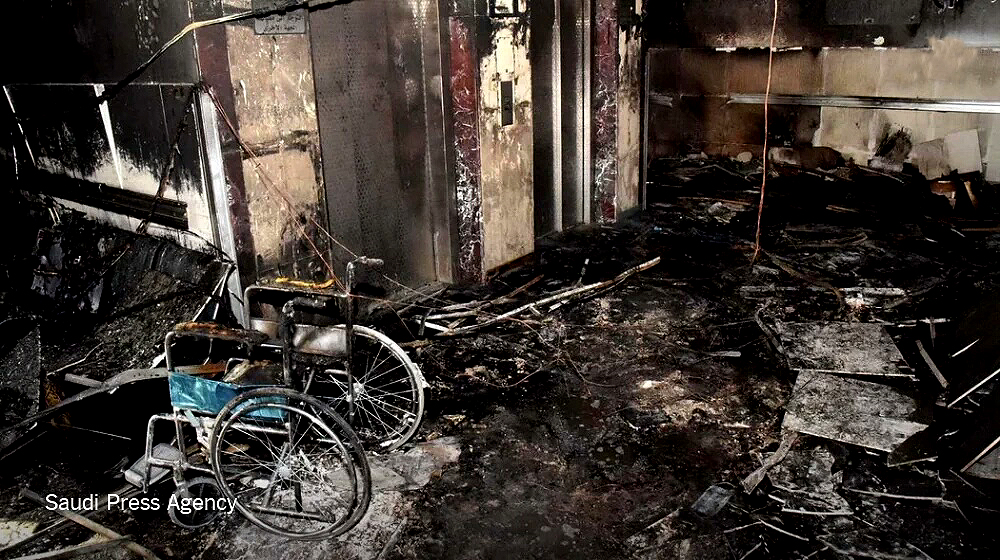
Colour photograph showing the post-fire scene of a devastated Lift Lobby with an abandoned Manual Wheelchair. 25 people died and 123 were injured in a Jazan Hospital Fire, Saudi Arabia, which occurred on 24 December 2015. The fire broke out in the hospital’s Intensive Care Unit and Maternity Ward. Click photograph to enlarge.
.
People with Activity Limitations … those people, of all ages, who are unable to perform, independently and without assistance, basic human activities or tasks – because of a health condition or physical / mental / cognitive / psychological impairment of a permanent or temporary nature … are a significant vulnerable group in every community, in every society, and include people with disabilities, children under the age of 5 years, frail older people, women in the later stages of pregnancy, and people with health conditions, etc.
Fire Safety Codes and Standards for healthy, able-bodied, agile adults using buildings exist in almost every country ; these people can take for granted that buildings are fire safe for them !
However, guidelines concerning Fire Safety for People with Activity Limitations / Fire Safety for ALL (if those guidelines exist at all) are usually technically inadequate, entirely tokenistic and/or blatantly discriminatory ; these people must assume that there is a serious risk to their safety every time they enter a building. For them, this is a very significant barrier to their personal development, participation and social inclusion ; it is a clear and present violation of their human rights !
Forcefully mandated in the United Nations Convention on the Rights of Persons with Disabilities, adopted on 13 December 2006 … the UN CRPD’s Principal Aim is to ensure that the Human Environment (social, built, economic, virtual, and institutional) is sufficiently accessible to facilitate the safe exercise and enjoyment of those rights, protections and freedoms set down in the 1948 Universal Declaration of Human Rights (UDHR), and subsequent International Rights Instruments, by a vulnerable and major section of the population in all of our communities.
.
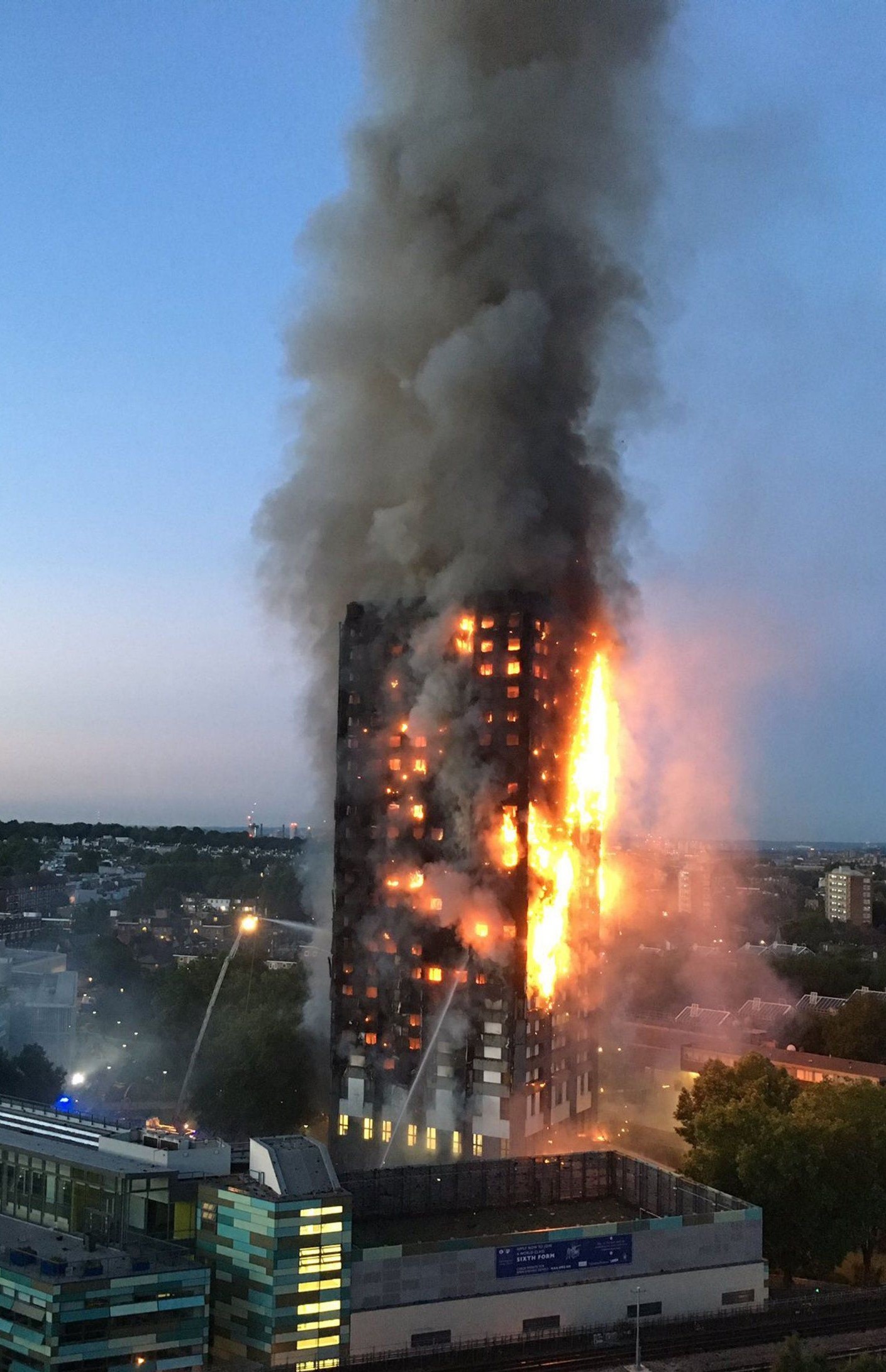
Colour photograph showing the scene of a raging fire in London, on 14 June 2017. 72 people died and many more were injured in this 24 Storey, 120 Apartment Residential Building. Vulnerable People, including people with activity limitations, refugees, and immigrants with a poor grasp of the English language lived at various heights throughout the Tower. . A serious design flaw in this building (among many, many others), i.e. a lack of Effective Accessibility … only one narrow, atrociously detailed staircase serving the entire building, lifts/elevators which were useless in a fire emergency, and no areas of rescue assistance adjoining the staircase … had a profoundly negative impact on Firefighter Operations and Safety on the night of 14 June and the following day. . Click photograph to enlarge.
.
It is time to Entirely Eradicate current obsolete, professionally negligent, incompetent and ridiculous approaches to Building Design which result in …
Fire Safety for SOME but not for ALL
Accessibility for SOME but not for ALL
Intricately inter-related … ‘Fire Safety for All’ is a vital component of ‘Accessibility for All’.
.
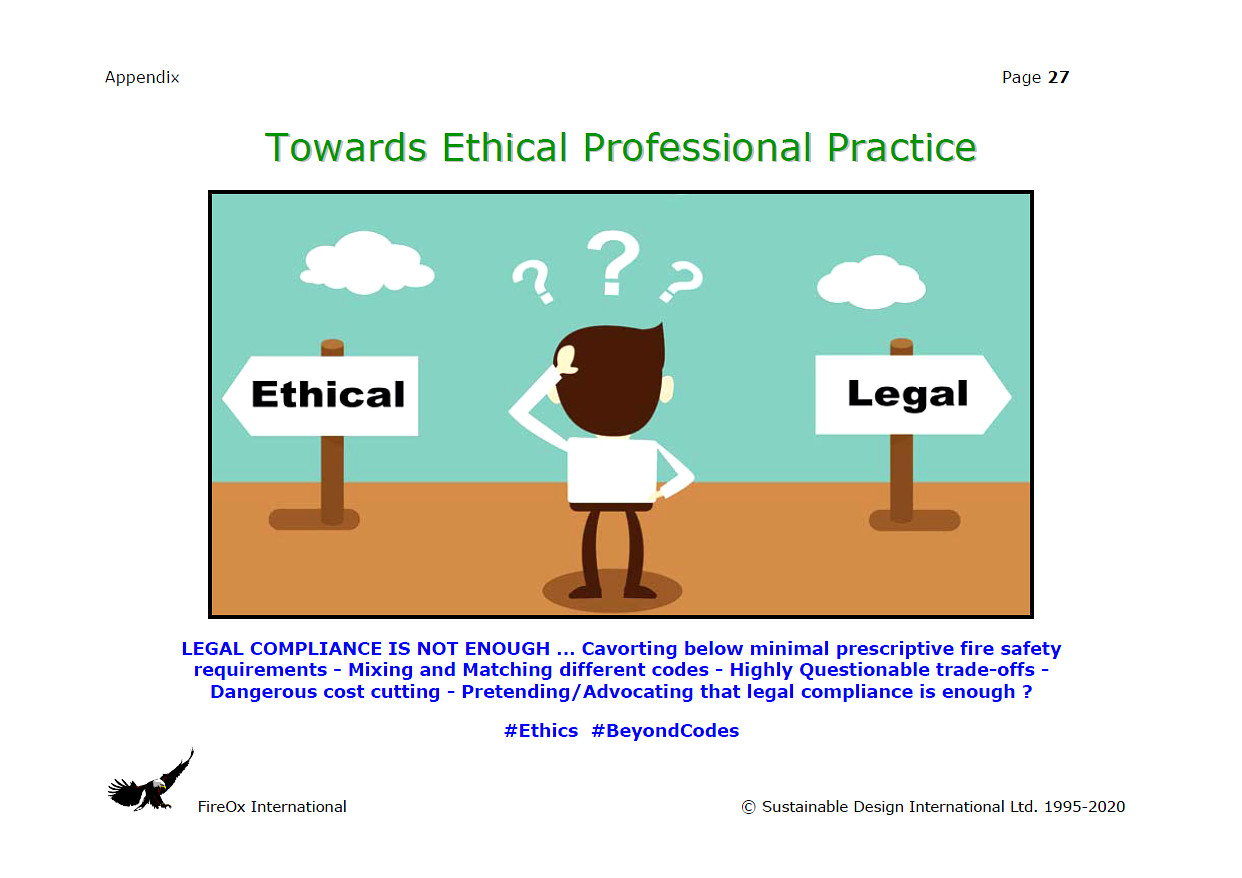
Colour image / Presentation overhead showing how building designers face a critical choice in everyday practice … Legal or Ethical … Beyond Codes ?!?!? . Legal Compliance is Never Enough. . Click image to enlarge.