Ar C.J. Walsh – Registered Architect, Fire Engineer & Independent Technical Controller …… International Expert on Accessibility for All (including Fire Safety) + 'Real' Sustainability Implementation !
2024-02-21: On this day in 1965 … Malcolm X … was Assassinated at an Organization of Afro-American Unity (#OAAU) Rally in the Audubon Ballroom, Harlem, New York City …
.
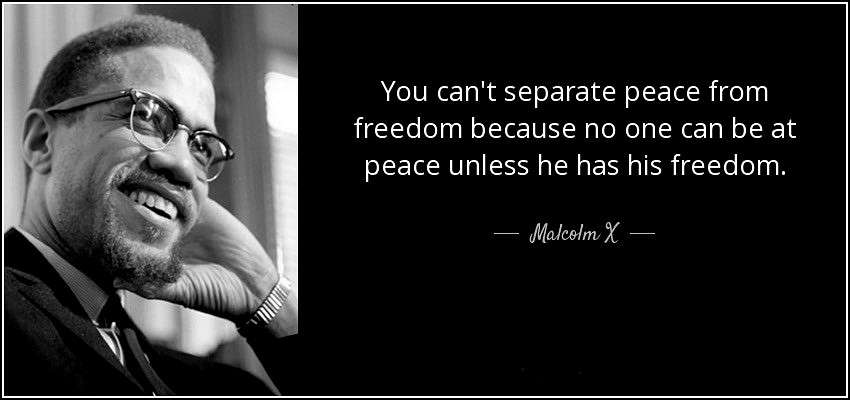
Black and white image combining a photograph of Malcolm X on the left … with one of his quotations on the right: “You can’t separate peace from freedom because no one can be at peace unless he has his freedom”. Still directly relevant today. Click to enlarge.
Malcolm X … later known as el-Hajj Malik el-Shabazz … was born on 19 May 1925.
.
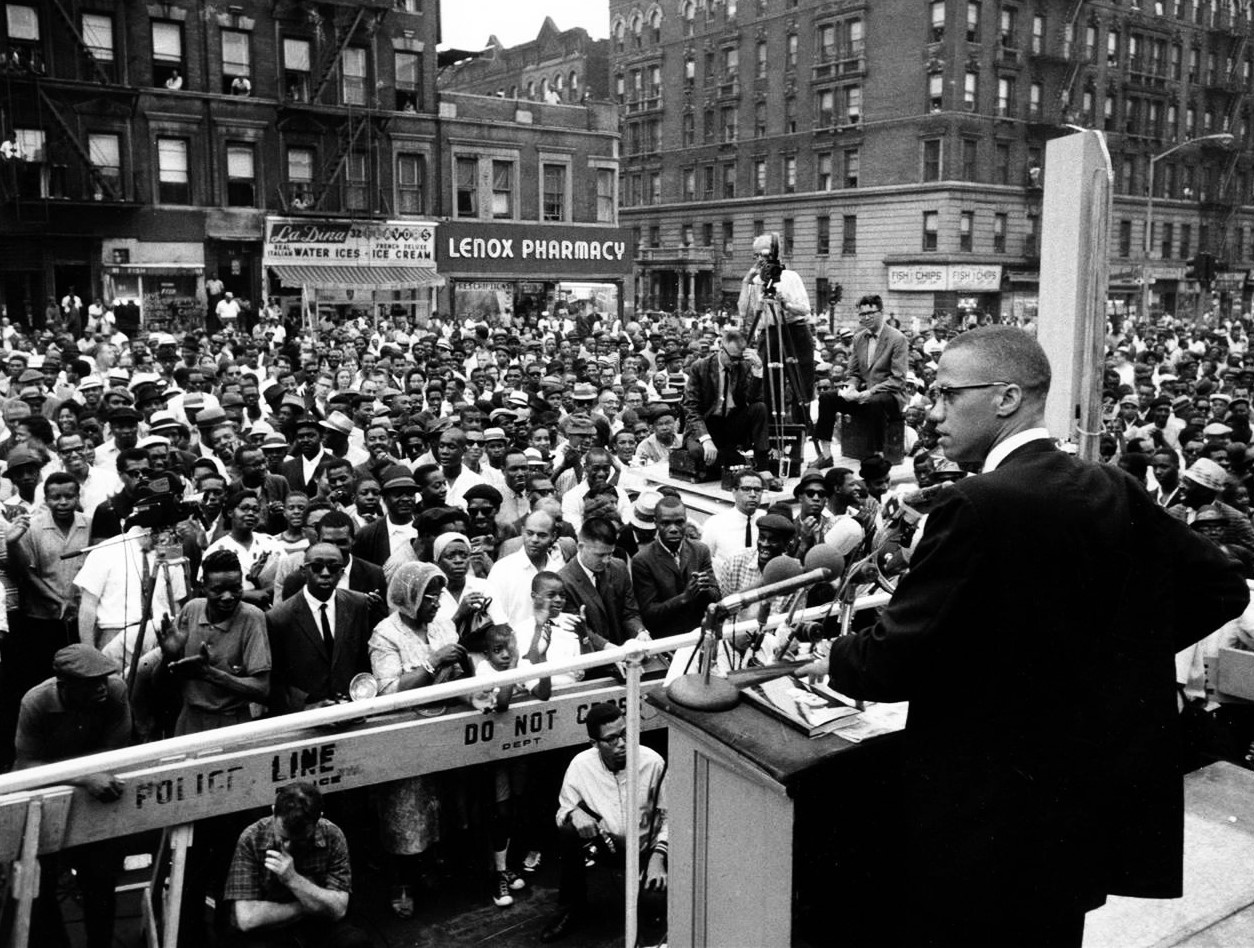
Black and white photograph showing Malcolm X addressing a crowd. Click to enlarge.
.
Black and white image showing a USA Postage Stamp, issued 1999, in honour of Malcolm X … who is seen in pensive mood. Click to enlarge.
2024-02-17: A very recent Report: The Fraud of Plastic Recycling – How Big Oil and the Plastics Industry Deceived the Public for Decades and Caused the Plastic Waste Crisis … published by the Centre for Climate Integrity ( www.climateintegrity,org ), in Washington D.C., #USA … raises serious issues about whether Any Plastic Recycling is technically or economically viable at scale … and serious questions, by implication, about Statistical Reliability in the European Union (#EU) concerning Recycling generally, and Plastics Recycling in particular.
Could this also be the Reason why the Global North is so busy dumping Un-Recyclable Plastics in the previously colonized territories of the Global South ???
.
Short Extract From This Report’s Introduction …
Plastic Pollution is one of the most serious Environmental Crises facing the world today. Between 1950 and 2015, over 90% of plastics were landfilled, incinerated, or leaked into the environment. Plastic Waste is ubiquitous – from our rivers, lakes, and oceans to roadways and coastlines. It is in ‘the air we breathe, the food we eat, and the water we drink’. One study estimates that humans ingest up to five grams, or the equivalent of one credit card worth of plastic per week. Some of the largest Oil and Gas Companies are among the 20 petrochemical companies responsible for more than half of all single-use plastics generated globally. #ExxonMobil, for example, is the world’s top producer of single-use plastic polymers.
Underpinning this Plastic Waste Crisis is a decades-long campaign of #Fraud and #Deception about the #Recyclability of #Plastics. Despite their long-standing knowledge that recycling plastic is neither technically nor economically viable, petrochemical companies – independently and through their industry trade associations and front groups – have engaged in fraudulent marketing and public education campaigns designed to mislead the public about the viability of plastic recycling as a solution to Plastic Waste.
By deceiving consumers, policymakers, and regulators about the viability of Plastic Recycling, petrochemical companies have ensured the continued expansion of plastic production, which has led to a Plastic Waste and Pollution Crisis for communities across the country. The costs of managing and cleaning up Plastic Waste are largely borne by municipal and state governments – and those costs are projected to increase exponentially in the coming decades, given that Plastic Waste generation in the United States of America is expected to increase from 73 million metric tonnes in 2019 to more than 140 million metric tonnes by 2060.
If not for the Big Oil and the plastic industry’s lies and deception, municipalities and states would not have invested in plastic recycling programmes and facilities – many of which have been shut down due to foreseeable economic losses. The industry not only misled municipal and state agencies to believe that Plastic Recycling was a viable solution to Plastic Waste but also discouraged them from pursuing other, more Sustainable Waste Management Strategies (e.g., waste reduction, reuse, bans, alternative materials) in favour of plastic recycling.
Fossil fuel and other petrochemical companies should now be held accountable for their deliberate campaign of deception and the resulting harms, much like tobacco and opioid companies that employed a similar playbook. Based on the growing body of evidence, municipalities and states are likely to pursue litigation, which could put an end to the industry’s deception, make the companies pay for the devastating harms they have caused to communities, and open the door to real solutions that are currently out of reach.
2023-06-28:Sustainability is not an abstract concept, divorced from current geo-political realities. Lasting Peace and Robust International Law are fundamental prerequisites for Sustainable Human and Social Development … a truth forgotten, and/or conveniently set aside, by all parties to the savage and immensely destructive #USA #NATO #EU / #Ukraine / #Russia #War.
.
USA, 60 Years Ago …
In the tense atmosphere of the Cold War with Russia, and just after the Cuban Missile Crisis a few months earlier … a short extract – inspiring words – from President John F. Kennedy’s Commencement Address at the American University, Washington D.C., on 10 June 1963 …
” … I have, therefore, chosen this time and this place to discuss a topic on which ignorance too often abounds and the truth is too rarely perceived – yet it is the most important topic on earth: World Peace.
What kind of peace do I mean ? What kind of peace do we seek ? Not a Pax Americana enforced on the world by American weapons of war. Not the peace of the grave or the security of the slave. I am talking about genuine peace, the kind of peace that makes life on earth worth living, the kind that enables men and nations to grow and to hope and to build a better life for their children – not merely peace for Americans but peace for all men and women – not merely peace in our time but peace for all time.
I speak of peace because of the new face of war. Total war makes no sense in an age when great powers can maintain large and relatively invulnerable nuclear forces and refuse to surrender without resort to those forces. It makes no sense in an age when a single nuclear weapon contains almost ten times the explosive force delivered by all the allied air forces in the Second World War. It makes no sense in an age when the deadly poisons produced by a nuclear exchange would be carried by wind and water and soil and seed to the far corners of the globe and to generations yet unborn.
Today the expenditure of billions of dollars every year on weapons acquired for the purpose of making sure we never need to use them is essential to keeping the peace. But surely the acquisition of such idle stockpiles – which can only destroy and never create – is not the only, much less the most efficient, means of assuring peace.
I speak of peace, therefore, as the necessary rational end of rational men. I realize that the pursuit of peace is not as dramatic as the pursuit of war – and frequently the words of the pursuer fall on deaf ears. But we have no more urgent task. …”
.
Fast Forward 60 Years To The Present …
The #GroupFeeling towards #China (#PRC) in the same Washington D.C. is an irrational and disturbing mixture of paranoia, panic, fear, jealousy, and war fever. All too easily, other countries have been sucked into the Hegemonic Agenda of President Joe Biden – an old fashioned, mid-20th Century Cold War Warrior. Pax Americana, USA #Exceptionalism, weaponisation of the #Dollar, widespread #Sanctioning (at this stage, who isn’t being sanctioned ?), illegal #Trade restrictions, and blatant #HumanRights hypocrisy (see the recent UN Report on the USA #Guantánamo Detention Facility in #Cuba) are all being quietly rejected by the Global ‘South’ and ‘East’.
But who today, in the ‘West’, understands China’s assertiveness … and why it must be uncompromising ? The #USA’s ideologically-driven ignorance has led, in the past, to enormous blunders … Viet Nam, Iraq, Libya, Afghanistan, etc., etc.
On 25 November 2020, I was very pleased to give a Virtual Presentation to a private discussion group …
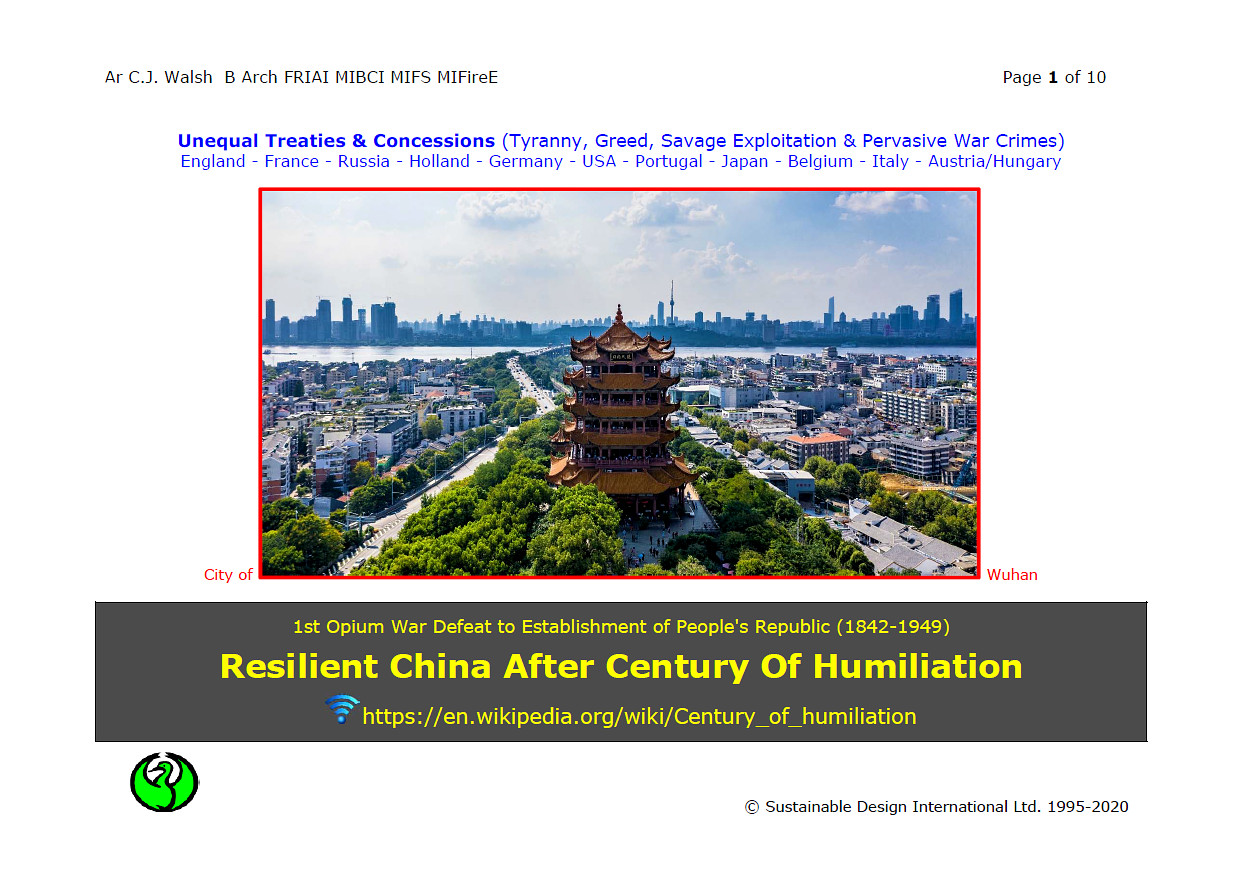
Colour Image showing the Title Page for CJ Walsh’s Presentation: ‘Resilient China After Century Of Humiliation’. In the centre, an aerial view over the city of Wuhan. Below, the Title Block for the presentation. At the top, a list of the countries responsible for China’s humiliation. Click to enlarge this image. Use the link below to download the Full Presentation of 10 Pages.
Click to download Presentation, 10 Pages, PDF File 5.55 MB
.
Using #Taiwan to bait China and ramp up military tensions can only end badly for the ‘West’. China’s ‘Century of Humiliation’ is over … President Xi Jinping, and the Communist Party of China (#CPC) Central Committee, will certainly not allow that sad history to repeat itself.
The proposal by NATO (North Atlantic Treaty Organization) to open an office – any type of office – in #Japan is not only ridiculous … it is preposterous.
China is not an enemy of the European Union (#EU) … Ursula von der Leyen (President of the European Commission) and Josep Borrell (High Representative of the European Union for Foreign Affairs and Security Policy) would do well to remember that !
.
[ Footnote 1: Use of Cluster Munitions in Armed Conflicts …
The Convention on Cluster Munitions (https://www.clusterconvention.org/) – adopted in Dublin on 30 May 2008, and became binding #InternationalLaw when it entered into force on 1 August 2010 – was born out of a collective determination to address the humanitarian consequences and unacceptable harm to civilians caused by cluster munitions. States Parties to the Convention are committed to the full universalization of the #CCM and to promote its norms, as well as to fully implement it. Its implementation contributes to advancing the achievement of the UN Sustainable Development Goals (#SDG’s) and the promotion of International #Peace and #Security, #HumanRights and International Humanitarian #Law.
Convention on Cluster Munitions Article 1 – General Obligations & Scope of Application
1. Each State Party undertakes never under any circumstances to:
(a) Use cluster munitions ;
(b) Develop, produce, otherwise acquire, stockpile, retain or transfer to anyone, directly or indirectly, cluster munitions ;
(c) Assist, encourage or induce anyone to engage in any activity prohibited to a State Party under this Convention.
Question: If the vast majority of NATO Member Countries have ratified this Convention … why has the USA been permitted to supply these munitions to Ukraine ?? ]
.
[ Footnote 2: Xi Jinping’s Visit to Ireland in February 2012 …
2019-11-11:Kensington and Chelsea’s wilful disdain for the Health, Safety and Welfare of ALL the residents within its functional area … and knowing neglect of its legal and ethical Duty of Care towards ALL … resulted in a significant number of people with activity limitations living high up in Grenfell Tower prior to June 2017 … in spite of the now incontrovertible fact that, in the event of a fire emergency, many would be left behind … to die.
‘All human beings are born free and equal in dignity and rights.’
Article 1, 1948 Universal Declaration of Human Rights
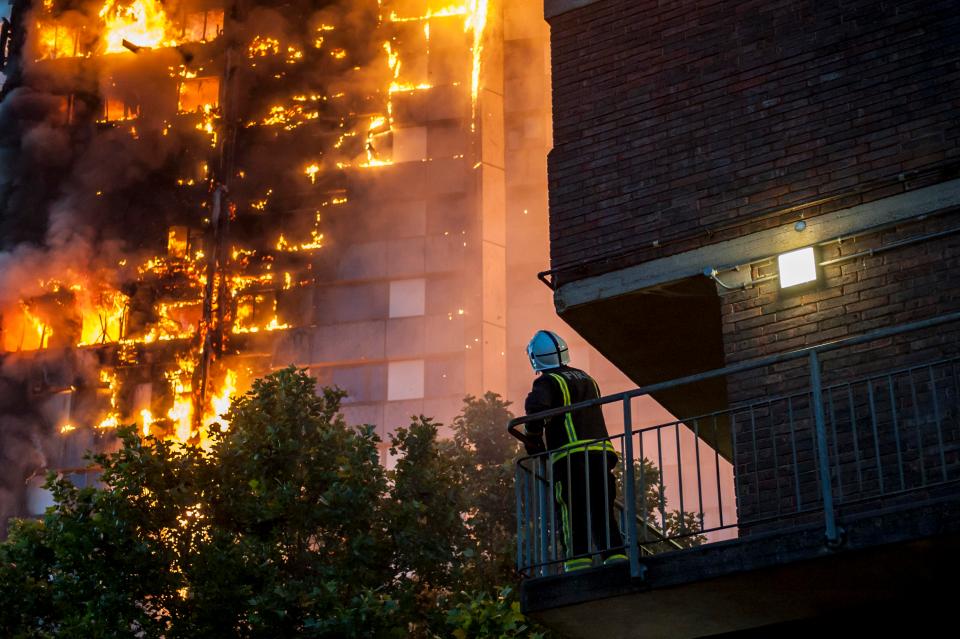
Colour photograph showing a Firefighter watching the horrific fatal fire scene at Grenfell Tower in London, on 14 June 2017, from a nearby balcony. Click to enlarge.
London Fire Brigade was an easy target for the Grenfell Fire Inquiry’s Phase 1 Report, made all the more so following some careless, insensitive and ignorant public comments by its Commissioner, Dany Cotton. However, we must clearly distinguish between the behaviour of LFB’s Frontline Firefighters, who were brave and dedicated despite inadequate training, and lack of proper equipment, back-up resources and personnel strength … and LFB’s Senior Commanders … which is another matter.
Colour photograph showing the London Fire Brigade (LFB) Commissioner, Dany Cotton. In order to ensure that transformation of the LFB actually takes place in the short term, and is fully effective, Dany Cotton and all of her Senior Commanders must resign now, or be fired ! Click to enlarge.
In England … there is widespread indifference, and some rabid resistance, to answering the desperate needs, and mitigating the agonizing plight, of Vulnerable Building Users during fire emergencies … which includes people with activity limitations, children under 5 years of age, frail older people (not All older people !), women in late stage pregnancy, people with disabilities, refugees, migrants, the poor, and people who do not understand the local culture or cannot speak the local language. British National Standard B.S.9999 (not solely those sections previously contained in B.S.5588:Part 8) and England’s National Building Regulations – Approved Document B: ‘Fire Safety’ – offer only token, i.e. inadequate, protection for vulnerable people in fire emergencies. When a senior representative of BSI, the British Standards Institution, was directly approached by me, and requested to open up B.S.9999 for meaningful updating … the answer was a firm “NO” ! The same attitude is deep-seated among fire research organizations in the country, and among people who develop computer fire evacuation models.
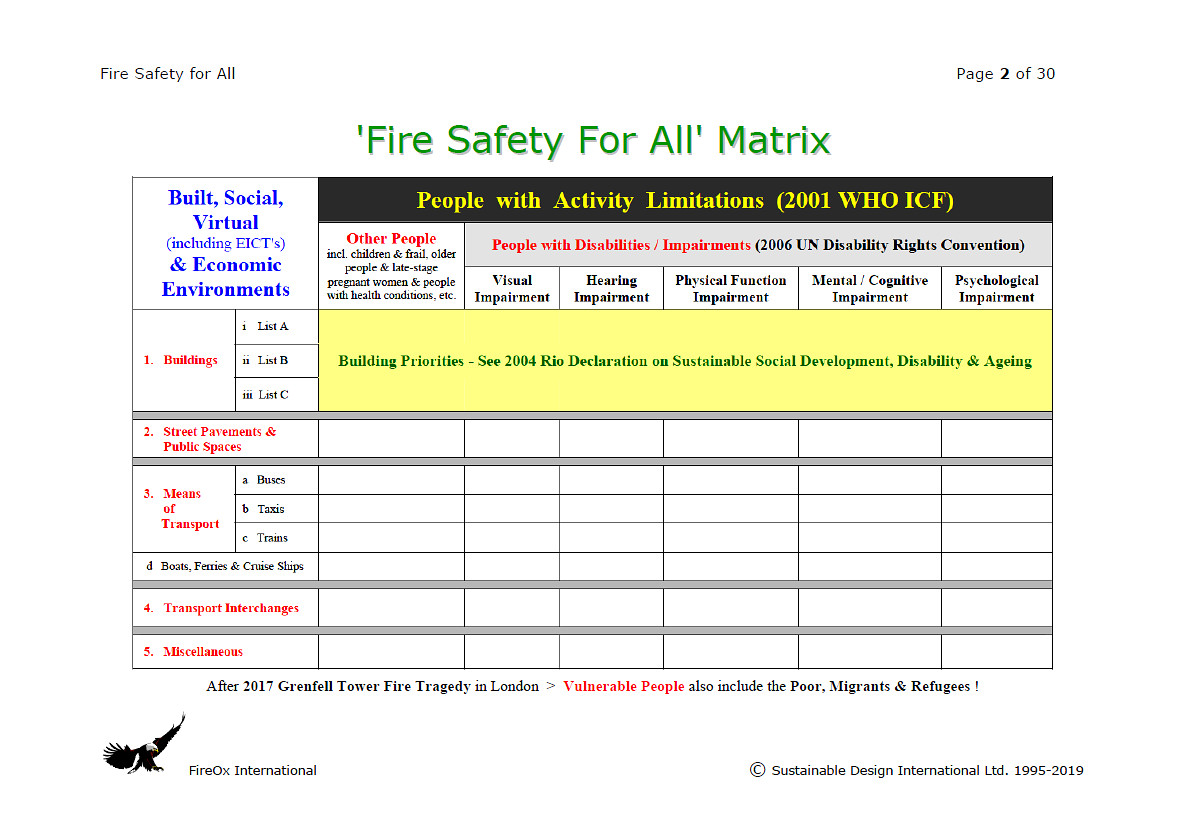
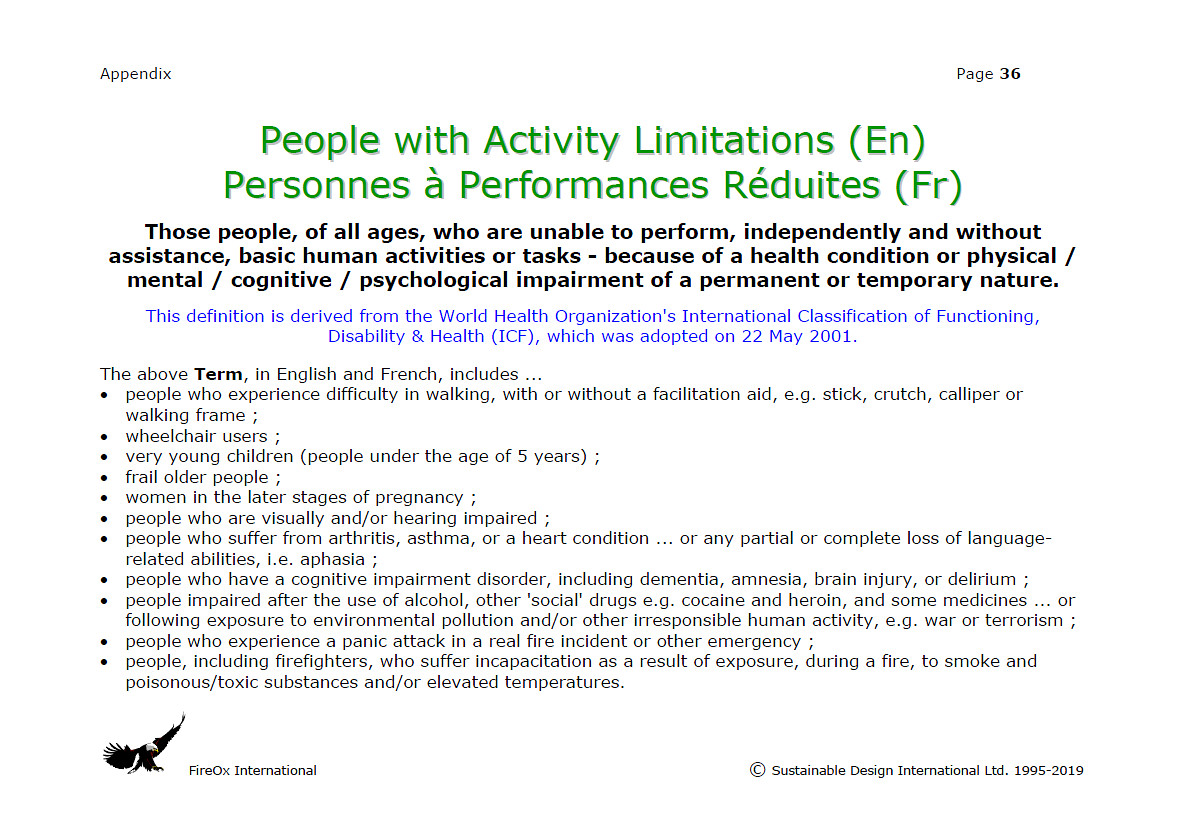
Presentation Overhead, in colour, showing the ‘Fire Safety for All’ Matrix, which outlines the scope of its application in the Human Environment and the different social groups to be targeted. Balanced consideration must be given to people who use wheelchairs (physical function impairment) … and to people with visual, hearing, psychological, and mental/cognitive impairments … and to other vulnerable building users, e.g. people with health conditions. Click to enlarge. Matrix developed by CJ Walsh.Presentation Overhead showing the definition of ‘people with activity limitations’, with its equivalent French translation … also showing from where this term is derived … and who this term includes. During a fire emergency, confused and/or confusing disability-related language costs lives ! Click to enlarge.
.
Grenfell Fire Inquiry’s Phase 1 Recommendations – Chapter #33
After hearing the first media reports about the tough Recommendations aimed at London Fire Brigade, I had naturally expected that the other Phase 1 Recommendations would be equally as tough. But NO … they are far from comprehensive … they are fragmentary, lack depth and any sort of coherence. Specifically with regard to Vulnerable Building Users, the Recommendations are pathetically and disgracefully inadequate !
And in case there is any doubt, the status quo in England – and to be fair, in many other countries as well – is entirely unacceptable !!
Few people realize that the fire safety objectives in current fire regulations/codes are limited and constrained. To implement changes to the flawed regulations in England, it will take many years … and, based on recent past history, implementation will be incomplete and unsatisfactory. Residents in high-rise buildings, whether public or private, must no longer wait in vain for this to happen. Instead, the time has arrived to become proactive, and to immediately initiate their own comprehensive programmes of Self-Protection In Case Of Fire … which go far and beyond the pathetic Recommendations in Moore-Bick’s Phase 1 Report.
Fires Similar To Grenfell Tower Are Frequent
[ Paragraph #33.5 ] … although not unprecedented, fires of the kind that occurred at Grenfell Tower are rare.
[ Response ] Not true … misleading, and a complete fallacy !
Just since 2010, fires similar to Grenfell Tower have occurred in South Korea, many in the United Arab Emirates, France, Chechnya, Australia, Azerbaijan, Russia, and most recently in Turkey. Each one of these fires has been recorded and illustrated on our Twitter Account: @sfe2016dublin. Seeing, and understanding, this striking pattern of unusual fire behaviour … a competent person would react and plan accordingly.
Effective Fire Compartmentation Is A Delusion … A Fantasy !
[ Paragraph #33.5 ] Effective compartmentation is likely to remain at the heart of fire safety strategy and will probably continue to provide a safe basis for responding to the vast majority of fires in high-rise buildings.
[ Response ] Not true … demonstrates a fundamental flaw in European fire safety strategizing !
In an environment of lax or non-existent compliance monitoring … the quality of architectural/fire engineering design and the reliability of related-construction will both, inevitably, be poor and unacceptable. Fire loads in today’s residential buildings are also far higher than a generation ago, for example, because of more electrical/electronic equipment and synthetic furnishings. And whatever about first-built, i.e. whether it’s good, bad or ugly, later alterations and other construction work will typically compromise the original performance of fire resisting doorsets and service penetration fire sealing. Modern ‘green’ building materials and construction methods are further aggravating these problems. A competent person would be aware of fire research at the UL Laboratories, in the U.S.A., which confirmed the above developments.
‘ Rigorous enforcement of building codes and standards by state and local agencies, well trained and managed, is critical in order for standards and codes to ensure the expected level of safety. Unless they are complied with, the best codes and standards cannot protect occupants, emergency responders, or buildings.’
U.S. National Institute of Standards and Technology. Final Report on the Collapse of the World Trade Center Towers. NIST NCSTAR 1. 2005.
‘Stay Put’ Policies Are Criminal
[ Paragraph #33.5 ] However, in the case of some high-rise buildings it will be necessary for building owners and fire and rescue services to provide a greater range of responses, including full or partial evacuation. Appropriate steps must therefore be taken to enable alternative evacuation strategies to be implemented effectively.
[ Paragraph #33.15 ]e. that policies be developed for managing a transition from ‘stay put’ to ‘get out’ ;
[ Response ] Too little … and far too late !
[ Solution ] Two fatal fires separated in time and space … the 2009 Lakanal House Fire, in London, and the 2017 Marco Polo High-Rise Apartment Building Fire, in Honolulu, continue to clearly demonstrate that effective fire compartmentation is a delusion. Even if carried out by a competent person … it is not possible to establish with reasonable certainty, by means of a visual/surface building inspection alone, whether or not fire compartmentation is effective in an existing building. The London and Honolulu buildings were not fitted with any active fire suppression system, e.g. fire sprinklers or a water mist system.
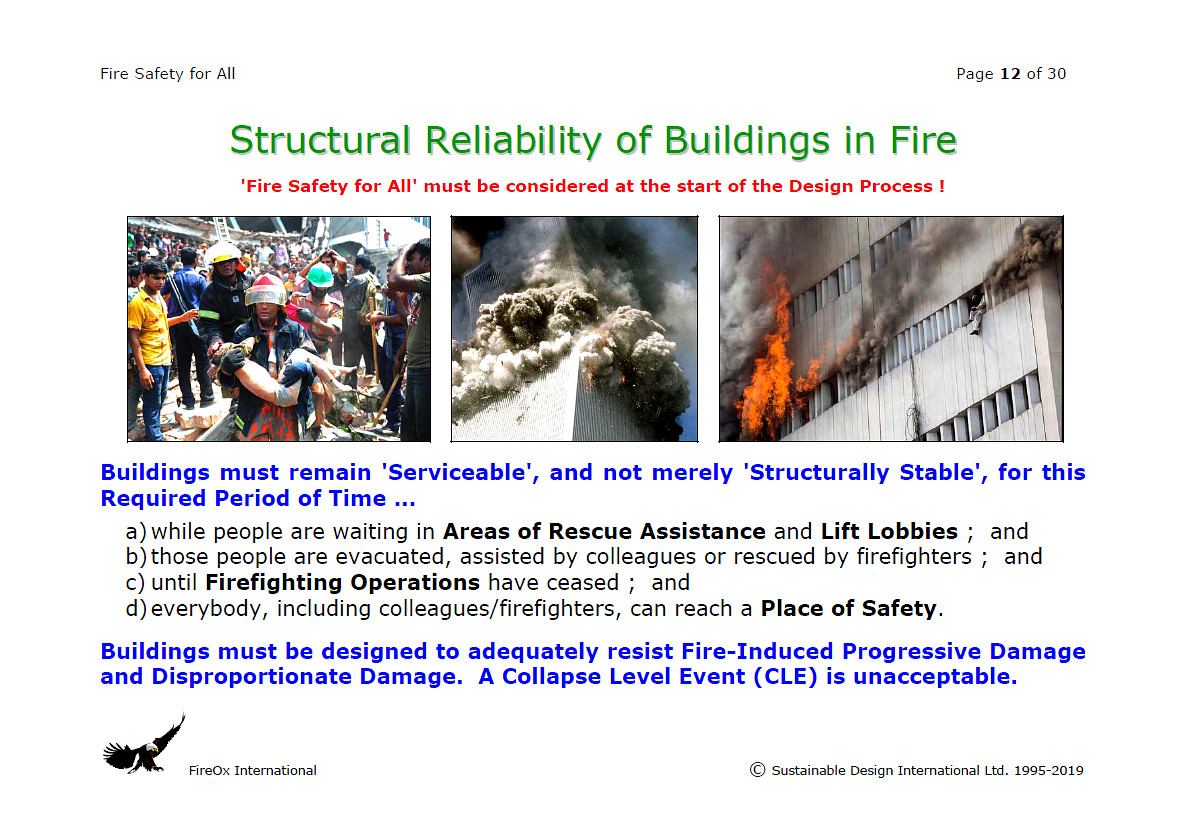
Buildings must remain structurally ‘serviceable’, not merely structurally ‘stable’, for a Required Period of Time. See the Presentation Overhead below.
Presentation Overhead, in colour, explaining the concept of ‘Structural Reliability’ in fire conditions … and defining ‘Required Period of Time’, during which a building must remain serviceable. Click to enlarge.
Authorities Having Jurisdiction (AHJ’s), firefighters, client organizations, design teams, and building owners/managers must not, therefore, direct, or even suggest, that any of its building users wait (‘stay put’) in that building during a fire emergency. A competent person always connects building fire performance with its structural performance, and vice versa … and always learns from the evidence of ‘real’ fatal fires.
All Lifts/Elevators Must Be Used For Fire Evacuation
[ Paragraph #33.13 ] When the firefighters attended the fire at Grenfell Tower they were unable to operate the mechanism that should have allowed them to take control of the lifts. Why that was so is not yet known, but it meant that they were unable to make use of the lifts in carrying out firefighting and search and rescue operations. It also meant that the occupants of the tower were able to make use of the lifts in trying to escape, in some cases with fatal consequences.
[ Response ] There is a ridiculous assumption in Moore-Bick’s Phase 1 Report that it is only firefighters who use lifts/elevators during a fire emergency, and that it is dangerous for anybody else to use them.
[ Solution ] In order to adequately protect Vulnerable Building Users … ALL lifts/elevators in a building must be capable of being used for fire evacuation during a fire emergency.
Until such time as firefighters arrive at a building fire scene in sufficient strength and are properly prepared to carry out effective firefighting and rescue operations … Firefighter Lifts/Elevators must be used for the fire evacuation of building occupants/users. Prior liaison and pre-planning with local fire services is always necessary with regard to the use of firefighting lifts/elevators for the evacuation of occupants/users.
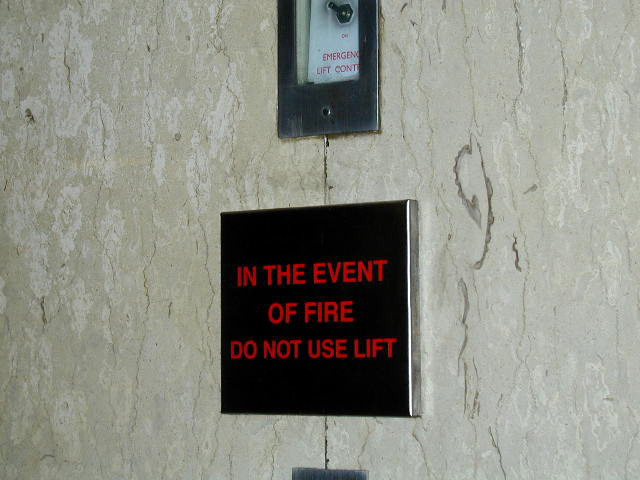
Colour photograph showing a typical sign outside most lifts/elevators around the world … ‘In The Event of Fire, Do Not Use Lift’. This is a pre-historic dinosaur of a policy which places Vulnerable Buildings Users in immediate and very serious danger during a fire emergency. Click to enlarge.
A fundamental principle of fire safety design is that there must be alternative, safe and accessible evacuation routes away from the scene of a fire, which can occur in any part of a building during its life cycle ; these evacuation routes must be capable of being used by all building users, including people with activity limitations.
This is why there must always be at least 2 Fire Evacuation Staircases in High-Rise Residential Buildings !
The location of lifts/elevators and lobbies, within peripheral building cores, must always be considered in relation to the position of adjacent fire protected evacuation staircases, which must be easily found by building occupants/users, and the areas of rescue assistance adjoining those staircases.
To be used for fire evacuation, a lift/elevator must be ‘fit for its intended use’, must operate reliably during a fire emergency, and must comprise a complete building assembly which meets specific performance criteria.
A Lift/Elevator Fire Evacuation Assembly is an essential aggregation of building components arranged together – comprising a lift/elevator, its operating machinery, a hard-construction vertical shaft enclosure, and on every floor served by the lift/elevator a sufficiently large, constantly monitored lobby for people to wait in safety and with confidence, all robustly and reliably protected from heat, smoke, flame and structural collapse during and after a fire – for the purpose of facilitating the safe evacuation of building occupants/users throughout the duration of a fire emergency.
If a building is located in a Seismic Zone, Lift/Elevator Fire Evacuation Assemblies which can safely operate during an earthquake must always be specified and installed.
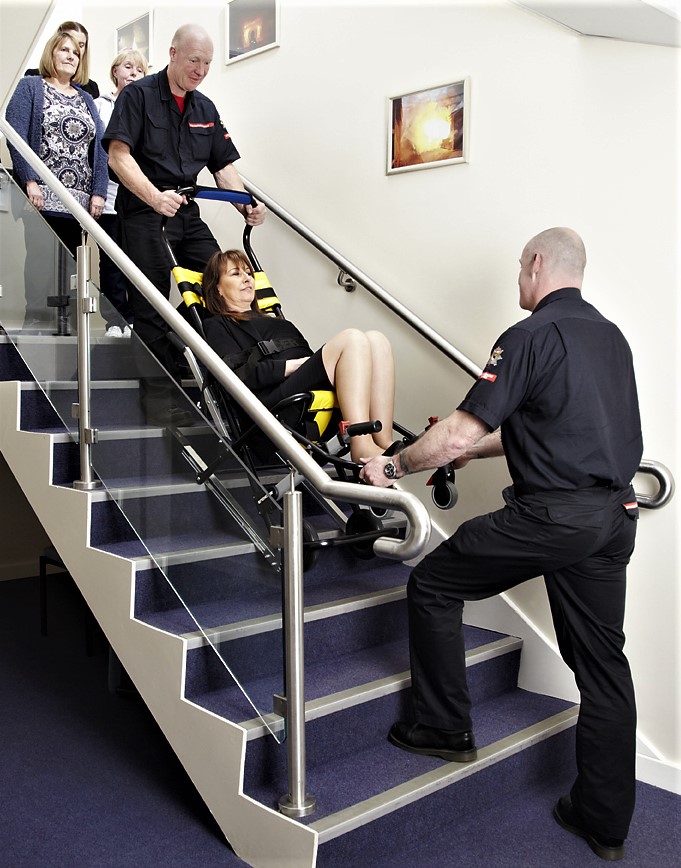
Gravity Evacuation Chair Devices, which are not electrically-powered and operate by gravity, facilitate downward movement, only, on straight flights of stairs. Having descended a staircase, with the user having left his/her wheelchair behind, these devices are not fully stable when travelling the long horizontal distances necessary to reach an external ‘place of safety’ remote from a building, perhaps over rough terrain.
Colour photograph showing a Gravity Evacuation Chair and how it is used during a fire emergency. Click to enlarge.
If lifts/elevators in existing buildings undergo a major overhaul, or if they are replaced, they should then be made capable of use for fire evacuation.
Lifts/elevators used for fire evacuation must always have a fire protected electrical supply which is separate from the main building electrical supply, in order to ensure that they can continue to operate without interruption during a fire emergency.
In addition to conventional passive fire protection measures, Lift/Elevator Lobbies must also be protected by an active fire suppression system. Water mist is the preferred fire suppression medium, because it is user-friendly, will not greatly interfere with user visibility, uses far less water compared to water sprinklers, and is also climate-friendly. Furthermore, because people with activity limitations will be waiting for evacuation in lift/elevator lobbies, building designers and managers must ensure that these lobbies are properly fitted out with appropriate fire safety equipment, facilitation aids, smoke hoods, signage and communications, etc., etc.
Proper Use of Personal Emergency Evacuation Plans (PEEP’s)
[ Paragraph #33.22 ]f. that the owner and manager of every high-rise residential building be required by law to include up-to-date information about persons with reduced mobility and their associated PEEP’s in the premises information box ;
[ Response ] There is No Recommendation or explanation in Moore-Bick’s Inquiry Phase 1 Report concerning the ‘what’, ‘why’ or ‘how’ of PEEP’s.
[ Solution ] A Personal Emergency Evacuation Plan is a person-specific and location-specific document, and is an integral part of the overall Fire Emergency Management Plan for a building. It is intended for regular occupants/users who may be vulnerable in an emergency situation, i.e. those with limited abilities in relation to self-protection, independent evacuation to an external place of safety remote from the building, and active participation in the building’s fire emergency procedures.
In new buildings, which are effectively accessible (including fire safe) for all, Personal Emergency Evacuation Plans are not necessary.
In existing buildings, Personal Emergency Evacuation Plans must not be used to limit or restrict access by an individual to any part of a building and its facilities. To ensure this, sufficient accessibility works must be carried out and appropriate management procedures put in place.
In buildings of historical, architectural and cultural importance, where the historical, architectural or cultural integrity of the building must be protected, Personal Emergency Evacuation Plans may limit or restrict access to parts of a building and some of its facilities. Refer to the ICOMOS 1964 International Charter for the Conservation and Restoration of Monuments and Sites.
There are No Recommendations in Moore-Bick’s Inquiry Phase 1 Report concerning these critical issues.
[ Solution ] There are many fire safety problems associated with high-rise and tall buildings. Evacuation by staircases alone can take many hours ; the physical exertion involved in descending even 10 floors/storeys by staircase is too much for many able-bodied people and is impossible for most vulnerable building occupants/users, particularly people with activity limitations. Passive fire protection of staircases, alone and/or supplemented by pressurization to prevent smoke ingress, is far too unreliable. And heavily equipped firefighters cannot be expected to ascend more than 10 floors/storeys by staircase before carrying out arduous firefighting and search/rescue operations. Furthermore, uninterrupted lift/elevator shafts, extending throughout the full height of a tall building, pose a significant risk of uncontrolled fire spread.
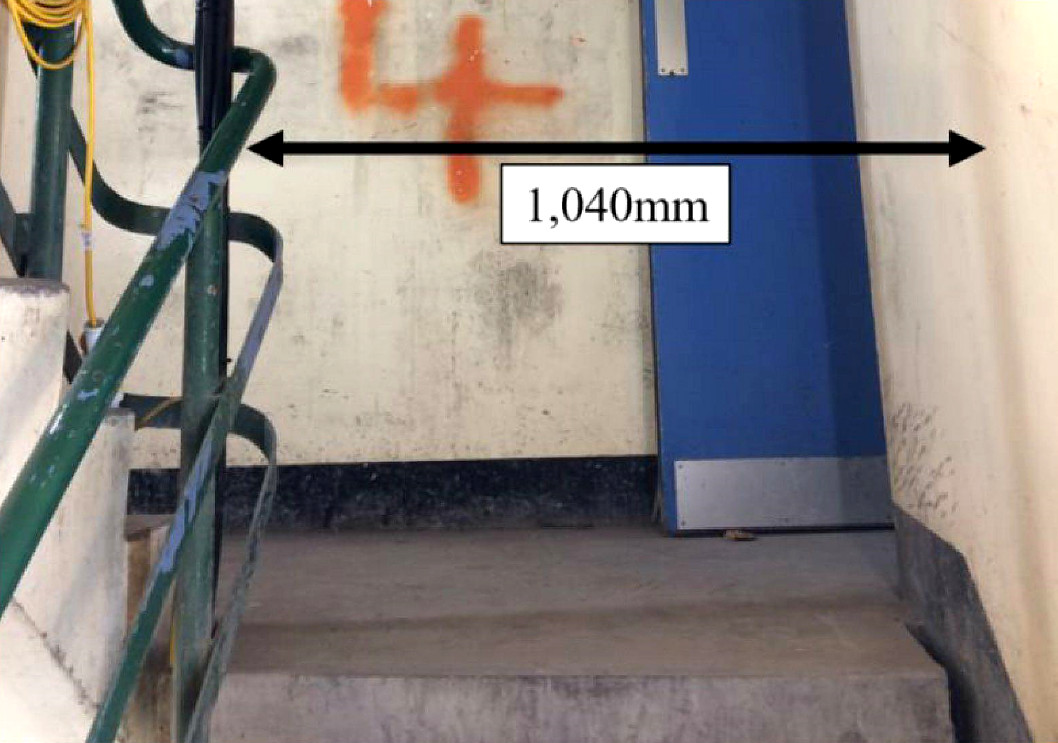
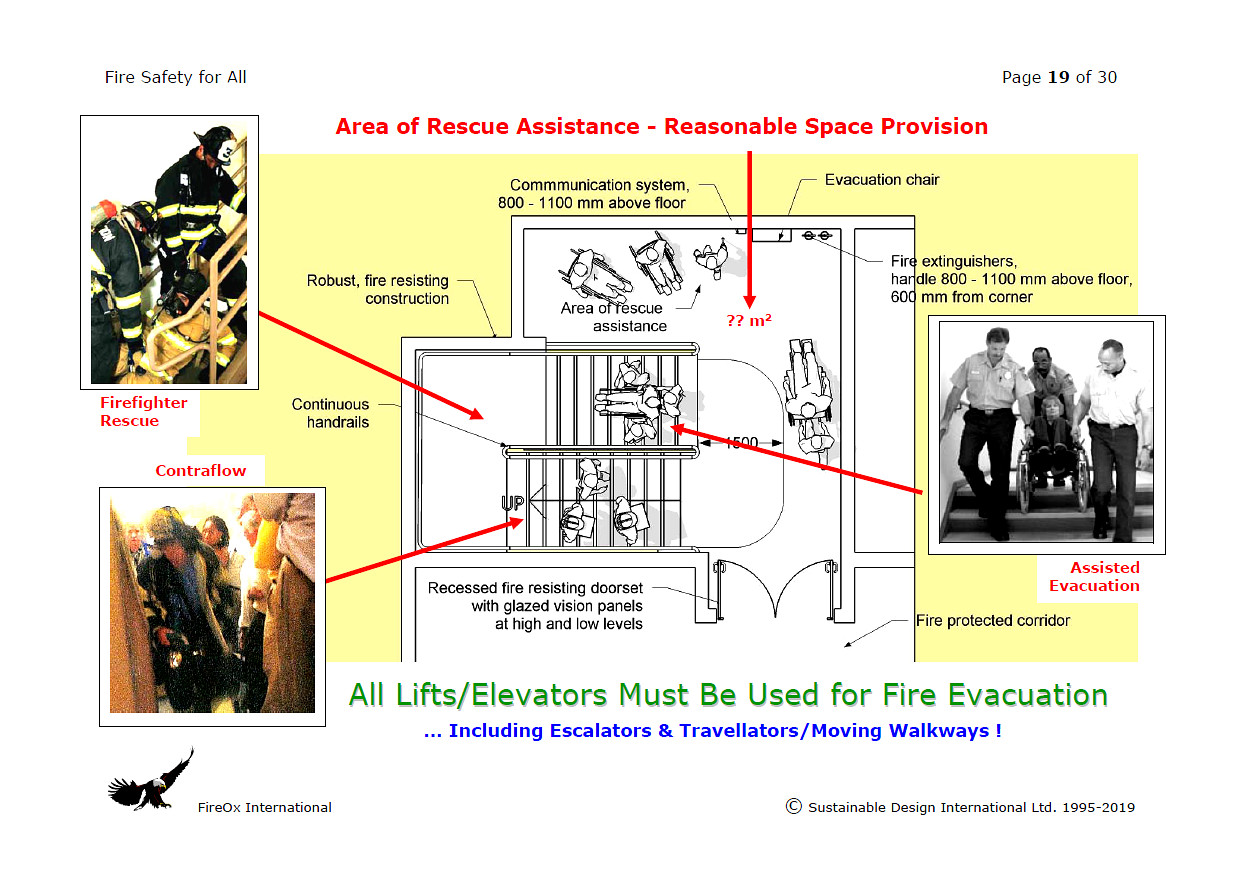
Colour photograph showing the very narrow, single staircase in the Grenfell Tower, London. How anybody – ANYBODY – could ever imagine that this staircase would be adequate to serve the fire evacuation needs of a diverse occupant population in a high-rise residential building is beyond belief ! A Syndrome is a cluster of symptoms which occur together and can be taken as indicative of a particular design abnormality. Click to enlarge.Presentation Overhead, in colour, illustrating a sufficiently wide fire evacuation staircase … minimum width 1.5m between handrails … which will accommodate Contraflow and the Assisted Evacuation of people in wheelchairs … with a sufficiently large, directly adjoining Area of Rescue Assistance … which will accommodate people unable to independently evacuate during a fire emergency. The space provided in an Area of Rescue Assistance, on each floor/storey, is calculated in relation to the design occupant/user population of a building. Even if a building is fully sprinklered, an Area of Rescue Assistance must adjoin every fire evacuation staircase. Click to enlarge. Staircase design by CJ Walsh.
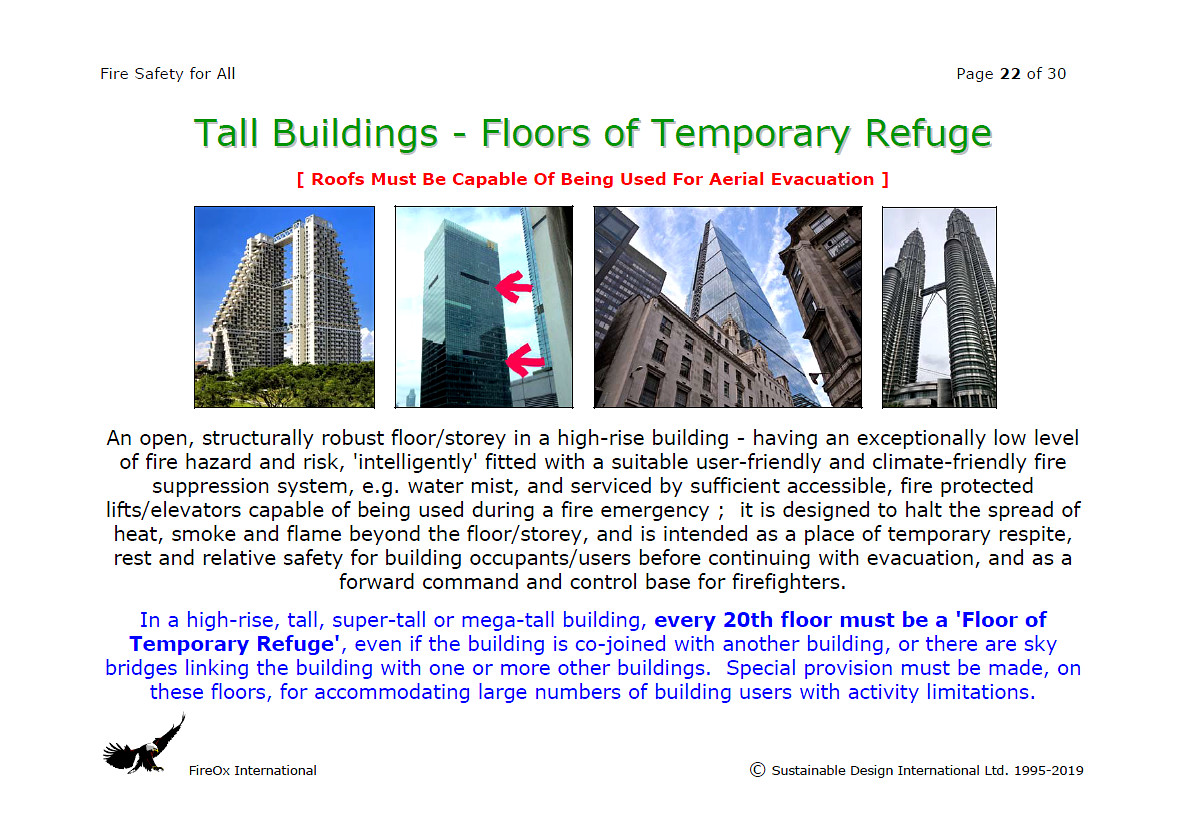
A Floor of Temporary Refuge is an open, structurally robust floor/storey in a tall building – having an exceptionally low level of fire hazard and risk, ‘intelligently’ fitted with a suitable user-friendly and climate-friendly fire suppression system, e.g. water mist, and serviced by sufficient accessible, fire protected lifts/elevators capable of being used for evacuation during a fire emergency ; it is designed and constructed to halt the spread of heat, smoke and flame beyond that floor/storey, and is intended as a place of temporary respite, rest and relative safety for building users before continuing with evacuation, and as a forward command and control base for firefighters.
In a high-rise, tall, super-tall or mega-tall building, every 20th floor must be a Floor of Temporary Refuge, even if the building is co-joined with another building, or there are sky bridges linking the building with one or more other buildings.
Special provision must be made, on these floors, for accommodating large numbers of building occupants/users with activity limitations … and because people will be waiting on Floors of Temporary Refuge, perhaps for extended periods of time, building designers and managers must ensure that these floors/storeys are properly fitted out with appropriate fire safety equipment, facilitation aids, smoke hoods, signage and communications, etc., etc.
Presentation Overhead, in colour, illustrating and explaining the design concept of Floors of Temporary Refuge. Click to enlarge.
.
Conclusion: Fire Engineering Capacity in England is Lacking
In England … the very important 2005 and 2008 U.S. NIST Recommendations following the 9-11 (2001) Attacks on the World Trade Center, in New York City, were completely ignored. Following the 2009 Lakanal House Fire, in London, the 2013 Coroner’s Recommendations were only partially implemented.
With regard to Vulnerable Building Users … there is NO capacity within the English Fire Establishment, including the National Fire Chiefs Council (NFCC), English Authorities Having Jurisdiction (AHJ’s), and its Building Design and Fire Engineering Communities … to properly respond to … never mind understand … the Fire Safety, Protection and Evacuation for ALL in Buildings.
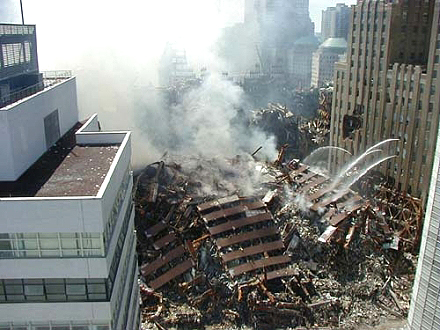
Long before the Rest of the World was introduced to the term Fire-Induced Progressive Damage, in the late afternoon of 11 September 2001 (WTC 9-11), with the collapse of World Trade Center Building No.7 in New York City …
(9-11) WTC Building No.7 – Fire-Induced Progressive Damage !
… decades earlier … Noel Manning had intuitively discovered the same Structural Fire Engineering Concept … and had developed and tested a suite of domestic-scale building systems to deal with this very dynamic aspect of fire behaviour …
Noel C Manning – 2017-11-05 RIP
.
The International Fire Engineering Community is still shy about discussing this concept, never mind understanding it … and most importantly, solving it ! Which makes me seriously wonder … is there a deep-seated flaw in International Fire Research ? Are mainstream Fire Researchers more interested in sourcing funding than in actually solving ‘real’ world fire engineering problems ???
And I also wonder … why have the 2005 and 2008 NIST (USA) WTC 9-11 Recommendations on the WTC Building Collapses still not been properly implemented within the USA … and why have they been ignored everywhere else ?????
As we approach the First Anniversary of the Grenfell Tower Fire Tragedy, in England, on 14 June … a few days ago, on 4 June 2018, the first batch of Grenfell Expert Witness Reports were uploaded (https://www.bbc.com/news/uk-44356660) to the Grenfell Tower Inquiry Website (https://www.grenfelltowerinquiry.org.uk/) for public view.
At this time, in London … multiple, fragmented investigations are taking place into the actual fire incident … the role of the Local Authority, and building management … those involved in the refurbishment (‘tarting up’) design and construction … the fire services, particularly their ‘Stay Put’ Policy and how it adversely impacted on vulnerable Tower occupants during the emergency … and the highly flawed regulatory model of Building and Fire Codes with light-touch Control, which is still operating in England. One of Murphy’s Laws immediately springs to mind with regard to the intended ineffectiveness of this overly-complex process !
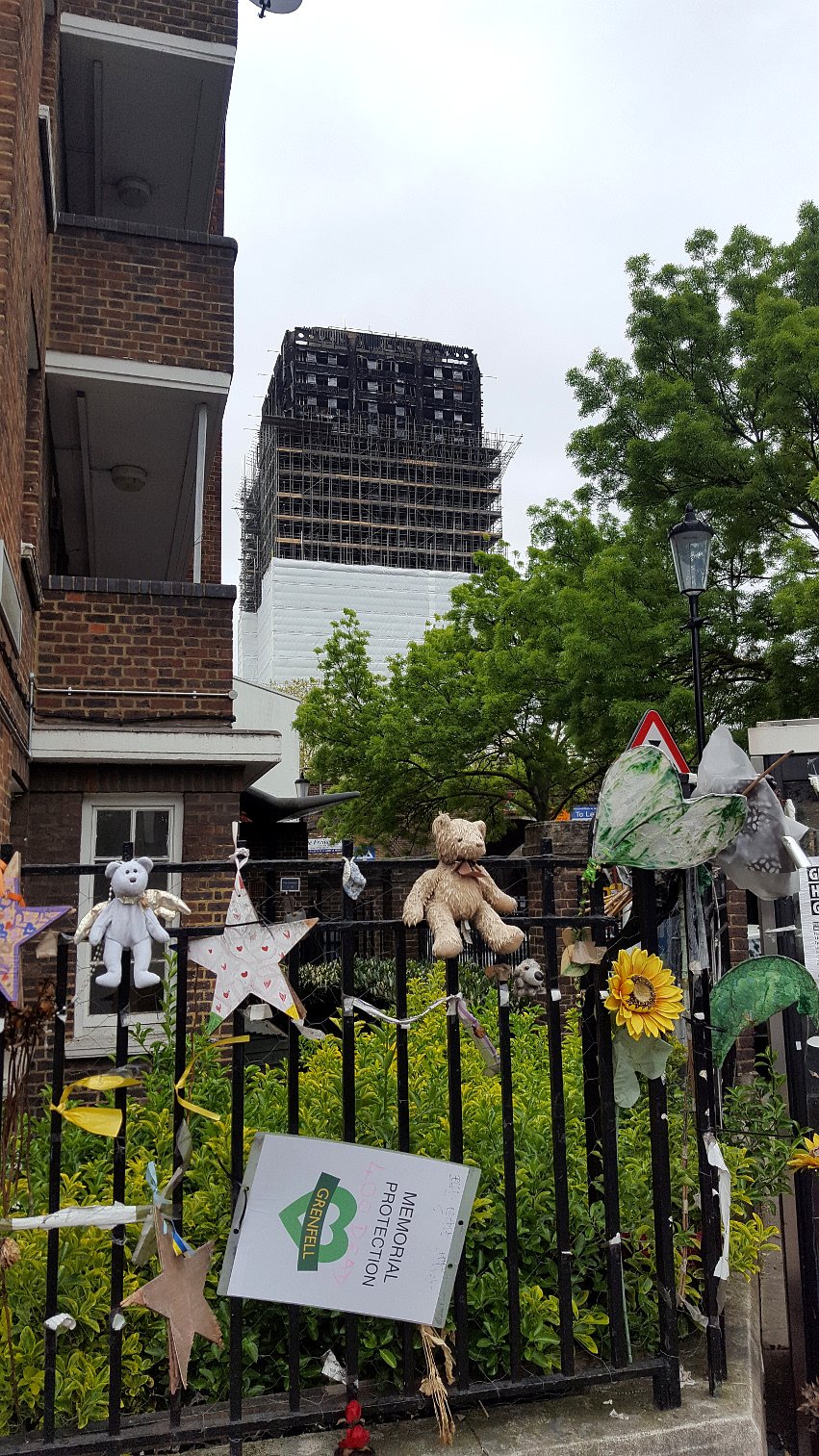
Colour photograph showing Grenfell Tower in the background … undergoing an almost complete ‘cover-up’ … with, in the foreground, mementos of the Fire Tragedy fixed to railings by local residents. Click to enlarge. Photograph taken by CJ Walsh. 2018-04-29.
Many other countries have adopted some or all of this modern English regulatory model which, after the repeal of an older Bye-Law format, has been shaped by political expediency, cost-effectiveness and general ineptitude … with little or no adaptation to local conditions in the adopting jurisdictions. Ireland adopted this model with some, but not a lot, of adaptation.
Fire Safety In Ireland ?
On 6 June 2018 … while that investigative activity was hitting the headlines in England … Minister Eoghan Murphy, T.D., Ireland’s Minister for Housing, Planning and Local Government, quietly published the Report: ‘Fire Safety in Ireland’ … http://www.housing.gov.ie/local-government/fire-and-emergency-management/fire-safety/eoghan-murphy-publishes-report-fire … by a High-Level Task Force within his Department’s National Directorate for Fire and Emergency Management, after serious concerns and fears had been expressed in the public media that a similar fire tragedy might also occur in this jurisdiction.
To be crystal clear … this Report is a Bureaucratic Whitewash … an insult to the Public ! Nice sounding technical ‘blarney’ camouflages a failure to deal directly with critical issues, and answer concerns … while other important issues are avoided altogether.
May 2018 – Ireland’s Department of Housing, Planning & Local Government Report
Expanding on my comments in the Interview with Barry Lenihan, on RTE Radio 1’s Drive Time early evening news programme on Friday (2018-06-08) …
A. Initially, Irish Local Authorities were requested to carry out a preliminary survey to identify all buildings of more than six storeys, or 18m in height. Specifically, they were asked to identify those buildings which had an external cladding system which might be a cause for concern.
This height threshold of six storeys/18m is arbitrary … an external cladding system can be just as much a cause for concern in a building which is lower. Imagine discarded cigarette butts or a rubbish fire at the base of such a system … and the resulting speed of fire spread and development across a building façade !
B. The highly flawed regulatory model of Building and Fire Codes, with light-touch Control, which resulted in the Grenfell Tower Fire Tragedy … we also have. Wake up and smell the coffee Ireland !
At the beginning of the 1990’s, when Ireland had been persuaded by the European Commission to finally introduce legal, national building regulations having a functional format … our National Authority Having Jurisdiction, in desperation, grabbed the then Approved Documents for England & Wales … brought them back to Ireland, put Irish covers on them, and originally called them ‘Technical Documents’ … but, after seeing a tiny ray of inspiring light, later changed their title to the more accurate ‘Technical Guidance Documents’ ! This hunger for adopting all things English which are fire safety related continues to this day … with a similar, ongoing division of Technical Guidance Document B: ‘Fire Safety’ into 2 Separate Volumes.
This may have been a convenient response under pressure … but it has been very short-sighted. It has impeded the growth of a comprehensive and coherent philosophy on Safe, Inclusive, Age-Friendly, Resilient, Sustainable Planning, Design and Construction Codes/Controls which is suited to an Irish context and responsible local needs (not desires!).
C. Everywhere … this Report has a lot – too much – to say about Fire Risk Assessment ! After the Grenfell Tower Fire, however, Fire Risk Assessments must only be carried out by competent persons … and the process of Fire Risk Assessment, itself, must be radically improved ! And of course, prior to any Risk Assessment … a proper Fire Hazard Appraisal must be carried out.
D. To accurately present Fire Safety Trends in Ireland … it is not enough to furnish reliable fire fatality statistics. It is also necessary to produce reliable fire injury statistics … and reliable information on direct/indirect socio-economic losses.
E. The quality of fire safety related construction on Irish Building Sites continues to be very poor and problematic. Fire Compartmentation is nowhere near being adequately – never mind acceptably – reliable ! And during the last few years we have had quite a number of close-calls concerning fire incidents in medium-rise residential buildings.
F.Fire Evacuation for people with activity limitations is still handled atrociously in our current building regulations. This is ironic because, on 20 March 2018 last, Ireland had to be dragged screaming to ratify the U.N. 2006 Convention on the Rights of Persons with Disabilities (CRPD) !
.
Positive Progress By Another Path !
1. Abandon the outdated English functional requirements in THEIR building regulations … and adopt a far better, more up-to-date body of functional requirements which is already on the Irish Statute Books … Annex I of the European Union’s Construction Products Regulation 305/2011. And because there are important horizontal linkages between requirements … immediately finish the ridiculous current separation between Fire Safety requirements and all of the other requirements. And yes … new Technical Guidance Documents will have to be drafted.
.Regulation (EU) No 305/2011 of the European Parliament and of the Council, of 9 March 2011, laying down harmonized conditions for the marketing of construction products and repealing Council Directive 89/106/EEC
2. Yes … ‘Persons Having Control’ of buildings have responsibilities with regard to fire safety. But that is only one side of the coin ! National and Local Authorities Having Jurisdiction have greater responsibilities.
If we are at all serious about Consumer Protection … bad, inadequate, faulty construction must be prevented beforehand … it is too late, too costly and, in many cases, too impractical to correct afterwards. Self Regulation by building design professions and construction organizations is NO Regulation ! Stringent, independent technical control inspections must be carried out on all projects by Building Control personnel … which used to happen in Dublin City/County and Cork City/County prior to the introduction of legal building regulations in the early 1990’s … and, depending on complexity, must also be carried out at critical stages during the construction process.
Building Control Sections in all Local Authorities must be properly resourced with competent personnel, equipment, training and support infrastructure.
Inspections concerning compliance with all functional requirements in the building regulations, including fire safety, must be carried out only by Building Control Personnel. Chief Fire Officers must not be allowed to manage or be involved in any aspect of Building Control. On the same project … a Disability Access Certificate Application and a Fire Safety Certificate Application must be inter-linked and overlap sufficiently, showing no gaps in compliance. Inspections must be carried out in connection with all Certificate Applications. Building Control personnel must satisfy themselves that actual construction at least matches, if not improves upon, what is shown in design documentation.
Building Control Inspection Reports must be made available for public view.
3.Firefighters are NOT a disposable Social Asset ! National and Local Authorities Having Jurisdiction … and some Chief Fire Officers … must begin to understand this fundamental truth !
Fire Services in all Local Authorities must each be properly resourced according to local needs … with competent personnel, equipment, training and support infrastructure. Shared provision of resources looks very neat on paper but, in practice, works very badly. Refer to the Grenfell Tower Fire and London Fire Brigade having to borrow firefighting equipment from other Fire Services.
After the 2015 Tianjin Regional Fire Devastation, in China, and the 2001 WTC Attacks on 9-11, in New York City … front line firefighters must be supported by Specialist Hazard Appraisal and Structural Engineering Units.
For Firefighter Safety in buildings and to quickly find people with activity limitations waiting in Areas of Rescue Assistance and/or other survivors in different locations … a portable and reliable Thermal Imaging Camera is an essential piece of every firefighter’s equipment.
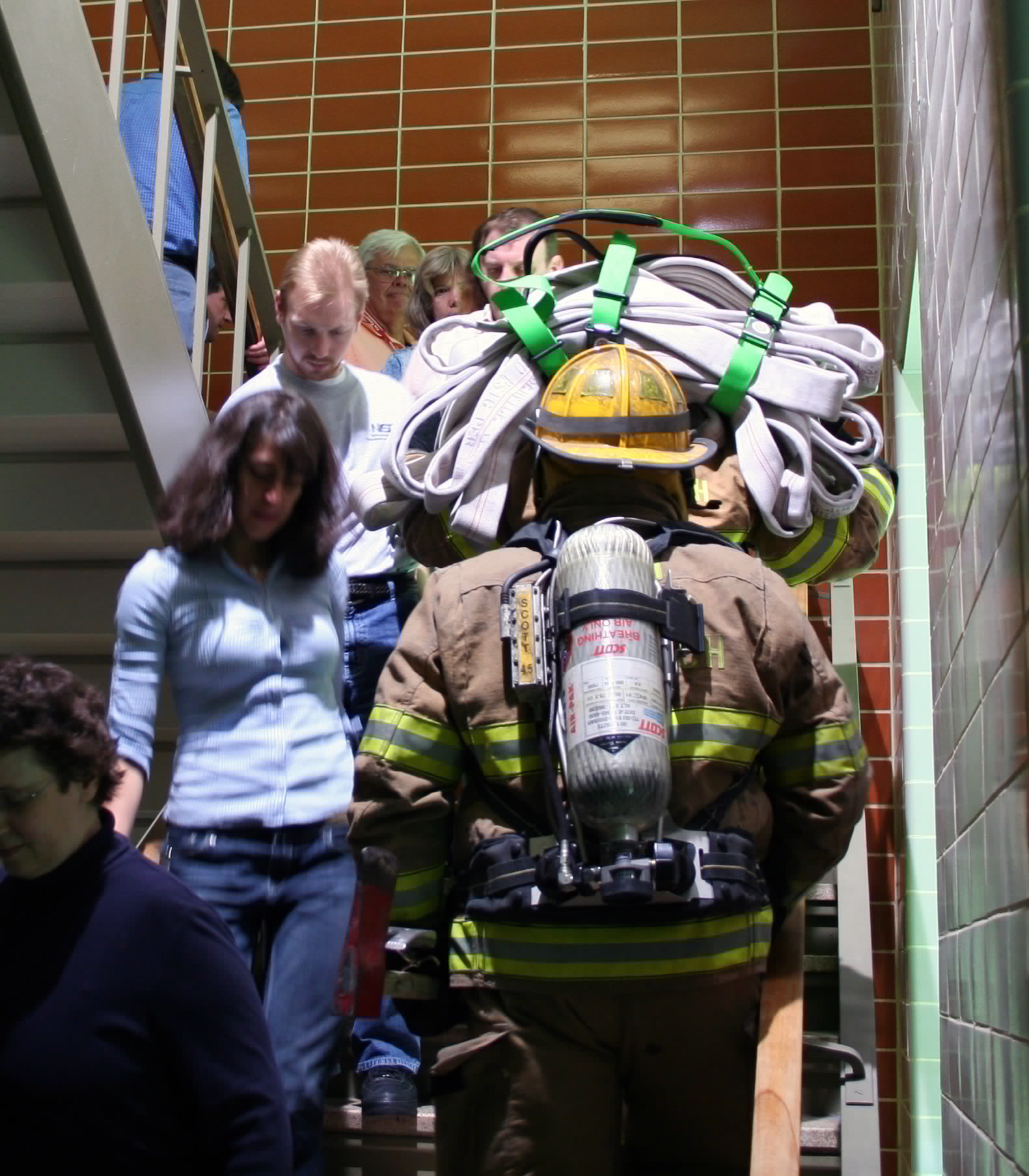
And Firefighter Safety begins with good building design. In all but the most simple building types, Circulation Routes must be designed for Contraflow … people moving away from a fire in a building and towards safety while, at the same time, heavily equipped firefighters are entering the building and moving towards the fire.
Colour photograph showing Contraflow on a building staircase … people moving down a staircase away from a fire and towards safety while, at the same time, heavily equipped firefighters are moving up the staircase towards the fire. Click to enlarge.
There is no place for ‘Stay Put’ Policies in Irish Residential Buildings of any height.
.
Ireland’s 2017 Oireachtas Report: ‘Safe As Houses’ …
December 2017 – Houses of the Oireachtas – Joint Committee on Housing, Planning & Local Government
This was a good effort by our public representatives … but they missed core issues !
.
After The Grenfell Tower Fire !
Further to my last Blog, dated 2017-10-10 …
The 2017 Fire in England was not an extraordinary fire. Since the beginning of this decade, we continue to see a series of such fires: South Korea (2010) – UAE & France (2012) – Chechnya (2013) -Australia (2014) – UAE, Azerbaijan & UAE again (2015) – UAE (2016) – UAE & Russia (2017) – Turkey (2018).
With regard to Command & Control of Large Scale Emergencies … English AHJ’s should have paid attention to the 2005 & 2008 U.S. National Institute of Science & Technology (NIST) Recommendations following the 9-11 WTC Buildings 1, 2 & 7 Collapses.
The Fire Safety Objectives in current Building & Fire Codes/Regulations are very limited. In Ireland, this is clearly stated in Technical Guidance Document B …
‘ Building Regulations are made for specific purposes. Part B of the Second Schedule to the Building Regulations is therefore primarily concerned with the health, safety and welfare of persons. The fire safety measures outlined in this guidance document are intended for the protection of life from fire.’
Only insofar as it is necessary to protect the lives of able-bodied building users/occupants … is there a concern for property protection.
There is only inadequate, token concern for the protection of people with disabilities.
Client organizations, facility managers, building designers, construction organizations … and journalists … must fully comprehend these limits.
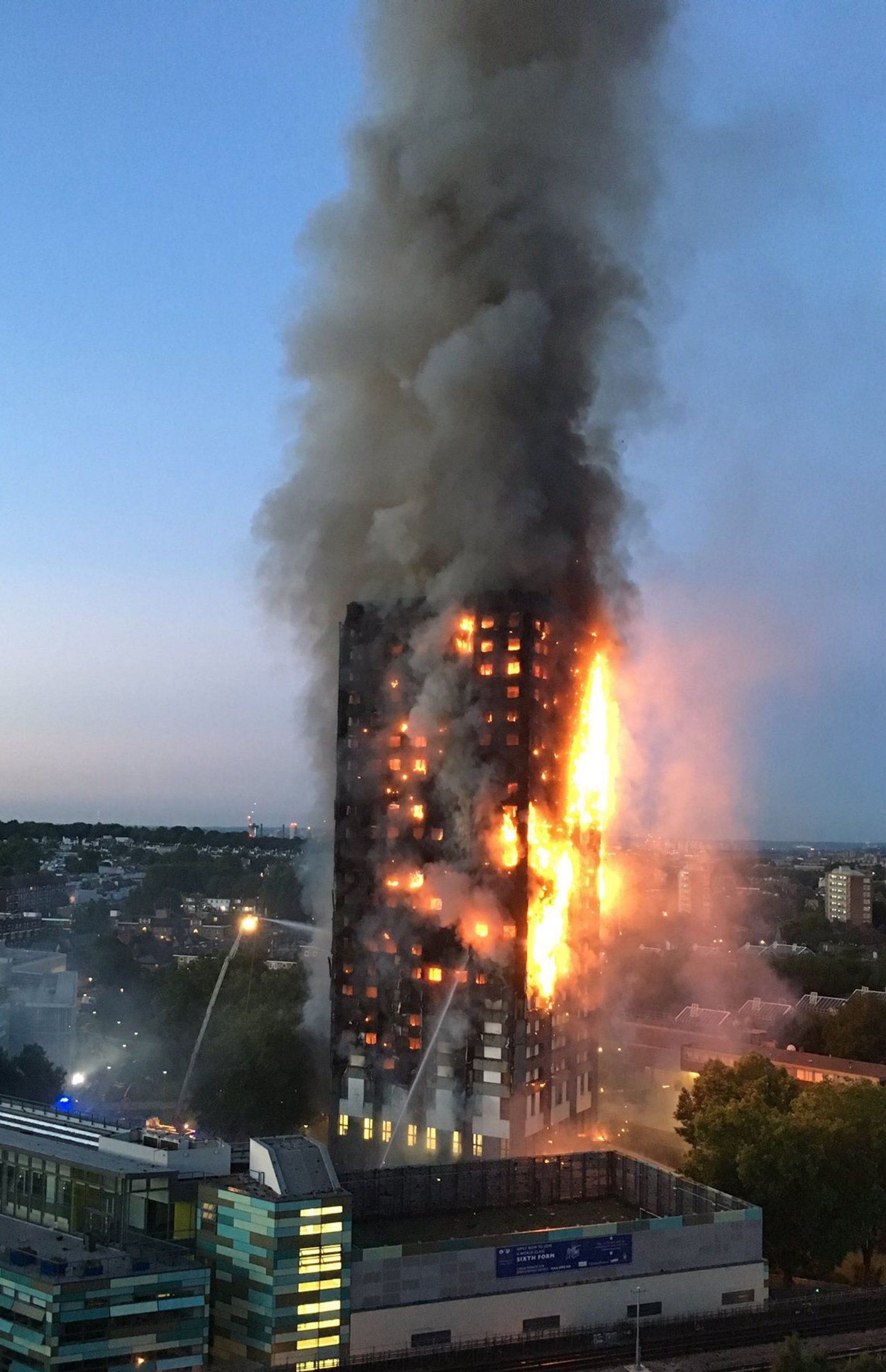
In the photograph below … look closely at the External Firefighting Operations at the bottom of the Tower. There are limits to what can be achieved from outside a building !
Colour photograph showing the developed fire at Grenfell Tower, in London. At the bottom of the Tower, external firefighting operations can be viewed. Click to enlarge.
.
A Fire Suppression System (Water Sprinklers/Mist/Hybrid) is an essential Fire Protection Measure in ALL Medium and High-Rise Residential Buildings … which include Apartment Blocks, Hotels, Hostels, Student Accommodation & Social Housing, i.e. ANYWHERE there is a Sleeping Hazard.
A Reliable and Credible Fire Detection & Warning System is an essential Fire Protection Measure in ALL Buildings … and must be capable, under the control of Building Management, of transmitting warnings in many formats, i.e. Audible + Visual + Multi-Lingual Voice + Tactile.
Fire Evacuation Routes in Buildings must be designed for CONTRAFLOW … people moving away from a fire and towards safety while, at the same time, heavily equipped firefighters are entering the building and moving towards the fire.
Good Fire Evacuation Route Design is INTUITIVE and OBVIOUS. In many buildings, however, this is not always the reality. Effective Fire Evacuation Signage … comprising high-level signage, low-level signage, with both supplemented by photoluminescence … must be installed in ALL Buildings.
For the purpose of protecting Vulnerable Building Users in Fire Emergencies, ALL Lifts/Elevators in Buildings must be capable of being used for Evacuation.
Fire Risk Assessments must NO LONGER be carried out by people WITHOUT COMPETENCE in Fire Engineering AND Building Design & Construction … and the Fire Risk Assessment Process itself must be thoroughly re-examined and upgraded.
Media reaction, in Ireland, to this News Release was hysterical and grossly ill-informed !
“A revolution is not a dinner party, or writing an essay, or painting a picture, or doing embroidery ; it cannot be so refined, so leisurely and gentle, so temperate, kind, courteous, restrained and magnanimous. A revolution is an insurrection, an act of violence by which one class overthrows another.”
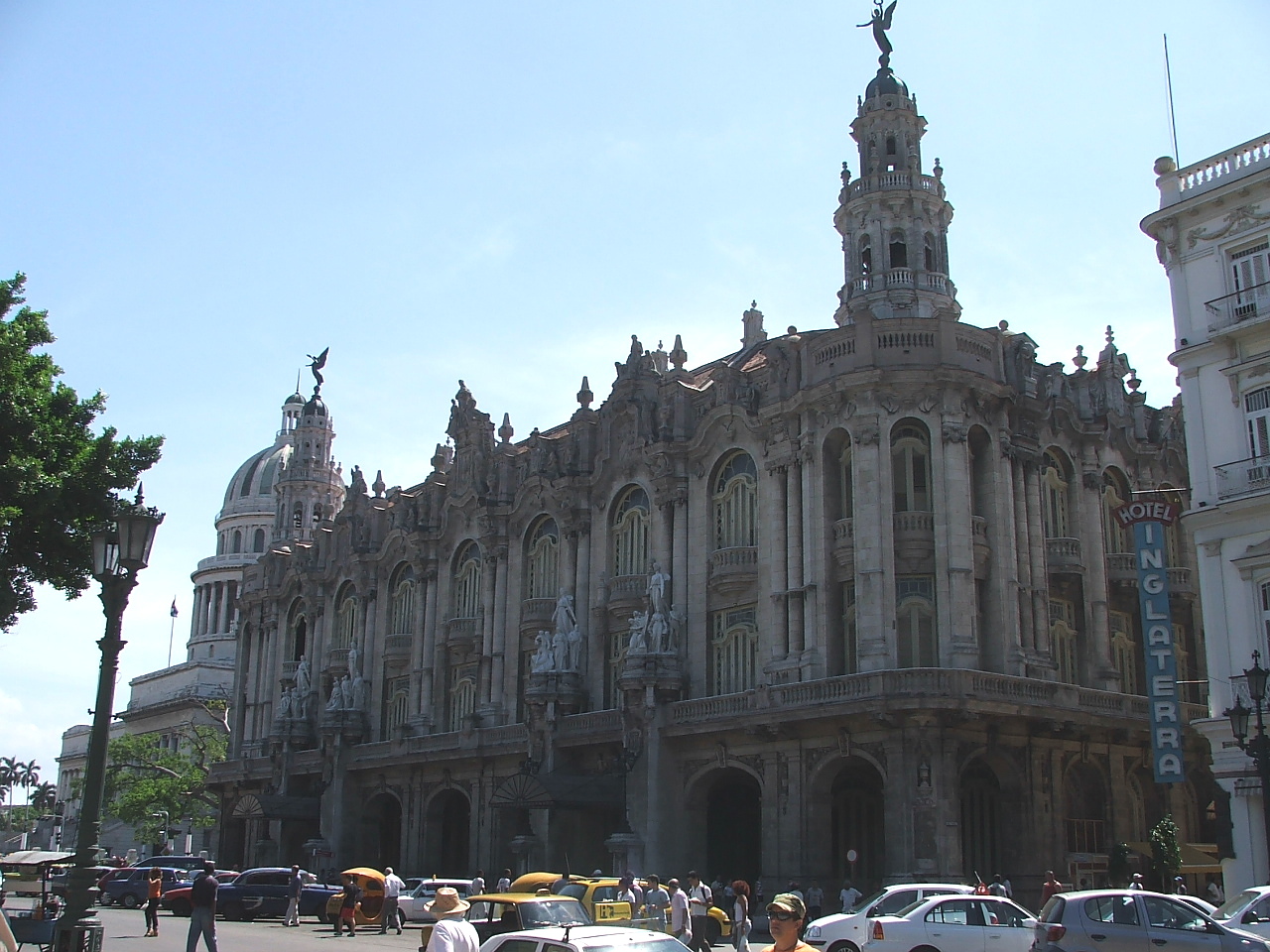
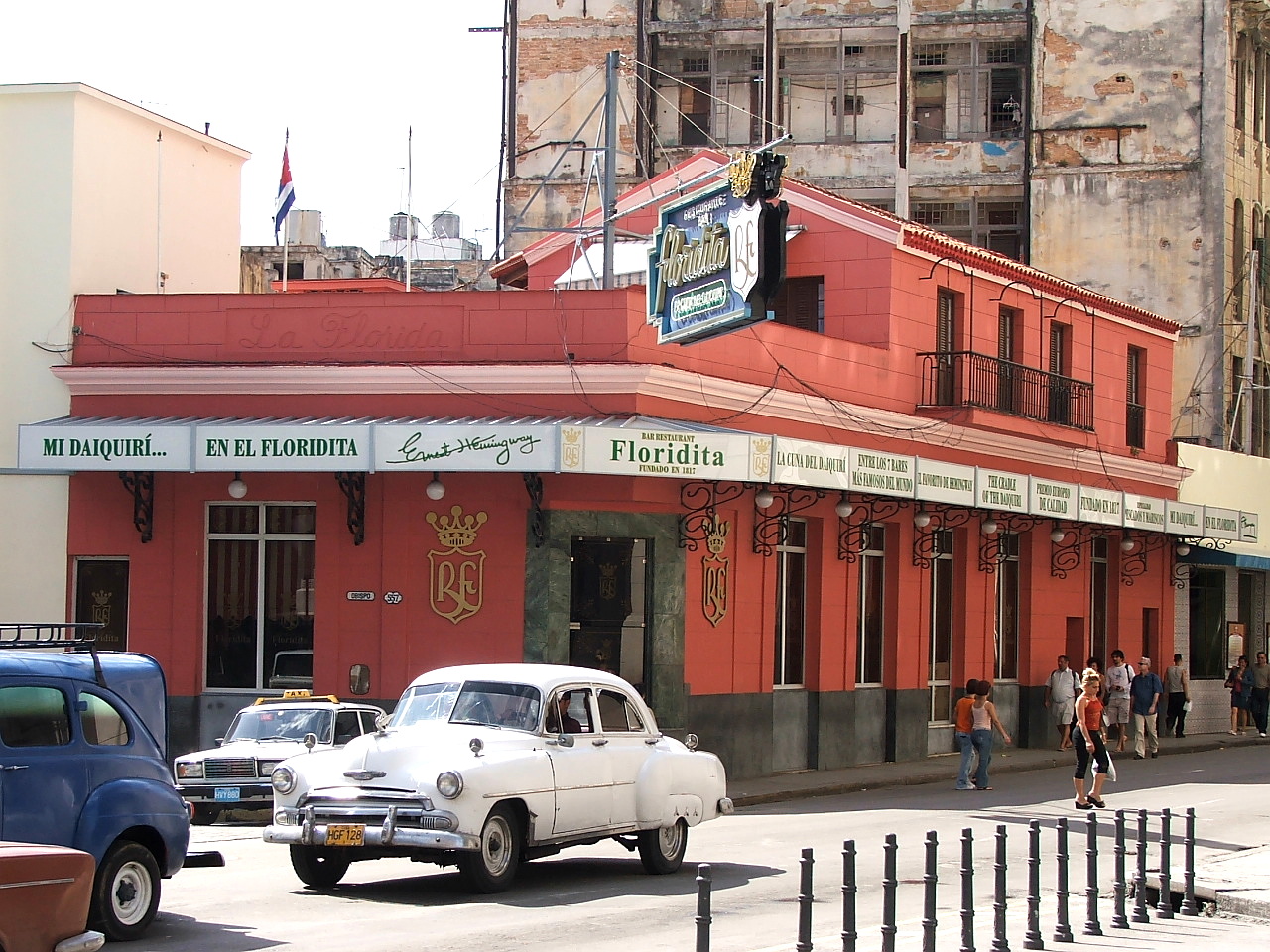
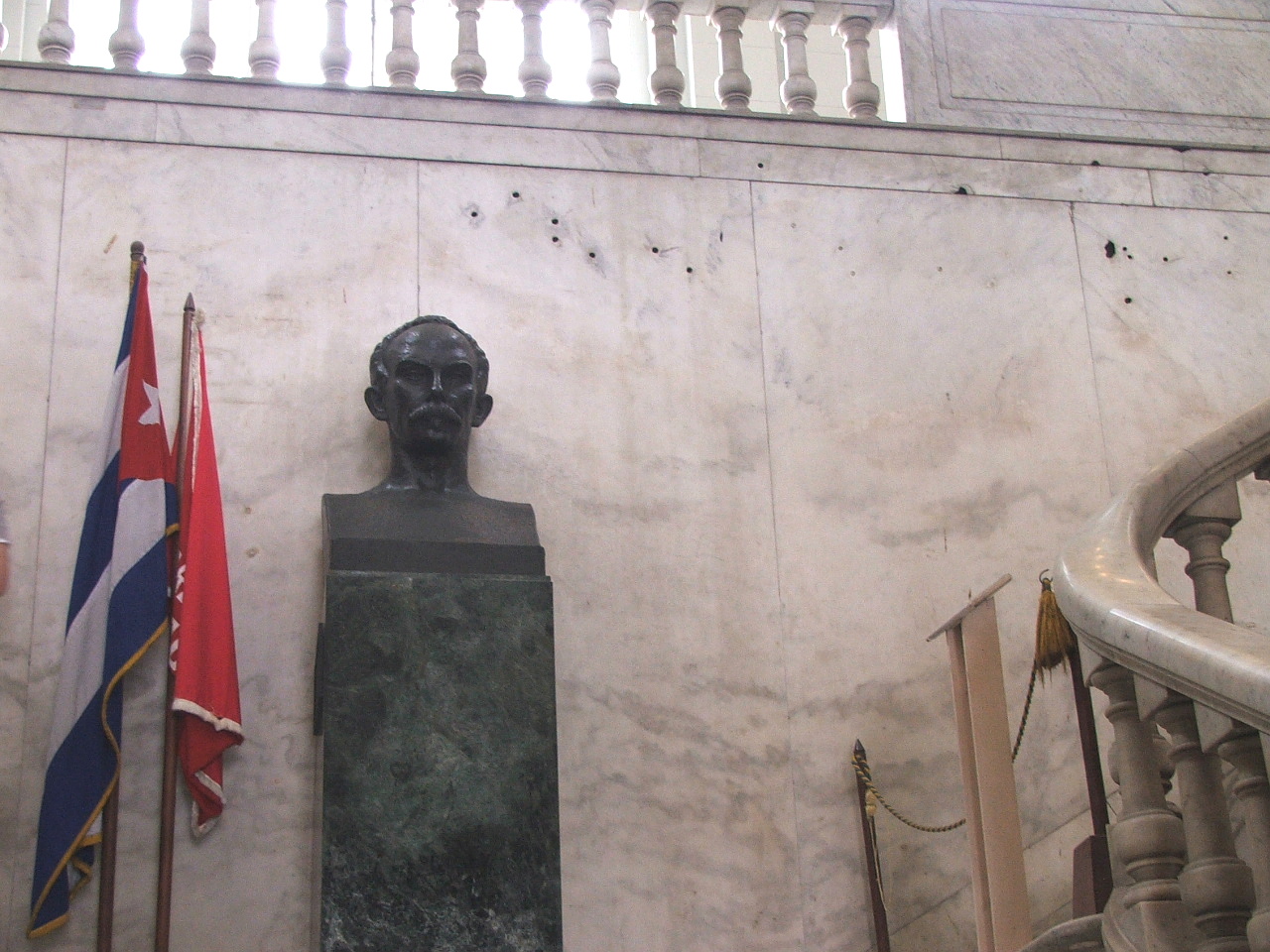
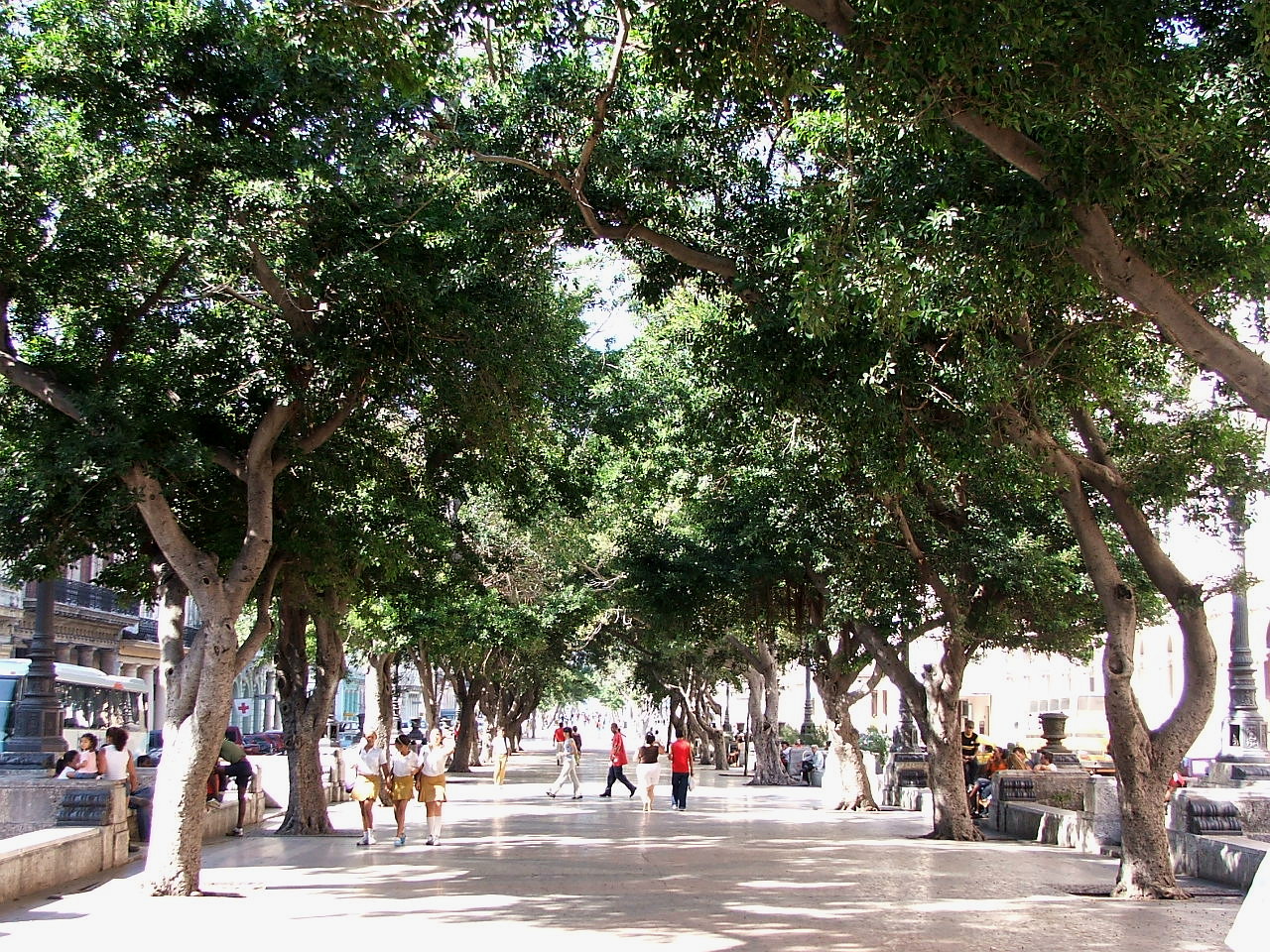
So here are some images from the ‘real’ Cuba … or ‘real’ images from Cuba … whichever you prefer …
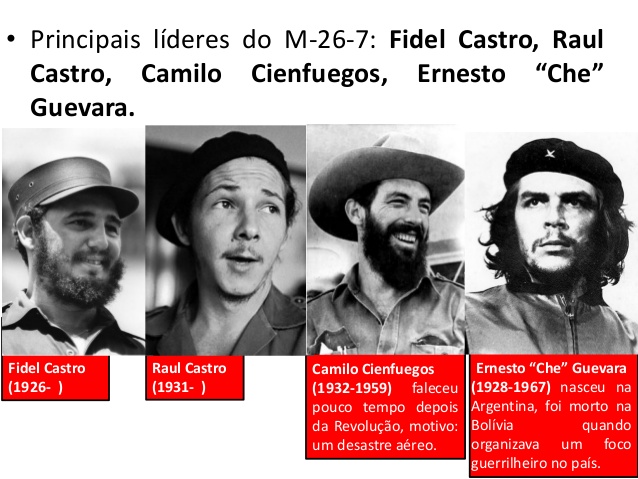
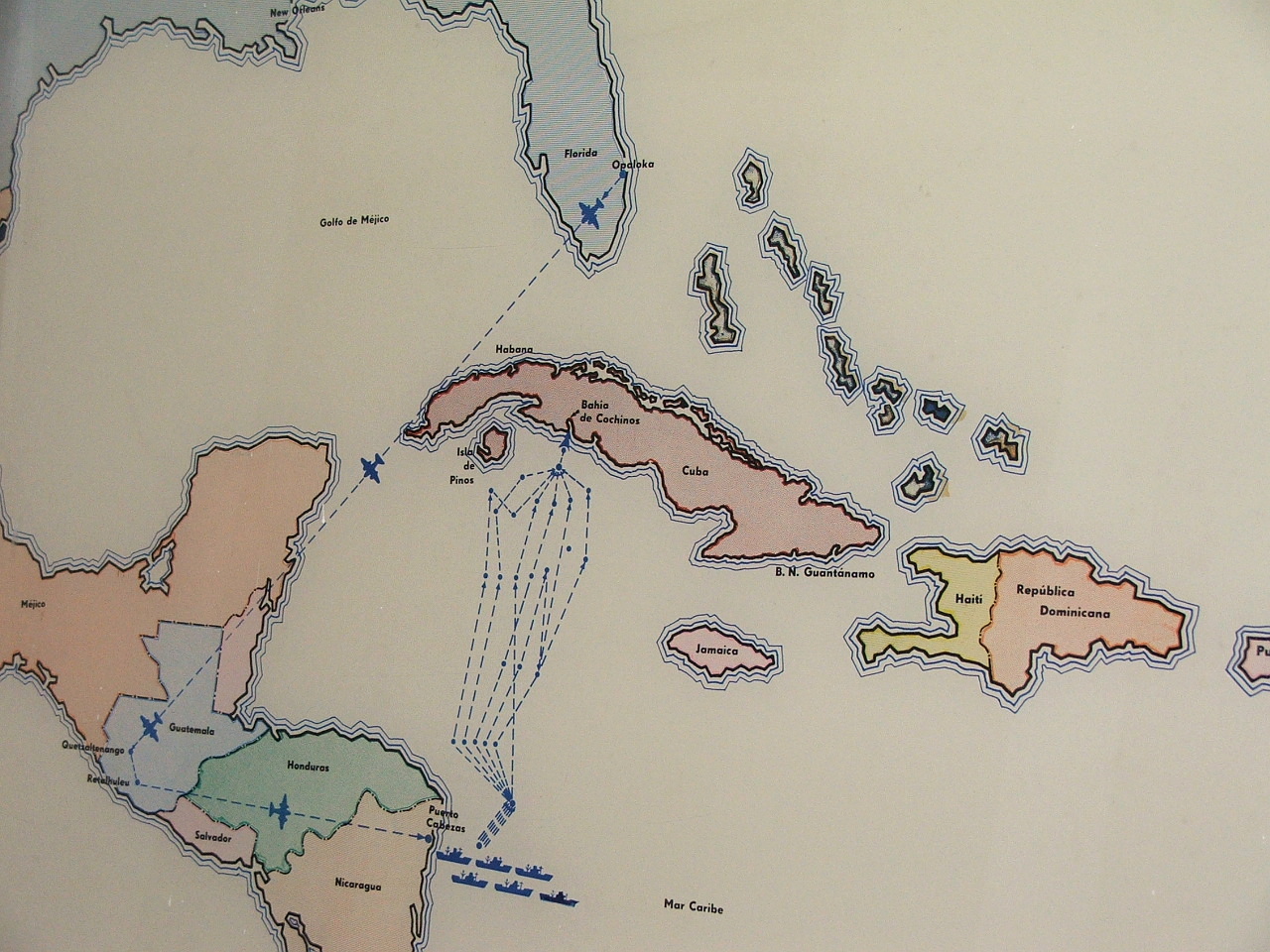
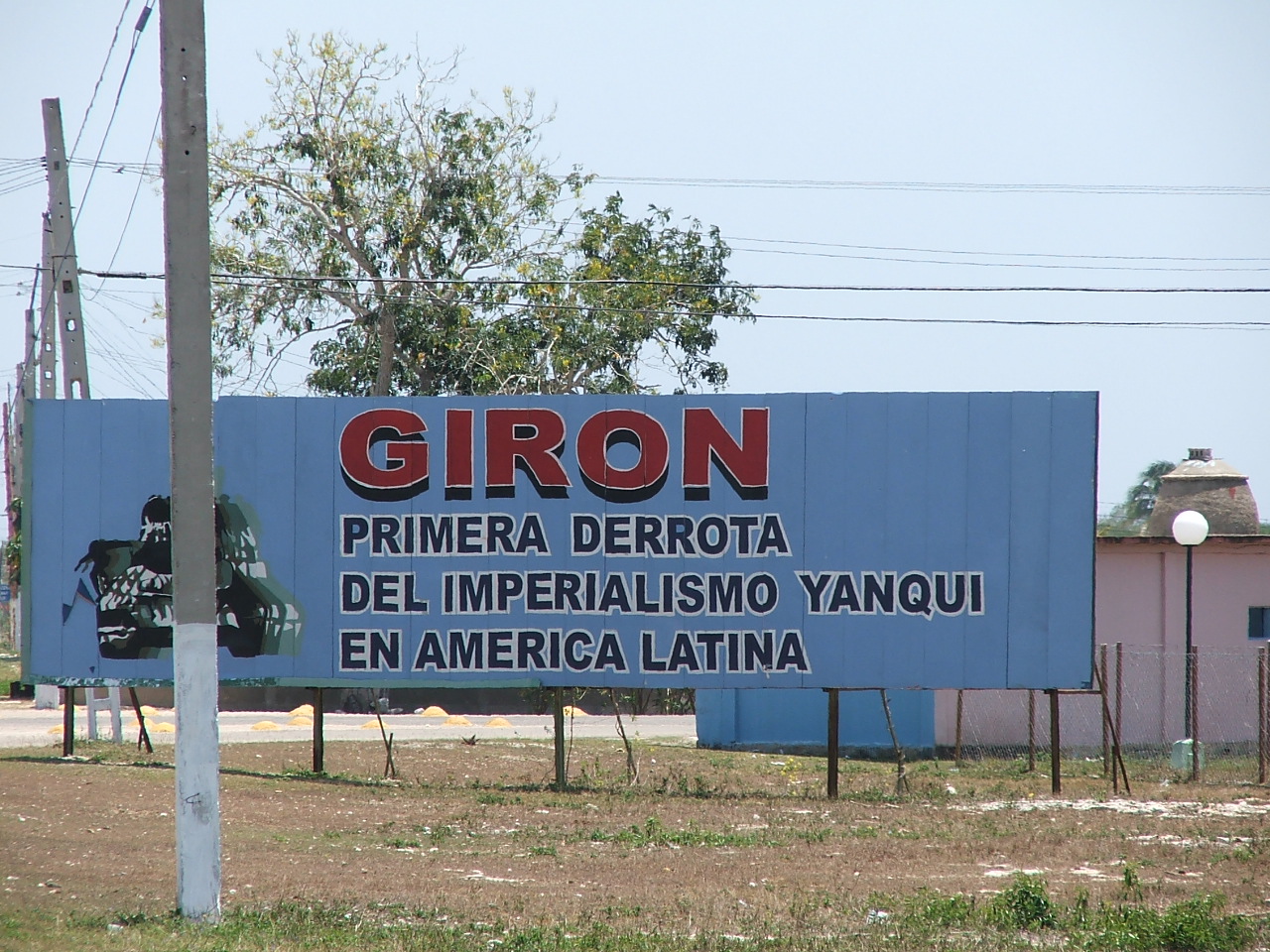
Fidel Castro was one of the Principal Leaders of the Cuban Revolution. Raul Castro, President of Cuba (and Fidel’s brother), is now the only surviving member of that Group. Click to enlarge. [M-26-7 = Movimiento 26 de Julio. See below.]In 1961, the United States of America attempted a Counter-Revolutionary Invasion of Cuba at the Bay of Pigs. This attempt was an embarrassing failure for the USA … but a resolute and consolidating success for Cuba and the Revolution. Photograph by CJ Walsh of a museum exhibit at Playa Giron. 2007-04-13. Click to enlarge.Playa Giron … one of the 1961 Invasion landing areas in the Bay of Pigs. Photograph by CJ Walsh. 2007-04-13. Click to enlarge.Every group of houses … every street in a community … has its own Committee for the Defence of the Revolution (CDR) … an important cohesive feature in a Socially Resilient Society. Photograph by CJ Walsh. 2007-04-04. Click to enlarge.
.
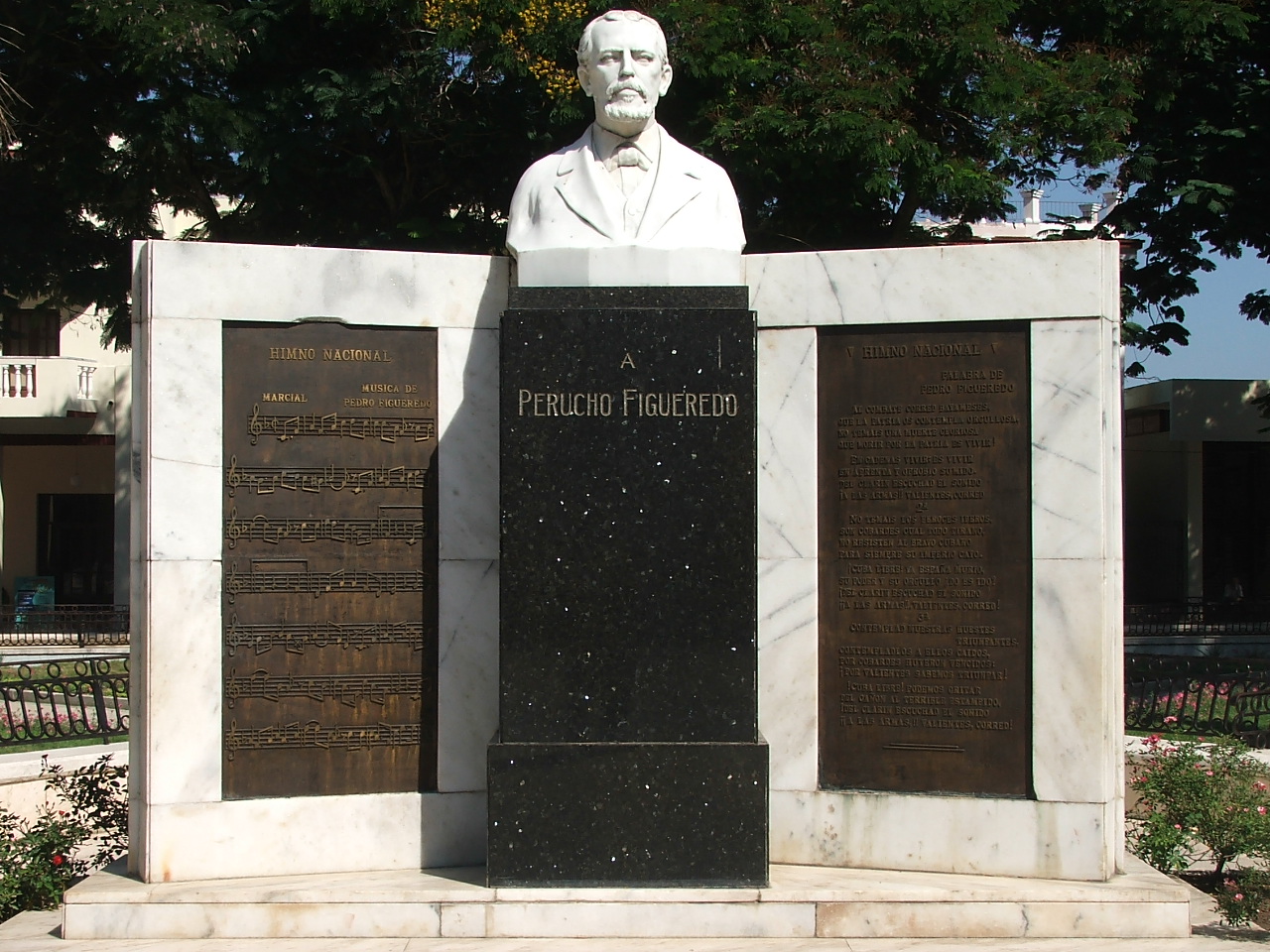
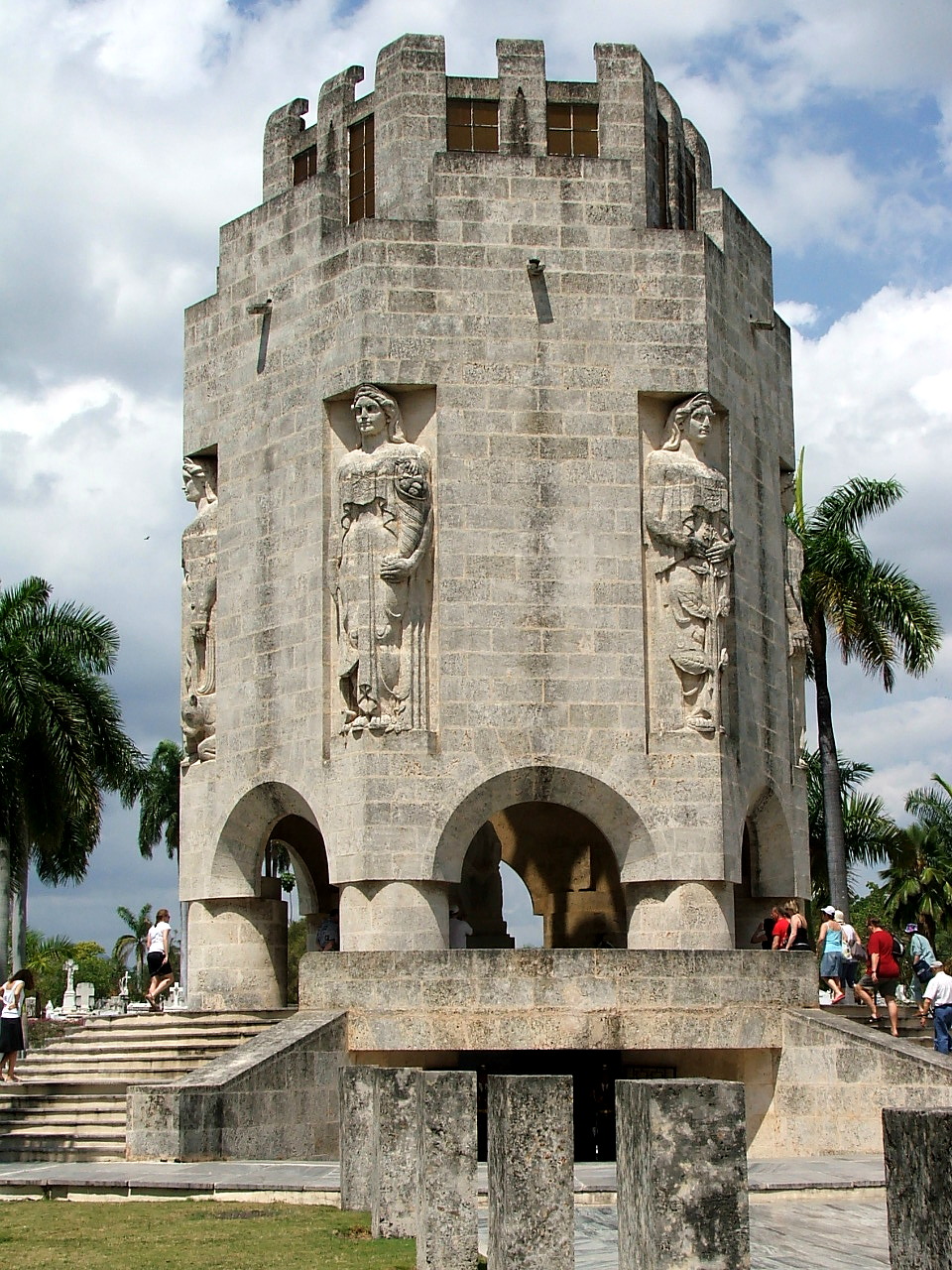
Hatuey, Indigenous ‘Taino’ Chief … Cuba’s First National Hero … burned at the stake in 1512 by Spanish soldiers … at Yara, Cuba. Photograph by CJ Walsh. 2007-04-10. Click to enlarge.Monument dedicated to Perucho Figueredo, who wrote the Cuban National Anthem: ‘La Bayamesa’ … in Bayamo, Cuba. The Anthem was first played in a local church, 1868. Photograph by CJ Walsh. 2007-04-10. Click to enlarge.Statue of General Antonio Maceo … Plaza de la Revolución … in Santiago de Cuba, Cuba. Photograph by CJ Walsh. 2007-04-09. Click to enlarge.Mausoleum of José Martí, Santa Ifigenia Cemetery … in Santiago de Cuba, Cuba. Photograph by CJ Walsh. 2007-04-09. Click to enlarge.
.
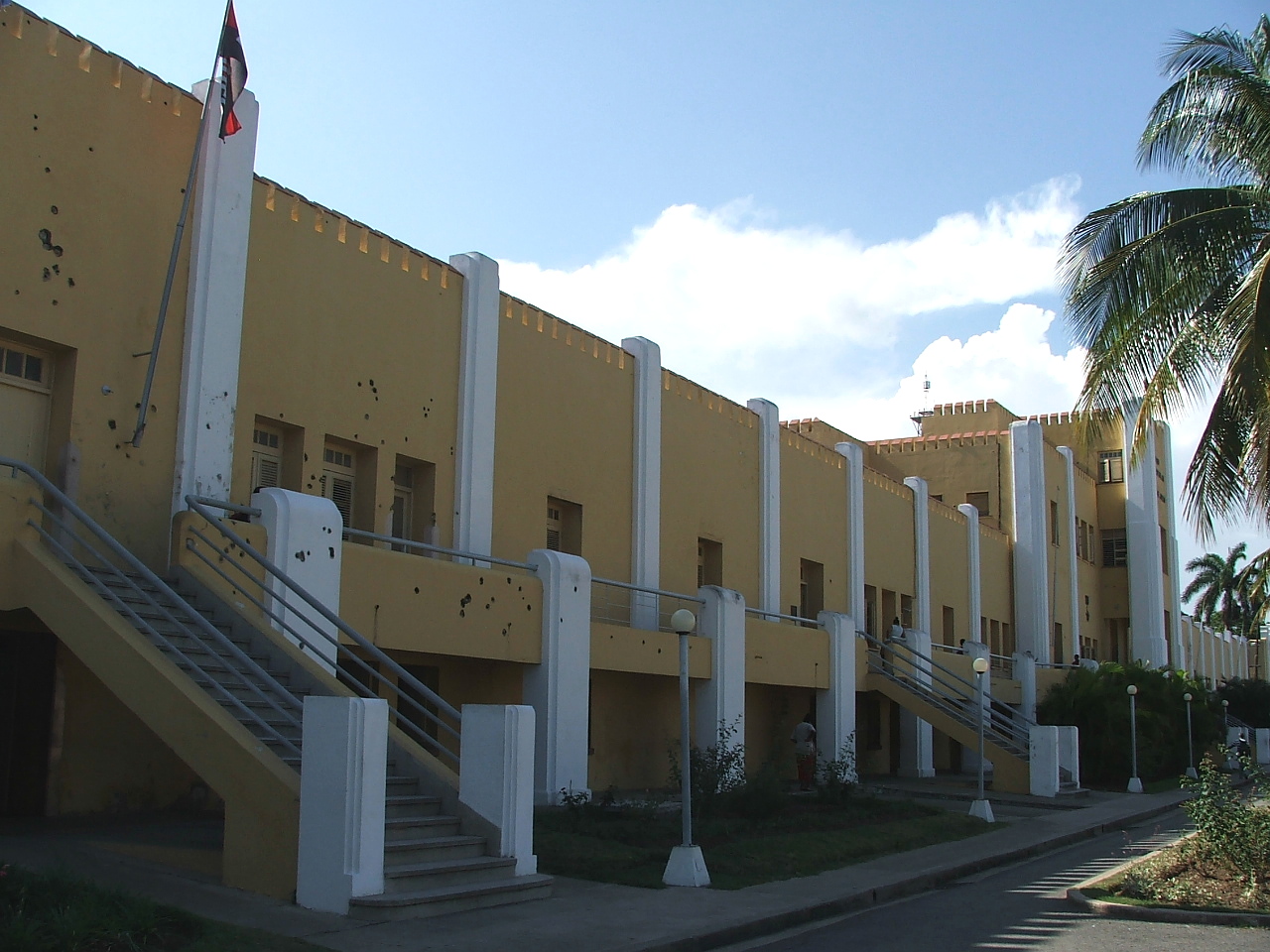
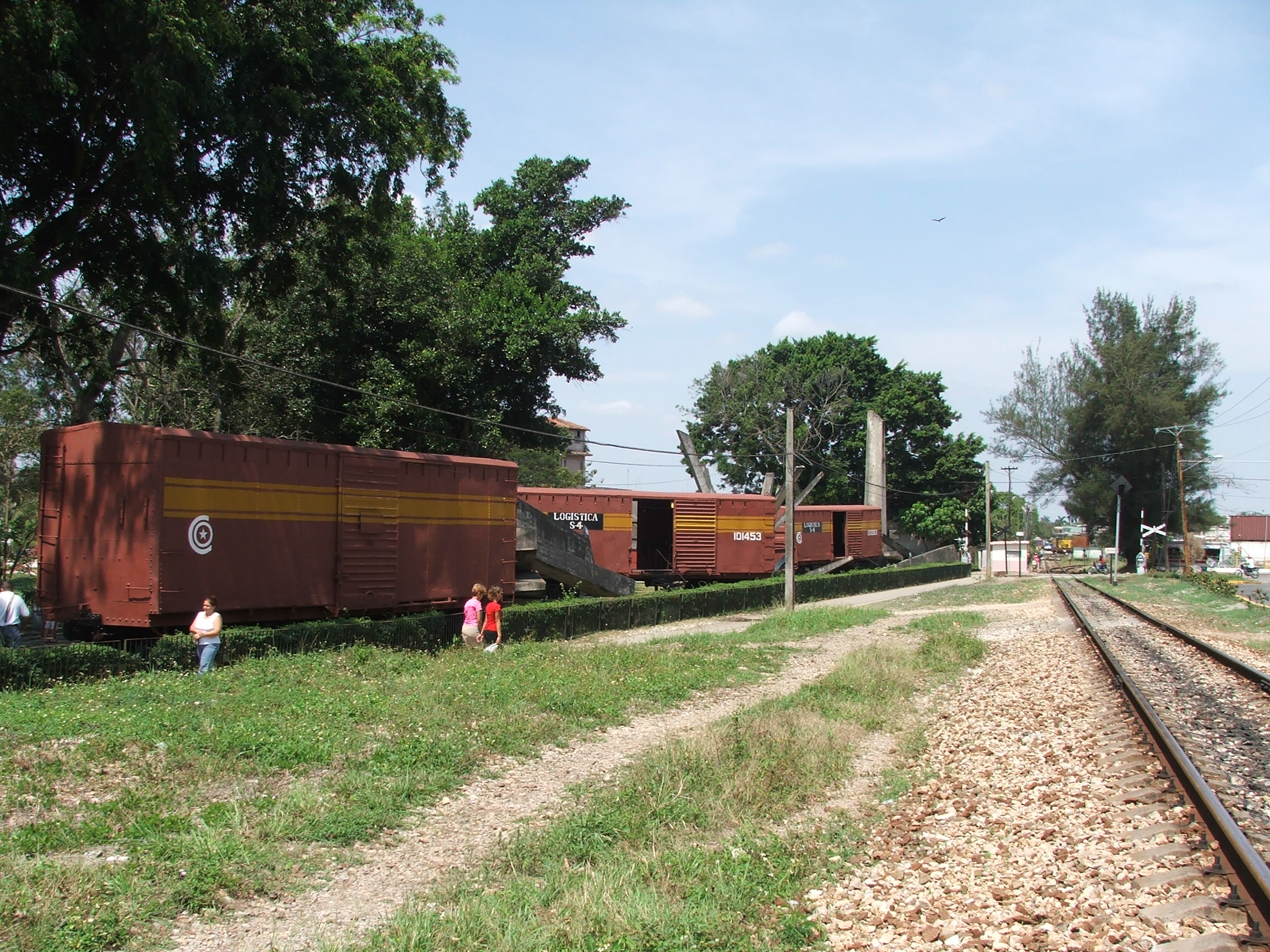
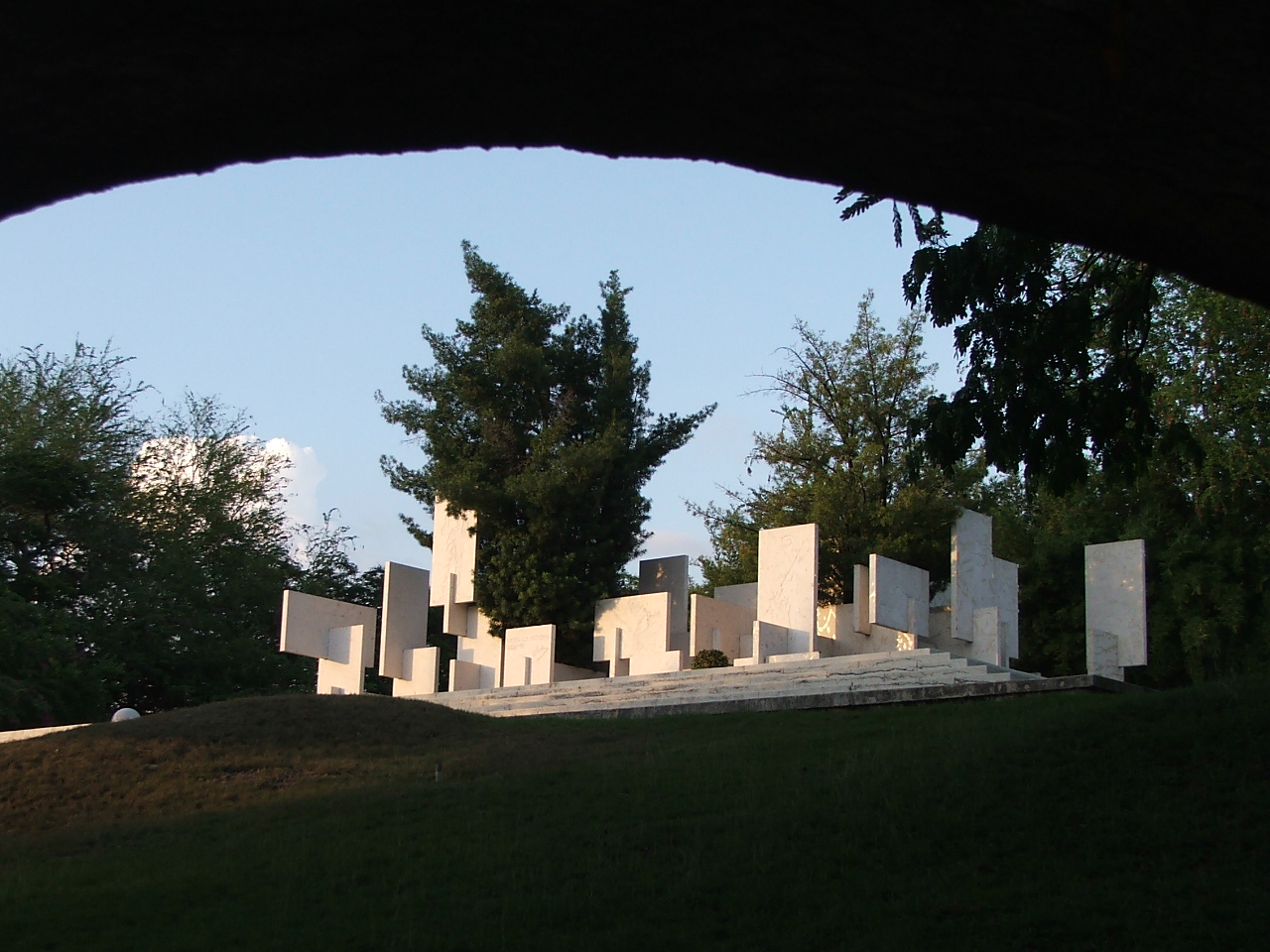
Moncada Army Barracks (formerly) … now a school and museum … in Santiago de Cuba, Cuba. On 26 July 1953, an attempted attack on the Barracks, led by Fidel Castro, failed. Photograph by CJ Walsh. 2007-04-09. Click to enlarge.The Sierra Maestra Mountains … in Eastern Cuba … birthplace of the second, successful phase of the Cuban Revolution … which began with the landing of the Granma in December 1956. Photograph by CJ Walsh. 2007-04-10. Click to enlarge.Early photograph of Dr. Ernesto ‘Che’ Guevara de la Serna Lynch, in Cuba. Photograph by CJ Walsh of a museum exhibit in Yara. 2007-04-10. Click to enlarge.1958 Armoured Train Ambush Site & Monument … in Santa Clara, Cuba. The successful ambush, on 29 December, was led by Che Guevara. Photograph by CJ Walsh. 2007-04-14. Click to enlarge.Bosque de los Héroes … Santiago de Cuba, Cuba … white marble monument in honour of Che Guevara and the comrades who died with him (1967) in Bolivia. Photograph by CJ Walsh. 2007-04-08. Click to enlarge.
.
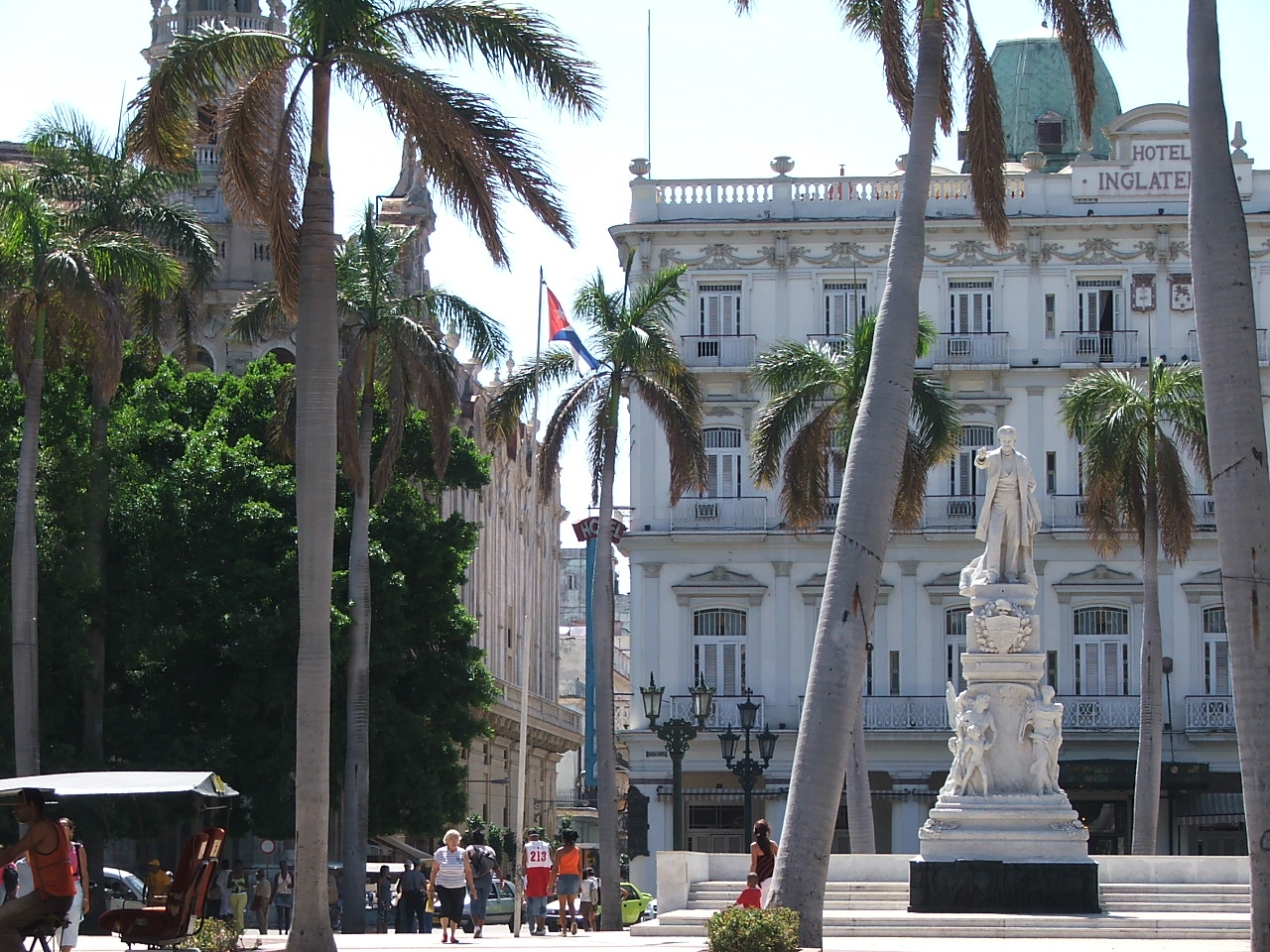
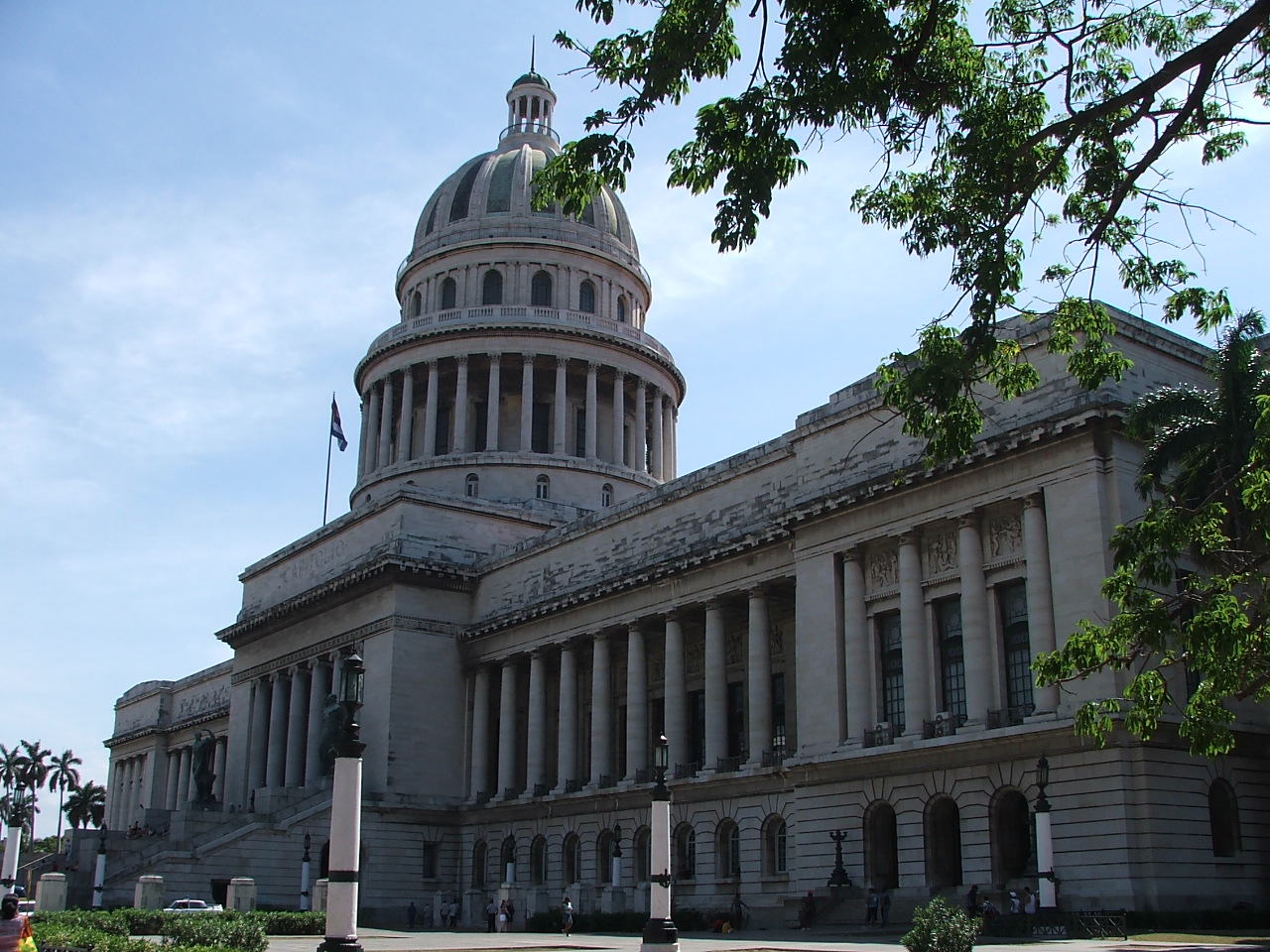
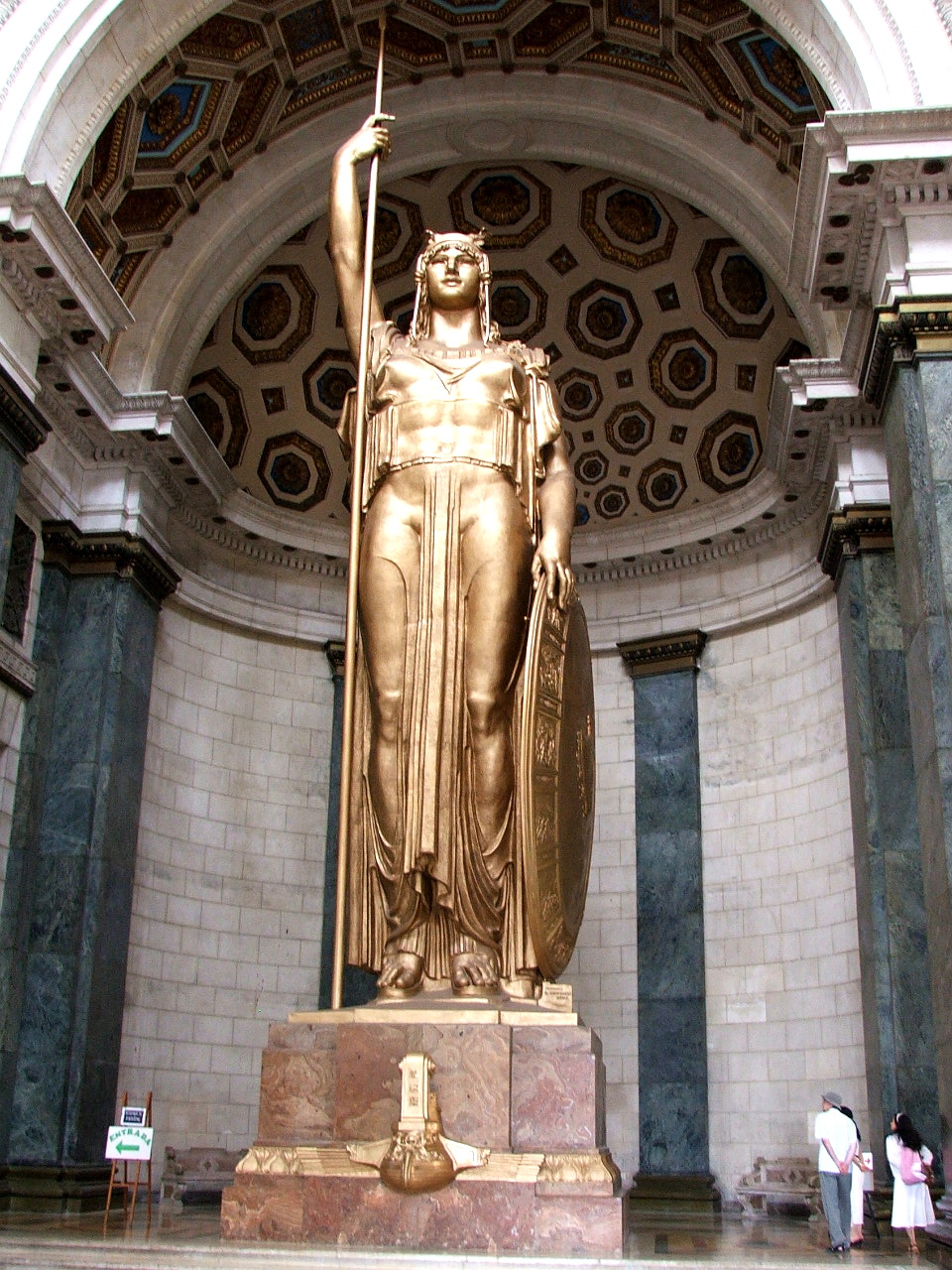
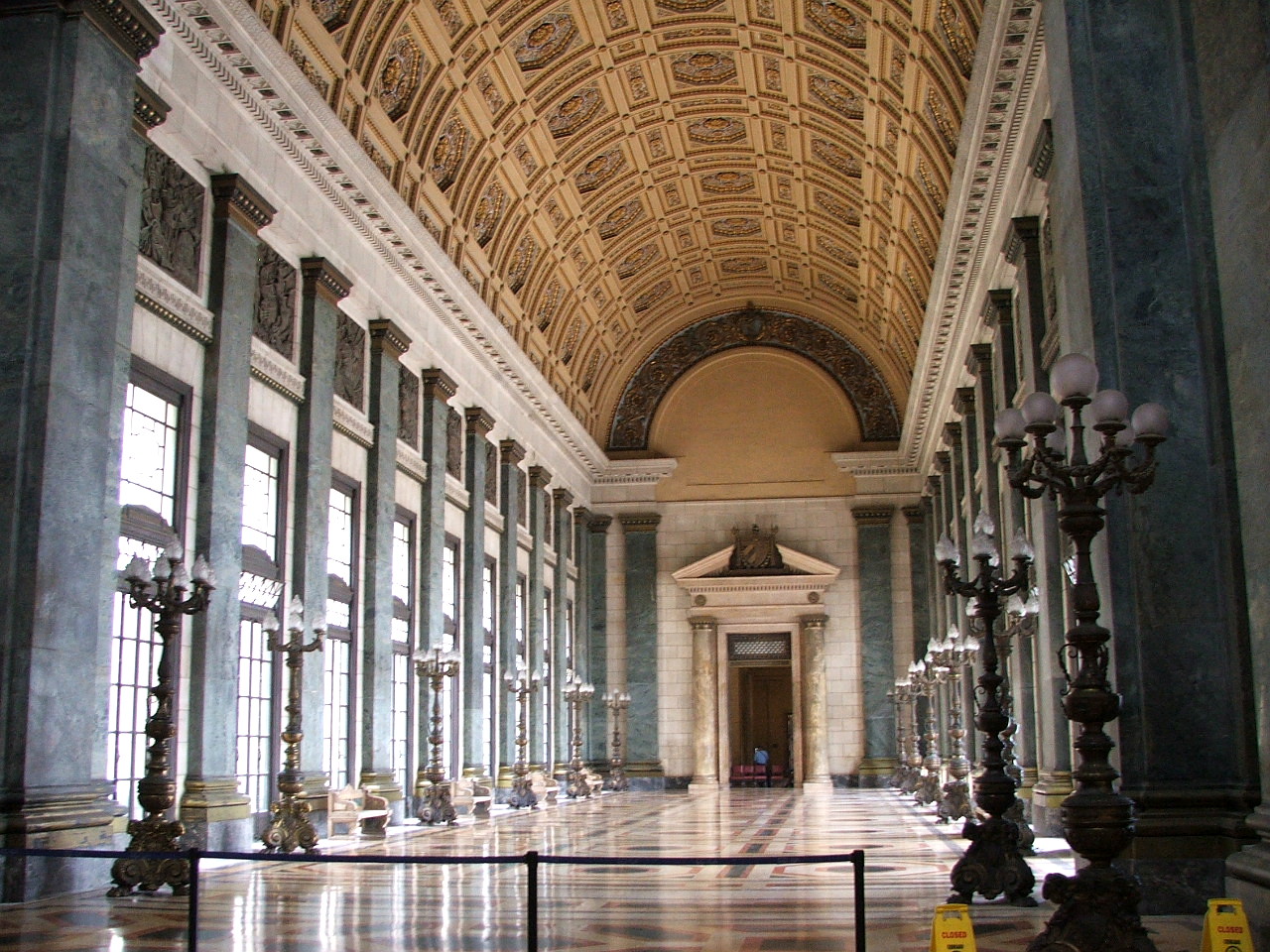
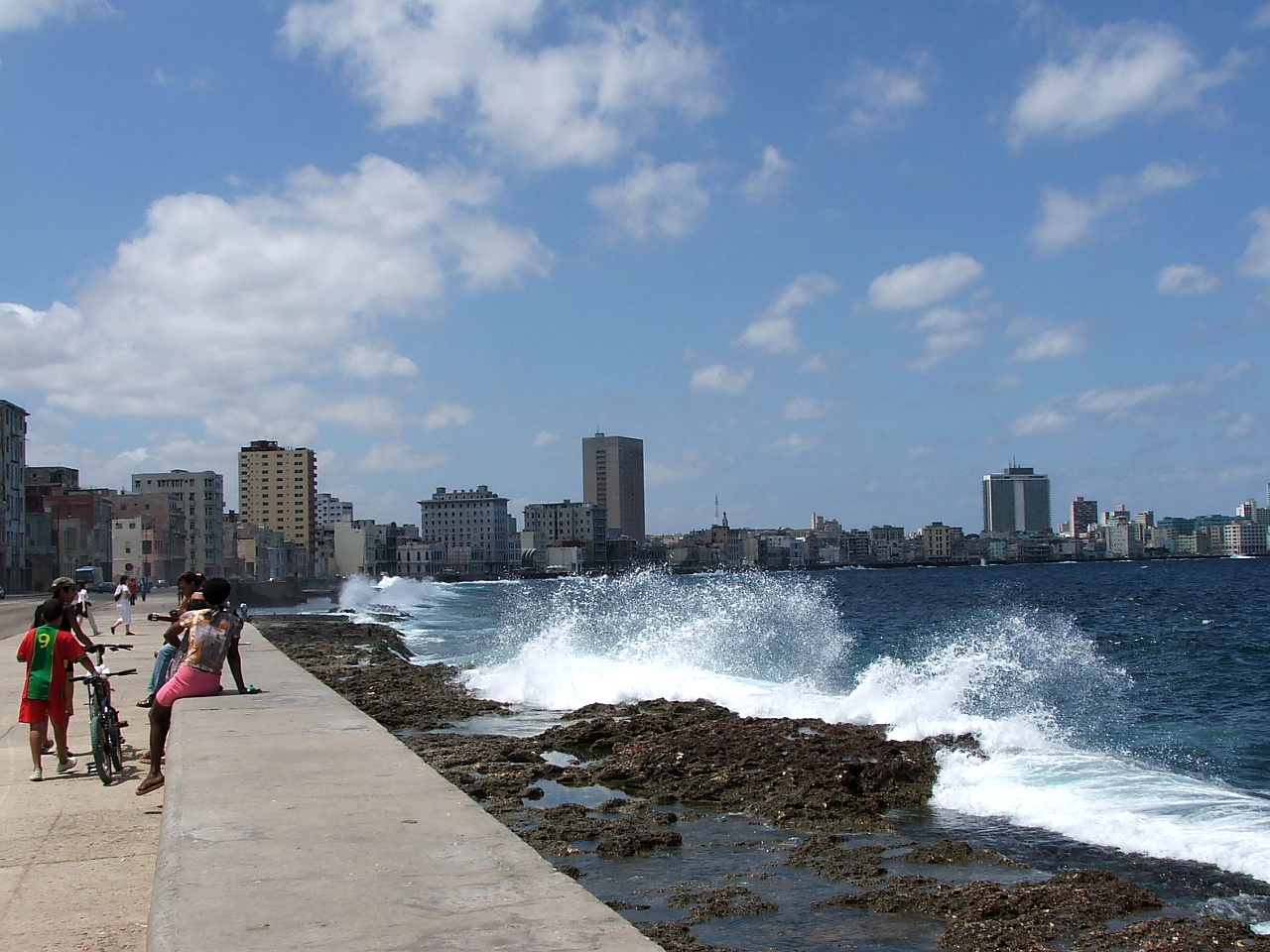
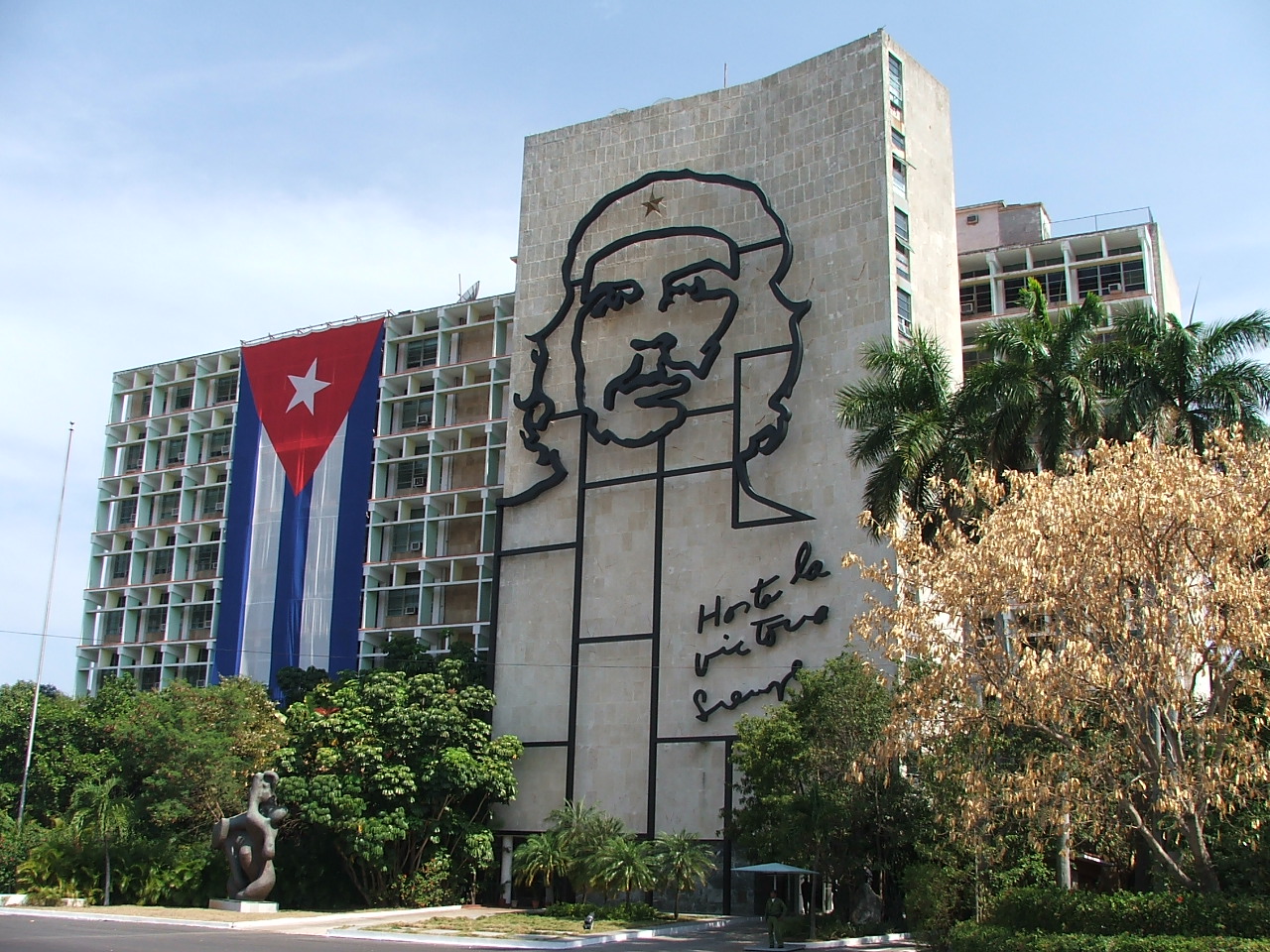
José Martí Statue, Parque Central … in Havana, Cuba. Photograph by CJ Walsh. 2007-04-03. Click to enlarge.The Capitolio … in Havana, Cuba. Photograph by CJ Walsh. 2007-04-03. Click to enlarge.Statue of the Republic, Capitolio … in Havana, Cuba. Photograph by CJ Walsh. 2007-04-04. Click to enlarge.Salón de los Pasos Perdidos, Capitolio … in Havana, Cuba. Photograph by CJ Walsh. 2007-04-04. Click to enlarge.Gran Teatro de La Habana … in Havana, Cuba. Photograph by CJ Walsh. 2007-04-03. Click to enlarge.El Floridita Bar & Restaurant … in Havana, Cuba. Photograph by CJ Walsh. 2007-04-07. Click to enlarge.Main Staircase, Museo de la Revolución (formerly the Presidential Palace) … in Havana, Cuba. Notice the bullet holes in the marble ! Photograph by CJ Walsh. 2007-04-06. Click to enlarge.Salón de los Espejos, Museo de la Revolución (formerly the Presidential Palace) … in Havana, Cuba. Photograph by CJ Walsh. 2007-04-06. Click to enlarge.Paseo del Prado … in Havana, Cuba. Photograph by CJ Walsh. 2007-04-03. Click to enlarge.The Malecón … in Havana, Cuba. Photograph by CJ Walsh. 2007-04-07. Click to enlarge.Ministerio del Interior, Plaza de la Revolución … in Havana, Cuba. Photograph by CJ Walsh. 2007-04-04. Click to enlarge.
.
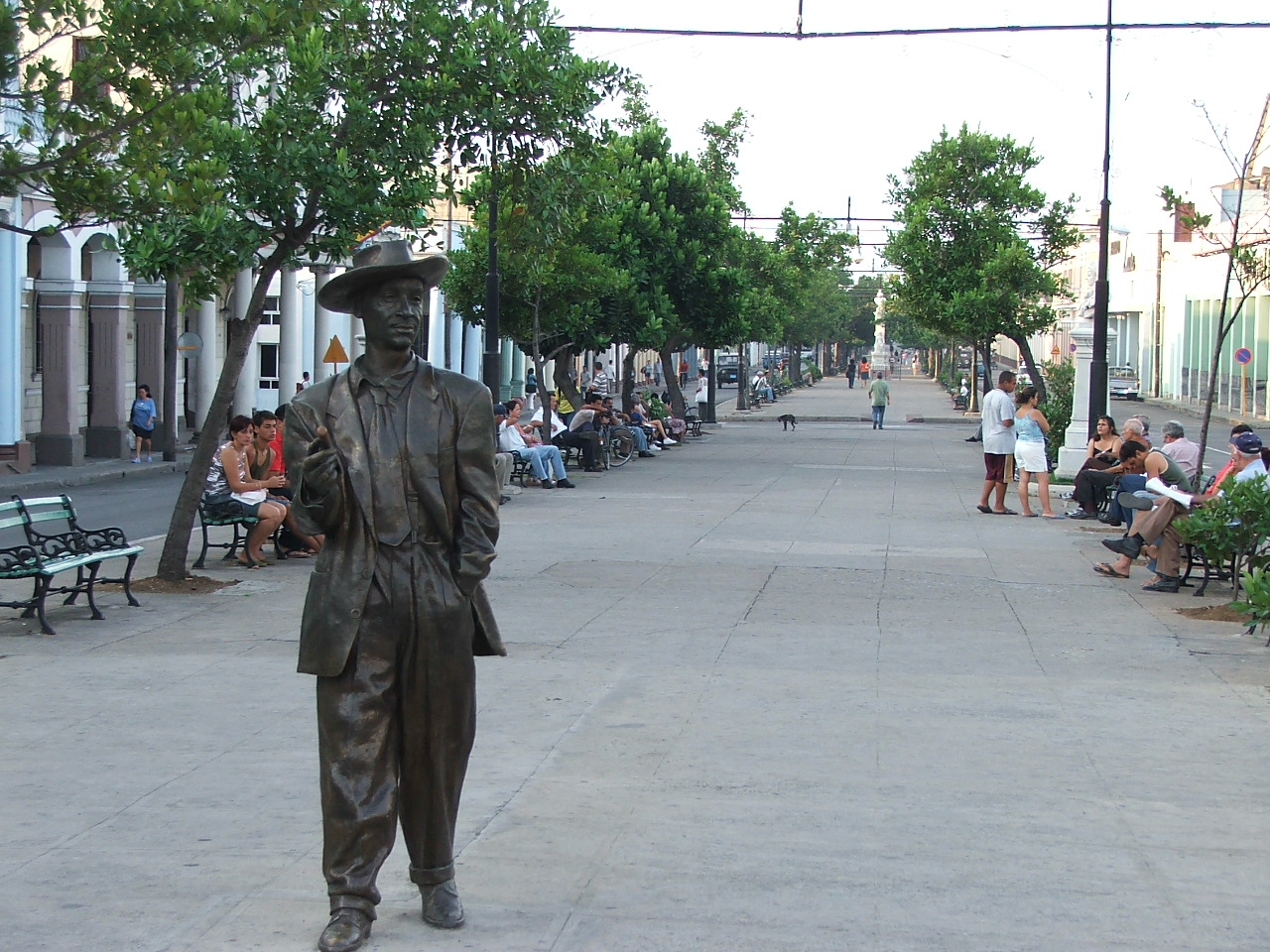
Mural de la Prehistoria (1959-62, and restored in 1980), by Cuban painter Leovigildo González, in the Valle de Viňales … Pinar del Rio, Cuba. Photograph by CJ Walsh. 2007-04-05. Click to enlarge.Tobacco Harvest … in Pinar del Rio, Cuba. Photograph by CJ Walsh. 2007-04-05. Click to enlarge.Statue of Benny Moré (1919-63) … Cuban singer, bandleader and songwriter … Paseo del Prado, Cienfuegos, Cuba. Photograph by CJ Walsh. 2007-04-14. Click to enlarge.
.
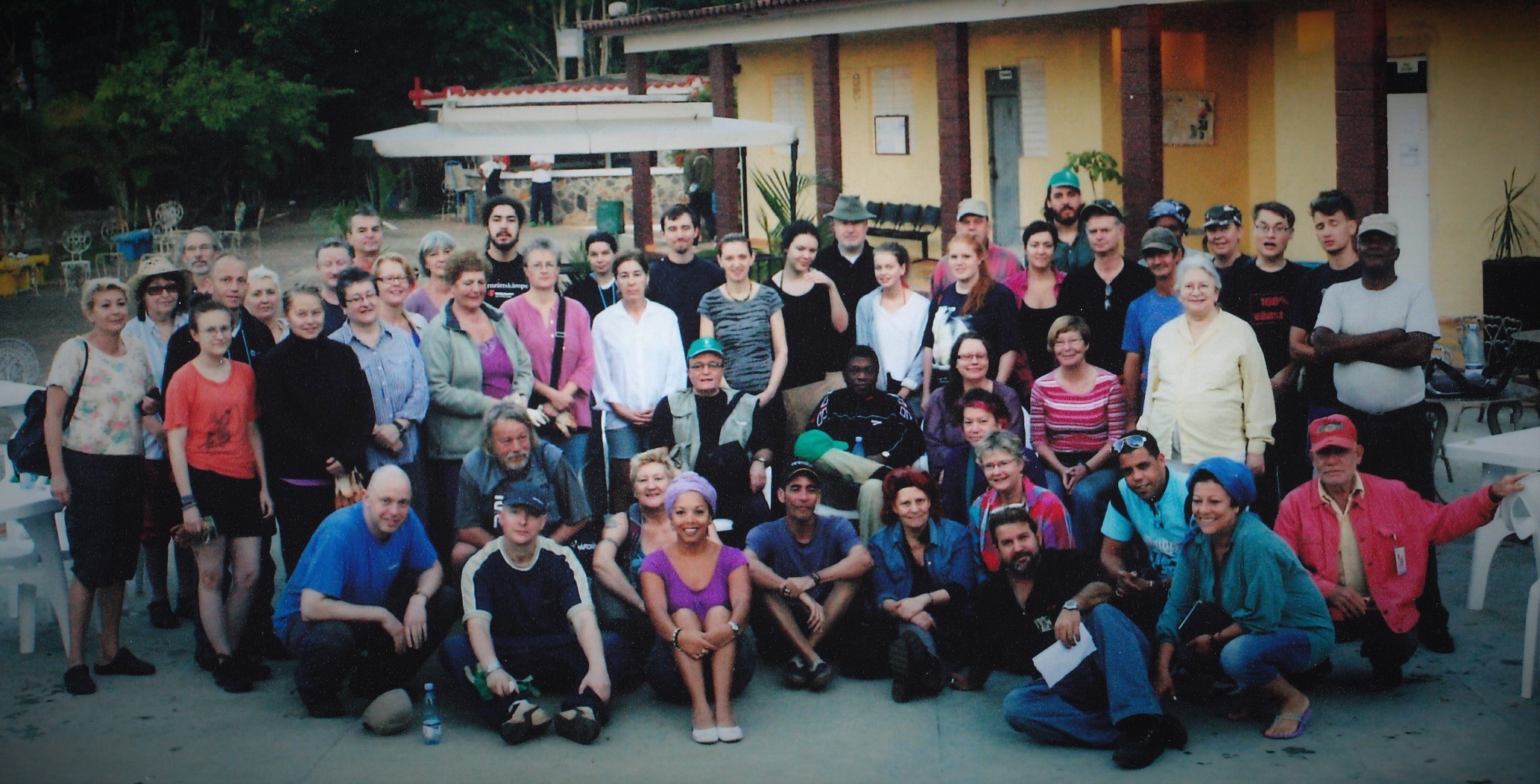
International Work Brigade (December 2011 – January 2012) at the Campamento Internacional Julio Antonio Mella … in Caimito, Cuba. Click to enlarge.
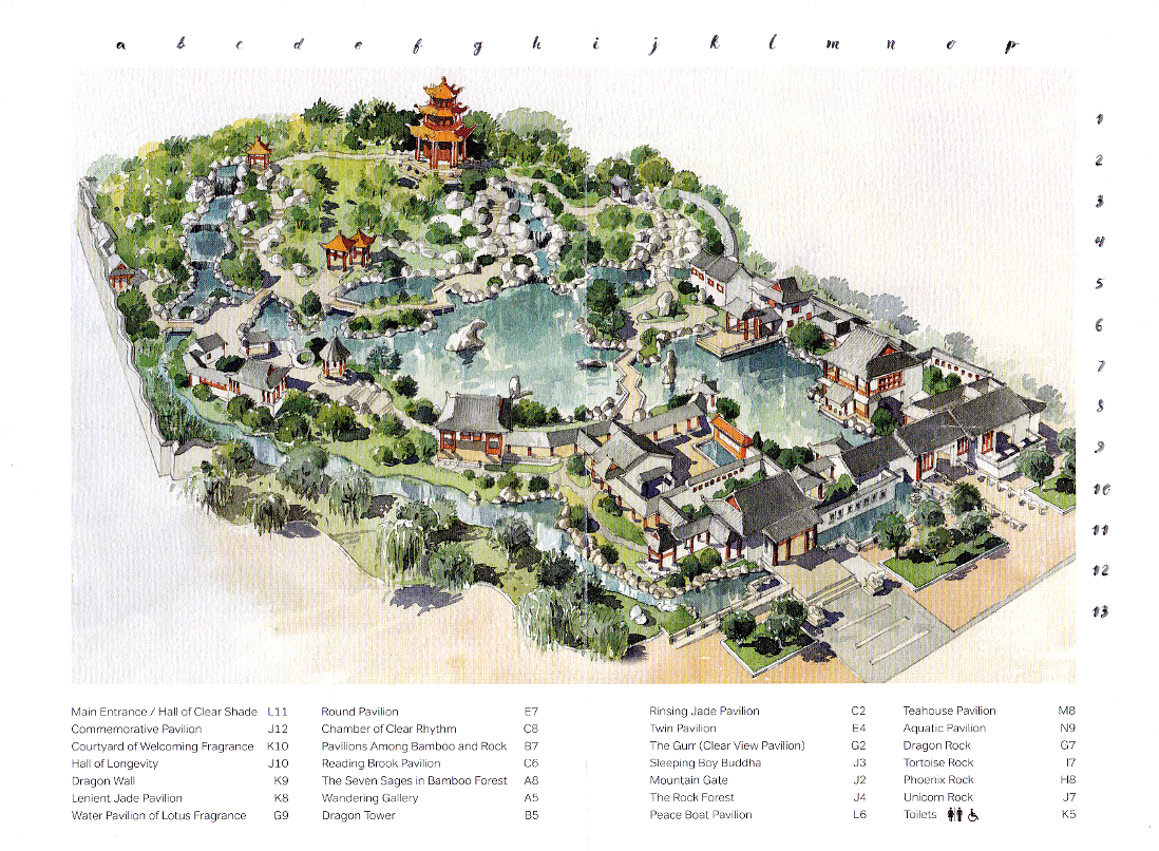
2016-12-21: Just as President-Elect Humpty Trumpy is turning up the pressure on China … (and IF there is a serious incident between these two countries, the USA will automatically assume that it will have the unconditional and unquestioning support of a select little band of ‘groupie’ allies, each claiming to have a special and unique relationship with it !) … let me to bring to your attention the wonderful Chinese Garden of Friendship, located near Darling Harbour, in the city of Sydney … a symbol of friendship between the people of Guangzhou, capital city of the province of Guangdong in south-eastern China (Peoples’ Republic of China), and the people of Sydney, in New South Wales – two sister cities of sister states.
Colour photograph showing an architectural feature in the Garden. Click to enlarge. Photograph taken by CJ Walsh. 2016-11-10.Colour photograph showing a water feature in the Garden. Click to enlarge. Photograph taken by CJ Walsh. 2016-11-10.Colour photograph showing a landscaping detail in the Garden. Click to enlarge. Photograph taken by CJ Walsh. 2016-11-10.
The Garden was officially opened in 1988.
Colour photograph showing the view up, towards the Rinsing Jade Pavilion. Click to enlarge. Photograph taken by CJ Walsh. 2016-11-10.Colour photograph showing the view down, over the Twin Pavilion and the Lake of Brightness. Click to enlarge. Photograph taken by CJ Walsh. 2016-11-10.Colour photograph showing a sculptural feature in the Garden. Click to enlarge. Photograph taken by CJ Walsh. 2016-11-10.
.
Colour Layout Drawing of the Garden, with Key. Click to enlarge.
Lasting Peace & Effective International Law are Essential Prerequisites for Sustainable Human & Social Development !
During the 12 Days of Christmas … Relax, Enjoy and Be Merry !!
2016-09-14: Only now are we really catching up with the extremely serious matter of Fire Safety in Sustainable Buildings … serious for building occupants … and firefighters !
‘ In order to achieve sustainable development, environmental protection and energy efficiency/conservation shall constitute integral parts of the development process, and shall not be considered in isolation.’
2016 Dublin Code of Ethics: Design, Engineering, Construction & Operation of a Safe, Resilient & Sustainable Built Environment for All ( www.sfe-fire.eu )
The Performance Target for New Construction must be Positive Energy Buildings.
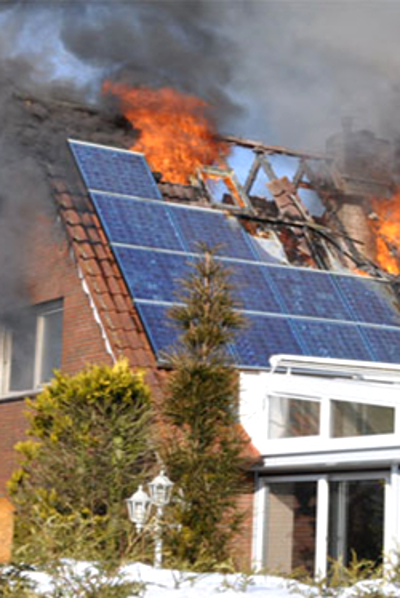
So … we will see more and more Solar Photovoltaic Panels installed on more and more buildings … in every country. Certainly not less ! And, let’s face it, many will not be properly approved, i.e. shown to be ‘fit for their intended use’ …
Colour photograph showing a house fire caused by Solar Photovoltaic Roof Panels.
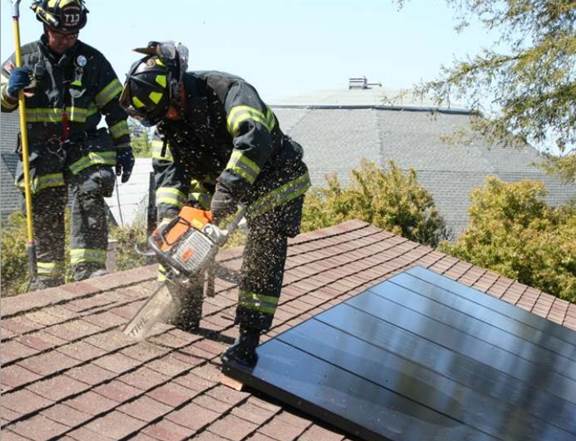
At the beginning of this decade, a Fire Research Project was carried out by the Underwriters Laboratories Firefighter Research Institute in the USA … and it addressed the issue of firefighter vulnerability to electrical hazards, and serious injury, when fighting a fire involving Solar Photovoltaic (PV) Modules and Support Systems installed on buildings.
Colour photograph showing two firefighters on a roof, one with cutting equipment. Solar Photovoltaic Roof Panels restrict firefighter access to building interior roof spaces.
The Total Global Solar Energy Capacity averaged 40 % annual growth from 2000 to 2010 (source: International Energy Agency). In the USA, Grid-Connected Solar Photovoltaic Capacity grew 50 % per year for much of that time (source: US Federal Energy Regulatory Commission). These trends increase the potential of a Fire Service Response to a building having a Photovoltaic Installation, irrespective of the PV being involved with the initiation of the fire event. As a result, conventional firefighter tactics for suppression, ventilation and overhaul have been complicated, leaving firefighters vulnerable to potentially unrecognized exposure. Though the electrical and fire hazards associated with electrical generation and distribution systems are well known, PV Systems present unique safety concerns. A limited body of knowledge and insufficient data exist to understand these risks … to the extent that Fire Services have been unable to develop safety solutions and respond in a safe manner.
This Fire Research Project developed the empirical data needed to quantify the hazards associated with PV Installations … and provided the foundation to modify current or develop new firefighting practices to reduce firefighter deaths and injury.
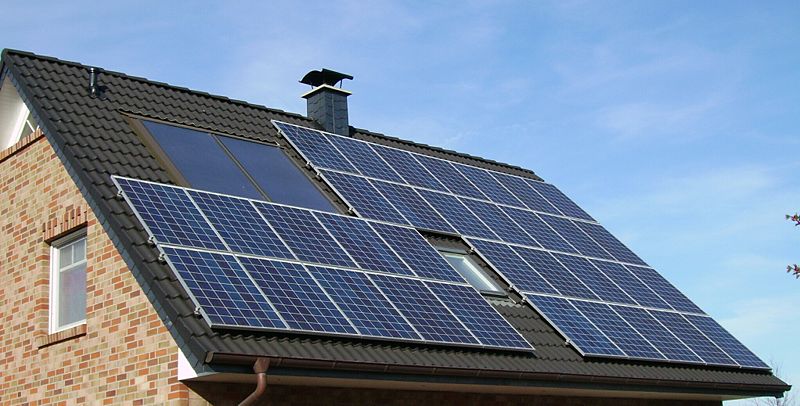
Colour photograph showing a large array of Solar Photovoltaic Panels on a roof. Extra loading on roof structures must be considered, as well as possible interference with roof fire evacuation routes for able-bodied occupants.
The Tactical Considerations addressed during the Project include:
Shock hazard due to the presence of water and PV power during fire suppression activities ;
Shock hazard due to the direct contact with energized components during firefighting operations ;
Emergency disconnect and disruption techniques ;
Severing of conductors ;
Assessment of PV power during low ambient light, artificial light and light from a fire ;
Assessment of potential shock hazard from damaged PV Modules and Systems.
.
Office of California’s State Fire Marshal – November 2010
UL Report (2011): The Following Summarizes the Findings of This Fire Research Project:
The electric shock hazard due to the application of water is dependent on voltage, water conductivity, distance and spray pattern. A slight adjustment from a solid fire hose stream towards a fog pattern (10 degree cone angle) reduced measured current below perception level. Salt water should not be used on live electrical equipment. A distance of 6 m has been determined to reduce potential shock hazard from a 1000 VDC source to a level below 2 mA, considered as safe. It should be noted that pooled water or foam may become energized due to damage in the PV System.
Outdoor weather exposure-rated electrical enclosures are not resistant to water penetration by fire hose streams. A typical enclosure will collect water and present an electrical hazard.
Firefighters’ gloves and boots afford limited protection against electrical shock provided the insulating surface is intact and dry. They should not be considered equivalent to Electrical Personal Protective Equipment (PPE).
Turning off an array is not as simple as opening a disconnect switch. Depending on the individual system, there may be multiple circuits wired together to a common point such as a combiner box. All circuits supplying power to this point must be interrupted to partially de-energize the system. As long as the array is illuminated, parts of the system will remain energized. Unlike a typical electrical or gas utility … on a PV Array, there is no single point of disconnect.
Tarps offer varying degrees of effectiveness to interrupt the generation of power from a PV Array, independent of cost. Heavy, densely woven fabric and dark plastic films reduce the power from PV to nearly zero. As a general guide, if light can be seen through a tarp, it should not be used. Caution should be exercised during the deployment of tarps on damaged equipment, as a wet tarp may become energized and conduct hazardous current if it contacts live equipment. Also, firefighting foam should not be relied upon to block light.
When illuminated by artificial light sources, such as Fire Department light trucks or an exposure fire, PV Systems are capable of producing electrical power sufficient to cause a lock-on hazard.
Severely damaged PV Arrays are capable of producing hazardous conditions ranging from perception to electrocution. Damage to the array may result in the creation of new and unexpected circuit paths. These paths may include both array components (module frame, mounting racks, conduits, etc) and building components (metal roofs, flashings and gutters). Care must be exercised during all operations, both interior and exterior. Contacting a local professional PV Installation Company should be considered to mitigate potential hazards.
Damage to modules from tools may result in both electrical and fire hazards. The hazard may occur at the point of damage or at other locations depending on the electrical path. Metal roofs present unique challenges in that the surface is conductive unlike other types such as shingle, ballasted or single ply.
Severing of conductors in both metal and plastic conduit results in electrical and fire hazards. Care must be exercised during ventilation and overhaul.
Responding personnel must stay away from the roofline in the event of modules or sections of an array sliding off the roof.
Fires under an array but above the roof may breach roofing materials and decking … allowing fire to propagate into the attic space of the building.