Fire Engineering Design

NIST WTC Recommendations 29-30 > Improved Fire Education

Previous Posts in This Series …

2011-10-25:  NIST’s Recommendations on the 9-11 WTC Building Collapses … GROUP 1. Increased Structural Integrity – Recommendations 1, 2 & 3 (out of 30)

2011-11-18:  NIST WTC Recommendations 4-7 > Structural Fire EnduranceGROUP 2.  Enhanced Fire Endurance of Structures – Recommendations 4, 5, 6 & 7

2011-11-24:  NIST WTC Recommendations 8-11 > New Design of StructuresGROUP 3.  New Methods for Fire Resisting Design of Structures – Recommendations 8, 9, 10 & 11

2011-11-25:  NIST WTC Recommendations 12-15 > Improved Active ProtectionGROUP 4.  Improved Active Fire Protection – Recommendations 12, 13, 14 & 15

2011-11-30:  NIST Recommendations 16-20 > Improved People EvacuationGROUP 5.  Improved Building Evacuation – Recommendations 16, 17, 18, 19 & 20

2011-12-04:  NIST WTC Recommendations 21-24 > Improved FirefightingGROUP 6.  Improved Emergency Response – Recommendations 21, 22, 23 & 24

2011-12-07:  NIST WTC Recommendations 25-28 > Improved PracticesGROUP 7.  Improved Procedures and Practices – Recommendations 25, 26, 27 & 28

.

2011-12-08:  SOME PRELIMINARY COMMENTS …

  1.     At last, we arrive at the Group 8 Recommendations !   At this stage … my impression is that the NIST Team began to run out of steam, because these two short Recommendations barely scratch the surface with regard to the significant education and training needs of the many different design, construction, management, operation, maintenance and emergency response disciplines engaged with, and confronted by, the Built Environment … every day of every week.

After a careful reading of all 30 NIST WTC Recommendations, I hope that you have satisfied yourself/yourselves that these Recommendations must be applied to ALL Buildings … not just Tall Buildings.  At various times … Iconic Buildings, and Buildings having a Critical Function or an Innovative Design have been specifically mentioned.  And look back to Recommendation 22a … tunnels and subways also made an appearance !   The proper focus for the International Fire Science and Engineering Community must be on the Built Environment as a whole.

At All Levels in a Typical Construction Project … there are also pressing education and training needs.  It is of little use if the Project Design Documentation is 100% … and the people actually installing the passive fire protection measures or the active fire protection systems on site don’t know which end is ‘up’ !   The Project Design Documentation, in whatever format, is merely a means to an end … a fully realized and occupied Building, which is fire-safe.

Preferably … we should be discussing the mandatory Re-education and Re-training of Practitioners in the different Disciplines … [CPD (Continuing Professional/Personal Development) is not at all sufficient !] … accompanied by a very necessary Re-engineering of the Stakeholder Professional and Educational Institutions … and other related Organizations, particularly National Authorities Having Jurisdiction (AHJ’s).

Our Best Hope for Transformation … lies with the current crop of third-level undergraduate students in the different disciplines.  And, as we are discovering with the introduction of the Structural EuroCodes in the European Union, it will take perhaps 5-8 years of continuous student output to transform pre-9/11 conventional fire engineering … into a post-9/11 and post-Mumbai fire engineering which is properly ‘reliability-based’ and ‘person-centred’, i.e. Sustainable Fire Engineering !

As for the Future, and Some Conclusions to this Series … coming shortly to a computer monitor screen near you !

.

2005 NIST WTC RECOMMENDATIONS

GROUP 8.  Education and Training

The professional skills of building and fire safety professionals should be upgraded through a national education and training effort for fire protection engineers, structural engineers, and architects.  The skills of building regulatory and fire service personnel should also be upgraded to provide sufficient understanding and the necessary skills to conduct the review, inspection, and approval tasks for which they are responsible.

NIST WTC Recommendation 29.

NIST recommends that continuing education curricula be developed, and programmes be implemented for:  (1) training fire protection engineers and architects in structural engineering principles and design;  and (2) training structural engineers, architects, fire protection engineers, and code enforcement officials in modern fire protection principles and technologies, including the fire resisting design of structures;  and (3) training building regulatory and fire service personnel to upgrade their understanding and skills to conduct the review, inspection, and approval tasks for which they are responsible.  The outcome would further the integration of the disciplines in effective fire-safe design of buildings.  Affected Organizations:  AIA, SFPE, ASCE, ASME, AISC, ACI, and state licensing boards.  Model Building Codes:  Detailed criteria and requirements should be incorporated into the model building codes under the topic ‘Design Professional in Responsible Charge’.

NIST WTC Recommendation 30.

NIST recommends that academic, professional short-course, and web-based training materials in the use of computational fire dynamics and thermo-structural analysis tools be developed and delivered to strengthen the base of available technical capabilities and human resources.  Affected Organizations:  AIA, SFPE, ASCE, ASME, AISC, ACI, ICC, and NFPA.

.

.

END

Enhanced by Zemanta

Tags: , , , , , , , , , , , , , , , , , , , , , , , , , , , , , , , , , , , , , , , , , , , , , , , , , , , , , , , , , , , , , , , , , , , , , , , , , , , ,

NIST WTC Recommendations 25-28 > Improved Practices

Previous Posts in This Series …

2011-10-25:  NIST’s Recommendations on the 9-11 WTC Building Collapses … GROUP 1. Increased Structural Integrity – Recommendations 1, 2 & 3 (out of 30)

2011-11-18:  NIST WTC Recommendations 4-7 > Structural Fire EnduranceGROUP 2.  Enhanced Fire Endurance of Structures – Recommendations 4, 5, 6 & 7

2011-11-24:  NIST WTC Recommendations 8-11 > New Design of StructuresGROUP 3.  New Methods for Fire Resisting Design of Structures – Recommendations 8, 9, 10 & 11

2011-11-25:  NIST WTC Recommendations 12-15 > Improved Active ProtectionGROUP 4.  Improved Active Fire Protection – Recommendations 12, 13, 14 & 15

2011-11-30:  NIST Recommendations 16-20 > Improved People EvacuationGROUP 5.  Improved Building Evacuation – Recommendations 16, 17, 18, 19 & 20

2011-12-04:  NIST WTC Recommendations 21-24 > Improved FirefightingGROUP 6.  Improved Emergency Response – Recommendations 21, 22, 23 & 24

.

2011-12-07:  SOME PRELIMINARY COMMENTS …

  1.     Concerning Recommendation 25 below … yes, this Recommendation applies to the types of organizations identified in the text, but it should also be understood as applying to ALL Organizations … public or private, governmental or non-governmental or quasi-governmental, whatever, etc … ‘supported’ (see the text further down in Recommendation 25) with rigorous enforcement, in all cases, by publically appointed building control officials and/or by private, independent, competent technical control professionals.

Once more … and again and again (!) … confirmed by the sort of debacle seen at the Priory Hall Apartment Complex, in Dublin … Self-Certification / Self-Approval, i.e. ‘lite’ regulation, does not work.  For National Authorities Having Jurisdiction (AHJ’s), however, it is a cheap solution to a difficult, resource-devouring issue, i.e. protecting society and the consumer … in that order.

  2.     Concerning the Footnote to Recommendation 26 below … the choice should never be between either Fire Compartmentation or Sprinklers … or the other way around, whichever you prefer.  Neither is 100% reliable !

Fire Compartmentation

The division of a building into fire-tight compartments, by fire and smoke resisting elements of construction, in order …

  • to contain an outbreak of fire, and to facilitate effective firefighting ;
  • to prevent damage, within the building, to other adjoining compartments and/or spaces ;
  • to protect a compartment interior from external fire attack, e.g. fire spread across the building’s facade or from an adjacent building ;
  • to minimize adverse, or harmful, environmental impacts outside the building.

As developed as that definition is above, Fire Compartmentation should be regarded as just one Fire Safety Strategy / Fire Engineering Strategy … not the only strategy, and certainly not the main strategy.

Here are two reasons why not …

a)   The connection between compartment size and the ability to effectively fight a fire within a space of limited volume has been lost … so more and more, commercial pressure is being exerted on national authorities to expand the acceptable compartment sizes in buildings … which significantly increases the fire hazard ;

[ Remembering the difference between the limited Fire Safety Objectives of Building Codes/Regulations and the much broader Project-Specific Fire Engineering Objectives of Ethical Fire Engineering required to protect society and the full interests of our clients ... it is easy to understand why national authorities feel that they can respond positively to such commercial pressures.]

b)   In a Sustainable Building … it is a very common design strategy to take advantage of the natural patterns of air movement in a building, for either cooling or heating purposes, depending on local climate conditions.  So there is simply no compartmentation, as understood in conventional fire engineering terms … and this throws up a fundamental conflict between the two.  To be discussed in another post !

  3.     Concerning the 2nd Footnote to Recommendation 28 below … in the very same New York City … at 09.40 hrs on a Saturday morning, 28 July 1945 … lost in fog, a B-25 Bomber slammed head-on into the 79th Floor of the Empire State Building … and caused enormous damage.  That building is still standing today … and surprise, surprise … there was aviation fuel in the B-25 !

In a similar vein … Fire-Induced Progressive Collapse was not observed for the first time, in New York, on 11 September 2001 !

.

2005 NIST WTC RECOMMENDATIONS

GROUP 7.  Improved Procedures and Practices

The procedures and practices used in the design, construction, maintenance, and operation of buildings should be improved to include encouraging code compliance by non-governmental and quasi-governmental entities, adoption and application of egress and sprinkler requirements in codes for existing buildings, and retention and availability of building documents over the life of a building.

NIST WTC Recommendation 25.

Non-governmental and quasi-governmental entities that own or lease buildings and are not subject to building and fire safety code requirements of any governmental jurisdiction are nevertheless concerned about the safety of building occupants and responding emergency personnel.  NIST recommends that such entities be encouraged to provide a level of safety that equals or exceeds the level of safety that would be provided by strict compliance with the code requirements of an appropriate governmental jurisdiction.  NIST further recommends that as-designed and as-built safety be certified by a qualified third party, independent of the building owner(s).  The process should not use self-approval for code enforcement in areas including interpretation of code provisions, design approval, product acceptance, certification of the final construction, and post-occupancy inspections over the life of the buildings.*

[ * F-46  The long-standing stated policy of the Port Authority of New York & New Jersey (PANYNJ) was to meet and, where appropriate, exceed the requirements of local building and fire codes, and it entered into agreements with the New York City Department of Buildings and the Fire Department of the City of New York in accordance with that policy.  Although the PANYNJ sought review and concurrence from New York City in the areas listed in the Recommendation, the PANYNJ was not required to yield, and appears not to have yielded, approval authority to New York City.  The PANYNJ was created as an interstate entity, a 'body corporate and politic', under its charter, pursuant to Article 1, Section 10 of the United States Constitution permitting compacts between states.  Further, there are many other similar non-governmental and quasi-governmental entities in the U.S.  A comprehensive review of documents conducted as part of this Investigation suggests that the WTC towers generally were designed and maintained consistent with the requirements of the 1968 New York City Building Code.  Areas of concern included fireproofing of the WTC floor system, height of tenant separation walls, and egress requirements for the assembly use spaces of 'Windows of the World' in WTC Tower 1 and the 'Top of the World' Observation Deck in WTC Tower 2.  These areas of concern did not play a significant role in determining the outcomes related to the events on 11th September 2001.]

NIST WTC Recommendation 26.

NIST recommends that state and local jurisdictions adopt and aggressively enforce available provisions in building codes to ensure that egress and sprinkler requirements are met by existing buildings.*  Further, occupancy requirements should be modified where needed (such as when there are assembly use spaces within an office building) to meet the requirements in model building codes.  Provisions related to egress and sprinkler requirements in existing buildings are available in such codes as the International Existing Building Code (IEBC), International Fire Code, NFPA 1, NFPA 101, and ASME A 17.3.  For example, the IEBC defines three levels of building alteration (removal and replacement or covering of existing materials and equipment, reconfiguration of space or system or installation of new equipment, and extending the work area in excess of 50% of the aggregate area of the building).  At the lowest level, there are no upgrade implications for sprinklers and the egress system.  At the next level, sprinklers are required in work areas serving greater than 30 people if certain other conditions related to building height and use such as shared exits also are met.  There are numerous requirements for means of egress, including number of exits, specification of doorsets, dead-end corridors and travel distances, lighting, signage, and handrails.  At the highest level, the sprinkler and egress requirements are identical to the second level without the minimum 30-person restriction and the other conditions related to building height and use.  The Life Safety Code (NFPA 101) applies retroactively to all buildings, independent of whether any work is currently being done on the building, and ASME A 17.3 applies retroactively to all elevators as a minimum set of requirements.

[ * F-47  The WTC towers were unsprinklered when built.  It took nearly 28 years after passage of New York City Local Law 5 in 1973, which required either compartmentation or sprinklering, for the buildings to be fully sprinklered (the Port Authority chose not to use the compartmentation option in Local Law 5).  This was about 13 years more than the 15-year period for full compliance with Local Law 5 that was set by Local Law 84 of 1979.]

NIST WTC Recommendation 27.

NIST recommends that building codes incorporate a provision that requires building owners to retain documents, including supporting calculations and test data, related to building design, construction, maintenance, and modifications over the entire life of the building.*  Means should be developed for off-site storage and maintenance of the documents.  In addition, NIST recommends that relevant information be made available in suitably designed hard copy or electronic formats for use by emergency responders.  Such information should be easily accessible by responders during emergencies.  Model Building Codes:  Model building codes should incorporate this Recommendation.  State and local jurisdictions should adopt and enforce these requirements.

[ * F-48  The availability of inexpensive electronic storage media and tools for creating large searchable databases makes this feasible.]

NIST WTC Recommendation 28.

NIST recommends that the role of the ‘Design Professional in Responsible Charge’* be clarified to ensure that:  (1) all appropriate design professionals (including, e.g. the fire protection engineer) are part of the design team providing the highest standard of care when designing buildings employing innovative or unusual fire safety systems;**  and (2) all appropriate design professionals (including, e.g. the structural engineer and the fire protection engineer) are part of the design team providing the highest standard of care when designing the structure to resist fires, in buildings that employ innovative or unusual structural and fire safety systems.  Affected Standards:  AIA Practice Guidelines.  Model Building Codes:  The International Building Code (IBC), which already defines ‘Design Professional in Responsible Charge’, should be clarified to address this Recommendation.  NFPA 5000 should incorporate the ‘Design Professional in Responsible Charge’ concept, and address this Recommendation.

[ * F-49  In projects involving a design team, the 'Design Professional in Responsible Charge' - usually the lead architect - ensures that the team members use consistent design data and assumptions, co-ordinates overlapping specifications, and serves as the liaison between the enforcement and reviewing officials and the owner.  This term is defined in the International Building Code (IBC) and in the International Code Council's Performance Code for Buildings and Facilities (where it is the Principal Design Professional).]

[ ** F-50  If the fire safety concepts in tall buildings had been sufficiently mature in the 1960's, it is possible that the risks associated with jet-fuel ignited multi-floor fires might have been recognized and taken into account when the impact of a Boeing 707 aircraft was considered by the structural engineer during the design of the WTC towers.]

.

.

END

Enhanced by Zemanta

Tags: , , , , , , , , , , , , , , , , , , , , , , , , , , , , , , , , , , , , , , , , , , , , , , , , , , , , , , , , , , , , , , , , , , , , , , , , , , , , , , , , , , , , , , , , , , , , , , , , , , , , , , , ,

NIST Recommendations 16-20 > Improved People Evacuation

Previous Posts in This Series …

2011-10-25:  NIST’s Recommendations on the 9-11 WTC Building CollapsesGROUP 1. Increased Structural Integrity – Recommendations 1, 2 & 3 (out of 30)

2011-11-18:  NIST WTC Recommendations 4-7 > Structural Fire EnduranceGROUP 2.  Enhanced Fire Endurance of Structures – Recommendations 4, 5, 6 & 7

2011-11-24:  NIST WTC Recommendations 8-11 > New Design of StructuresGROUP 3.  New Methods for Fire Resisting Design of Structures – Recommendations 8, 9, 10 & 11

2011-11-25:  NIST WTC Recommendations 12-15 > Improved Active ProtectionGROUP 4.  Improved Active Fire Protection – Recommendations 12, 13, 14 & 15

.

2011-11-30:  SOME PRELIMINARY COMMENTS …

  1.     In the First Post of this Series, I wrote …

” As such a high level of performance is expected … indeed demanded … of a Sustainable BuildingSustainable Fire Engineering must be ‘reliability-based’ … in other words, it must have a rational, empirical and scientifically robust basis … “

Sustainable Fire Engineering must also be ‘person-centred’ … i.e. a design process (in whatever architectural or engineering discipline) which places ‘real’ people at the centre of creative endeavours and gives due consideration to their responsible needs, and their health, safety, welfare and security in the Human Environment.

In order to prolong, and if at all possible, significantly extend the Life Cycle of a Sustainable Building beyond 100 years … Fire Engineers must begin to feel at ease … and be comfortable … with the following mainstream Sustainable Design Concepts

Flexibility:  The extent to which a building interior is designed, when new, to be capable of being easily modified at any later stage during the life cycle of that building – with minimal cost and user inconvenience – because of a person’s changing living or working needs.

Adaptability:  The extent to which a building, or a building component, is designed when new, or capable of being easily modified at any later stage, to meet the changing life and living needs of the broad range of potential users, who may or may not have activity limitations, or may develop a health condition during the life cycle of that building or component.

Accessibility of a Building:  Ease of independent approach, entry, egress (during normal ambient conditions), evacuation (in the event of an emergency) and/or use of a building and its services and facilities, by all of the building’s potential users - with an assurance of individual health, safety and welfare during the course of those activities.

  2.     Group 5 of the 2005 NIST WTC Recommendations is, by far, the most important … introducing some innovative concepts of ‘real’ evacuation … with nothing too startling.  Contrary to the impression given by NIST … these Recommendations are equally valid for complex building types and, in reality, for all but the most simple of low-rise buildings.  It is interesting to note, however, that when discussing fire behaviour or structural performance in fire, for example … the NIST texts are confident and direct.  Here, when dealing with ‘people’ issues … not so confident, prone to some rambling … and lacking clarity.

Shortly after the 2005 NIST Report (NCSTAR 1) was published, I stated the following on the SDI Corporate WebSite … at this FireOx International Pagehttp://www.sustainable-design.ie/fire/structdesfire.htm

” In its treatment of ‘disability’ and ‘people with activity limitations’, the Report does not go far enough, and is seriously flawed.”

Let me explain why …

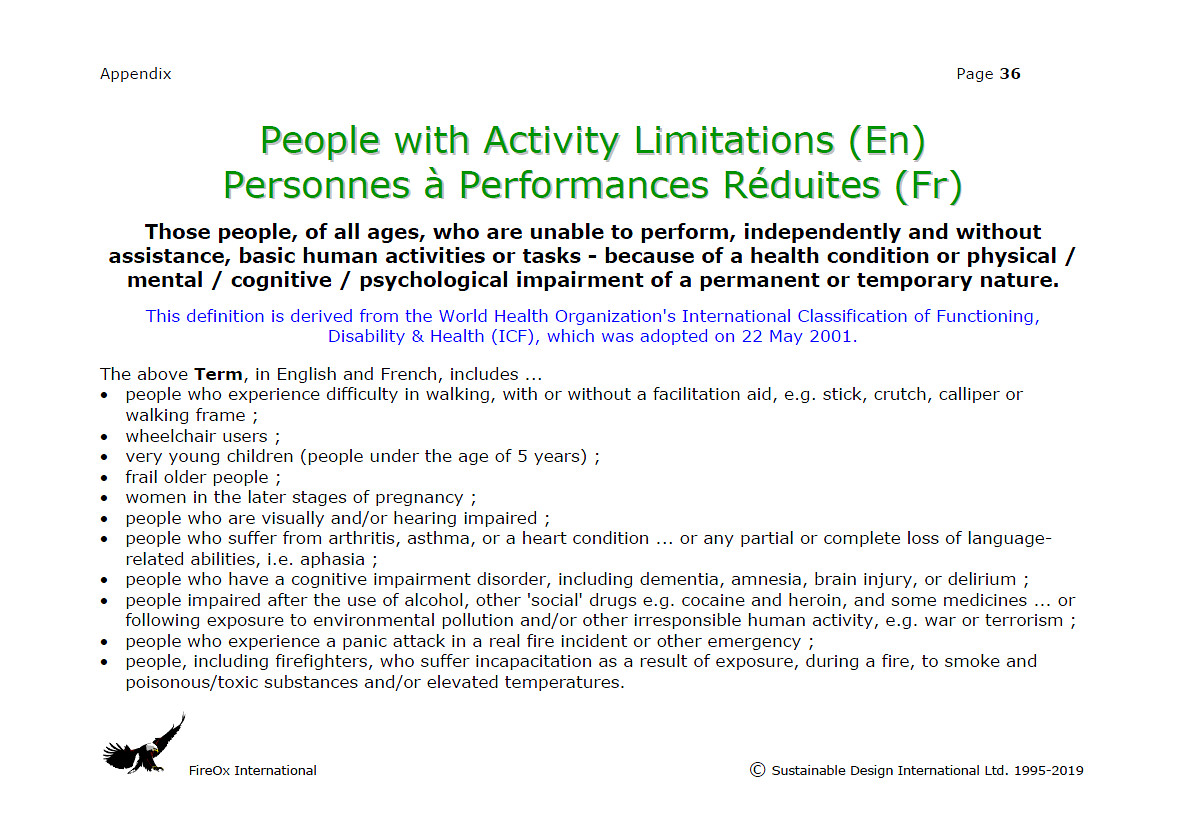
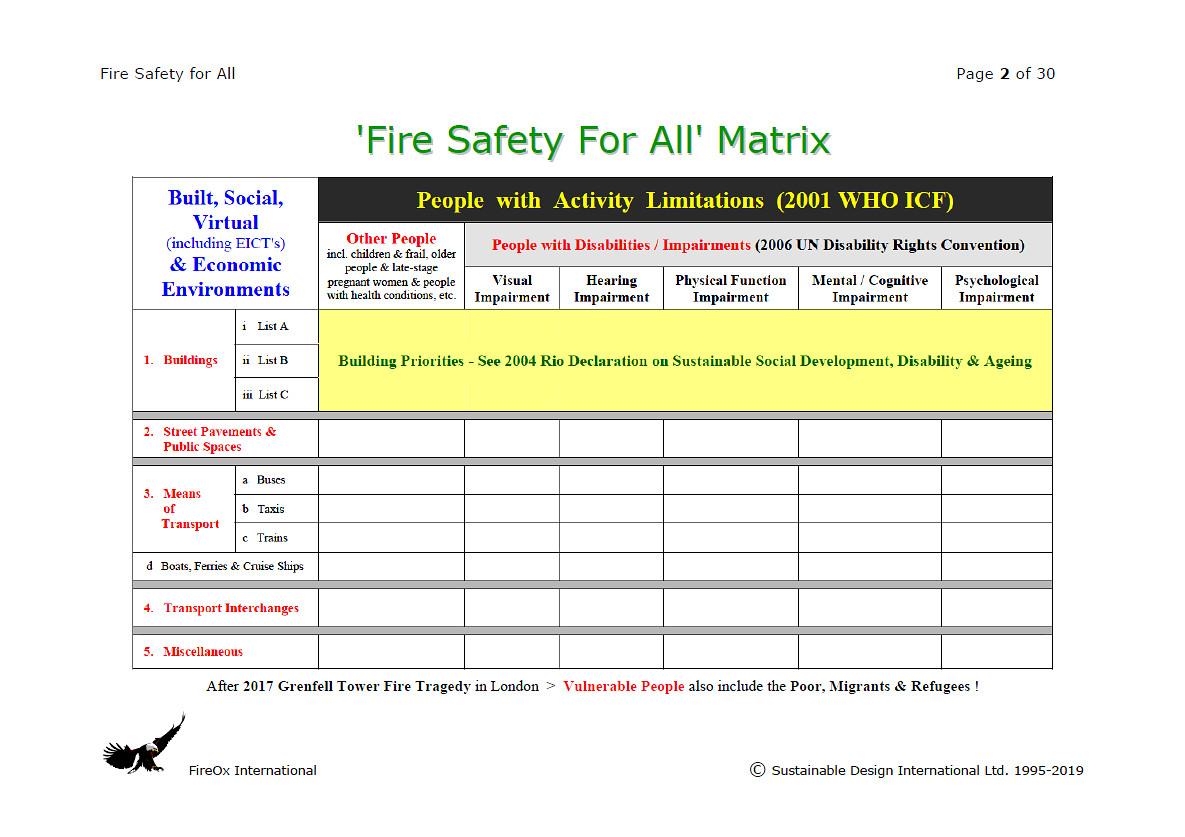
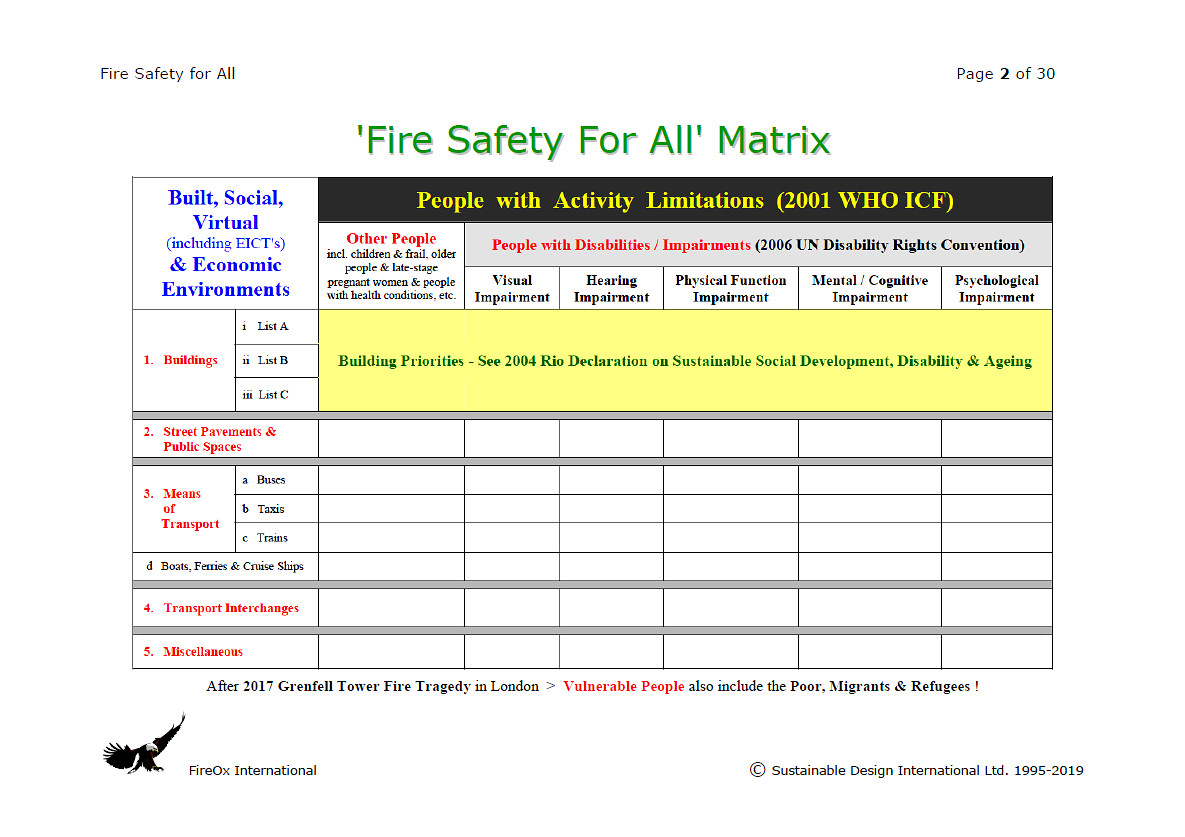
As you go scan down through NIST’s Recommendations 16-20, you will encounter 1 reference to ‘mobility impaired occupants’ and  2 references to the impersonal ‘mobility impaired’.  IF (and that is still a very big ‘if’, because there is still so much rabid resistance to this topic !) … a New Post-9/11 Evacuation Model, or Construct, Dealing with ‘Disability’ is being developed … all of the major impairment groupings (i.e. visual impairment, hearing impairment, physical function impairment, mental/cognitive impairment, and psychological impairment) must be added to the mix from the beginning.  In other words, our proper focus of attention must be ‘people with activity limitations’ … not just people with disabilities, but also frail older people (not all older people !), children under the age of 5 years, women in the later stages of pregnancy, people with a health condition, etc.

And … because of the social stigma still firmly attaching to ‘disability’ … many building occupants/users will not self-identify … not even if their lives depend on it !

Concentrating on one group only, i.e. people with mobility impairments, is simplistic and entirely inadequate … and we will all end up, in a few years time, having to graft on a consideration of the other impairment groups.

This is exactly what has already gone wrong with the development of Accessibility Design Guidance during the last 30 years … where ‘people with visual or hearing impairments’ received merely token attention … and ‘people with cognitive or psychological impairments’ received no attention at all !   And … we are now grappling with the challenge of having to graft on additional texts to try to re-balance International Design Guidance on Accessibility of the Built Environment.  Been there – done that – I have all of the t-shirts !!

People with Activity Limitations (English) / Personnes à Performances Réduites (French):  Those people, of all ages, who are unable to perform, independently and without aid, basic human activities or tasks – because of a health condition or physical/mental/cognitive/psychological impairment of a permanent or temporary nature.

The above Terms (in English and French) include …

  • wheelchair users ;
  • people who experience difficulty in walking, with or without a facilitation aid, e.g. stick, crutch, calliper or walking frame ;
  • frail, older people ;
  • the very young (people under the age of 5 years) ;
  • people who suffer from arthritis, asthma, or a heart condition ;
  • the visually and/or hearing impaired ;
  • people who have a cognitive impairment disorder, including dementia, amnesia, brain injury, or delirium ;
  • women in the later stages of pregnancy ;
  • people impaired following the use of alcohol, other ‘social’ drugs e.g. cocaine and heroin, and some medicines ;
  • people who suffer any partial or complete loss of language related abilities, i.e. aphasia ;
  • people impaired following exposure to environmental pollution and/or other irresponsible human activities, e.g. war and terrorism ;

and …

  • people who experience a panic attack in a fire situation or other emergency ;
  • people, including firefighters, who suffer incapacitation as a result of exposure, during a fire, to poisonous or toxic substances, and/or elevated  temperatures.

  3.     So … what provision should be made for ‘people with activity limitations’ in typical Fire Engineering Design Projects ?

Equivalent to the concept of Maximum Credible Fire Scenario, which has already been discussed in this Series … at FireOx International, some years ago, we developed the concept of …

Maximum Credible User Scenario

Representing building user conditions which are also severe but reasonable to anticipate …

a)   10% of People Using the Building (occupants, visitors and other users) have an Impairment (visual or hearing, physical function, mental or cognitive, psychological, with some impairments not being identifiable) ;

[ This performance indicator appears in ISO FDIS 21542: 'Building Construction - Accessibility & Usability of the Built Environment', which will soon be published.]

b)   The Number of People Using a Building increases, on occasions which cannot be specified, to 120% of designed/calculated maximum building capacity.

[ Generally ... the fire safety related texts contained in ISO 21542 are based on the 2005 & 2008 NIST WTC Recommendations.]

  4.     With regard to Recommendation 17 below, and NIST’s reference to the widths of evacuation staircases and door openings, etc … fire codes and regulations, fire authorities having jurisdiction (AHJ’s), and even the fire services themselves … still have a crazy mixed-up approach to defining the width of these building features … an approach which I am not even going to attempt to repeat !   Forget it !!

Without Exception … all understandings of Evacuation Route Width, Evacuation Staircase Width and Evacuation Door Opening Width … must be harmonized with the following definitions of Unobstructed Width

Unobstructed Width – General

Free, unobstructed space – clear of all obstacles below a height of 2.1 metres above finished floor level – necessary for passage along a circulation route, or other route component, e.g. a staircase.

[ For example ... the Unobstructed Width of a Staircase is the clear dimension from the edge of one handrail to the edge of the opposite handrail ... and there is always a continuous handrail on each side of an evacuation staircase ! ]

Unobstructed Width – Door Opening

Free, unobstructed space – clear of all obstacles below a height of 2.0 metres above finished floor level – necessary for passage through a door opening, measured when the door leaf is opened to an angle of 90°, or when a sliding or folding door leaf is opened to its fullest extent.

[ For example ... the Unobstructed Width of a Door Opening is the dimension from the edge of the door leaf (when open at an angle of 90°) to the nearest edge of the door frame.]

This FireOx International Page on the SDI Corporate WebSite provides more guidance … http://www.sustainable-design.ie/fire/appendixd.htm

  5.     With regard to Recommendation 20 below, and NIST’s reference to allowing “all occupants an equal opportunity for evacuation” … this is not just a ‘nice idea’, or an ‘idealistic notion’ … this is now a Human and Social Right which is backed up and supported by International Law !   And … it is no longer acceptable for the Fire Science and Engineering Community to continue its stubborn resistance in the face of this fact !!

For the benefit of my fire engineering colleagues … I will, once again here, reproduce the most relevant extracts from the United Nations Convention on the Rights of Persons with Disabilities …

UN CRPD  Preamble Paragraph (g)

Emphasizing the importance of mainstreaming disability issues as an integral part of relevant strategies of sustainable development, …

UN CRPD  Article 9 – Accessibility

1.  To enable persons with disabilities to live independently and participate fully in all aspects of life, States Parties shall take appropriate measures to ensure to persons with disabilities access, on an equal basis with others, to the physical environment, to transportation, to information and communications, including information and communications technologies and systems, and to other facilities and services open or provided to the public, both in urban and in rural areas.  These measures, which shall include the identification and elimination of obstacles and barriers to accessibility, shall apply to, inter alia:

(a)  Buildings, roads, transportation and other indoor and outdoor facilities, including schools, housing, medical facilities and workplaces ;

(b)  Information, communications and other services, including electronic services and emergency services.

2.  States Parties shall also take appropriate measures:

(a)  To develop, promulgate and monitor the implementation of minimum standards and guidelines for the accessibility of facilities and services open or provided to the public ;

(b)  To ensure that private entities that offer facilities and services which are open or provided to the public take into account all aspects of accessibility for persons with disabilities ;

(c)  To provide training for stakeholders on accessibility issues facing persons with disabilities ;

(d)  To provide in buildings and other facilities open to the public signage in Braille and in easy to read and understand forms ;

(e)  To provide forms of live assistance and intermediaries, including guides, readers and professional sign language interpreters, to facilitate accessibility to buildings and other facilities open to the public ;

(f)  To promote other appropriate forms of assistance and support to persons with disabilities to ensure their access to information ;

(g)  To promote access for persons with disabilities to new information and communications technologies and systems, including the Internet ;

(h)  To promote the design, development, production and distribution of accessible information and communications technologies and systems at an early stage, so that these technologies and systems become accessible at minimum cost.

UN CRPD  Article 11 – Situations of Risk & Humanitarian Emergencies

States Parties shall take, in accordance with their obligations under international law, including international humanitarian law and international human rights law, all necessary measures to ensure the protection and safety of persons with disabilities in situations of risk, including situations of armed conflict, humanitarian emergencies and the occurrence of natural disasters.

[ Note:  An outbreak of fire in a building is a situation of serious risk for all vulnerable building occupants/users.]

.

At the time of writing, 153 Countries had signed the UN CRPD … while 106 Countries have ratified the Convention and are, therefore, the ‘State Parties’ referred to above.

These are just a few of the State Parties to the UN CRPD …

  • Argentina  (ratified the UN CRPD, 2008-09-02)
  • Australia  (ratified the UN CRPD, 2008-07-17)
  • Brazil  (ratified the UN CRPD, 2008-08-01)
  • Canada  (ratified the UN CRPD, 2010-03-11)
  • China  (ratified the UN CRPD, 2008-08-01)
  • Cuba  (ratified the UN CRPD, 2007-09-06)
  • European Union  (ratified the UN CRPD, 2010-12-23)
  • India  (ratified the UN CRPD, 2007-10-01)
  • Malaysia  (ratified the UN CRPD, 2010-07-19)
  • Mexico  (ratified the UN CRPD, 2007-12-17)
  • Philippines  (ratified the UN CRPD, 2008-04-15)
  • South Africa  (ratified the UN CRPD, 2007-11-30)
  • Turkey  (ratified the UN CRPD, 2009-09-28)
  • United Arab Emirates  (ratified the UN CRPD, 2010-03-19)

I wonder how implementation is proceeding in these countries !?!

.

2005 NIST WTC RECOMMENDATIONS

GROUP 5.  Improved Building Evacuation

Building evacuation should be improved to include system designs that facilitate safe and rapid egress, methods for ensuring clear and timely emergency communications to occupants, better occupant preparedness regarding their roles and duties for evacuation during emergencies, and incorporation of appropriate egress technologies.*

[ * F-36  This effort should include standards and guidelines for the development and evaluation of emergency evacuation plans, including best practices for both partial and full evacuation, and the development of contingency plans that account for expected conditions that may require adaptation, including the compromise of all or part of an egress path before or during evacuation, or conditions such as widespread power failure, earthquake, or security threat that restrict egress from the building.  Evacuation planning should include the process from initial notification of the need to evacuate up to the point when occupants arrive at a place where their safety is ensured.  These standards and guidelines should be suitable for assessing the adequacy of evacuation plans submitted for approval, and should require occupant training through the conduct of regular drills.]

NIST WTC Recommendation 16.

NIST recommends that public agencies, non-profit organizations concerned with building and fire safety, and building owners and managers develop and carry out public education and training campaigns, jointly and on a nationwide scale, to improve building occupants’ preparedness for evacuation in case of building emergencies.  This effort should include better training and self-preparation of occupants, an effectively implemented system of floor wardens and building safety personnel, and needed improvements to standards.  Occupant preparedness should include:

a.     Improved training and drills for building occupants to ensure that they know evacuation procedures for a variety of emergency scenarios (e.g. including evacuation and shelter in place), are familiar with the egress route, and are sufficiently aware of what is necessary if evacuation is required with minimal notice (e.g. footwear consistent with the distance to be travelled, a flashlight/glow stick for pathway illumination, and dust masks).

b.     Building owners and managers should educate tenants on the life safety systems present in their building(s), provide training materials explaining egress routes and stairwell and elevator information, and develop educational programmes explaining the most appropriate responses in emergency situations.  It is further recommended that the owners and managers of office buildings implement the necessary systems for collecting and storing the training history of each building occupant.

c.     Improved training and drills that routinely inform building occupants that roof rescue is not (or is) presently feasible as a standard evacuation option, that they should evacuate down the stairs in any full-building evacuation unless explicitly instructed otherwise by on-site incident commanders, and that elevators can be used if they are still in service and haven’t been recalled or stopped.

d.     Improved codes, laws, and regulations that do not restrict or impede building occupants during evacuation drills from familiarizing themselves with the detailed layout of alternative egress routes for a full building evacuation.*

[ * F-37  New York City Local Law 5 prohibits requiring occupants to practice stairwell evacuation during drills.]

Affected Standard:  ICC/ANSI A117-1.  Model Building and Fire Codes:  The standard should be adopted in model building and fire codes by mandatory reference to, or incorporation of, the latest edition of the standard.  Affected Organizations:  NFPA, NIBS, NCSBCS, BOMA, and CTBUH.

NIST WTC Recommendation 17.

NIST recommends that tall buildings be designed to accommodate timely full building evacuation of occupants when required in building-specific or large-scale emergencies such as widespread power outages, major earthquakes, tornadoes, hurricanes without sufficient advance warning, fires, explosions, and terrorist attack.  Building size, population, function, and iconic status should be taken into account in designing the egress system.  Stairwell capacity and stair discharge door opening width* should be adequate to accommodate contraflow due to emergency access by responders.

[ * F-38  Egress capacity should be based on an all-hazards approach that considers the number and width of stairs (and door openings) as well as the possible use of scissor stairs credited as a single stair.]

a.     Improved egress analysis models, design methodology, and supporting data should be developed to achieve a target evacuation performance (e.g. time for full building evacuation*) for the design building population by considering the building and egress system designs, and human factors such as occupant size, mobility status, stairwell tenability conditions, visibility, and congestion.

[ * F-39  Use of egress models is required to estimate the egress capacity for a range of different evacuation strategies, including full building evacuation.  NIST found that the average surviving occupant in the WTC towers descended stairwells at about half the slowest speed previously measured for non-emergency evacuations.]

b.     To the degree possible, mobility impaired occupants should be provided a means for self-evacuation in the event of a building emergency.  Current strategies (and law) generally require the mobility impaired to shelter in place.  New procedures, which provide redundancy in the event that the floor warden system or co-worker assistance (i.e. a buddy system) fails, should consider full building evacuation, and may include use of fire-protected and structurally hardened elevators,* motorized evacuation technology (e.g. a battery-operated evacuation chair), and/or dedicated communication technologies for the mobility impaired.

[ * F-40  Elevators should be explicitly designed to provide protection against large, but conventional, building fires.  Fire-protected elevators also should be structurally hardened to withstand the range of foreseeable building-specific or large-scale emergencies.  While progress has been made in developing the requirements and technologies for fire-protected elevators, similar criteria and designs for structurally hardened elevators remain to be developed.]

c.     If protected/hardened elevators are provided for emergency responders but become unusable during an emergency, due to a malfunction or a conventional threat whose magnitude exceeds the magnitude considered in design, sufficient stairwell capacity should be provided to ensure timely emergency responder access to buildings that are undergoing full evacuation.  Such capacity could be provided either via dedicated stairways for fire service use or by building sufficient stairway capacity (i.e. number and width of stairways and/or use of scissor stairs credited as a single stair) to accommodate the evacuation of building occupants while allowing access to emergency responders with minimal hindrance from occupant contraflow.

d.     The egress allowance in assembly use spaces should be limited in state and local laws and regulations to no more than a doubling of the stairway capacity for the provision of a horizontal exit on a floor, as is the case now in the national model codes.*  The use of a horizontal exit creates an area of refuge with a 2 hour fire rated separation, at least one stair on each side, and sufficient space for the expected occupant load.

[ * F-41  The New York City Building Code permits a doubling of allowed stair capacity when one area of refuge is provided on a floor, and a tripling of stair capacity for two or more areas of refuge on a floor.  In the world after 11 September 2001, it is difficult to predict: (1) if, and for how long, occupants will be willing to wait in a refuge area before entering an egress stairway; and (2) what the impact would be of such a large group of people moving down the stairs on the orderly evacuation of lower floors.]

Affected Standards:  NFPA 101, ASME A 17.  Model Building and Fire Codes:  The standards should be adopted in model building and fire codes by mandatory reference to, or incorporation of, the latest edition of the standard.

NIST WTC Recommendation 18.

NIST recommends that egress systems be designed:  (1) to maximize remoteness of egress components (i.e. stairs, elevators, exits) without negatively impacting on average travel distances;  (2) to maintain their functional integrity and survivability under foreseeable building-specific or large-scale emergencies;  and (3) with consistent layouts, standard signage, and guidance so that systems become intuitive and obvious to building occupants during evacuations.

a.     Within a safety-based design hierarchy that should be developed, highest priority should be assigned to maintain the functional integrity, survivability, and remoteness of egress components and active fire protection systems (sprinklers, standpipes, associated water supply, fire alarms, and smoke management systems).  The design hierarchy should consider the many systems (e.g. stairs, elevators, active fire protection, mechanical, electrical, plumbing, and structural) and system components, as well as functional integrity, tenant access, emergency responder access, building configuration, security, and structural design.

b.     The design, functional integrity, and survivability of the egress and other life safety systems (e.g. stairwell and elevator shafts, and active fire protection systems) should be enhanced by considering accidental structural loads such as those induced by overpressures (e.g. gas explosions), impacts, or major hurricanes and earthquakes, in addition to fire separation requirements.  In selected buildings, structural loads due to other risks such as those due to terrorism may need to be considered.  While NIST does not believe that buildings should be designed for aircraft impact, as the last line of defence for life safety, the stairwells and elevator shafts individually, or the core if these egress components are contained within the core, should have adequate structural integrity to withstand accidental structural loads and anticipated risks.

c.     Stairwell remoteness requirements should be met by a physical separation of the stairwells that provide a barrier to both fire and accidental structural loads.  Maximizing stairwell remoteness, without negatively impacting on average travel distances, would allow a stairwell to maintain its structural integrity independent of any other stairwell that is subject to accidental loads, even if the stairwells are located within the same structural barrier such as the core.  The current ‘walking path’ measurement allows stairwells to be physically next to each other, separated only by a fire barrier.  Reducing the clustering of stairways that also contain standpipe water systems provides the fire service with increased options for formulating firefighting strategies.  This should not preclude the use of scissor stairs* as a means of increasing stair capacity – provided the scissor stair is only credited as a single stair.

[ * F-42  Two separate stairways within the same enclosure and separated by a fire rated partition.]

d.     Egress systems should have consistent layouts with standard signage and guidance so that the systems become intuitive and obvious to all building occupants, including visitors, during evacuations.  Particular consideration should be given to unexpected deviations in the stairwells (e.g. floors with transfer hallways).

Affected Standard:  NFPA 101.  Model Building and Fire Codes:  The standard should be adopted in model building and fire codes by mandatory reference to, or incorporation of, the latest edition of the standard.

NIST WTC Recommendation 19.

NIST recommends that building owners, managers, and emergency responders develop a joint plan and take steps to ensure that accurate emergency information is communicated in a timely manner to enhance the situational awareness of building occupants and emergency responders affected by an event.  This should be accomplished through better co-ordination of information among different emergency responder groups, efficient sharing of that information among building occupants and emergency responders, more robust design of emergency public address systems, improved emergency responder communication systems, and use of the Emergency Broadcast System (now known as the Integrated Public Alert and Warning System) and Community Emergency Alert Networks.

a.     Situational awareness of building occupants and emergency responders in the form of information and event knowledge should be improved through better co-ordination of such information among emergency responder groups (9-1-1 dispatch, fire department or police department dispatch, emergency management dispatch, site security, and appropriate federal agencies), efficient sharing and communication of information between building occupants and emergency responders, and improved emergency responder communication systems (i.e. including effective communication within steel and reinforced concrete buildings, capacity commensurate with the scale of operations, and interoperability among different communication systems.

b.     The emergency communications systems in buildings should be designed with sufficient robustness and redundancy to continue providing public address announcements or instructions in foreseeable building-specific or large-scale emergencies, including widespread power outage, major earthquakes, tornadoes, hurricanes, fires, and accidental explosions.  Consideration should be given to placement of building announcement speakers in stairways in addition to other standard locations.

c.     The Integrated Public Alert and Warning System (IPAWS) should be activated and used, especially during large-scale emergencies, as a means to rapidly and widely communicate information to building occupants and emergency responders to enhance their situational awareness and assist with evacuation.

d.     Local jurisdictions (cities and counties or boroughs) should seriously consider establishing a Community Emergency Alert Network (CEAN), within the framework of IPAWS, and make it available to the citizens and emergency responders of their jurisdictions to enhance situational awareness in emergencies.*  The network should deliver important emergency alerts, information and real time updates to all electronic communication systems or devices registered with the CEAN.  These devices may include e-mail accounts, cell/mobile phones, text pagers, satellite phones, and wireless PDA’s.

[ * F-43  Types of emergency communications could include life safety information, severe weather warnings, disaster notifications (including information on terrorist attacks), directions for self-protection, locations of nearest available shelters, precautionary evacuation information, identification of available evacuation routes, and accidents or obstructions associated with roadways and utilities.]

Affected Standard:  NFPA 101, and/or a new standard.  Model Building and Fire Codes:  The standard should be adopted in model building and fire codes by mandatory reference to, or incorporation of, the latest edition of the standard to the extent it is within the scope of building and fire codes.

NIST WTC Recommendation 20.

NIST recommends that the full range of current and next generation evacuation technologies should be evaluated for future use, including protected/hardened elevators, exterior escape devices, and stairwell descent devices, which may allow all occupants an equal opportunity for evacuation and facilitate emergency response access.  Affected Standards:  NFPA 101, ASME A 17, ASTM E 06, ANSI A117.1.  Model Building and Fire Codes:  The standards should be adopted in model building and fire codes by mandatory reference to, or incorporation of, the latest edition of the standard.

.

.

END

Tags: , , , , , , , , , , , , , , , , , , , , , , , , , , , , , , , , , , , , , , , , , , , , , , , , , , , , , , , , , , , , , , , , , , , , , , , , , , , , , , , , , , , , , , , , , , , , , , , , , , , , , , , , , , , , , , , , , , , , , , , , ,

NIST WTC Recommendations 12-15 > Improved Active Protection

Previous Posts in This Series …

2011-10-25:  NIST’s Recommendations on the 9-11 WTC Building CollapsesGROUP 1. Increased Structural Integrity – Recommendations 1, 2 & 3 (out of 30)

2011-11-18:  NIST WTC Recommendations 4-7 > Structural Fire EnduranceGROUP 2.  Enhanced Fire Endurance of Structures – Recommendations 4, 5, 6 & 7

2011-11-24:  NIST WTC Recommendations 8-11 > New Design of StructuresGROUP 3.  New Methods for Fire Resisting Design of Structures – Recommendations 8, 9, 10 & 11

.

2011-11-25:  SOME PRELIMINARY COMMENTS …

  1.     Reliability has always been an issue with Active Fire Protection Systems … but, it is neither acknowledged, nor fully understood, that … Reliability Is Equally An Issue With Passive Fire Protection Measures !

Furthermore, the following should always be taken into account when considering the Safety Factors to be applied in calculating the level of satisfactory fire safety and protection which is provided in a specific project … one of the design objectives in Ethical Fire Engineering.

For example, if Category C below is indicative of the design and construction quality on a particular building site … just think of the Priory Hall Apartment Development in Dublin (!) … the Safety Factors to be applied in the design should be high … and with regard to actual construction, it should be expected that the Reliability of both Active Fire Protection Systems and Passive Fire Protection Measures will be initially low … with Life Cycle Reliability being entirely non-existent.

Quality of Fire Engineering Design & Related Construction 

Category A

(a)   Design of the works is exercised by an independent, appropriately qualified and experienced architect/engineer/fire engineer, with design competence relating to fire safety and protection in buildings … and, most importantly, that he/she interacts directly with the Project Design Professional in Responsible Charge ;

(b)   Installation/fitting of related construction products/systems is exercised by appropriately qualified and experienced personnel, with construction competence relating to fire safety and protection in buildings ;

(c)   Supervision of the works is exercised by appropriately qualified and experienced personnel from the principal construction organization ;

(d)   Regular inspections, by appropriately qualified and experienced personnel familiar with the design, and independent of the construction organization(s), are carried out to verify that the works are being executed in accordance with the fire engineering design.

Category B

(a)   Design of the works is exercised by an independent, appropriately qualified and experienced architect/engineer/fire engineer ;

(b)   Installation/fitting of fire-related construction products/systems is exercised by appropriately qualified and experienced personnel ;

(c)   Supervision of the works is exercised by appropriately qualified and experienced personnel from the principal construction organization.

Category C

This level of design and construction execution is assumed when the requirements for Category A or Category B are not met.

  2.     With regard to Recommendations 12 & 13 below … in an earlier post in this series, and elsewhere, I have defined Disproportionate Damage … and differentiated that structural concept from the related concept of Fire-Induced Progressive Collapse.

A significant number of countries include a requirement on Resistance to Disproportionate Damage in their national building codes.  Often, it is only necessary to consider this requirement in the case of buildings having 5 Storeys, or more … a completely arbitrary height threshold.  I would consider that adequately tying together the horizontal and vertical structural elements of a building … any building … is a fundamental principle of good structural engineering !!

Putting it simply … for the purpose of showing compliance with this structural requirement … it is necessary to demonstrate that a building will remain structurally stable if a portion of the building’s structure is removed … always remembering that every building comprises both structure and fabric, i.e. non-structure.

In reality this may happen, and quite often does happen, when, for example, a large truck runs into the side of a building, which can happen anywhere … or there is a gas explosion in some part of the building, which happened in Dublin’s Raglan House back in 1987, and many times in other countries … or a plane hits a high-rise building, which happened to Milan’s iconic Pirelli Tower in 2002, and to New York’s Empire State Building way back in 1945 … etc., etc.  Raglan House collapsed … the Pirelli Tower and the Empire State Building did not.

[ The World Trade Center Towers were originally designed to absorb the impact of a large plane and to remain structurally stable afterwards ... in ambient conditions.  However, what was not considered in the ambient structural design was 'fire', i.e. the fuel tanks were empty and no fire in the building would be initiated as a result of the mechanical damage caused by the plane impact ... which, on 11 September 2001, proved to be a ridiculous basis for any structural design !   This is why 9-11 should be regarded, at its core, as being a very serious 'real' fire incident.]

What I am leading up to is this … the concept of removing a portion of a building, and it remaining structurally stable afterwards … should now – logically and rationally – also be incorporated into the fire engineering design of Active Fire Protection Systems.  In other words, if a portion of a building is removed, will any particular Active Fire Protection System continue to operate effectively in the rest of the building ?   This has implications for the location and adequate protection of critical system components in a building … and for the necessary redundancy, zoning and back-up alternative routeing which must be designed into the system from the beginning !

.

2005 NIST WTC RECOMMENDATIONS

GROUP 4.  Improved Active Fire Protection

Active fire protection systems (i.e. sprinklers, standpipes/hoses, fire alarms, and smoke management systems) should be enhanced through improvements to the design, performance, reliability, and redundancy of such systems.

NIST WTC Recommendation 12.

NIST recommends that the performance and possibly the redundancy of active fire protection systems (sprinklers, standpipes/hoses, fire alarms, and smoke management systems) in buildings be enhanced to accommodate the greater risks associated with increasing building height and population, increased use of open spaces, high-risk building activities, fire department response limits, transient fuel loads, and higher threat profile.  The performance attributes should deal realistically with the system design basis, reliability of automatic/manual operations, redundancy, and reduction of vulnerabilities due to single point failures.  Affected Standards:  NFPA 13, NFPA 14, NFPA 20, NFPA 72, NFPA 90A, NFPA 92A, NFPA 92B, and NFPA 101.  Model Building Codes:  The performance standards should be adopted in model building codes by mandatory reference to, or incorporation of, the latest edition of the standard.

NIST WTC Recommendation 13.

NIST recommends that fire alarm and communications systems in buildings be developed to provide continuous, reliable, and accurate information on the status of life safety conditions at a level of detail sufficient to manage the evacuation process in building fire emergencies;  all communication and control paths in buildings need to be designed and installed to have the same resistance to failure and increased survivability above that specified in present standards.  This should include means to maintain communications with evacuating occupants that can both reassure them and redirect them if conditions change.  Pre-installed fire warden telephone systems can serve a useful purpose and may be installed in buildings and, if so, they should be made available for use by emergency responders.  All communication and control paths in buildings need to be designed and installed to have the same resistance to failure and increased survivability above that specified in present standards.  Affected Standards:  NFPA 1, NFPA 72, and NFPA 101.  Model Building and Fire Codes:  The performance standards should be adopted in model building and fire codes by mandatory reference to, or incorporation of, the latest edition of the standard.

NIST WTC Recommendation 14.

NIST recommends that control panels at fire/emergency command stations in buildings be adapted to accept and interpret a larger quantity of more reliable information from the active fire protection systems that provide tactical decision aids to fire ground commanders, including water flow rates from pressure and flow measurement devices, and that standards for their performance be developed.  Affected Standards:  NFPA 1, NFPA 72, and NFPA 101.  Model Building and Fire Codes:  The performance standards should be adopted in model building and fire codes by mandatory reference to, or incorporation of, the latest edition of the standard.

NIST WTC Recommendation 15.

NIST recommends that systems be developed and implemented for:  (1) real time off-site secure transmission of valuable information from fire alarm and other monitored building systems for use by emergency responders, at any location, to enhance situational awareness and response decisions, and maintain safe and efficient operation;*  and (2) preservation of that information either off-site, or in a black box that will survive a fire or other building failure, for purposes of subsequent investigations and analysis.  Standards for the performance of such systems should be developed, and their use should be required.  Affected Standards:  NFPA 1, NFPA 72, and NFPA 101.  Model Building and Fire Codes:  The performance standards should be adopted in model building and fire codes by mandatory reference to, or incorporation of, the latest edition of the standard.

[ * F-35  The alarm systems in the WTC towers were only capable of determining and displaying: (a) areas that had at some time reached alarm point conditions; and (b) areas that had not.  The quality and reliability of information available to emergency responders at the Fire Command Station was not sufficient to understand the fire conditions.  The only information transmitted outside the buildings was the fact that the buildings had gone into alarm.  Further, the fire alarm system in WTC Building 7, which was transmitted to a monitoring service, was on 'test mode' during the morning of 11 September 2001, because routine maintenance was being performed.  Under test mode conditions: (1) the system is typically disabled for the entire building, not just for the area where work is being performed; and (2) alarm signals typically do not show up on an operator console.]

.

.

END

Tags: , , , , , , , , , , , , , , , , , , , , , , , , , , , , , , , , , , , , , , , , , , , , , , , , , , , , , , , , , , , , , , , , , , , , , , , , , , , , , , , , , , , , , , , , , , , , , , , , , , , , , , , , , , , , , , , , ,

NIST WTC Recommendations 8-11 > New Design of Structures

Previous Posts in This Series …

2011-10-25:  NIST’s Recommendations on the 9-11 WTC Building CollapsesGROUP 1. Increased Structural Integrity – Recommendations 1, 2 & 3 (out of 30)

2011-11-18:  NIST WTC Recommendations 4-7 > Structural Fire EnduranceGROUP 2.  Enhanced Fire Endurance of Structures – Recommendations 4, 5, 6 & 7

.

2011-11-24:  SOME PRELIMINARY COMMENTS …

  1.     The first of two NIST Publications being referenced in this Series of Posts is as follows …

NIST (National Institute of Standards and Technology).  September 2005.  Federal Building and Fire Safety Investigation of the World Trade Center Disaster: Final Report on the Collapse of the World Trade Center Towers.  NIST NCSTAR 1.  Gaithersburg, MD, USA.

The 2005 NIST Report concludes, in Chapter 9, with a list of 30 Recommendations for Action, grouped together under the following 8 Subject Headings

i)        Increased structural integrity ;

ii)       Enhanced fire endurance of structures ;

iii)      New methods for fire resisting design of structures ;

iv)      Enhanced active fire protection ;

v)       Improved building evacuation ;

vi)      Improved emergency response ;

vii)     Improved procedures and practices ;   and

viii)    Education and training.

NIST has clearly stated that “the numerical ordering (of the Recommendations) does not reflect any priority”.

From my point of view, the 2005 NIST Report is especially noteworthy for the emphasis placed on:

(a)     The 3 R’s … Reality – Reliability – Redundancy ;

(b)     Evacuation Way Finding … should be ‘intuitive and obvious’ … a major challenge for building designers, since buildings are still typically designed for ‘access’ only.  In order to find the evacuation routes in a building, it is usually necessary to have a compass, a map, a magnifying glass, a torch … and a prayer book !!!   More about this in later posts …

  2.     However, following on from NIST’s emphasis on Reality … and just between you, me and the World Wide Web … there is a lot of misunderstanding in the International Fire Science and Engineering Community about what exactly is the Realistic End Condition.  But, here it goes …

Realistic End Condition:  A ‘real’ fire in a ‘real’ building, which is used by ‘real’ people with varying abilities in relation to self-protection, independent evacuation to a ‘place of safety’, and participation in the Fire Defence Plan for the building.

It is strange, therefore … and quite unacceptable … to have to point out that the Realistic End Condition IS NOT … a test fire or an experimental fire in a laboratory … or a design fire in a computer model, even IF it is properly validated !

  3.     With regard to Recommendation 8 below … NIST’s contention that “Current methods for determining the fire resistance of structural assemblies do not explicitly specify a performance objective” is not strictly the case.

If we examine Technical Guidance Document B (Ireland) and Approved Document B (England & Wales) once again, as examples close to home … Part B: ‘Fire Safety’ in both jurisdictions should be read in conjunction with its associated Part A: ‘Structure’, which contains a requirement on Disproportionate Damage.

In everyday practice, however, this never happens.  Instead, people dealing with Part B in both jurisdictions enter a sort of bubble … a twilight zone … and, if there is anything to do with structural performance in fire, they immediately refer to the Appendices at the back of both Guidance Documents (ignoring Part A altogether) … where we find a ‘single element’ approach to design, no consideration of connections, etc., etc., etc.

And … this fundamental error is further reinforced in Ireland because, under the national system of Fire Safety Certification for buildings, it is only Part B which is relevant.

At European Level, I would make the same point … under EU Regulation 305/2011 on Construction Products … Basic Requirement for Construction Works 2: ‘Safety in Case of Fire’ must be read in conjunction with Basic Requirement 1: ‘Mechanical Resistance & Stability’ … where we will again find a direct reference to Disproportionate Damage … and an indirect, but explicit, reference to Serviceability Limit States under normal conditions of use … including fire !

A major gap … the missing link at international level … is the failure, still, to elaborate and flesh out the structural concept of Fire-Induced Progressive Collapse.  More about this in later posts …

  4.     With regard to Recommendation 10 below … and amplifying my earlier comments concerning Recommendation 6 … the manufacturers of all Lightweight Structural Fire Protection Systems … not just the Sprayed Systems … have a lot to answer for.

Major question marks concerning Life Cycle Durability, and Resistance to Mechanical Damage at any stage in a building’s life cycle, hang over all of these systems.

Fire testing, alone, does not show that a Lightweight Structural Fire Protection System is ‘fit for its intended use’ !   And manufacturers well know this !!!

And as for the Installation of Lightweight Structural Fire Protection Systems on site … it’s a hornets’ nest that nobody wants to touch !

Vested interests … vested interests … vested interests !!!

.

2005 NIST WTC RECOMMENDATIONS

GROUP 3.  New Methods for Fire Resisting Design of Structures

The procedures and practices used in the fire resisting design of structures should be enhanced by requiring an objective that uncontrolled fires result in burnout without partial or global (total) collapse.  Performance-based methods are an alternative to prescriptive design methods.  This effort should include the development and evaluation of new fire resisting coating materials and technologies, and evaluation of the fire performance of conventional and high-performance structural materials.

NIST WTC Recommendation 8.

NIST recommends that the fire resistance of structures be enhanced by requiring a performance objective that uncontrolled building fires result in burnout without partial or global (total) collapse.  Such a provision should recognize that sprinklers could be compromised, non-operational, or non-existent.  Current methods for determining the fire resistance of structural assemblies do not explicitly specify a performance objective.  The rating resulting from current test methods indicates that the assembly (component or sub-system) continued to support its superimposed load (simulating a maximum load condition) during the test exposure without collapse.  Model Building Codes:  This Recommendation should be included in the national model building codes as an objective, and adopted as an integral pert of the fire resistance design for structures.  The issue of non-operational sprinklers could be addressed using the existing concept of Design Scenario 8 of NFPA 5000, where such compromise is assumed and the result is required to be acceptable to the Authority Having Jurisdiction (AHJ).  Affected Standards:  ASCE-7, AISC Specifications, ACI 318, and ASCE/SFPE 29.

NIST WTC Recommendation 9.

NIST recommends the development of:  (1) performance-based standards and code provisions, as an alternative to current prescriptive design methods, to enable the design and retrofit of structures to resist real building fire conditions, including their ability to achieve the performance objective of burnout without structural or local fire collapse;  and (2) the tools, guidelines, and test methods necessary to evaluate the fire performance of the structure as a whole system.  Standards development organizations, including the American Institute of Steel Construction, have already begun developing performance-based provisions to consider the effects of fire in structural design.

This performance-based capability should include the development of, but not be limited to:

a.     Standard methodology, supported by performance criteria, analytical design tools, and practical design guidance;  related building standards and codes for fire resistance design and retrofit of structures, working through the consensus process for nationwide adoption;  comprehensive design rules and guidelines;  methodology for evaluating thermo-structural performance of structures;  and computational models and analysis procedures for use in routine design practice.

b.     Standard methodology for specifying multi-compartment, multi-floor fire scenarios for use in the design and analysis of structures to resist fires, accounting for building-specific conditions such as geometry, compartmentation, fuel load (e.g. building contents and any flammable fuels such as oil and gas), fire spread, and ventilation;  and methodology for rating the fire resistance of structural systems and barriers under realistic design-basis fire scenarios.

c.     Publicly available computational software to predict the effects of fires in buildings – developed, validated, and maintained through a national effort – for use in the design of fire protection systems and the analysis of building response to fires.  Improvements should include the fire behaviour and contribution of real combustibles;  the performance of openings, including door openings and window breakage, that controls the amount of oxygen available to support the growth and spread of fires and whether the fire is fuel-controlled or ventilation-controlled;  the floor-to-floor flame spread;  the temperature rise in both insulated and un-insulated structural members and fire barriers;  and the structural response of components, sub-systems, and the total building system due to the fire.

d.     Temperature-dependent thermal and mechanical property data for conventional and innovative construction materials.

e.     New test methods, together with associated conformance assessment criteria, to support the performance-based methods for fire resistance design and retrofit of structures.  The performance objective of burnout without collapse will require the development of standard fire exposures that differ from those currently used.

Affected National and International Standards:  ASCE-7, AISC Specifications, ACI 318, and ASCE/SFPE 29 for fire resistance design and retrofit of structures;  NFPA, SFPE, ASCE, and ISO TC92 SC4 for building-specific multi-compartment, multi-floor design basis fire scenarios;  and ASTM, NFPA, UL, and ISO for new test methods.  Model Building Codes:  The performance standards should be adopted as an alternative method in model building codes by mandatory reference to, or incorporation of, the latest edition of the standard.

NIST WTC Recommendation 10.

NIST recommends the development and evaluation of new fire resisting coating materials, systems, and technologies with significantly enhanced performance and durability to provide protection following major events.  This could include, for example, technologies with improved adhesion, double-layered materials, intumescent coatings, and more energy absorbing SFRM’s.*  Consideration should be given to pre-treatment of structural steel members with some type of mill-applied fire protection to minimize the uncertainties associated with field application and in-use damage.  If such an approach were feasible, only connections and any fire protection damaged during construction and fit-out would need to be field-treated.  Affected Standards:  Technical barriers, if any, to the introduction of new structural fire resisting materials, systems and technologies should be identified and eliminated in the AIA MasterSpec, AWCI Standard 12 and ASTM standards for field inspection, conformance criteria, and test methods.  Model Building Codes:  Technical barriers, if any, to the introduction of new structural fire resisting materials, systems, and technologies should be eliminated from the model building codes.

[ * F-34  Other possibilities include encapsulation of SFRM by highly elastic energy absorbing membranes or commodity grade carbon fibre or other wraps.  The membrane would remain intact under shock, vibration, and impact but may be compromised in a fire, yet allowing the SFRM to perform its thermal insulation function.  The carbon wrap would remain intact under shock, vibration, and impact, and possibly under fire conditions as well.]

NIST WTC Recommendation 11.

NIST recommends that the performance and suitability of advanced structural steels, reinforced and pre-stressed concrete, and other high-performance material systems be evaluated for use under conditions expected in building fires.  This evaluation should consider both presently available and new types of steels, concrete, and high-performance materials to establish the properties (e.g. yield and ultimate strength, modulus, creep behaviour, and failure) that are important for fire resistance, establish needed test protocols and acceptance criteria for such materials and systems, compare the performance of newer systems to conventional systems, and the cost-effectiveness of alternative approaches.  Technical and standards barriers to the introduction and use of such advanced steels, concrete, and other high-performance material systems should be identified and eliminated, or at least minimized, if they are found to exist.  Affected Standards:  AISC Specifications and ACI 318.  Technical barriers, if any, to the introduction of these advanced systems should be eliminated in ASTM E 119, NFPA 251, UL 263, ISO 834.  Model Building Codes:  Technical barriers, if any, to the introduction of these advanced systems should be eliminated from the model building codes.

.

.

END

Tags: , , , , , , , , , , , , , , , , , , , , , , , , , , , , , , , , , , , , , , , , , , , , , , , , , , , , , , , , , , , , , , , , , , , , , , , , , , , , , , , , , , , , , , , , , , , , , , , , , , , , , , , , , , , , , , , , , , , , , , , , , , , , , ,

NIST WTC Recommendations 4-7 > Structural Fire Endurance

First Post in This Series …

2011-10-25:  NIST’s Recommendations on the 9-11 WTC Building Collapses … GROUP 1. Increased Structural Integrity – Recommendations 1, 2 & 3 (out of 30)

.

2011-11-18:  SOME PRELIMINARY COMMENTS …

  1.     Before launching into the next Group of NIST WTC Recommendations, it would be useful to distinguish between the following technical terms … which have been adapted from ISO/TR 10158: ‘Principles and Rationale Underlying Calculation Methods in Relation to Fire Resistance of Structural Elements’

Real Fire:  A fire which develops in a building and which is influenced by such factors as the type of building and its occupancy;  the combustible content (fire load);  the ventilation, geometry and thermal properties of the fire compartment, or building space (should no fire compartmentation exist);  the fire suppression systems in the building and the actions of the fire services.

Real Fires are complex phenomena.  Consequently, in structural fire engineering, idealized versions of ‘real fires’ are employed.

Experimental Fire:  A full or reduced scale fire with specified and controlled characteristics.

Design Fire:  A fire with specified exposure data intended for use in connection with structural fire engineering calculations.

A Design Fire may either be representative of the thermal exposure described by the standard time-temperature-pressure relationship in an International/European/National Standard, or some non-standard exposure intended to simulate particular fire exposure conditions.

However, in SDI Technical Guidance Note 95/102: ‘Proper Evidence of a Fire Test Result within the European Economic Area (EEA)’, issued on 22 May 1995, I included the following caution …

#1.7  A Fire Test in a Fire Test Laboratory, involving exposure of a test specimen or prototype to ‘test fire’ conditions, gives only a limited indication of:  (a) the likely performance of a particular product, material or component when exposed to ‘real fire’ conditions;  and (b) the suitability of a product, material or component for a particular end use.

  2.     In conventional fire engineering, much confusion arises because of a failure to properly distinguish between these two concepts …

Fire Resistance

The inherent capability of a building assembly, or an ‘element of construction’, to resist the passage of heat, smoke and flame for a specified time during a fire.

Structural Reliability

The ability of a structural system to fulfil its design purpose, for a specified time, under the actual environmental conditions encountered in a building.

[ In structural fire engineering, the concern must be that the structure will fulfil its purpose, both during the fire - and for a minimum period afterwards, during the 'cooling phase'.]

  3.     Therefore, with regard to Recommendation 6 … it is more correct and precise to refer to ‘Steel Fire Protection Systems’, rather than to ‘steel fire resisting materials’ !   AND … the same questions must be asked about All Lightweight Steel Fire Protection Systems … not just the sprayed systems.

Lightweight Fire Protection Systems are also used to protect concrete in buildings and tunnels.

  4.     These 2005 NIST Recommendations will later be confirmed, and further reinforced, by the 2008 NIST Recommendations.  Bringing Recommendation 7, below, closer to home … it is interesting to note that a very necessary discussion on the technical adequacy of the approach taken to structural performance in fire … in both Technical Guidance Document B (Ireland) and Approved Document B (England & Wales) … has yet not even commenced !

.

2005 NIST WTC RECOMMENDATIONS

GROUP 2.  Enhanced Fire Endurance of Structures

The procedures and practices used to ensure the fire endurance of structures should be enhanced by improving the technical basis for construction classifications and fire resistance ratings, improving the technical basis for standard fire resistance testing methods, use of the ‘structural frame’ approach to fire resistance ratings, and developing in-service performance requirements and conformance criteria for sprayed fire resisting materials.

NIST WTC Recommendation 4.

NIST recommends evaluating, and where needed improving, the technical basis for determining appropriate construction classifications and fire rating requirements (especially for tall buildings) – and making related code changes now, as much as possible – by explicitly considering factors including: *

[ * F-23  The construction classification and fire rating requirements should be risk-consistent with respect to the design-basis hazards and the consequences of those hazards.  The fire rating requirements, which were originally developed based on experience with buildings less than 20 storeys in height, have generally decreased over the past 80 years since historical fire data for buildings suggest considerable conservatism in those requirements.  For tall buildings, the likely consequences of a given threat to an occupant on the upper floors are more severe than the consequences to an occupant on the first floor or the lower floors.  For example, with non-functioning elevators, both of the time requirements are much greater for full building evacuation from upper floors and emergency responder access to those floors.  It is not clear how the current height and areas tables in building codes consider the technical basis for the progressively increasing risk to an occupant on the upper floors of tall buildings that are much greater than 20 storeys in height.]

  • timely access by emergency responders and full evacuation of occupants, or the time required for burnout without partial collapse ;
  • the extent to which redundancy in active fire protection systems (sprinklers and standpipe, fire alarm, and smoke management) should be credited for occupant life safety ; *

[ * F-24  Occupant life safety, prevention of fire spread, and structural integrity are considered separate safety objectives.]

  • the need for redundancy in fire protection systems that are critical to structural integrity ; *

[ * F-25  The passive fire protection system (including fire protection insulation, compartmentation, and fire stopping) and the active sprinkler system each provide redundancy for maintaining structural integrity in a building fire, should one of the systems fail to perform its intended function.]

  • the ability of the structure and local floor systems to withstand a maximum credible fire scenario* without collapse, recognizing that sprinklers could be compromised, not operational, or non-existent ;

[ * F-26  A maximum credible fire scenario includes conditions that are severe, but reasonable to anticipate, conditions related to building construction, occupancy, fire loads, ignition sources, compartment geometry, fire control methods, etc., as well as adverse, but reasonable to anticipate operating conditions.]

  • compartmentation requirements (e.g. 1,200 sq.m *) to protect the structure, including fire rated doorsets and automatic enclosures, and limiting air supply (e.g. thermally resisting window assemblies) to retard fire spread in buildings with large, open floor plans ;

[ * F-27  Or a more appropriate limit, which represents a reasonable area for active fire fighting operations.]

  • the effect of spaces containing unusually large fuel concentrations for the expected occupancy of the building ;   and
  • the extent to which fire control systems, including suppression by automatic or manual means, should be credited as part of the prevention of fire spread.

Adoption of this Recommendation will allow building codes to distinguish the risks associated with different building heights, fuel concentrations, and fire protection systems.  Research is needed to develop the data and evaluate alternative proposals for construction classifications and fire ratings.  Model Building Codes:  A comprehensive review of current construction classifications and fire rating requirements and the establishment of a uniform set of revised thresholds with a firm technical basis that considers the factors identified above should be undertaken.*

[ * F-28  The National Fire Protection Association (NFPA) 5000 model code and the International Building Code (IBC) both recognize the risks associated with different building heights and accepted changes in 2001 and 2004, respectively.  Both model codes now require that buildings 126 metres and higher have a minimum 4 hour structural fire resistance rating.  The previous requirement was 2 hours.  The change provides increased fire resistance for the structural system leading to enhanced tenability of the structure and gives firefighters additional protection while fighting a fire.  While NIST supports these changes as an interim step, NIST believes that it is essential to complete a comprehensive review that will establish a firm technical basis for construction classifications and fire rating requirements.]

NIST WTC Recommendation 5.

NIST recommends that the technical basis for the century-old standard for fire resistance testing of components, assemblies and systems be improved through a national effort.  Necessary guidance also should be developed for extrapolating the results of tested assemblies to prototypical building systems.  A key step in fulfilling this Recommendation is to establish a capability for studying and testing components, assemblies, and systems under realistic fire and load conditions.

This effort should address the technical issues listed below: *

[ * F-29  The technical issues were identified from the series of four fire resistance tests of the WTC Floor system, and the review and analysis of relevant documents that were conducted as part of this Investigation.]

a.     Criteria and test methods for determining:

  • structural limit states, including failure, and means for measurement ;
  • effect of scale of test assembly versus prototype application, especially for long-span structures that significantly exceed the size of test furnaces ;
  • effect of restraining thermal expansion (end-restraint conditions) on test results, especially for long-span structures that have greater flexibility ;
  • fire resistance of structural connections, especially the fire protection required for a loaded connection to achieve a specified rating ; *

[ * F-30  There is a lack of test data on the fire resistance ratings of loaded connections.  The fire resistance of structural connections is not rated in current practice.  Also, standards and codes do not provide guidance on fire protection requirements for structural connections when the connected members have different fire resistance ratings.]

  • effect of the combination of loading and exposure (time-temperature profile) required to adequately represent expected conditions ;
  • the repeatability and reproducibility of test results (typically, results from a single test are used to determine the rating for a component or assembly) ;   and
  • realistic ratings for structural assemblies made with materials that have improved elevated temperature properties (strength, modulus, creep behaviour).

b.     Improved procedures and guidance to analyze and evaluate existing data from fire resistance tests of building components and assemblies for use in qualifying an untested building element.

c.     Relationships between prescriptive ratings and performance of the assembly in real fires.

Affected National and International Standards: * ASTM E 119, NFPA 251, UL 263, and ISO 834.  Model Building Codes:  The standards should be adopted in model building codes by mandatory reference to, or incorporation of, the latest edition of the standard.

[ * F-31  While the NIST Recommendations are focused mainly on U.S. national standards, each U.S. standard has counterpart international standards.  In a recent report (ISO/TMB AGS N 46), the International Organization for Standardization (ISO), through its Advisory Group for Security (AGS), has recommended that since many of the ISO standards for the design of buildings date back to the 1980's, they should be reviewed and updated to make use of the studies done by NIST on the World Trade Center disaster, the applicability of new technology for rescue from high buildings, natural disasters, etc.  ISO's Technical Advisory Group 8 co-ordinates standards work for buildings.]

NIST WTC Recommendation 6.

NIST recommends the development of criteria, test methods, and standards:  (1) for the in-service performance of Sprayed Fire Resisting Materials (SFRM, also commonly referred to as fire protection insulation) used to protect structural components;  and (2) to ensure that these materials, as installed, conform to conditions in tests used to establish the fire resistance rating of components, assemblies, and systems.

This should include:

  • Improved criteria and testing methodologies for the performance and durability of SFRM (e.g. adhesion, cohesion, abrasion, and impact resistance) under in-service exposure conditions (e.g. temperature, humidity, vibration, impact, with/without primer paint on steel*) for use in acceptance and quality control.  The current test method to measure the bond strength, for example, does not distinguish the cohesive strength from the tensile and shear adhesive strengths.  Nor does it consider the effect of primer paint on the steel surface.  Test requirements that explicitly consider the effects of abrasion, vibration, shock, and impact under normal service conditions are limited or do not exist.  Also, the effects of elevated temperatures on thermal properties and bond strength are not considered in evaluating the performance and durability of SFRM.

[ * F-32  NIST tests show that the adhesive strength of SFRM on steel coated with primer paint was a third to half of the adhesive strength on steel that had not been coated with primer paint.  The SFRM products used in the WTC towers were applied to steel components coated with primer paint.]

  • Inspection procedures, including measurement techniques and practical conformance criteria, for SFRM in both the building codes and fire codes for use after installation, renovation, or modification of all mechanical and electrical systems and by fire inspectors over the life of the building.  Existing standards of practice (AIA MasterSpec and AWCI Standard 12), often required by codes for some buildings need to be broadly applied to both new and existing buildings.  These standards may require improvements to address the issues identified in this Recommendation.
  • Criteria for determining the effective uniform SFRM thickness – thermally equivalent to the variable thickness of the product as it is actually applied – that can be used to ensure that the product in the field conforms to the near uniform thickness conditions in the tests used to establish the fire resistance rating of the component, assembly, or system.  Such criteria are needed to ensure that the SFRM, as installed, will provide the intended performance.
  • Methods for predicting the effectiveness of SFRM insulation as a function of its properties, the application characteristics, and the duration and intensity of the fire.
  • Methods for predicting service life performance of SFRM under in-service conditions.

Affected Standards:  AIA MasterSpec and AWCI Standard 12 for field inspection and conformance criteria; ASTM standards for SFRM performance criteria and test methods.  Model Building Codes:  The standards should be adopted in model building codes by mandatory reference to, or incorporation of, the latest edition of the standard.  (See Recommendation 10 for more on this issue.)

NIST WTC Recommendation 7.

NIST recommends the adoption and use of the ‘structural frame’ approach to fire resistance ratings.  This approach requires that structural members – such as girders, beams, trusses, and spandrels having direct connection to the columns, and bracing members designed to carry gravity loads – be fire protected to the same fire resistance rating as columns.  This approach is currently required by the International Building Code (IBC), one of the model codes, and is in the process of adoption by NFPA 5000, the other model code.  This requirement ensures consistency in the fire protection provided to all of the structural elements that contribute to overall structural stability.*  State and local jurisdictions should adopt and enforce this requirement.

[ * F-33  Had this requirement been adopted by the 1968 New York City building code, the WTC floor system, including its connections, would have had the 3 hour rating required for the columns since the floors braced the columns.]

.

.

END

Tags: , , , , , , , , , , , , , , , , , , , , , , , , , , , , , , , , , , , , , , , , , , , , , , , , , , , , , , , , , , , , , , , , , , , , , , , , , , , , , , , , , , , , , , , , , , , , , , , , , , , , , , , , , , , , , , , ,

Sustainable Fire Engineering – IABSE Lecture 1 December 2011

2011-11-14 …

On Thursday evening, 1st December 2011, at 19.00 hrs … in the Dublin Institute of Technology … I will present an IABSE-Ireland Sponsored Lecture on the subject: ‘Sustainable Fire Engineering IS THE FUTURE !’.

This Presentation has been in continuous development across a snaking international path … Dubayy (UAE) in 2008 … Lund (Sweden) and Bengaluru (India) in 2009 … Dilli (India), Zurich (Switzerland) and Dublin (Ireland) in 2010 … Paris (France), the IFE’s International Fire Conference in Cardiff (Wales) and the ASFP-Ireland Fire Seminar in 2011 … and on 1 December next, in Dublin, I will be introducing some tough new realities for fire engineering generally … not just in Ireland …

Colour photograph showing the impact of witnessing the 9-11 WTC Incident in New York. Sustainable Fire Engineering must be 'reliability-based' & 'person-centred'. But ... do building designers, including fire engineers, actually understand that the people who use their buildings are 'individuals' ... each having a different range of abilities ? Photograph by Marty Lederhandler/AP. Click to enlarge.

Colour photograph showing the impact of witnessing the 9-11 WTC Incident in New York. Sustainable Fire Engineering must be 'reliability-based' & 'person-centred'. But ... do building designers, including fire engineers, actually understand that the people who use their buildings are 'individuals' ... each having a different range of abilities ? Photograph by Marty Lederhandler/AP. Click to enlarge.

.

IABSE Irish National Group Sponsored Lecture

Dublin Institute of Technology, Bolton Street – Michael O’Donnell Room (259)

Thursday, 1 December 2011 @ 19.00 hrs / 7.00 p.m.

CJ Walsh: Sustainable Fire Engineering IS THE FUTURE !  (Lecture Flyer, PDF File, 259 kb)

.

The aim of Sustainable Fire Engineering is to realize a safe and sustainable built environment.

Responding ethically, in built and/or wrought form, to the still evolving concept of sustainable human and social development … a principal objective of Sustainable Fire Engineering is to design for maximum credible fire and user scenarios … in order to maintain a proper and satisfactory level of fire safety and protection over the full life cycle of, for example, a building … and for a Sustainable Building, that life cycle is 100 years minimum.

Sustainable Fire Engineering must, therefore, be ‘reliability-based’ & ‘person-centred’.

This presentation will examine the authentic language and meaning of sustainability … and will then track how this impacts on the professional practice of fire engineering.  Special mention will be made of Fire-Induced Progressive Collapse.

.

See you all there !   And I will be looking forward to a lot of challenging feedback on the night !!

.

.

END

Tags: , , , , , , , , , , , , , , , , , , , , , , , , , , , , , , , , , , , , , , , , , , , , , , ,

NIST’s Recommendations on the 9-11 WTC Building Collapses

2011-10-25:  Since shortly after my visit to Lower Manhattan in mid-October 2001 … we have maintained an Archive Page on Structural Fire Engineering, World Trade Center Incident (9-11) & Fire Serviceability Limit States … at SDI’s Corporate WebSite.  And I have referenced here … many, many times … the Recommendations contained in the 2005 & 2008 Final Reports of the U.S. National Institute of Standards & Technology (NIST) on the 9-11 World Trade Center Building 1, 2 & 7 Collapses.

In this post (and a series of future posts) … I find it most necessary that the 2005 & 2008 NIST Recommendations now be presented for everyone to read.  Yes, some of Recommendations apply specifically to Tall and Very Tall Buildings … and Building Designers in India, China, Brazil, Russia & South Africa (BRICS), the Arab Gulf RegionEurope and North America, etc., should be fully aware of their contents.

BUT … I am also strongly convinced … precisely because I am an Architect, a Fire Engineer and a Technical Controller … that most of the NIST Recommendations apply to ALL Buildings … so catastrophic was the failure exposed on that fateful day (11 September 2001) … in all of our common design and construction practices … and our operation, maintenance and emergency response procedures !

.

PRELIMINARY COMMENTS

  1.     Extract from Paragraph #9.2, Chapter 9, NIST Final Report on the Collapse of the World Trade Center Towers – Report Reference NIST NCSTAR 1 (2005) …

  • NIST believes  that these Recommendations are both realistic and achievable within a reasonable period of time, and that their implementation would make buildings safer for occupants and emergency responders in future emergencies.
  • NIST strongly urges  that immediate and serious consideration be given to these Recommendations by the building and fire safety communities – especially designers, owners, developers, codes and standards development organizations, regulators, fire safety professionals, and emergency responders.
  • NIST also strongly urges  building owners and public officials to:  (i) evaluate the safety implications of these Recommendations for their existing inventory of buildings;  and (ii) take the steps necessary to mitigate any unwarranted risks without waiting for changes to occur in codes, standards, and practices.

  2.     At the time of writing … it is important to point out that although they are related Structural Concepts … and there is still, to this day, a lot of confusion about these concepts in the USA … it is important to clearly distinguish between …

Disproportionate Damage

The failure of a building’s structural system  (i) remote from the scene of an isolated overloading action;  and (ii) to an extent which is not in reasonable proportion to that action.

Fire-Induced Progressive Collapse

The sequential growth and intensification of distortion, displacement and failure of elements of construction in a building – during a fire and the ‘cooling phase’ afterwards – which, if unchecked, will result in disproportionate damage, and may lead to total building collapse.

  3.     Recommendation 2, below, would certainly need to be understood and implemented within today’s additional design constraints of Sustainable Climate Change Adaptation and Resilience to Severe Weather Events.  Therefore … Design Wind Speeds must be increased, accordingly, for ALL Buildings.

  4.     As such a high level of performance is expected … indeed demanded … of a Sustainable BuildingSustainable Fire Engineering must be ‘reliability-based’.  In other words, it must have a rational, empirical and scientifically robust basis … unlike conventional fire engineering, which is yet aimlessly wandering around in pre-historic caves !

  5.     Finally … there is no use trying to hide the fact that progress on implementing the NIST Recommendations, within the USA, has been lamentably slow.  Outside that jurisdiction, the response has ranged from mild interest, to complete apathy, and even to vehement antipathy.  The implications arising from implementation are much too hard to digest … for long established fire safety professionals and researchers who are unswervingly committed to the flawed and out-of-date practices and procedures of conventional fire engineering and, especially, for vested interests !

However … is it either in society’s interest, or in the interests of our clients/client organizations … that, to give you a simple example which is relevant close to home, British Standard 9999 (published on 31 October 2008): ‘Code of Practice for Fire Safety in the Design, Management and Use of Buildings’ takes absolutely no account of any of the NIST Recommendations ?   As far as the British Standards Institution is concerned … 9-11 never happened … which I think is an inexcusable and unforgivable technical oversight !

For this reason, the General Public in ALL of our societies and Clients/Client Organizations in ALL countries should also be fully aware of the contents of these Recommendations …

.

Colour photograph showing the two World Trade Center Towers immediately after the impact of the second plane. At a fundamental level, this was a very serious 'real' fire incident ... which was extensively, and very thoroughly, investigated by the U.S. National Institute of Standards & Technology (NIST) ... and resulted in the important 2005 & 2008 NIST Recommendations. Click to enlarge.

Colour photograph showing the two World Trade Center Towers immediately after the impact of the second plane. At a fundamental level, this was a very serious 'real' fire incident ... which was extensively, and very thoroughly, investigated by the U.S. National Institute of Standards & Technology (NIST) ... and resulted in the important 2005 & 2008 NIST Recommendations. Click to enlarge.

.

2005 NIST WTC RECOMMENDATIONS

GROUP 1.   Increased Structural Integrity

The standards for estimating the load effects of potential hazards (e.g. progressive collapse, wind) and the design of structural systems to mitigate the effects of those hazards should be improved to enhance structural integrity.

NIST WTC Recommendation 1.

NIST recommends that:  (1) progressive collapse be prevented in buildings through the development and nationwide adoption of consensus standards and code provisions, along with the tools and guidelines needed for their use in practice;  and (2) a standard methodology be developed – supported by analytical design tools and practical design guidance – to reliably predict the potential for complex failures in structural systems subjected to multiple hazards.

a.   Progressive collapse* should be prevented in buildings.

[ * F-19  Progressive collapse (or disproportionate damage) occurs when an initial local failure spreads from structural element to structural element resulting in the collapse of an entire structure or a disproportionately large part of it.]

The primary structural systems should provide alternate paths for carrying loads in case certain components fail (e.g. transfer girders or columns).  This is especially important in buildings where structural components (e.g. columns, girders) support unusually large floor areas.*

[ * F-20  While the WTC towers eventually collapsed, they had the capacity to redistribute loads from impact and fire damaged structural components and sub-systems to undamaged components and sub-systems.  However, the core columns in the WTC towers lacked sufficient redundant (alternative) paths for carrying gravity loads.]

Progressive collapse is addressed only in a very limited way in practice and by codes and standards.  For example, the initiating event in design to prevent progressive collapse may be removal of one or two columns at the bottom of the structure.  Initiating events at multiple locations within the structure, or involving other key components and sub-systems, should be analyzed commensurate with the risks considered in the design.  The effectiveness of mitigation approaches involving new system and sub-system design concepts should be evaluated with conventional approaches based on indirect design (continuity, strength and ductility of connections), direct design (local hardening), and redundant (alternate) load paths.  The capability to prevent progressive collapse due to abnormal loads should include:  (i) comprehensive design rules and practice guides;  (ii) evaluation criteria, methodology, and tools for assessing the vulnerability of structures to progressive collapse;  (iii) performance-based criteria for abnormal loads and load combinations;  (iv) analytical tools to predict potential collapse mechanisms;  and (v) computer models and analysis procedures for use in routine design practice.  The federal government should co-ordinate the existing programmes that address this need:  those in the Department of Defence;  the General Services Administration;  the Defence Threat Reduction Agency;  and NIST.  Affected Standards:  ASCE-7, AISC Specifications, and ACI 318.  These standards and other relevant committees should draw on expertise from ASCE/SFPE 29 for issues concerning progressive collapse under fire conditions.  Model Building Codes:  The consensus standards should be adopted in model building codes (i.e. the International Building Code and NFPA 5000) by mandatory reference to, or incorporation of, the latest edition of the standard.  State and local jurisdictions should adopt and enforce the improved model building codes and national standards based on all 30 WTC Recommendations (2005).  The codes and standards may vary from the WTC Recommendations, but satisfy their intent.

b.   A robust, integrated predictive capability should be developed, validated, and maintained to routinely assess the vulnerability of whole structures to the effects of credible hazards.  This capability to evaluate the performance and reserve capacity of structures does not exist and is a significant cause for concern.  This capability would also assist in investigations of building failure – as demonstrated by the analyses of the WTC building collapses carried out in this Investigation.  The failure analysis capability should include all possible complex failure phenomena that may occur under multiple hazards (e.g. bomb blasts, fires, impacts, gas explosions, earthquakes, and hurricane winds), experimentally validated models, and robust tools for routine analysis to predict such failures and their consequences.  This capability should be developed via a co-ordinated effort involving federal, private sector, and academic research organizations in close partnership with practicing engineers.

NIST WTC Recommendation 2.

NIST recommends that nationally accepted performance standards be developed for:  (1) conducting wind tunnel testing of prototype structures based on sound technical methods that result in repeatable and reproducible results among testing laboratories;  and (2) estimating wind loads and their effects on tall buildings for use in design, based on wind tunnel testing data and directional wind speed data.  Wind loads specified in current prescriptive codes may not be appropriate for the design of very tall buildings since they do not account for building-specific aerodynamic effects.  Further, a review of wind load estimates for the WTC towers indicated differences by as much as 40 % from wind tunnel studies conducted in 2002 by two independent commercial laboratories.  Major sources of differences in estimation methods currently used in practice occur in the selection of design wind speeds and directionality, the nature of hurricane wind profiles, the estimation of ‘component’ wind effects by integrating wind tunnel data with wind speed and direction information, and the estimation of ‘resultant’ wind effects using load combination methods.  Wind loads were a major factor in the design of the WTC tower structures and were relevant to evaluating the baseline capacity of the structures to withstand abnormal events such as major fires or impact damage.  Yet, there is lack of consensus on how to evaluate and estimate winds and their load effects on buildings.

a.   Nationally accepted standards should be developed and implemented for conducting wind tunnel tests, estimating site-specific wind speed and directionality based on available data, and estimating wind loads associated with specific design probabilities from wind tunnel test results and directional wind speed data.

b.   Nationally accepted standards should be developed for estimating wind loads in the design of tall buildings.  The development of performance standards for estimating wind loads should consider:  (1) appropriate load combinations and load factors, including performance criteria for static and dynamic behaviour, based on both ultimate and serviceability limit states;  and (2) validation of wind load provisions in prescriptive design standards for tall buildings, given the universally acknowledged use of wind tunnel testing and associated performance criteria.  Limitations to the use of prescriptive wind load provisions should be clearly identified in codes and standards.

The standards development work can begin immediately to address many of the above needs.  The results of those efforts should be adopted in practice as soon as they become available.  The research that will be required to address the remaining needs also should begin immediately and results should be made available for standards development and use in practice.  Affected National Standard:  ASCE-7.  Model Building Codes:  The standard should be adopted in model building codes by mandatory reference to, or incorporation of, the latest edition of the standard.

NIST WTC Recommendation 3.

NIST recommends that an appropriate criterion be developed and implemented to enhance the performance of tall buildings by limiting how much they sway under lateral load design conditions (e.g. winds and earthquakes).  The stability and safety of tall buildings depend upon, among other factors, the magnitude of building sway or deflection, which tends to increase with building height.  Conventional strength-based methods, such as those used in the design of the WTC towers, do not limit deflections.  The deflection limit state criterion, which is proposed here is in addition to the stress limit state and serviceability requirement;  it should be adopted either to complement the safety provided by conventional strength-based design or independently as an alternate deflection-based approach to the design of tall buildings for life safety.  The recommended deflection limit state criterion is independent of the criterion used to ensure occupant comfort, which is met in current practice by limiting accelerations (e.g. in the 15 to 20 milli-g range). Lateral deflections, which already are limited in the design of tall buildings to control damage in earthquake-prone regions, should also be limited in non-seismic areas.*

[ * F-22  Analysis of baseline performance under the original design wind loads indicated that the WTC towers would need to have been between 50 % and 90 % stiffer to achieve a typical drift ratio used in current practice for non-seismic regions, though not required by building codes.  Limiting drift would have required increasing exterior column areas in lower stories and/or significant additional damping.]

Affected National standards:  ASCE-7, AISC Specifications, and ACI 318.  Model Building Codes:  The standard should be adopted in model building codes by mandatory reference to, or incorporation of, the latest edition of the standard.

.

.

END

Tags: , , , , , , , , , , , , , , , , , , , , , , , , , , , , , , , , , , , , , , , , , , , , , , , , , , , , , , , , , , , , , , , , , , , , , , , , , , , , , , , , , , , , , , , , , , , , , , , , , , , , , , , , , , , , , , , , ,

‘Priory Hall’, Fire Engineering & Protecting Society’s Interests ??

2011-10-23:  Further to my post, dated 18 October 2011 …

Has anybody’s interests been protected by what has happened at the ‘Priory Hall’ Apartment Development, in Donaghmede, Dublin 13 ?   NO.

Now that the buildings there have been completed … will it be possible to effectively repair the most serious fire protection, sound transmission and energy conservation problems with the buildings ??   NO.

At the heart of these problems lie Fundamental Design and Construction Flaws … because, back in the 1990′s and early 2000′s, indigenous builders of simple two storey semi-detached houses suddenly became ‘developers’ of apartment complexes … and these were very different building animals altogether, requiring a degree of technical competence well beyond their reach.  And, of course, during the actual construction process everything had to be finished ‘yesterday’, and as cheaply as possible (a policy of cheap product substitution was the un-stated national norm !).  In fact, so many corners were cut on Irish Building Sites, at the time, that we should refer to almost the entire construction output from this era as: The Celtic Tiger Round Towers !

And guess who is going to carry out the Corrective/Repair/Refurbishment Works at ‘Priory Hall’ ?   The very same Construction Organization which created the mess in the first place !!   Can you believe it ??

Furthermore … once these Corrective/Repair/Refurbishment Works are eventually finished … the performance of the Fire Protection Measures in ‘Priory Hall’ will still be compromised, because you can only do so much, physically, when a building is completed.  BUT … it would be possible to achieve a Proper Level of Fire Safety in ‘Priory Hall’ … by installing a Fire Suppression System (sprinklers or mist) throughout the development.  That’s what it will take !!

.

Tremendous fire damage was caused to the local environment in Buncefield ... but SOCIETY can no longer suffer this scale of damage ... and these Criminal Human Acts! Click to enlarge.

Tremendous fire damage was caused to the local environment in Buncefield ... but SOCIETY can no longer suffer this scale of damage ... and these Criminal Human Acts! Click to enlarge.

.

WHO IS PROTECTING SOCIETY ?

So extensive is the damage caused by fire … throughout Europe … that not all of the Direct and Indirect Fire Losses have yet been identified.

Pause, to consider this definition …

Environmental Impact:  Any effect caused by a given activity on the environment, including human health, safety and welfare, flora, fauna, soil, air, water, and especially representative samples of natural ecosystems, climate, landscape and historical monuments or other physical structures, or the interactions among these factors; it also includes effects on accessibility, cultural heritage or socio-economic conditions resulting from alterations to those factors.

And this means, of course, that our current Fire Loss Data and Statistics are unreliable.

.

It is not well known, or widely publicised, that the Fire Safety Objectives of Building Regulations are limited to protecting building occupants.  The Objectives are only concerned with protecting property, insofar as it is relevant to the protection of those building occupants.

Can you image the look of astonishment on the face of a Managing Director, after his/her factory has been entirely destroyed by a fire, when told by a fire consultant …

” We complied with Part B of the Building Regulations, and here is your Fire Safety Certificate to prove it”  ??

.

What should be happening instead ?

     1.  Fire Engineering Design & Practice cannot … and must not … be concerned merely with the ‘cost-effective’ compliance with minimal (which they most certainly are !) Fire Safety Objectives mandated by Building Legislation.

     2.  To properly protect the interests of Society and Clients/Client OrganizationsFire Engineering Design & Practice must also take into account: Safety at Work Legislation; Rights, Equality & Anti-Discrimination Legislation; Environmental Impact Legislation; Public Procurement Legislation; Product Liability Legislation; etc., etc.

     3.  There is an evolving realization in Ethical Fire Engineering Design & Practice, however, that there is still a significant gap to be bridged.  There is no legislation (effective, or otherwise) yet in place, anywhere, which deals with such issues as …

  • Resistance to Fire-Induced Progressive Collapse – as very strongly recommended in the 2005 & 2008 U.S. NIST Final Reports on the 9-11 World Trade Center Building 1, 2 & 7 Collapses ;
  • Protection of Vulnerable Building Users in ‘Situations of Risk’ – as required, for example, by Article 11 of the UN Convention on the Rights of Persons with Disabilities (CRPD) ;
  • Safety of Firefighters/Rescue Teams – as specified in Basic Requirement for Construction Works No.2, in Annex I of European Union Construction Product Regulation 305/2011 ;
  • Adaptation to Climate Change and Severe Weather Events – the Developed World Economies appear to have no interest, whatsoever, in these issues ;
  • Sustainable Human & Social Development !

     4.  We must clearly distinguish, therefore, between the Fire Safety Objectives of Building Regulations/Codes … and Project-Specific Fire Engineering Design Objectives.  This difference must be fully understood by the Fire Engineer himself/herself … and then, in all circumstances, properly explained to the Client/Client Organization.

.

In designing a Building for conditions of fire, and its aftermath … which may take place at any time during the Life Cycle of that Building … Project-Specific Fire Engineering Design Objectives should cover the following spectrum of concerns … in order to properly protect the interests of Society and our Clients/Client Organizations

  -   Protection of the Health & Safety of All Building Users … including People with Activity Limitations (2001 WHO ICF), visitors to the building who may be unfamiliar with its layout, and contractors or product/service suppliers temporarily engaged in work or business transactions on the premises ;

  -   Protection of Property … including the building, its contents, and adjoining or adjacent properties … from loss or damage ;

  -   Protection of the Health & Safety of Firefighters, Rescue Teams & Other Emergency First Response Personnel ;

  -   Facility, Ease & Efficient Cost of Carrying Out Effective Reconstruction, Refurbishment or Repair Works after a Fire ;

  -   Sustainability of the Human Environment (social, built, virtual, economic, …) – including Fitness for Intended Use and Life Cycle Costing of fire engineering related products, components, systems, etc., fixed, installed or incorporated in the building ;

  -   Protection of the Natural Environment from Harm, i.e. Adverse Impacts.

.

.

CRIMINAL RESPONSE TO 1981 DUBLIN STARDUST TRAGEDY !

As I write … a stampede has just commenced by the various Construction-Related Professional Institutes and Organizations … to demand closer independent monitoring of what is happening on Irish Building Sites.  Far too little … and definitely, far too late !   Back in the early 1990′s, everybody stood by … and co-operated with the installation of an entirely ineffective and dysfunctional system of National Building Control in Ireland … which, let us not forget, survives intact to this day … while, at the same time, the strong long-established and well-resourced Building Control Sections in Dublin and Cork were being quietly dismantled.

The Minister for the Environment, Community & Local Government, Mr. Phil Hogan T.D. … is also chirping in from his ivory tower !

Crocodile Tears !!

.

Take a Fire Safety Certificate for a Building, for example …

With or Without Conditions … this document confirms that the Local Building Control/Fire Authority is satisfied that the Design Documentation for that building shows proper compliance with the Legal Requirements of Part B of the Irish Building Regulations.

Focus in on the relevant wording of a Fire Safety Certificate, which is as follows …

‘ … hereby certify that the works or building to which the application relates, will, if constructed in accordance with the plans, calculations, specifications and particulars submitted, comply with the requirements of Part B of the Second Schedule to the Building Regulations 1997 to 2008.’

Fire Safety Related Inspections of Construction Projects are not carried out by Competent Local Authority Personnel, or by Competent Independent Technical Controllers.  Therefore … a Fire Safety Certificate cannot give, and is not intended to give, any indication with regard to Fire Safety in the Completed Building.  The ‘Fire’ Establishment in Ireland knows full well that this is the situation !

Is this any sort of a reasonable, caring or competent response to the 1981 Stardust Discotheque Fire Tragedy in Dublin ??

.

.

END

Tags: , , , , , , , , , , , , , , , , , , , , , , , , , , , , , , , , , , , , , , , , , , , , , , , , , , , , , , , , , , , , , , , , , , , , , , , , , , , , , , , , , , , , , , , , , , , , , , , , , , , ,

Buildings & Firefighters Not Yet Safer ! – 10 Years After 9-11 (II)

2011-09-20:  Continuing on from where I left off on 11 September 2011

Applying the Recommendations contained in the 2005 & 2008 National Institute of Standards & Technology (NIST – USA) Reports on the 9-11 WTC Buildings 1, 2 & 7 Collapses to the everyday practice of Architecture and Fire Engineering has been a central part of our work for many years.  Long discussions on this subject have taken place within CIB (International Council for Building Research) Working Commission 14: ‘Fire Safety’ … and I also chair Commission 14′s Research Working Group IV on ‘Fire-Induced Progressive Collapse’.

My particular interest in Disproportionate Damage and Progressive Collapse reaches back as far as the late 1980′s !

So I was intrigued, amused … and at the same time, highly concerned … to read the following Letter to the Editor of the Irish Times Newspaper, on Saturday 10 September 2011 …

Recalling 9/11

Sir, – One of the most important factors in the tragedy of 9/11, and one that has received scant attention, was the mode of failure of the towers.

They were struck high up on their structures and failed via progressive collapse.  Had they been designed this side of the Atlantic, they would not have collapsed.  These were flimsy structures. -

Yours, etc,

Jim Ryan, Chartered Structural Engineer,

Waterfall, Cork.

.

JIM …  If the WTC Towers (which were not flimsy structures !) had been designed on this side of the Atlantic … they would have collapsed.

Furthermore …  If the Towers had only been completed last week in the USA, Ireland, England & Wales, India or China … they would still collapse, if a similar event were to occur next year.

To be crystal clear …  What we witnessed, on Tuesday 11 September 2001, was a Collapse Level Event (CLE) which exposed, very harshly and cruelly, a catastrophic failure in all of our common Design and Construction Practices and Procedures used in/by/as …

  • Architectural Design | (Ambient) Structural Engineering | Fire Engineering ;
  • Building Management Systems ;
  • Emergency Responders | Firefighters | Rescue Teams ;
  • Technical Control Organizations Having Authority (AHJ’s) or Jurisdiction ;
  • Fire Safety Objectives in Building Legislation, Codes and Standards.

To the average ‘person in the street’ …  Whether he/she lives in Manhattan or Chicago in the USA, Dublin or Cork in Ireland, Cardiff or London in Britain, Dilli or Mumbai in India, Beijing or Shanghai or Hong Kong in China … it is unacceptable that buildings collapse … entirely unacceptable !!

.

COLLAPSE OF WTC BUILDINGS 1, 2 & 7

JIM …  Unless you believe in conspiracy theories, please study the 2005 & 2008 NIST(USA) Reports on the 9-11 WTC Buildings 1, 2 & 7 Collapses.  The 2 Final Reports can be downloaded from this Page on Sustainable Design International’s Corporate WebSitehttp://www.sustainable-design.ie/fire/structdesfire.htm … along with other key documents and links.

Some indication of the enormous quantity of 9-11 WTC Incident Documentation issued by NIST(USA) can be seen below …

Colour photograph showing the enormous quantity of 9-11 WTC Incident Documentation, issued by the U.S. National Institute of Standards & Technology, which is still readily available for the public to access and download.

Colour photograph showing the enormous quantity of 9-11 WTC Incident Documentation, issued by the U.S. National Institute of Standards & Technology, which is still readily available for the public to access and download.

.

PUBLIC SAFETY 10 YEARS AFTER 9-11 ?

If it is entirely unacceptable to the Public that buildings collapse … in how many National Building Codes does the following Critical Public Safety Equation appear today ?   The answer is NONE !

Colour image showing Page 21 from my Overhead Presentation on 'Sustainable Fire Engineering' ... scheduled for this Thursday, 22 September 2011, at the ASFP Ireland Fire Seminar & Workshop ... to be held at the RDS, in Ballsbridge, Dublin. Click to enlarge.

Colour image showing Page 21 from my Overhead Presentation on 'Sustainable Fire Engineering' ... scheduled for this Thursday, 22 September 2011, at the ASFP Ireland Fire Seminar & Workshop ... to be held at the RDS, in Ballsbridge, Dublin. Click to enlarge.

.

Is there some fundamental reason why Levels of Safety for the Public should vary so much from one country to another ?   NO, there is not !

Within Europe, and in relation to the New EU Construction Product Regulation 305/2011, which I discussed here a few days ago … the European Commission, in a discussion document dating back to the mid-1980′s, suggested that the only way to effectively realize a Single Market for Construction Products would be to introduce Harmonized EU Building Regulations in all of the EU Member States.  Of course the Member States, at the time, went ballistic at the very mention of this idea … and it was quickly withdrawn.  I take great pleasure in repeating that important idea today.

Jim …  The Critical Public Safety Statement above is fully consistent with … and meets … the ‘Basic Requirements for Construction Works’ in Annex I of EU Regulation 305/2011.

.

However, in relation to any one EU Member State … let’s take Ireland as an example … compare a situation where, in a remote rural location, it might take almost an hour for a sufficient fire service presence to arrive at the scene of a building fire emergency … with a similar situation in the middle of a city, or large town, where the time required will not be greater than 15 minutes … then, although the Level of Safety for the Public can be / should be / must be the same in both situations … I would expect, in the remote rural location having a poor fire service support infrastructure, that the range of Fire Protection Measures to be employed in a typical building would be more extensive, and the performance expected of those Measures would be higher … in order to achieve an Equivalent Level of Safety in both rural and urban locations.  Is that not a rational idea ??

Unfortunately, that’s not how the present systems work … National or European !   Levels of Public Safety differ from one country to the next … and from one region, within any one country, to the next … without any good reason … and without meaningful consultation and the full understanding of the Public.

.

BUILDINGS & FIREFIGHTERS ARE NOT YET SAFER

JIM …  In spite of all of the spin coming from the other side of the Atlantic … and discounting criminality and fraud in construction practices … Buildings and Firefighters are not yet safer … because the large, difficult, complex flaws and failures in Conventional Fire Engineering have not yet been aggressively confronted … and properly solved.

In a post last year, on 18 October 2010 … I referred to the Cul-de-Sac of Current Fire Engineering … and illustrated a typical architectural detail in a Dublin Building – a common detail also to be found in India, China, USA, England & Wales, etc., etc – which demonstrates a Fundamental Flaw at the very core of conventional thinking and practice.

On Thursday next … 22 September 2011 … at the ASFP Ireland Fire Seminar and Workshop in the RDS, Dublin … I will present this flawed detail … and a solution which is fully compatible with … and answers … the NIST Recommendations !

BUT … would anybody like to show me where any National Building Codes have been revised and updated to solve this Fundamental Flaw ?

Colour image showing Page 33 from my Overhead Presentation on 'Sustainable Fire Engineering' ... scheduled for this Thursday, 22 September 2011, at the ASFP Ireland Fire Seminar & Workshop ... to be held at the RDS, in Ballsbridge, Dublin. Click to enlarge.

Colour image showing Page 33 from my Overhead Presentation on 'Sustainable Fire Engineering' ... scheduled for this Thursday, 22 September 2011, at the ASFP Ireland Fire Seminar & Workshop ... to be held at the RDS, in Ballsbridge, Dublin. Click to enlarge.

. 

Colour image showing Page 35 from my Overhead Presentation on 'Sustainable Fire Engineering' ... scheduled for this Thursday, 22 September 2011, at the ASFP Ireland Fire Seminar & Workshop ... to be held at the RDS, in Ballsbridge, Dublin. Click to enlarge.

Colour image showing Page 35 from my Overhead Presentation on 'Sustainable Fire Engineering' ... scheduled for this Thursday, 22 September 2011, at the ASFP Ireland Fire Seminar & Workshop ... to be held at the RDS, in Ballsbridge, Dublin. Click to enlarge.

.

Colour image showing Page 36 from my Overhead Presentation on 'Sustainable Fire Engineering' ... scheduled for this Thursday, 22 September 2011, at the ASFP Ireland Fire Seminar & Workshop ... to be held at the RDS, in Ballsbridge, Dublin. Click to enlarge.

Colour image showing Page 36 from my Overhead Presentation on 'Sustainable Fire Engineering' ... scheduled for this Thursday, 22 September 2011, at the ASFP Ireland Fire Seminar & Workshop ... to be held at the RDS, in Ballsbridge, Dublin. Click to enlarge.

.

Colour image showing Page 37 from my Overhead Presentation on 'Sustainable Fire Engineering' ... scheduled for this Thursday, 22 September 2011, at the ASFP Ireland Fire Seminar & Workshop ... to be held at the RDS, in Ballsbridge, Dublin. Click to enlarge.

Colour image showing Page 37 from my Overhead Presentation on 'Sustainable Fire Engineering' ... scheduled for this Thursday, 22 September 2011, at the ASFP Ireland Fire Seminar & Workshop ... to be held at the RDS, in Ballsbridge, Dublin. Click to enlarge.

.

Colour image showing Page 38 from my Overhead Presentation on 'Sustainable Fire Engineering' ... scheduled for this Thursday, 22 September 2011, at the ASFP Ireland Fire Seminar & Workshop ... to be held at the RDS, in Ballsbridge, Dublin. Click to enlarge.

Colour image showing Page 38 from my Overhead Presentation on 'Sustainable Fire Engineering' ... scheduled for this Thursday, 22 September 2011, at the ASFP Ireland Fire Seminar & Workshop ... to be held at the RDS, in Ballsbridge, Dublin. Click to enlarge.

.

A CASE STUDY OF ENGLAND & WALES

10 years after 9-11 … there are two reasons for taking a closer look at England & Wales (Britain)

  • The Building Regulations for England & Wales were used as the model for the Irish Building Regulations, which were first introduced here in the early 1990′s.  And, in the absence of Harmonized European Standards … British National Standards tend, with only a few exceptions, to become the default Irish National Standard ;
  • British National Standards are being applied in many different parts of the world outside England & Wales … in most cases, without any proper consideration of content … or adaptation to local conditions.

.

Colour image showing the Cover Page of Approved Document B: 'Fire Safety' ... Volume 2 - Buildings Other Than Dwellinghouses ... from the Building Regulations for England & Wales. Click to enlarge.

Colour image showing the Cover Page of Approved Document B: 'Fire Safety' ... Volume 2 - Buildings Other Than Dwellinghouses ... from the Building Regulations for England & Wales. Click to enlarge.

.

The Institution of Fire Engineers (Ireland) Annual Fire Conference, which was held last year, on Wednesday 20th October 2010 … in the Dublin Fire Brigade Training Centre, Marino, Dublin … threw up some interesting ‘notions’ for consideration by a diverse range of participants.

One curious proposition … repeated quite often during the day … was that Approved Document B, in the British System of Building Regulations, was basically still a sound document … and that it should pass an upcoming major review with little difficulty.

I don’t agree … Approved Document B is inadequate and dysfunctional !

With regard to Structural Performance in Fire … instead of referring to Approved Document A – Structure … the reader is referred to Appendices at the back of Approved Document B, which only reinforce the erroneous concept of Single Structural Element Fire Protection …

And along with its many other major problems … see my post, dated 2009-06-14 … British Standard BS 9999 takes no account of any of the 2005 & 2008 NIST Recommendations, Fire-Induced Progressive Collapse or Disproportionate Damage … and, in fact, directly conflicts with aspects of the Building Regulations for England & Wales …

Colour image showing Page 51 in the Appendix of my Overhead Presentation on 'Sustainable Fire Engineering' ... scheduled for this Thursday, 22 September 2011, at the ASFP Ireland Fire Seminar & Workshop ... to be held at the RDS, in Ballsbridge, Dublin. Click to enlarge.

Colour image showing Page 51 in the Appendix of my Overhead Presentation on 'Sustainable Fire Engineering' ... scheduled for this Thursday, 22 September 2011, at the ASFP Ireland Fire Seminar & Workshop ... to be held at the RDS, in Ballsbridge, Dublin. Click to enlarge.

.

In order to take a close look at Approved Document B … I used the vehicle of a Notional Hotel Project in Cardiff, Wales … similar to the Early 1990′s Dublin Hotel Project shown above …

Colour image showing Page 52 in the Appendix of my Overhead Presentation on 'Sustainable Fire Engineering' ... scheduled for this Thursday, 22 September 2011, at the ASFP Ireland Fire Seminar & Workshop ... to be held at the RDS, in Ballsbridge, Dublin. Click to enlarge.

Colour image showing Page 52 in the Appendix of my Overhead Presentation on 'Sustainable Fire Engineering' ... scheduled for this Thursday, 22 September 2011, at the ASFP Ireland Fire Seminar & Workshop ... to be held at the RDS, in Ballsbridge, Dublin. Click to enlarge.

.

With regard to properly showing Fitness for Intended Use of Fire Protection related Products and Building Systems … instead of referring to Regulation 7 … the reader is again referred to Appendices at the back of Approved Document B … which explains why we have such serious problems, i.e. lack of Durability and very low Resistance to Mechanical Damage, with the Thermal Insulation Products used for the Fire Protection of Structural Steelwork …

I also had to quote from Part D of the Irish Building Regulations to fill a gap in the British Regulation 7

Colour image showing Page 53 in the Appendix of my Overhead Presentation on 'Sustainable Fire Engineering' ... scheduled for this Thursday, 22 September 2011, at the ASFP Ireland Fire Seminar & Workshop ... to be held at the RDS, in Ballsbridge, Dublin. Click to enlarge.

Colour image showing Page 53 in the Appendix of my Overhead Presentation on 'Sustainable Fire Engineering' ... scheduled for this Thursday, 22 September 2011, at the ASFP Ireland Fire Seminar & Workshop ... to be held at the RDS, in Ballsbridge, Dublin. Click to enlarge.

.

.

END

Tags: , , , , , , , , , , , , , , , , , , , , , , , , , , , , , , , , , , , , , , , , , , , , , , , , , , , , , , , , , , , , , , , , , , , , , , , , , , , , , , , , , , , , , , , , , , , , , , , , , , , , , , , , , , , ,

Search


May 2012
S M T W T F S
« Apr    
 12345
6789101112
13141516171819
20212223242526
2728293031  

Links