Ar C.J. Walsh – Registered Architect, Fire Engineer & Independent Technical Controller …… International Expert on Accessibility for All (including Fire Safety) + 'Real' Sustainability Implementation !
2023-10-11: Theory is one thing, but the practical working out and implementation of Sustainable Fire Engineering Design is something else …
The (Sustainable) Fire Engineer will already be an active, contributing member of a collaborative Project Design Team. So, very early on in the Design Process for a Simple Building / Complex Building / Innovative Building / High-Rise Building / Tall Building or Group of Buildings (whatever) … he or she has a relatively mature sketch design on which to work, and major elements of the design can still be modified, without cost implications, based on her or his Creative Solutions which positively support and aid – not hinder, weaken or dilute – the Project Team’s Design Intent.
The Sustainable Fire Engineer should always / must, therefore, have a minimum competence with regard to Building Design and Construction in order to effectively communicate and creatively collaborate in these Design Teams.
[ Recommendation: Instead of looking down on, or discriminating against, Architects … they should be warmly welcomed into the International Community of Fire Engineering … where their particular expertise is badly needed.]
A blank sheet of paper, pencil in hand … or, if you prefer, an empty monitor screen, with mouse poised to move … and how to proceed … should it be this fire safety strategy (?) … or a different, more appropriate fire safety strategy (?)
Incorporate Ease & Reasonable Cost of Post-Fire Reconstruction.
At this early stage in the Design Process … treat Conventional Fire Codes as an irrelevancy in the context of the above Design Objectives … question the adequacy of out-dated, simple prescriptive solutions … and forget about European and North American biases with regard to Passive and Active Fire Protection Measures. Investigate new Sustainable Building Materials & Smart Technologies. Incorporate Factors of Safety throughout the Fire Engineering Design Process. Always remember Defence in Depth and Redundancy. Prioritize Construction Reliability.
.
Sustainable Design: Green Walls & Fire ?
‘Green Walls’ (also known as Planted Facades, Living Walls, Vertical Gardens, and Vertical Landscapes) is a general term which covers the architectural use of natural vegetation as a vertical element in buildings, both externally and/or internally ; intrinsically, each ‘Wall’ is different. To be absolutely clear from a fire engineering viewpoint, there is no such thing as a ‘standard’ green wall which can be fire tested in a laboratory. There are many benefits and advantages to these Walls … but, in future, they will play an important role in dealing with Climate Disruption, particularly the Urban Heat Island Effect in cities and large towns.
If properly installed and maintained … properly nourished and watered depending on local environmental conditions … Green Walls will not pose a fire hazard. But those are a lot of ‘ifs’ !
Remembering Defence in Depth … the installed ‘sub-soil’ watering system for a Green Wall may be interrupted or break down, so a Smart Water Mist System will help with hydration of the vegetation, and cooling for building occupants/users, as Climate Disruption intensifies. Some of the trees, shrubs or plants may wither and die, so a Water Sprinkler/Deluge (as appropriate) Fire Suppression System will deal with any accidental or intentional outbreaks of fire.
.
Photograph, in colour, showing a street view at the rear of the Twin Tower, Multi-Storey Bosco Verticale Project in Milan, Italy. In the view shown, ‘Green Wall’ covers a wide range, from a simple planted façade on the left to a vertical forest (Italian: bosco verticale) on the right. With natural vegetation, similar types of ‘Wall’ can be very different. Photograph by CJ Walsh 2023-06-07. Click to enlarge.
Colour Photograph showing the Twin Tower, Multi-Storey Bosco Verticale Project in Milan, Italy. Designed by Ar.Stefano Boeri, it was completed in late 2014. Early research based on an examination of the 900 trees (23 species) in the Project revealed that some adapted better to a challenging high-level environment than others, and trees on the upper floors were more stressed, requiring 20 percent more water. Photograph by CJ Walsh 2023-06-07. Click to enlarge.
Sustainable Fire Engineering (SFE) is a Facilitator – no more than Architecture, Structural Engineering, or Spatial Planning – in the task of realizing a Safe, Resilient and Sustainable Built Environment for All. However, SFE has an essential role to fill throughout the difficult journey towards that target. In close collaboration with other design disciplines, many iterations … twists and turns along the road … will be necessary.
Beware Greenwashing !
Sustainability is NOT a graft-on, or an optional extra, to Conventional Fire Engineering. This intricate, open, dynamic and continuously evolving Concept must cut right to the core of everyday design practice, and must positively impact all areas of that practice.
Ethical Transformation
In this third decade of the 21st Century … the Safety Objectives in current Fire Codes / Regulations are limited, inadequate, and lagging far behind today’s creative moulding and re-shaping of the Built Environment ; they are almost, but not entirely, irrelevant in the context of the urgently required transformation of conventional fire engineering. For anybody who cannot see the broad, beautiful landscape beyond codes and regulations … this SFE Road Map is definitely not for you. For those who can see, your constant companion … your compass … will be a Personal Code of Ethics.
.
Essential Considerations Before Starting Out On The Road …
1.World Trade Centre Attacks in New York City, on 11 September 2001. Two sets of important Recommendations were issued by the U.S. National Institute of Standards and Technology (NIST) in 2005 and 2008. Not only is the implementation of these still incomplete, but the solid progress which has been made e.g. on Firefighter Safety, is continuously under threat from vested interests. Other jurisdictions have tended to ignore the Recommendations. SFE takes full account of this Extreme Man-Made Event.
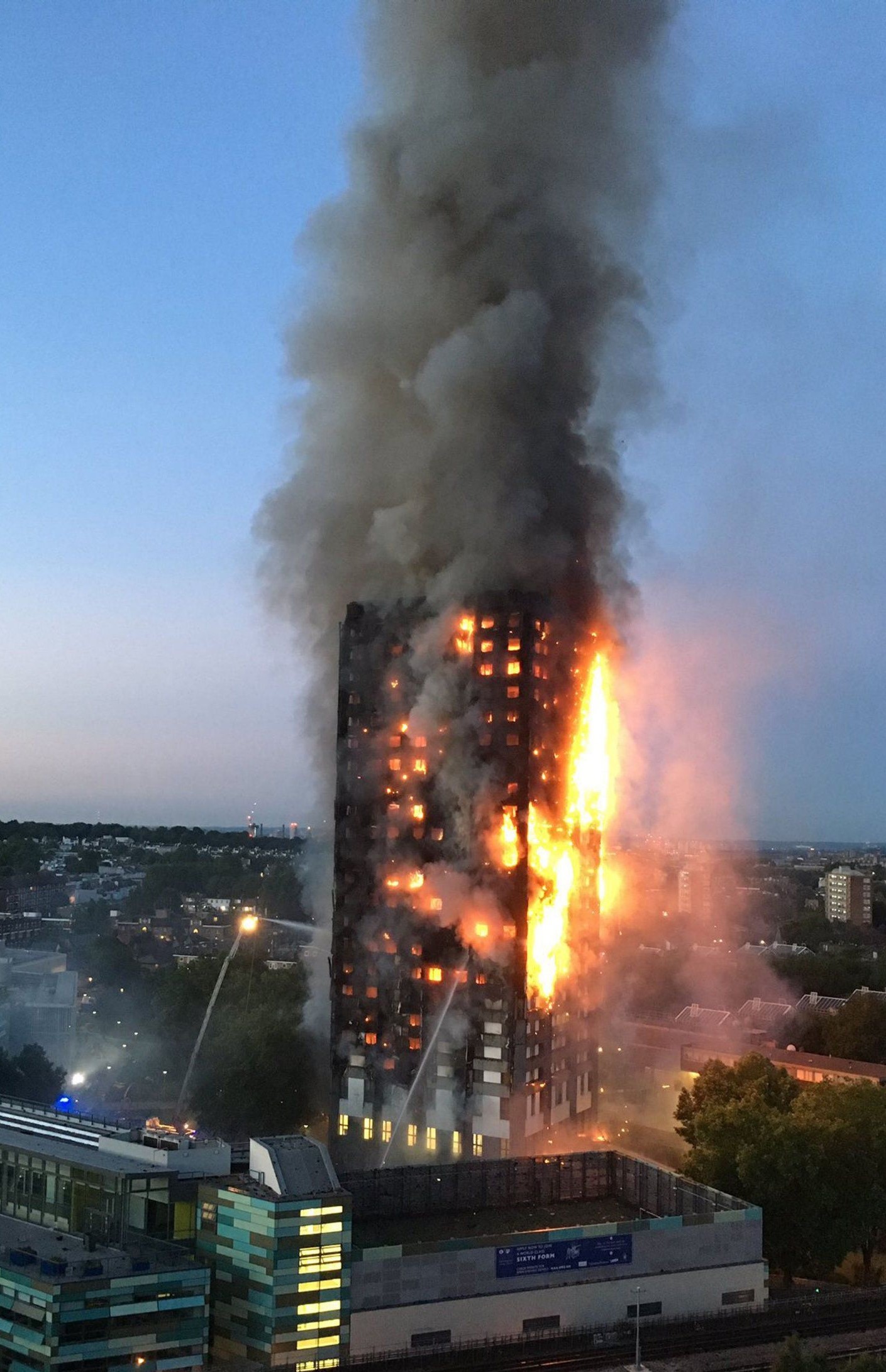
2.Grenfell Tower Fire in London, on 14 June 2017. Evidence at the Official Inquiry continues to shock and horrify ; the entire fire safety regulatory edifice in England is dysfunctional, and it poses a real and serious danger to Public Health and Safety. Inquiry Phase 1 Recommendations were issued in 2019. Already, the Recommendation concerning Evacuation for Vulnerable Building Users & PEEP’s (#33.22 e and f) has been discarded by AHJ’s … and it has also been stated (#34.14) that as everything about the single narrow staircase in the Tower appeared to be OK, it will not be investigated in Inquiry Phase 2 … a sure sign of dysfunctional dysfunction ! SFE sees beyond these major flaws.
3.Sustainable Buildings Il Bosco Verticale Towers in Milano … this exciting Project, designed by Stefano Boeri and completed in October 2014, has become the International Icon for innovative / environment-friendly construction. These new approaches to building design are posing enormous fire safety challenges. [ Remember back … was it 15 years before fire codes were able to ‘solve’ the Atrium in buildings ? ] SFE, however, must cope with this extraordinary level of architectural creativity ; and Fire Engineering Practitioners must be capable of active participation, collaboratively, within Project Design/Construction Teams.
Looking past the Milan Project … it is important for the reader to experience a more rounded flavour of where the exciting synergy between Creative Design and the Inclusive Language of Sustainability is at present, and where it is tending to go …
4.Building Energy Performance Rating Schemes Under enormous environmental and political pressures, the headlong rush to conserve energy in buildings, and to make them more energy efficient … especially after the 2022 Russian Invasion of Ukraine … is proceeding in blissful ignorance of fire safety and necessary independent technical controls. Measurement of real building performance, after energy refurbishment has been completed, is generally avoided.
.
The Road Ahead … From Gro Harlem Brundtland To Reliable Fire Statistics …
2020-09-22: Adopted at the International Fire Conference: SFE 2016 DUBLIN (www.sfe-fire.eu) …
Many years have passed since the 1972 UN Stockholm Declaration on the Human Environment and the 1992 Rio Declaration on Environment and Development. In 2016, Sustainable Development remains an intricate, open, dynamic and continually evolving concept. The guide and driver for frontline practitioners, policy and decision makers must be a personal Code of Ethics … an integrated and inter-related whole which cannot be reduced to fixed rules inviting game playing and ‘trade-offs’. After working with this Code, it may be necessary to expand on and discuss its principles and/or some of the issues raised … not to narrow its focus, but to broaden interpretation.
The realization of a Safe, Inclusive, Resilient & Sustainable Built Environment demands a concerted, collaborative, very creative and widely trans-disciplinary effort at national, local, regional and international levels across the whole planet – Our Common Home. The informed operation of appropriate legislation, administrative procedures, performance monitoring and targeting, and incentives/disincentives, at all of these levels, will facilitate initial progress towards this objective … but not the quantity, quality or speed of progress necessary. Our time is running out !
This Code of Ethics applies … for those who subscribe to its values … to policy and decision makers, and the many different individuals and organizations directly and indirectly involved in the design, engineering, construction, and operation (management and maintenance) of a Safe, Resilient & Sustainable Built Environment for ALL.
The Purpose of this Code of Ethics is to guide the work of competent individuals and organizations in a context where incomplete or inadequate legislation, administrative procedures and incentives/disincentives exist … but, more importantly, where they do not exist at all … and, amid much confusion and obfuscation of the terms, to ensure that implementation is authentically ‘sustainable’, and reliably ‘safe’ and ‘resilient’ for every person in the receiving community, society or culture … before it is too late !
2020-09-08: Ignoring Britain’s silly sabre-rattling, toothless threats and boorish blackmail attempts reported in the Media during this past weekend, yesterday and today … the actual state of play in the tortuous Brexit Negotiations can best be judged from the following sources …
Michel Barnier’s Presentation to the Institute for International and European Affairs (IIEA), on 2 September 2020 … View it Here on YouTube
Map of Europe, in colour, showing the current extent of the European Union. Points to Note: a) Europe, as a continent, extends as far as the Ural Mountains in Russia; b) From 1 January 2021, after an implementation period of one year, Great Britain will be entirely outside the EU and the Single Market; c) The EU is not a Christian organization and as soon the political classes in certain countries (e.g. France and The Netherlands) get over their hysterical hatreds, Turkey will enter the EU as a full Member State; d) furthermore and eventually, an Independent Scotland will re-join the EU. Click map to enlarge.
This is the European Union (EU), a Single Market of approximately 450 Million consumers. The EU operates under the freedoms and protections of Codified / Written Law, i.e. EU Treaties ratified by all of the EU Member States, EU Secondary Legislation (Regulations and Directives), and EU Administrative Provisions.
.
A suite of EU Regulations and Directives covers Industrial Products. While there is some flexibility with regard to how Directives are implemented at national level in the Member States, no such flexibility exists with Regulations. Construction Products can only be placed on the EU Single Market if they can be shown to comply with the requirements of the EU’s Construction Products Regulation (CPR) Framework, or in other words, be shown to be ‘fit for their intended use’ in the European Union …
EU Regulation 305/2011. Article 13(2) Before placing a Construction Product on the market, Importers shall ensure that the assessment and the verification of constancy of performance has been carried out by the Manufacturer. They shall ensure that the Manufacturer has drawn up the Technical Documentation referred to in the second sub-paragraph of Article 11(1) and the Declaration of Performance in accordance with Articles 4 and 6. They shall also ensure that the Product, where required, bears the CE Marking, that the Product is accompanied by the required documents and that the Manufacturer has complied with the requirements set out in Article 11(4) and (5).
.
BREXIT ~ IMPLICATIONS FOR THE BRITISH FIRE INDUSTRY
Trade ‘No Deal’ or ‘Minimal Deal’ … from 1 January 2021, Great Britain will be completely outside the European Single Market, and the EU’s Construction Products Regulation Framework. The designation ‘Notified Body’ under that Framework will fall away from British Organizations. Construction Products/Systems manufactured in, or supplied from, Britain will then have to undergo an entirely new EU Testing and Approvals Programme in order to access the European Single Market. Fire Safety related Construction Products will have to be tested, and assessed or appraised, against all 7 Basic Requirements for Buildings together, during the same period of time (see Annex I, EU Regulation 305/2011) …
Mechanical Resistance and Stability
Safety in Case of Fire
Hygiene, Health and the Environment
Safety and Accessibility in Use
Protection against Noise
Energy Economy and Heat Retention
Sustainable Use of Natural Resources
… a process which will be very interesting to observe, since the Fire Industry (particularly England’s Fire Establishment, AHJ’s, etc) dislikes, with intensity, the whole idea of ‘environmental impact’ … the concept of ‘sustainable development’ is hardly understood … and no consideration is given to the reasonable fire safety and accessibility needs of ‘vulnerable building users’ (including people with activity limitations, refugees, migrants, etc).
The tragic 2017 Grenfell Tower Fire, and its sad aftermath, have demonstrated how dysfunctional, and rotten to the core, is the whole national system of Building Fire Safety in England. More than 3 years later … on the evidence to date of an ongoing, incompetent Inquiry and a series of shoddy responses from Government … will survivors and the victims’ families ever receive Justice, and find Peace ? cf. The 1981 Stardust Discotheque Fire in Dublin. Survivors and victims’ families are still waiting for the truth to be revealed.
In parallel, mutual recognition of British Professional Building Designers, e.g. Architects, Structural Engineers, Fire Engineers, etc., within the European Union will cease.
In parallel, British Fire Research involvement in EU Research Networks will also cease … unless a heavy price is paid to be involved as a 3rd Country. British Institutions should forget any notions they might have about Network Leadership.
In parallel, Information and Data Flows between Britain and the EU will be disrupted or cease altogether … unless Britain complies fully with the requirements of EU General Data Protection Regulation (GDPR) 2016/679. As a vassal state of the USA, this compliance may prove difficult for Britain !
.
EU Fire Safety Related Product/System Manufacturers ~ A Word of Caution !
Many EU Construction Product/System Manufacturers continue to use the services provided by British Fire Test Laboratories and/or Fire Consultancy Organizations located in Great Britain … some of which have already established EU-based dummy companies and letterheads. These British organizations must be avoided altogether. For example, the practice of fire testing in England and later adding a title page of a Full Test Report with an EU location address is entirely unacceptable !
2020-04-28: A look back at a Benchmark Document, and an Introduction written nearly 16 years ago. So many years, so much valuable time has been wasted …
The words ‘green’, ‘environmental’, ‘ecological’ and ‘sustainable’ are becoming part of everyday language in the Developed World, but are frequently interchanged without understanding. To date, however, the concept of Sustainable Development has been hijacked by Environmentalists. For example, no connection at all may be seen between a ‘sustainable’ building and ensuring that it can be safely and conveniently entered and used by ordinary people.
In other parts of the World, the ambiguous WCED / Brundtland Definition of Sustainable Development is being systematically rejected ; the concept is viewed as an unaffordable luxury and/or as a means of continued domination and control by the ‘North’. Yet, sustainability must be a global compact.
In this intolerant and more fundamentalist 21st Century, the United Nations System, International Law, and Social Justice continue to come under sustained attack. And the Beslan School Tragedy* demonstrates that it is far more hazardous for disadvantaged, vulnerable and indigenous peoples in every society.
Some specific objectives for the 2004 Rio Declaration were as follows …
To present a 2nd Generation Definition of Sustainable Development which is more acceptable to the Developing World ;
To restore primacy to the Social Aspects of Sustainable Development … and particularly the ethical values of Social Justice, Solidarity and Inclusion-for-All ;
To embed the concept of the ‘Person’ in Sustainable Development … rather than the fleeting reference to ‘People’ which too often results in Disadvantaged, Vulnerable and Indigenous Groups being left behind ;
To signal one of the main challenges of Sustainable Development ahead – which will be to establish a framework of horizontal co-ordination at the many institutional levels … and between the many actors and end users … in the human environment.
Adopted in December 2004, at the Brazil Designing for the 21st Century III Conference, the Rio Declaration consists of a Preamble, 10 Principles and 5 Appendices ; its central concern involves People with Activity Limitations (2001 WHO ICF).
This Declaration extols implementation, and the targeting and monitoring of ‘real’ performance – as opposed to ‘imagined’ or ‘paper’ performance.
2020-03-23: The Grenfell Fire Inquiry’s Phase 1 Recommendations (Part V in Volume 4 of the Phase 1 Report), were published on 30 October 2019. The initial issues covered in those Recommendations are fragmentary, lack depth and coherence … and in the case of Fire Alarms, with just one indirect reference to them in Paragraph #33.22 … they are in serious error …
.
Colour image showing the Volume 4 Cover Page of the Grenfell Tower Inquiry Phase 1 Report. The Phase 1 Recommendations are contained in Chapter #33, on Pages 771-780. Click to enlarge.
[ Paragraph #33.22 ] There were no plans in place for evacuating Grenfell Tower should the need arise. I therefore recommend:
d. that all high-rise residential buildings (both those already in existence and those built in the future) be equipped with facilities for use by the fire and rescue services enabling them to send an evacuation signal to the whole or a selected part of the building by means of sounders or similar devices ;
.
FUNDAMENTALS OF A SOLUTION
1. A Fire Alarm (more precisely from here on, a Fire Detection & Warning System) is a critical safety feature in all buildings … ALL BUILDINGS … from the smallest and most simple, to the biggest and most complex … no exceptions !!
In order to survive in a fire emergency, Vulnerable Building Users need more time to react, and evacuate, than other occupants/users. The valuable time provided by early, accurate and precise detection is the only way to effectively facilitate this. The ‘Required Time’ to prepare for evacuation depends on many factors, e.g. building complexity, familiarity of users with evacuation routes, range and severity of user activity limitations, etc.
It follows, therefore, that if building occupants/users have to wait 15, or 20, or 30 minutes before firefighters arrive at the fire scene (Full Response Time*) and ‘an evacuation signal to the whole or a selected part of the building’ is only then sent by those firefighters … all of that valuable evacuation time for vulnerable building users has been lost. This is ridiculous, and makes no sense whatsoever. This Recommendation must be rejected out of hand, and ignored !
[ *Full Response Time: The time interval from the receipt of an emergency communication at the primary public safety answering point (#PSAP) to when emergency response units are initiating action or intervening to control a fire incident. ]
.
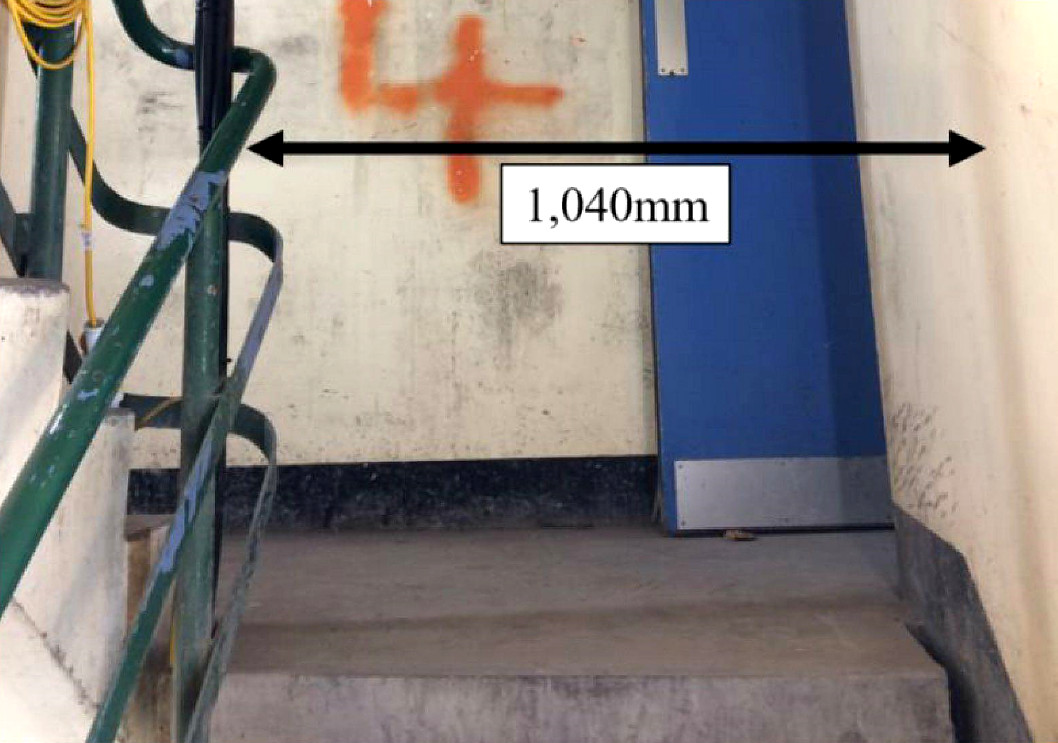
Colour photograph showing the Single, Narrow Staircase (1.040 metres in width between a handrail on one side of the staircase and a bare wall on the other side) in London’s Grenfell Residential Tower. This staircase, which was inadequately protected from fire, heat and smoke, was not wide enough to facilitate the ‘contraflow’ circulation of firefighters entering, while occupants evacuated at the same time. Without a Fire Alarm in the building, occupants could not have known that a serious Fire Emergency was in progress … especially Vulnerable Building Users accommodated high up in the Tower … and they remained in place (‘stayed put’). Once firefighters arrived at the scene, occupant evacuation using this staircase became impossible or extremely difficult. Click photograph to enlarge.
Important Note: In Chapter #34: ‘Looking Ahead to Phase 2’ of Moore-Bick’s Phase 1 Report, Volume 4 … Paragraph #34.14 states …
A question was raised about the width of the stairs, given that they provided the sole means of access to the upper floors of the tower for firefighters as well as the sole means of escape for the occupants. However, the stairs appear to have complied with requirements of the legislation in force at the time of their construction and the expert evidence supports the conclusion that they had sufficient capacity to enable all the occupants of the building to escape within a reasonable time. This aspect of the building will not, therefore, be the subject of further investigation in Phase 2.’
Astounding ! Absurd !! FUBAR !!!
.
All Fire Emergency Warning Systems must be designed to accommodate People with Hearing Impairments. Audible and visual warning devices must be provided together, as a single combined unit. This is particularly important in noisy and isolated building spaces, e.g. bathrooms, small meeting rooms. Vibrating devices, such as pagers or mobile phones, can be integrated into a building’s fire emergency warning system in order to provide any individual with a tactile emergency alert.
Colour photograph showing a single combined visual-audible Fire Emergency Warning Device. Click to enlarge.
Important Note: Audible sounders, on their own, are never a sufficient Fire Emergency Warning !
.
2. The Purpose of a Fire Emergency Warning System is to provoke calm, efficient and adaptable evacuation movement by ALL building users/occupants at the earliest possible stage in a fire incident, without causing user confusion, disorientation or panic. In all building types, therefore, a reliable, informative and accessible fire emergency warning system must be installed, and such a system must always have a fire protected electrical supply.
Colour image showing the movement of building occupants and users. The purpose of a Fire Emergency Warning System is to provoke calm, efficient and adaptable evacuation movement by ALL building occupants at the earliest possible stage in a fire incident, without causing user confusion, disorientation or panic. During a Fire Emergency, STANDARD MOVEMENT TIMES DO NOT EXIST. Click image to enlarge.
.
3. To provoke a Calm Response from Building Users … the output from Fire Emergency Warning Devices, e.g. light, sound and messages, must be adapted to the local context of people and building surroundings.
Fire Emergency Audible Warnings … A sufficient number of low-output audible sounders, i.e. between 60-80 dB, must be specified for effectiveness. Small numbers of sounders with high output (in order to reduce costs) should never be specified, as this can lead to confusion, disorientation and panic attacks among some building users/occupants. The output of sounders must be adapted to suit interior surroundings, e.g. in small spaces with hard surfaces a lower sound output will be adequate.
Colour image. The output from Fire Emergency Audible Sounders must be between 60-80 dB. Click image to enlarge.
Important Note: When they are asleep, hearing-able children (around ten years of age and under) … and hearing-able older people (around 65 years of age and over) are more difficult to wake and rouse sufficiently for evacuation when alerted by an audible signal alone.
Fire Emergency Visual Warnings … Light strobes/beacons must be clearly visible. To reinforce #1 above … light strobes/beacons must be placed in wash rooms and in other locations within buildings where people may be alone ; they must also be placed in noisy environments.
A sufficient number of low-output strobes/beacons must be specified for effectiveness. Small numbers of strobes/beacons with high output (in order to reduce costs) should never be specified, as these produce a glare which may cause confusion, disorientation and panic attacks among some building users/occupants. The light output of strobes/beacons must be adapted to suit interior surroundings, e.g. in dark rooms.
For light strobes/beacons, a slow rate of flash is important, i.e. no faster than once every two or three seconds, in order to encourage a calm response from building users/occupants and to avoid photosensitivity seizures. Most importantly, the flash of one strobe/beacon must be synchronized with the flashes of all other light strobes/beacons in view.
.
Colour video clip (.gif). The output from Fire Emergency Visual Strobes / Beacons must be no faster than one flash every two or three seconds. The flash rate shown above is too fast ! Click to run video clip.
Fire Emergency Voice Message Warnings … Are essential to improve Warning Credibility. In other words, building users are far less likely to sit around wondering, waiting to see whether this is a ‘real’ fire emergency, a false alarm, a practice evacuation, or an electrical error. Verbal or voice messages must be short and contain appropriate warning information which is easily assimilated. The speaker should be distinct and easy to understand. Live messaging during a fire emergency is preferred over pre-recorded, standard messages. In today’s multi-cultural social environment, messages must be transmitted in at least two to three different languages, as appropriate.
Fire Emergency Directional Warnings … Combination sounder, visible strobe/beacon, and voice messaging Fire Emergency Warning Devices are now a mainstream technology, are readily available, and are being specified in new and existing buildings.
.
Colour image showing a combination Fire Emergency Directional Audible Sounder, with Voice Messaging capability. Click image to enlarge.
Audible directional signalling must be installed when dealing with difficult building configurations, e.g. in large open office layouts/spaces with minimal signage … where building users/occupants are unfamiliar with their surroundings in modern shopping centres/malls and other complex building types … or visibility of high-level signage may be reduced because of smoke logging.
Directional sounders, which guide building users during a Fire Evacuation towards Exits, Areas of Rescue Assistance and Lift/Elevator Lobbies, must be positioned at carefully chosen, suitable locations. Once reached, a directional sounder must also have a voice messaging capability in order to inform people about the next phase of evacuation.
4. Fire Emergency Warning Systems must be Accessible (for People with Activity Limitations), i.e. capable of transmitting a warning in many formats in order to ensure that all users/occupants perceive and act upon the warning in a calm manner and, thereafter, that effective evacuation movement commences without delay. Warning Credibility improves in direct relation to the type and number of different warning formats.
.
As well as indirectly referring to Fire Detection and Warning Systems, Paragraph #33.22 in Moore-Bick’s Phase 1 Recommendations has some other things to say about Evacuation. So this is an opportune moment to discuss some practical and human issues concerning Fire Emergency Evacuation … and, straight away, to deal with an unexpected consequence arising from the current CoronaVirus/CoVID-19 Emergency …
CoronaVIRUS / CoVID-19 PANDEMIC
There have been widely reported instances, in many countries, of panic buying in shops because of the 2020 CoronaVirus/CoVID-19 Emergency … but the photograph below illustrates an example of a panic reaction by building management. This appears to be a crime scene … the yellow and black tape is so dramatic. In a real Fire Emergency, many building users/occupants will be reluctant to use this final fire exit ; they will not have the time to read the small print on a notice ; they will attempt to re-trace their path of evacuation and find another exit.
Colour photographs showing how, as a panic reaction to the 2020 CoronaVirus/CoVID-19 Emergency, a Final Fire Exit has been blocked off from normal, everyday use. Click to enlarge.
This panic reaction by building management IS a serious impediment to Fire Evacuation !
Whatever the Motives of Building Management …
in countries which have Fire Codes / Regulations, this action is illegal ; and
in these days, when a wide range of ‘smart’ technologies is readily available … this action is inexcusable.
.
SOME PRACTICAL FIRE EVACUATION ISSUES
A Skill is the ability of a person, resulting from competent training and regular practice, to carry out complex, well-organized patterns of behaviour efficiently and adaptively, in order to achieve some end or goal. All building occupants/users must be skilled for evacuation to an external ‘place of safety’, which is at a safe and remote distance from the fire building. Practice fire evacuations must be carried out sufficiently often to equip building users, particularly vulnerable users, with this skill, i.e. at least once every six months ; in complex building types, practices should be carried out more often. Prior notification to occupants/users, and regular scheduling of practice evacuations should be avoided.
Familiarity with Fire Evacuation Routes will be fostered and greatly improved by means of normal, everyday use by occupants/users. This is an important task for pro-active Building Management in existing buildings … and an important aspect of new building design for Architects and Fire Engineers.
While the transmission of fire emergency warnings in many formats will increase Warning Credibility, close observation of past tragic ‘real’ fire events, e.g. the WTC 9-11 Attacks in New York City, shows that initiation of evacuation and the actual process of evacuation itself can be problematic. An interesting, easily assimilated and user-targeted skills programme of training should incorporate practical solutions to deal with the following typical problems:
Fire Emergency Preparedness: Irregular attendance of building occupants/users at fire prevention and safety training sessions, and participation in practice fire evacuations. Users not being familiar with a building’s fire emergency management plan and not knowing who is in charge … not using a building’s fire evacuation route(s), particularly staircases, during practices … or having no information about where to assemble after evacuating … or, once at a place of safety, not having any head count or identification process ;
Delaying Activities Inside The Fire Building: Once building occupants/users decide to evacuate, but before moving to evacuate, they gather personal effects … seek out friends/co-workers … search for others … make phone calls/send tweets … finish tasks/turn off computers … wait around for instructions … change shoes … and try to obtain permission to leave ;
Delaying Activities Outside The Fire Building: Once outside the building’s final fire exit, but before moving directly to a place of safety, building occupants/users stop to see what is happening … look for friends/co-workers … look for a phone … do not know where to go … or, within the ‘danger zone’ of the fire building, stop to receive medical attention.
It may seem obvious that Fire Evacuation Routes must also be Accessible (for People with Activity Limitations), which also makes routes much safer for every other building user … and sufficiently wide to accommodate Contraflow (emergency access by firefighters or rescue teams into a building and towards a real fire, while building users are still moving away from the fire and evacuating the building) … a harsh lesson learned from the 2001 WTC 9-11 Attacks and the 2017 Grenfell Tower Fire. Since they are new, strange and unusual for many building designers, and most fire engineers … these aspects of building performance are overlooked in nearly every building.
Practice Evacuations should include exercise of the buddy system ; fire safety fittings, e.g. portable fire extinguishers ; and fire evacuation devices intended for use by people with activity limitations which will require more intensive training.
.
Colour image showing a range of personal Facilitation / Mobility Aids. People with Activity Limitations must be allowed, and positively encouraged, to keep these Aids during practice and real fire evacuations. Prior meaningful consultation (see below) is essential. Click to enlarge.
Important Note: During fire emergencies, People with Activity Limitations must be permitted to keep possession of their own personal Facilitation / Mobility Aids.
.
SOME HUMAN FIRE EVACUATION ISSUES
The actual people who use and occupy buildings are individuals. They are different from each other, and they each have a different range of abilities (in relation to self-protection, independent evacuation to an external place of safety remote from a fire building, and active participation in a building’s fire emergency management plan), behaviour and manner of perceiving their surroundings. Two apparently similar people will also show variations in how they react to and behave in any specific situation, particularly a fire emergency.
Ability / Disability is a Continuum – a gentle gradient on which every person functions and acts at different levels due to personal and environmental, i.e. external, factors.
In situations of severe stress, e.g. during a fire emergency in a building, where there is a lack of preparedness for such an event, a lack of familiarity with evacuation routes, lack of reliable evacuation information, lack of competent leadership and clear direction, and the presence of smoke, user/occupant confusion, disorientation and panic will occur. Standard evacuation movement times will also be non-existent. In addition, people with activity limitations must then deal with many physical barriers which routinely impede their evacuation from buildings, e.g. fire resisting doorsets which are difficult to open, steps along evacuation routes and at final fire exits.
In the case of people with a mental or cognitive impairment, there is a particular need to encourage, foster and regularly practice the adaptive thinking which will be necessary during evacuation a real fire incident.
People with respiratory health conditions will not be able to enter or pass through smoke. People with visual impairments will require continuous, linked tactile and/or voice information during the whole process of fire evacuation. People with psychological impairments, i.e. vertigo and agoraphobia, will be unable to use fire evacuation staircases with glass walls in high-rise buildings. Because of the stigma still associated with disability in many countries, some users/occupants who will need assistance during a fire emergency will be reluctant to self-identify beforehand. Other people may not even be able to recognize that they have an activity limitation or a health condition.
Meaningful Consultation with a person known to occupy or use a building, for the purposes of receiving his/her active co-operation and informed consent (involving a personal representative, if necessary), is an essential component of adequate pre-planning and preparation for a fire emergency.
Building Designers, Fire Engineers and Firefighters should be aware of the following human conditions:
Agoraphobia: A fear of open spaces.
Commentary: Agoraphobia is one of the most commonly cited phobic disorders of people seeking psychiatric or psychological treatment. It has a variety of manifestations, e.g. a deep fear of leaving a building, or of being caught alone in some public place. When placed in threatening situations, agoraphobics may experience a panic attack.
Anosognosia: A neurological disorder marked by the inability of a person to recognize that he/she has an activity limitation or a health condition.
Dementia: Any degenerative loss of intellectual capacity, to the extent that normal and occupational activities can no longer be carried out.
Panic: A sudden overwhelming feeling of anxiety, which may be of momentary or prolonged duration.
Panic Attack: A momentary period of intense fear or discomfort, accompanied by various symptoms which may include shortness of breath, dizziness, palpitations, trembling, sweating, nausea, and often a fear by a person that he/she is going mad.
2019-12-21: Recapping with regard to Vulnerable Building Users … the Grenfell Inquiry Phase 1 Recommendations are pathetically and disgracefully inadequate ! At a later stage and in order to make amends for this serious error … Inquiry Chairperson, Sir Martin Moore-Bick must direct that Proper Consideration – not just Token Consideration – be given, in Law, to the Fire Safety of Vulnerable Building Users, who include people with activity limitations, children under 5 years of age, frail older people (not ALL older people !), women in late stage pregnancy, people with disabilities, refugees, migrants, the poor, and people who do not understand the local culture or cannot speak the local language … OR, to put it another way and to remove any ambiguity … any person who may be vulnerable in a fire emergency, i.e. those with limited abilities in relation to self-protection, independent evacuation to an external place of safety remote from the building, and active participation in the building’s fire emergency procedures.
Do you care that Vulnerable People also use Your Building ?People with Activity Limitations. Click to enlarge.
.
Now, Over 2.5 Years After The Grenfell Tower Fire … London Fire Brigade Commissioner (#LFB), Dany Cotton, has recently stated that she will retire at the end of December 2019.
On 17 December 2019 … The National Inspectorate in Britain for Police and Fire Services (#HMICFRS … www.justiceinspectorates.gov.uk/hmicfrs) published a report into the performance of London Fire Brigade. Some extracts from that document …
‘ We have concluded there is a long way to go before London Fire Brigade is as efficient as it could be. We have criticised both the way it uses resources and makes its services affordable now and in future. In some areas it is wasteful. While it has made savings, these are not of the level made in other services.
Worryingly, the Brigade is inadequate at getting the right people with the right skills. It also needs to improve how it promotes the right values and culture, ensuring fairness and promoting diversity as well as managing performance and developing leaders.
The tragic fire at Grenfell Tower in 2017 was one of the biggest challenges London Fire Brigade has ever had to face. The incident has had a profound effect on how the Brigade now performs. Although our findings are broadly consistent with those of the Grenfell Tower Inquiry, it must be emphasised that this was an inspection of the Brigade in 2019. We found that while the Brigade has learned lessons from Grenfell, it has been slow to implement the changes needed. This is unfortunately typical of the Brigade’s approach to organisational change.’
Title Page of GB’s National Inspectorate (HMICFRS) Report, published on 17 December 2019.
If Dany Cotton is the only person to go at the end of December 2019, this is very obviously political scapegoating !
Very Quickly … the entire Culture and Value System of London Fire Brigade must change for the better. And to ensure that this transformation is Immediate and Fully Effective … ALL of Dany Cotton’s Senior Commanders must also go, or be fired … including Dany’s intended replacement, Andy Roe !
In addition … because it is still attempting to defend the criminal ‘Stay Put’ Policy … the National Fire Chiefs Council (#NFCC … www.nationalfirechiefs.org.uk/) in Britain must be held accountable. Its Chair, Vice Chairs and those Lead Officers with responsibility for fire safety in buildings must ALL be replaced NOW !
.
FIRE EMERGENCY MANAGEMENT PLANNING
The Grenfell Fire Inquiry’s Phase 1 Recommendations were published on 30 October 2019. Under the initial topics covered … they are far from being comprehensive … they are fragmentary, lack depth and any sort of coherence …
[ Paragraph #33.10 ] I therefore recommend:
a. that the owner and manager of every high-rise residential building be required by law to provide their local fire and rescue service with information about the design of its external walls together with details of the materials of which they are constructed and to inform the fire and rescue service of any material changes made to them ;
[ Paragraph #33.12 ] I therefore recommend that the owner and manager of every high-rise residential building be required by law:
a. to provide their local fire and rescue services with up-to-date plans in both paper and electronic form of every floor of the building identifying the location of key fire safety systems ;
b. to ensure that the building contains a premises information box, the contents of which must include a copy of the up-to-date floor plans and information about the nature of any lift intended for use by the fire and rescue services.
I also recommend, insofar as it is not already the case, that all fire and rescue services be equipped to receive and store electronic plans and to make them available to incident commanders and control room managers.
[ Paragraph #33.13 ] I therefore recommend:
a. that the owner and manager of every high-rise residential building be required by law to carry out regular inspections of any lifts that are designed to be used by firefighters in an emergency and to report the results of such inspections to their local fire and rescue service at monthly intervals ;
b. that the owner and manager of every high-rise residential building be required by law to carry out regular tests of the mechanism which allows firefighters to take control of the lifts and to inform their local fire and rescue service at monthly intervals that they have done so.
[ Paragraph #33.22 ] I therefore recommend:
a. that the government develop national guidelines for carrying out partial or total evacuations of high-rise residential buildings, such guidelines to include the means of protecting fire exit routes and procedures for evacuating persons who are unable to use the stairs in an emergency, or who may require assistance (such as disabled people, older people and young children) ;
b. that fire and rescue services develop policies for partial and total evacuation of high-rise residential buildings and training to support them ;
c. that the owner and manager of every high-rise residential building be required by law to draw up and keep under regular review evacuation plans, copies of which are to be provided in electronic and paper form to their local fire and rescue service and placed in an information box on the premises ;
d. that all high-rise residential buildings (both those already in existence and those built in the future) be equipped with facilities for use by the fire and rescue services enabling them to send an evacuation signal to the whole or a selected part of the building by means of sounders or similar devices ;
e. that the owner and manager of every high-rise residential building be required by law to prepare personal emergency evacuation plans (PEEP’s) for all residents whose ability to self-evacuate may be compromised (such as persons with reduced mobility or cognition) ;
f. that the owner and manager of every high-rise residential building be required by law to include up-to-date information about persons with reduced mobility and their associated PEEP’s in the premises information box ;
g. that all fire and rescue services be equipped with smoke hoods to assist in the evacuation of occupants through smoke-filled exit routes.
.
Residents in High-Rise Buildings, whether public or private, must no longer wait in vain for a saviour, or to be saved by the ‘system’. Instead, the time has arrived to become proactive, and to immediately initiate their own comprehensive programmes of Self-Protection In Case Of Fire … which go far beyond the Recommendations in Moore-Bick’s Phase 1 Report.
.
Fire Emergency Management Planning begins very early in the long life cycle of a building. The following framework should be scaled up or down, depending on the size and extent of a project …
Fire Defence Plan (FDP)
A Fire Defence Plan (#FDP) elaborates the particular fire engineering strategy which has been developed for a specific building at design stage. It is usually in electronic format and/or hard copy … and comprises fire engineering drawings, descriptive text (including a clear statement of the project’s fire engineering design objectives), a full construction specification (including façade cladding systems), fire safety related product/system information, with supporting calculations and the fire test/approval data which demonstrates their ‘fitness for intended use’.
A Fire Defence Plan must demonstrate a proper consideration for the fire safety, protection and evacuation of all building occupants/users, with a particular and integrated focus on vulnerable building users, especially people with activity limitations. Refer to Personal Emergency Evacuation Plans (PEEP’s) in my previous post.
In ‘real’ everyday practice, as opposed to academic theorizing … effective fire compartmentation is very difficult to achieve. Passive/active fire protection measures are never 100% reliable … sometimes nowhere near 100%. Building management systems are very far from being reliable. For these reasons, ‘Stay Put’ Policies must be completely avoided !
[ In the specific case of Health Care Facilities, e.g. hospitals, it is highly hazardous to patients and unacceptable with regard to their welfare that they be evacuated during a fire emergency to a place of safety which is remote from the building. Instead, the optimal fire engineering strategy here is to ‘protect in place’ … which requires a very high level of independently monitored competence, quality and reliability in design, construction, management, operation, and servicing. ]
Fire Defence Plans become ‘live’ during Construction.
A hard copy of the Fire Defence Plan for a building must always be available for inspection on-site. A copy of the fire defence plan must also be retained at a remote, safe and secure location off-site.
Fire Emergency Planning Committee (FEPC)
Immediately after the completion of construction and occupation of a building, a Fire Emergency Planning Committee (#FEPC) must be established by the building owner(s), in consultation with building occupants/users. Membership of the FEPC must comprise representatives of the building owner(s), building occupants, and regular users of the building. The Committee’s task must be to develop, implement and maintain a Fire Emergency Management Plan, consisting of the emergency response procedures and related training and regular practices, which are essential for the effective and efficient management of any fire emergency in the building. Sufficient resources must be allocated to the FEPC, by the building owner(s), to ensure that it can satisfactorily complete this task.
Fire Emergency Control Room. Click to enlarge.
The FEPC must ensure that all relevant legislative requirements are met and must examine, if necessary, the need for the appointment of competent, specialist advisors and support. Special attention must be paid by the FEPC to the fire safety of vulnerable building occupants/users. The FEPC must establish a Fire Emergency Control Room (#FECR), which must be fitted-out and competently operated – 24/7/365 – in accordance with the Fire Emergency Management Plan. The FEPC must also appoint a competent Fire Emergency Control Unit Manager.
Fire Emergency Management Plan (FEMP)
The Fire Defence Plan is the basis for, and main component of, a building’s Fire Emergency Management Plan (#FEMP). This document elaborates the fire emergency response procedures for an occupied building and is produced by the Fire Emergency Control Unit Manager, in liaison with the Local Fire Service. It contains relevant information about the fire safety preparedness and prevention/protection/recovery measures in the building, and includes the pre-emergency, emergency and post-emergency roles, duties and responsibilities assigned to individuals and, in the case of their absence, nominated deputies.
The Fire Emergency Control Unit Manager liaising with the Local Fire Service.
The objective of a Fire Emergency Management Plan is to ensure that, in the event of a fire emergency, the health and safety of every building occupant/user is protected, including visitors to the building, contractors, and product/service suppliers … and access for, and the safety of, firefighters is assured. Particular attention must be paid to those occupants with activity limitations. All Personal Emergency Evacuation Plans (#PEEP’s) must be fully integrated into the overall Fire Emergency Management Plan for the building. Documented procedures must accurately reflect reality, and real behaviour, in the building.
The Fire Emergency Management Plan must include the procedures, chosen methods of warning to be used during a fire emergency, management control and co-ordination during the fire emergency, communications between each member of the Fire Emergency Control Unit and the building’s occupants/users and with the Fire Service Incident Commander at the scene, emergency response equipment in the building, evacuation actions, arrangements for occupants/users with activity limitations, first-aid personnel, evacuation by lift/elevator fire evacuation assemblies, escalators, travellators and staircases, use and fitting-out of areas of rescue assistance (including visual monitoring and the provision of smoke hoods), lift/elevator lobbies (including visual monitoring and provision of smoke hoods) and floors of temporary refuge, up-to-date emergency contact details, etc.
The Fire Emergency Management Plan must always be available for inspection, in hard copy format, at a convenient location in the building. A copy must be provided to all building occupants, as they request, in hard copy, electronic and/or alternative formats. A further copy of the Fire Emergency Management Plan must be provided to the Local Fire Service, as they request, in hard copy and/or electronic formats.
To ensure its effectiveness, the Fire Emergency Management Plan must be regularly practiced at least every three months, tested and reviewed. If necessary, e.g. in the case of large/complex building types or existing buildings having suspect levels of fire safety, the establishment of an on-site, permanent, competent/specialist Fire Emergency First Response Team (#FEFRT) must be considered.
Fire Emergency Control Unit (FECU)
The Fire Emergency Control Unit (#FECU) must be established by the Fire Emergency Planning Committee to implement, manage, and recommend improvements to the Fire Emergency Management Plan.
In the event of a Fire Emergency, instructions given by the Fire Emergency Control Unit Manager, or his/her Deputy, must take precedence over normal management structures and procedures in the building; and it shall be his/her duty to inform the Local Fire Service, immediately upon their arrival at the scene, about the number/locations of people still in the building, and the number/locations of vulnerable people who may need to be rescued.
Other members of the Fire Emergency Control Unit must accompany occupants/users as they evacuate to place(s) of safety, remote from the building. Once there, a head count must immediately be taken by those members – now the Person in Charge at a place of safety – to establish the following:
That everybody is present, and that nobody has been left behind ;
That everybody is uninjured … or if anybody is injured, what appropriate Medical Aid is rendered and/or summoned.
Communications during a fire emergency between all of the interested parties involved can be fraught with difficulty … lack of discipline will cause misunderstandings and confusion … signal strengths may suffer interference because of the building’s construction. If necessary, Repeater Units must be installed in the building at any signal ‘drop-zones’ … and the development of a Fire Emergency Management Communications ‘App’, for use on FECU/occupant/user smartphones, must also be considered.
The Fire Emergency Control Unit Manager must prepare for the swift and orderly transfer of the Fire Emergency Control Room and its personnel to a safe location off-site, in the unlikely event of a severe fire emergency in the building.
Fire Safety Training & Regular Practice Evacuations
The objective of fire safety training and regular practice evacuations, which are held at least every 3 months, is to ensure that everybody in the building is skilled for evacuation during a fire incident, using safe accessible routes to an external place/places of safety which is/are remote from the building.
Place(s) of Safety. Click to enlarge.
Fire safety training and regular practice evacuations must be conducted by the Fire Emergency Control Unit Manager for all building occupants and regular visitors to the building, including FECU personnel. Fire safety training material used, e.g. brochures, hand0outs and fact sheets, must be site-specific, appropriate to an individual’s role and responsibilities, and easily assimilated, i.e. can be comprehended by everyone, including people with activity limitations and those who are illiterate or may use different languages.
A programme of site-specific practice fire evacuations must be developed, in collaboration with the Local Fire Service, by the Fire Emergency Control Unit Manager.
Skill: The ability of a person – resulting from proper training and sufficient regular practice – to carry out complex, well-organized patterns of behaviour efficiently and adaptively, in order to achieve some end or goal.
Routine Fire Safety/Evacuation Inspections & Maintenance
The Fire Emergency Control Unit Manager must ensure that all fire safety and evacuation related aspects of the Fire Emergency Management Plan, including systems, products and fittings, are routinely inspected, tested and maintained/serviced. Any deficiencies must be reported to the Fire Emergency Planning Committee at the completion of an inspection and/or test, and must be rectified as soon as it is reasonably practicable. Records of all activities must be regularly updated and safely/securely stored in the building, with a duplicate copy provided to the Local Fire Service.
Fire Evacuation Performance Indicators (Metrics)
Performance indicators/metrics must be formulated by the Fire Emergency Control Unit Manager in order to evaluate the effectiveness of the fire emergency response procedures in the building. During practice evacuations, the time between warning communications and first occupant/user movement, the time taken for evacuation to an external place/places of safety remote from the building, the evacuation routes chosen by occupants/users, and the time required to identify everyone who participated in the practice evacuation at the place/places of safety, including those occupants/users who did not participate, must all be recorded.
The Local Fire Service has two functions: a) to suppress and control a fire in the building, and to confirm extinguishment ; and b) to rescue people in the building who are injured, trapped, or otherwise unable to independently evacuate, e.g. people waiting in areas of rescue assistance and lift/elevator lobbies. In addition, therefore, the time taken for the first fire service vehicle to arrive on-site and, more importantly, the time taken for the fire services to arrive in sufficient strength to deal effectively with a fire emergency in the building must be recorded. In the event that either or both of these times are inordinately long, an on-site specialist Fire Emergency First Response Team (FEFRT) must be established by the Fire Emergency Planning Committee. The FEFRT must work under the control of, and report directly to, the Fire Emergency Control Unit Manager.
‘Contraflow’ movement in Building Circulation Routes. Click to enlarge.
During the process of evaluation, generous allowance must be made for contraflow circulation during a real fire incident, i.e. emergency access by firefighters into a building and towards a fire, while building occupants/users are still moving away from the fire and evacuating the building.
The Fire Emergency Control Unit Manager must report, in full, the recorded performance and his/her evaluation of practice evacuations to the Fire Emergency Planning Committee.
.
Addendum 2020-04-14: For business application … the National Fire Protection Association (#NFPA) issued a very useful Emergency Preparedness Checklist in September 2018 …… which also covers Business Continuity and Recovery …
2019-11-11:Kensington and Chelsea’s wilful disdain for the Health, Safety and Welfare of ALL the residents within its functional area … and knowing neglect of its legal and ethical Duty of Care towards ALL … resulted in a significant number of people with activity limitations living high up in Grenfell Tower prior to June 2017 … in spite of the now incontrovertible fact that, in the event of a fire emergency, many would be left behind … to die.
‘All human beings are born free and equal in dignity and rights.’
Article 1, 1948 Universal Declaration of Human Rights
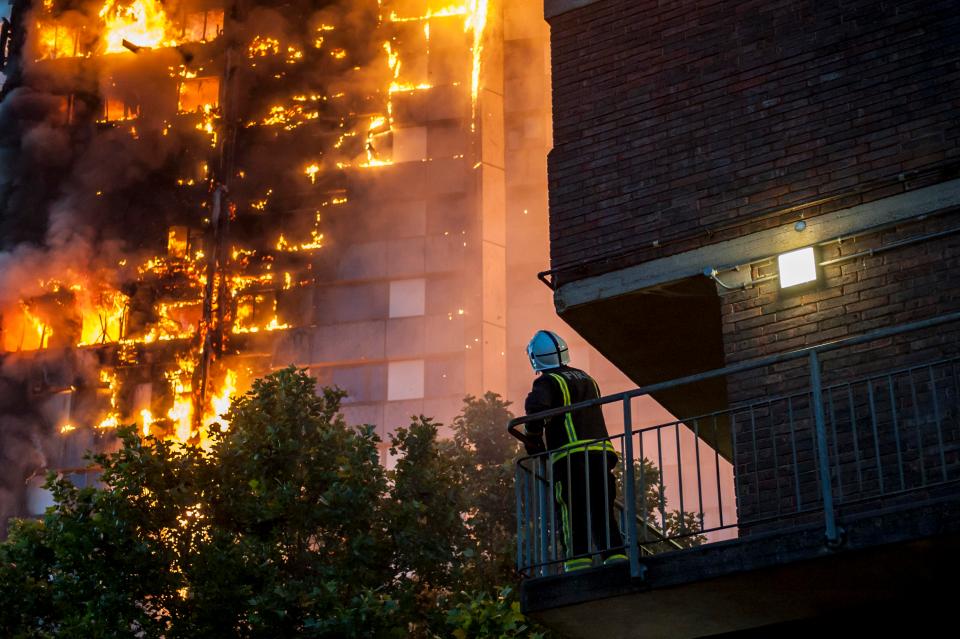
Colour photograph showing a Firefighter watching the horrific fatal fire scene at Grenfell Tower in London, on 14 June 2017, from a nearby balcony. Click to enlarge.
London Fire Brigade was an easy target for the Grenfell Fire Inquiry’s Phase 1 Report, made all the more so following some careless, insensitive and ignorant public comments by its Commissioner, Dany Cotton. However, we must clearly distinguish between the behaviour of LFB’s Frontline Firefighters, who were brave and dedicated despite inadequate training, and lack of proper equipment, back-up resources and personnel strength … and LFB’s Senior Commanders … which is another matter.
Colour photograph showing the London Fire Brigade (LFB) Commissioner, Dany Cotton. In order to ensure that transformation of the LFB actually takes place in the short term, and is fully effective, Dany Cotton and all of her Senior Commanders must resign now, or be fired ! Click to enlarge.
In England … there is widespread indifference, and some rabid resistance, to answering the desperate needs, and mitigating the agonizing plight, of Vulnerable Building Users during fire emergencies … which includes people with activity limitations, children under 5 years of age, frail older people (not All older people !), women in late stage pregnancy, people with disabilities, refugees, migrants, the poor, and people who do not understand the local culture or cannot speak the local language. British National Standard B.S.9999 (not solely those sections previously contained in B.S.5588:Part 8) and England’s National Building Regulations – Approved Document B: ‘Fire Safety’ – offer only token, i.e. inadequate, protection for vulnerable people in fire emergencies. When a senior representative of BSI, the British Standards Institution, was directly approached by me, and requested to open up B.S.9999 for meaningful updating … the answer was a firm “NO” ! The same attitude is deep-seated among fire research organizations in the country, and among people who develop computer fire evacuation models.
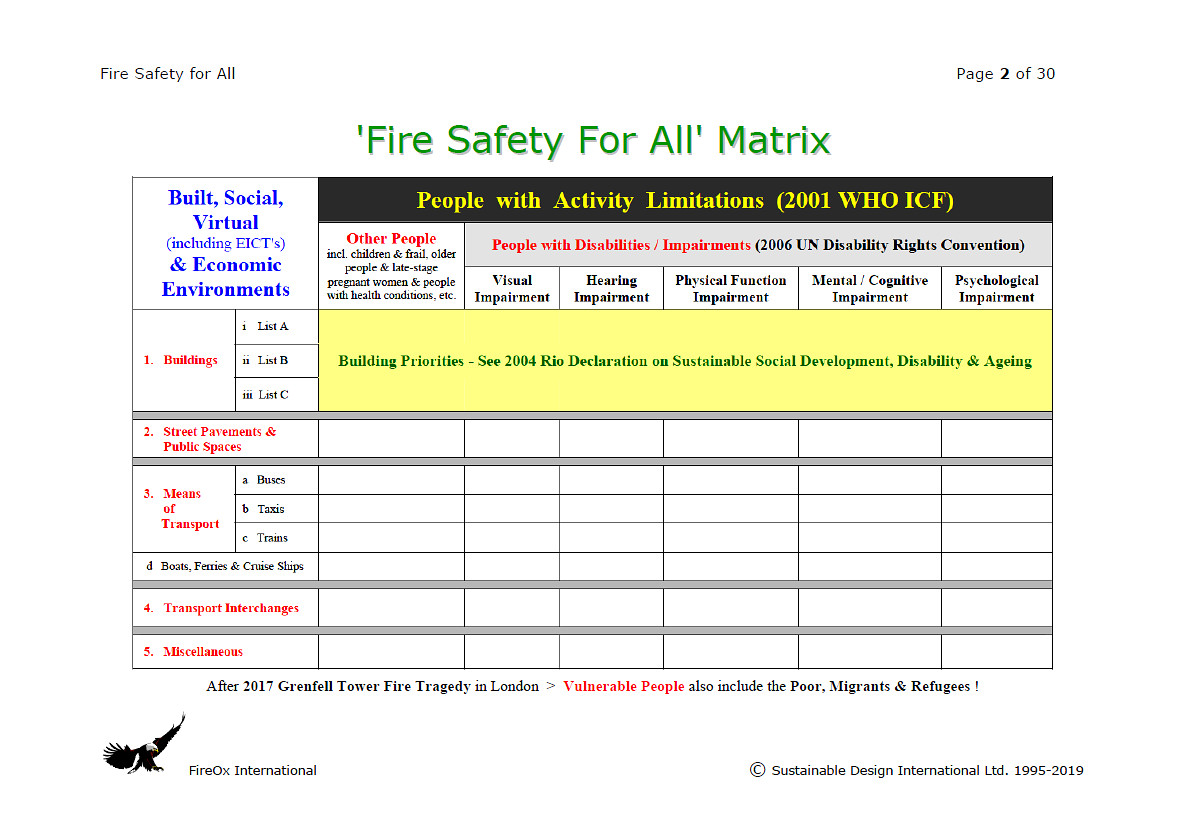
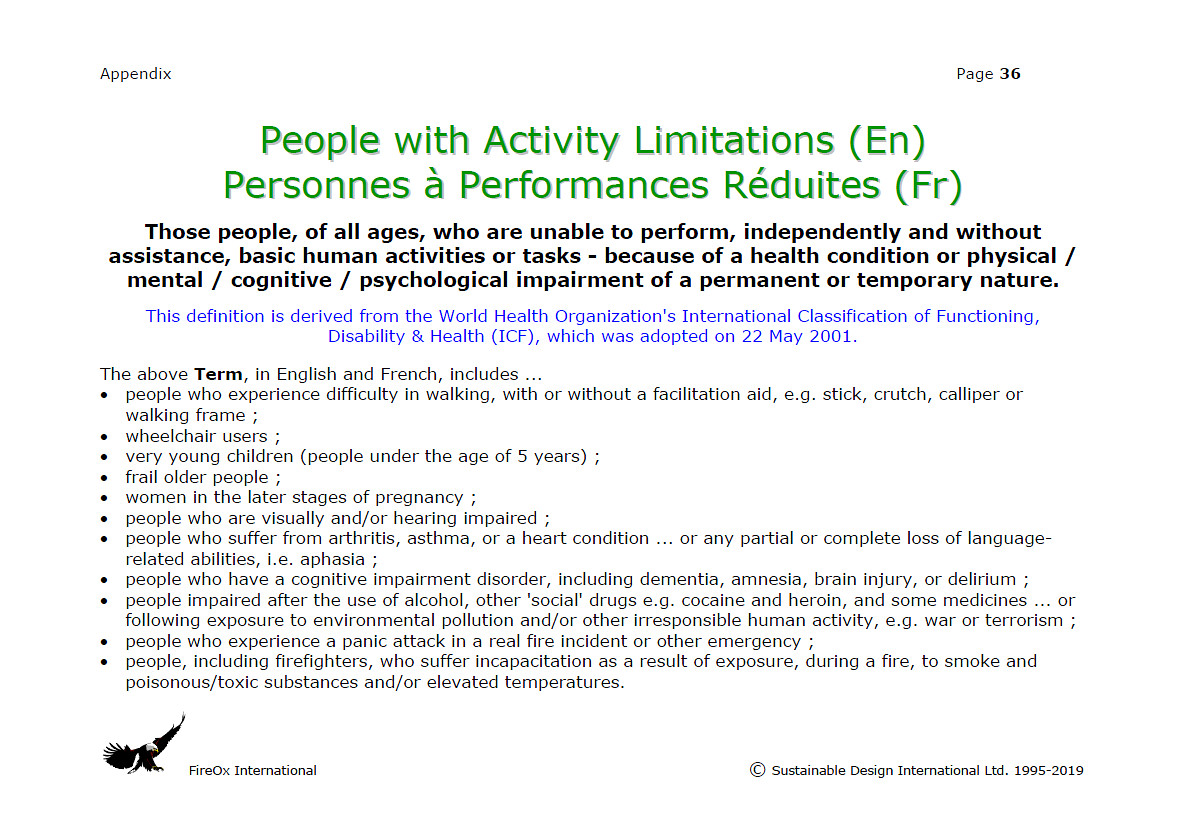
Presentation Overhead, in colour, showing the ‘Fire Safety for All’ Matrix, which outlines the scope of its application in the Human Environment and the different social groups to be targeted. Balanced consideration must be given to people who use wheelchairs (physical function impairment) … and to people with visual, hearing, psychological, and mental/cognitive impairments … and to other vulnerable building users, e.g. people with health conditions. Click to enlarge. Matrix developed by CJ Walsh.Presentation Overhead showing the definition of ‘people with activity limitations’, with its equivalent French translation … also showing from where this term is derived … and who this term includes. During a fire emergency, confused and/or confusing disability-related language costs lives ! Click to enlarge.
.
Grenfell Fire Inquiry’s Phase 1 Recommendations – Chapter #33
After hearing the first media reports about the tough Recommendations aimed at London Fire Brigade, I had naturally expected that the other Phase 1 Recommendations would be equally as tough. But NO … they are far from comprehensive … they are fragmentary, lack depth and any sort of coherence. Specifically with regard to Vulnerable Building Users, the Recommendations are pathetically and disgracefully inadequate !
And in case there is any doubt, the status quo in England – and to be fair, in many other countries as well – is entirely unacceptable !!
Few people realize that the fire safety objectives in current fire regulations/codes are limited and constrained. To implement changes to the flawed regulations in England, it will take many years … and, based on recent past history, implementation will be incomplete and unsatisfactory. Residents in high-rise buildings, whether public or private, must no longer wait in vain for this to happen. Instead, the time has arrived to become proactive, and to immediately initiate their own comprehensive programmes of Self-Protection In Case Of Fire … which go far and beyond the pathetic Recommendations in Moore-Bick’s Phase 1 Report.
Fires Similar To Grenfell Tower Are Frequent
[ Paragraph #33.5 ] … although not unprecedented, fires of the kind that occurred at Grenfell Tower are rare.
[ Response ] Not true … misleading, and a complete fallacy !
Just since 2010, fires similar to Grenfell Tower have occurred in South Korea, many in the United Arab Emirates, France, Chechnya, Australia, Azerbaijan, Russia, and most recently in Turkey. Each one of these fires has been recorded and illustrated on our Twitter Account: @sfe2016dublin. Seeing, and understanding, this striking pattern of unusual fire behaviour … a competent person would react and plan accordingly.
Effective Fire Compartmentation Is A Delusion … A Fantasy !
[ Paragraph #33.5 ] Effective compartmentation is likely to remain at the heart of fire safety strategy and will probably continue to provide a safe basis for responding to the vast majority of fires in high-rise buildings.
[ Response ] Not true … demonstrates a fundamental flaw in European fire safety strategizing !
In an environment of lax or non-existent compliance monitoring … the quality of architectural/fire engineering design and the reliability of related-construction will both, inevitably, be poor and unacceptable. Fire loads in today’s residential buildings are also far higher than a generation ago, for example, because of more electrical/electronic equipment and synthetic furnishings. And whatever about first-built, i.e. whether it’s good, bad or ugly, later alterations and other construction work will typically compromise the original performance of fire resisting doorsets and service penetration fire sealing. Modern ‘green’ building materials and construction methods are further aggravating these problems. A competent person would be aware of fire research at the UL Laboratories, in the U.S.A., which confirmed the above developments.
‘ Rigorous enforcement of building codes and standards by state and local agencies, well trained and managed, is critical in order for standards and codes to ensure the expected level of safety. Unless they are complied with, the best codes and standards cannot protect occupants, emergency responders, or buildings.’
U.S. National Institute of Standards and Technology. Final Report on the Collapse of the World Trade Center Towers. NIST NCSTAR 1. 2005.
‘Stay Put’ Policies Are Criminal
[ Paragraph #33.5 ] However, in the case of some high-rise buildings it will be necessary for building owners and fire and rescue services to provide a greater range of responses, including full or partial evacuation. Appropriate steps must therefore be taken to enable alternative evacuation strategies to be implemented effectively.
[ Paragraph #33.15 ]e. that policies be developed for managing a transition from ‘stay put’ to ‘get out’ ;
[ Response ] Too little … and far too late !
[ Solution ] Two fatal fires separated in time and space … the 2009 Lakanal House Fire, in London, and the 2017 Marco Polo High-Rise Apartment Building Fire, in Honolulu, continue to clearly demonstrate that effective fire compartmentation is a delusion. Even if carried out by a competent person … it is not possible to establish with reasonable certainty, by means of a visual/surface building inspection alone, whether or not fire compartmentation is effective in an existing building. The London and Honolulu buildings were not fitted with any active fire suppression system, e.g. fire sprinklers or a water mist system.
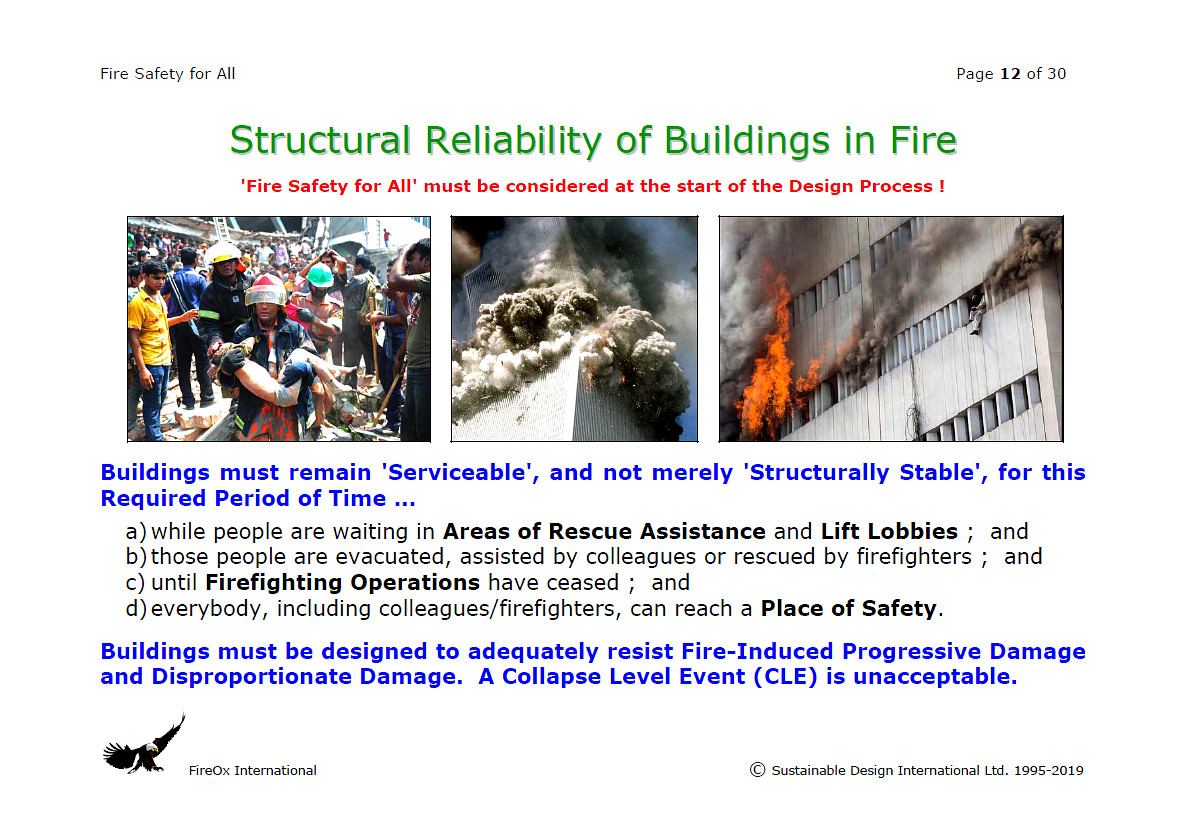
Buildings must remain structurally ‘serviceable’, not merely structurally ‘stable’, for a Required Period of Time. See the Presentation Overhead below.
Presentation Overhead, in colour, explaining the concept of ‘Structural Reliability’ in fire conditions … and defining ‘Required Period of Time’, during which a building must remain serviceable. Click to enlarge.
Authorities Having Jurisdiction (AHJ’s), firefighters, client organizations, design teams, and building owners/managers must not, therefore, direct, or even suggest, that any of its building users wait (‘stay put’) in that building during a fire emergency. A competent person always connects building fire performance with its structural performance, and vice versa … and always learns from the evidence of ‘real’ fatal fires.
All Lifts/Elevators Must Be Used For Fire Evacuation
[ Paragraph #33.13 ] When the firefighters attended the fire at Grenfell Tower they were unable to operate the mechanism that should have allowed them to take control of the lifts. Why that was so is not yet known, but it meant that they were unable to make use of the lifts in carrying out firefighting and search and rescue operations. It also meant that the occupants of the tower were able to make use of the lifts in trying to escape, in some cases with fatal consequences.
[ Response ] There is a ridiculous assumption in Moore-Bick’s Phase 1 Report that it is only firefighters who use lifts/elevators during a fire emergency, and that it is dangerous for anybody else to use them.
[ Solution ] In order to adequately protect Vulnerable Building Users … ALL lifts/elevators in a building must be capable of being used for fire evacuation during a fire emergency.
Until such time as firefighters arrive at a building fire scene in sufficient strength and are properly prepared to carry out effective firefighting and rescue operations … Firefighter Lifts/Elevators must be used for the fire evacuation of building occupants/users. Prior liaison and pre-planning with local fire services is always necessary with regard to the use of firefighting lifts/elevators for the evacuation of occupants/users.
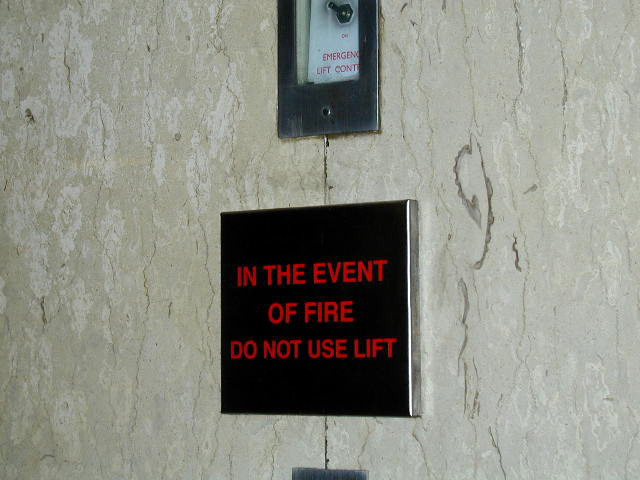
Colour photograph showing a typical sign outside most lifts/elevators around the world … ‘In The Event of Fire, Do Not Use Lift’. This is a pre-historic dinosaur of a policy which places Vulnerable Buildings Users in immediate and very serious danger during a fire emergency. Click to enlarge.
A fundamental principle of fire safety design is that there must be alternative, safe and accessible evacuation routes away from the scene of a fire, which can occur in any part of a building during its life cycle ; these evacuation routes must be capable of being used by all building users, including people with activity limitations.
This is why there must always be at least 2 Fire Evacuation Staircases in High-Rise Residential Buildings !
The location of lifts/elevators and lobbies, within peripheral building cores, must always be considered in relation to the position of adjacent fire protected evacuation staircases, which must be easily found by building occupants/users, and the areas of rescue assistance adjoining those staircases.
To be used for fire evacuation, a lift/elevator must be ‘fit for its intended use’, must operate reliably during a fire emergency, and must comprise a complete building assembly which meets specific performance criteria.
A Lift/Elevator Fire Evacuation Assembly is an essential aggregation of building components arranged together – comprising a lift/elevator, its operating machinery, a hard-construction vertical shaft enclosure, and on every floor served by the lift/elevator a sufficiently large, constantly monitored lobby for people to wait in safety and with confidence, all robustly and reliably protected from heat, smoke, flame and structural collapse during and after a fire – for the purpose of facilitating the safe evacuation of building occupants/users throughout the duration of a fire emergency.
If a building is located in a Seismic Zone, Lift/Elevator Fire Evacuation Assemblies which can safely operate during an earthquake must always be specified and installed.
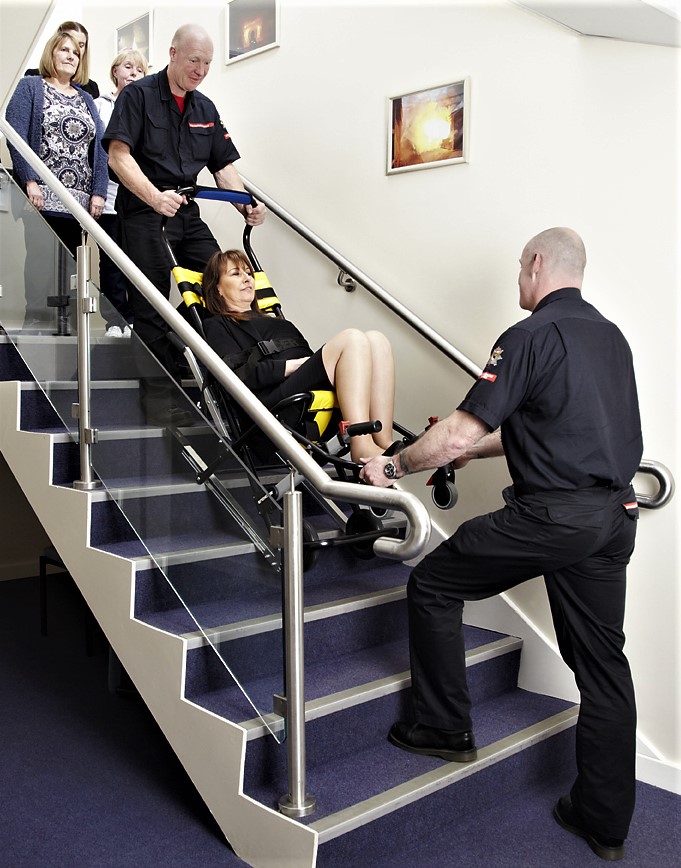
Gravity Evacuation Chair Devices, which are not electrically-powered and operate by gravity, facilitate downward movement, only, on straight flights of stairs. Having descended a staircase, with the user having left his/her wheelchair behind, these devices are not fully stable when travelling the long horizontal distances necessary to reach an external ‘place of safety’ remote from a building, perhaps over rough terrain.
Colour photograph showing a Gravity Evacuation Chair and how it is used during a fire emergency. Click to enlarge.
If lifts/elevators in existing buildings undergo a major overhaul, or if they are replaced, they should then be made capable of use for fire evacuation.
Lifts/elevators used for fire evacuation must always have a fire protected electrical supply which is separate from the main building electrical supply, in order to ensure that they can continue to operate without interruption during a fire emergency.
In addition to conventional passive fire protection measures, Lift/Elevator Lobbies must also be protected by an active fire suppression system. Water mist is the preferred fire suppression medium, because it is user-friendly, will not greatly interfere with user visibility, uses far less water compared to water sprinklers, and is also climate-friendly. Furthermore, because people with activity limitations will be waiting for evacuation in lift/elevator lobbies, building designers and managers must ensure that these lobbies are properly fitted out with appropriate fire safety equipment, facilitation aids, smoke hoods, signage and communications, etc., etc.
Proper Use of Personal Emergency Evacuation Plans (PEEP’s)
[ Paragraph #33.22 ]f. that the owner and manager of every high-rise residential building be required by law to include up-to-date information about persons with reduced mobility and their associated PEEP’s in the premises information box ;
[ Response ] There is No Recommendation or explanation in Moore-Bick’s Inquiry Phase 1 Report concerning the ‘what’, ‘why’ or ‘how’ of PEEP’s.
[ Solution ] A Personal Emergency Evacuation Plan is a person-specific and location-specific document, and is an integral part of the overall Fire Emergency Management Plan for a building. It is intended for regular occupants/users who may be vulnerable in an emergency situation, i.e. those with limited abilities in relation to self-protection, independent evacuation to an external place of safety remote from the building, and active participation in the building’s fire emergency procedures.
In new buildings, which are effectively accessible (including fire safe) for all, Personal Emergency Evacuation Plans are not necessary.
In existing buildings, Personal Emergency Evacuation Plans must not be used to limit or restrict access by an individual to any part of a building and its facilities. To ensure this, sufficient accessibility works must be carried out and appropriate management procedures put in place.
In buildings of historical, architectural and cultural importance, where the historical, architectural or cultural integrity of the building must be protected, Personal Emergency Evacuation Plans may limit or restrict access to parts of a building and some of its facilities. Refer to the ICOMOS 1964 International Charter for the Conservation and Restoration of Monuments and Sites.
There are No Recommendations in Moore-Bick’s Inquiry Phase 1 Report concerning these critical issues.
[ Solution ] There are many fire safety problems associated with high-rise and tall buildings. Evacuation by staircases alone can take many hours ; the physical exertion involved in descending even 10 floors/storeys by staircase is too much for many able-bodied people and is impossible for most vulnerable building occupants/users, particularly people with activity limitations. Passive fire protection of staircases, alone and/or supplemented by pressurization to prevent smoke ingress, is far too unreliable. And heavily equipped firefighters cannot be expected to ascend more than 10 floors/storeys by staircase before carrying out arduous firefighting and search/rescue operations. Furthermore, uninterrupted lift/elevator shafts, extending throughout the full height of a tall building, pose a significant risk of uncontrolled fire spread.
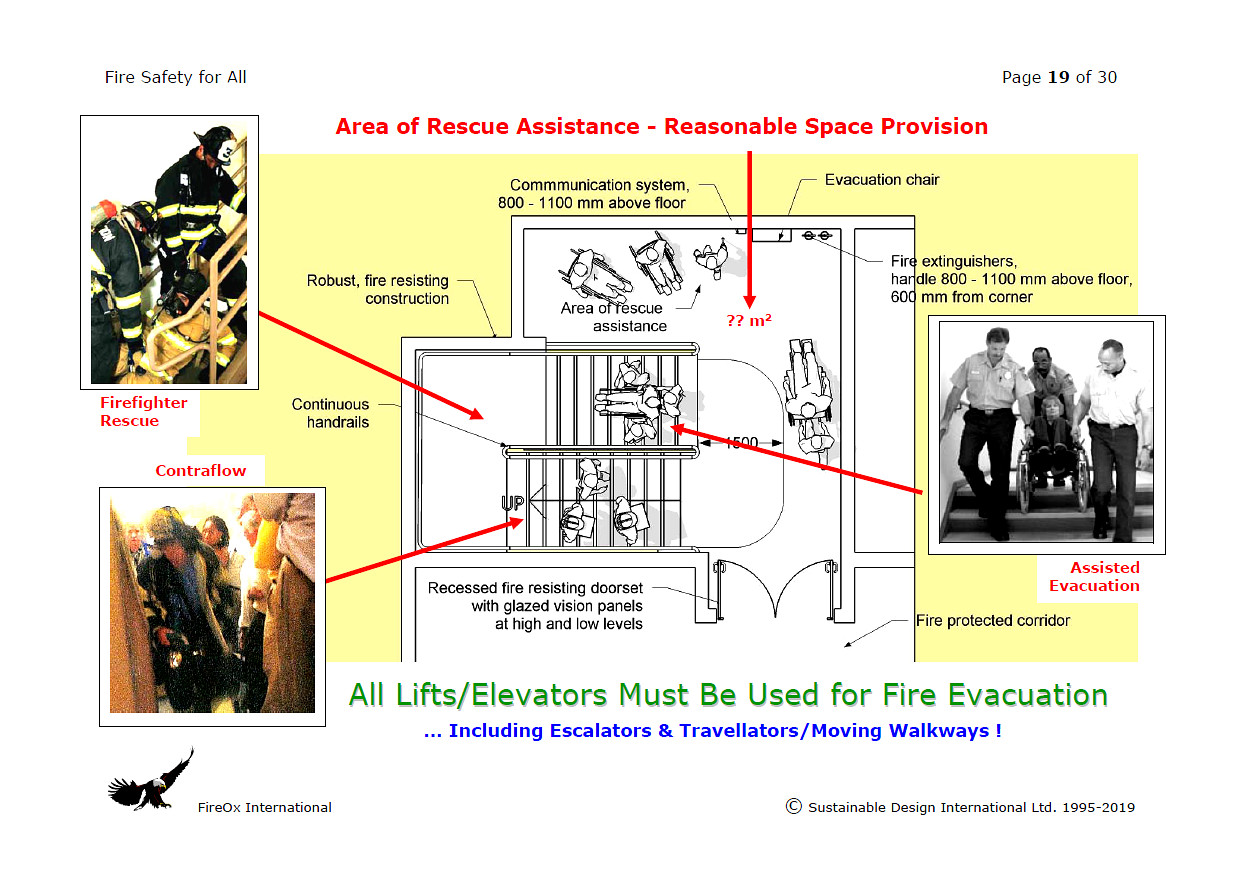
Colour photograph showing the very narrow, single staircase in the Grenfell Tower, London. How anybody – ANYBODY – could ever imagine that this staircase would be adequate to serve the fire evacuation needs of a diverse occupant population in a high-rise residential building is beyond belief ! A Syndrome is a cluster of symptoms which occur together and can be taken as indicative of a particular design abnormality. Click to enlarge.Presentation Overhead, in colour, illustrating a sufficiently wide fire evacuation staircase … minimum width 1.5m between handrails … which will accommodate Contraflow and the Assisted Evacuation of people in wheelchairs … with a sufficiently large, directly adjoining Area of Rescue Assistance … which will accommodate people unable to independently evacuate during a fire emergency. The space provided in an Area of Rescue Assistance, on each floor/storey, is calculated in relation to the design occupant/user population of a building. Even if a building is fully sprinklered, an Area of Rescue Assistance must adjoin every fire evacuation staircase. Click to enlarge. Staircase design by CJ Walsh.
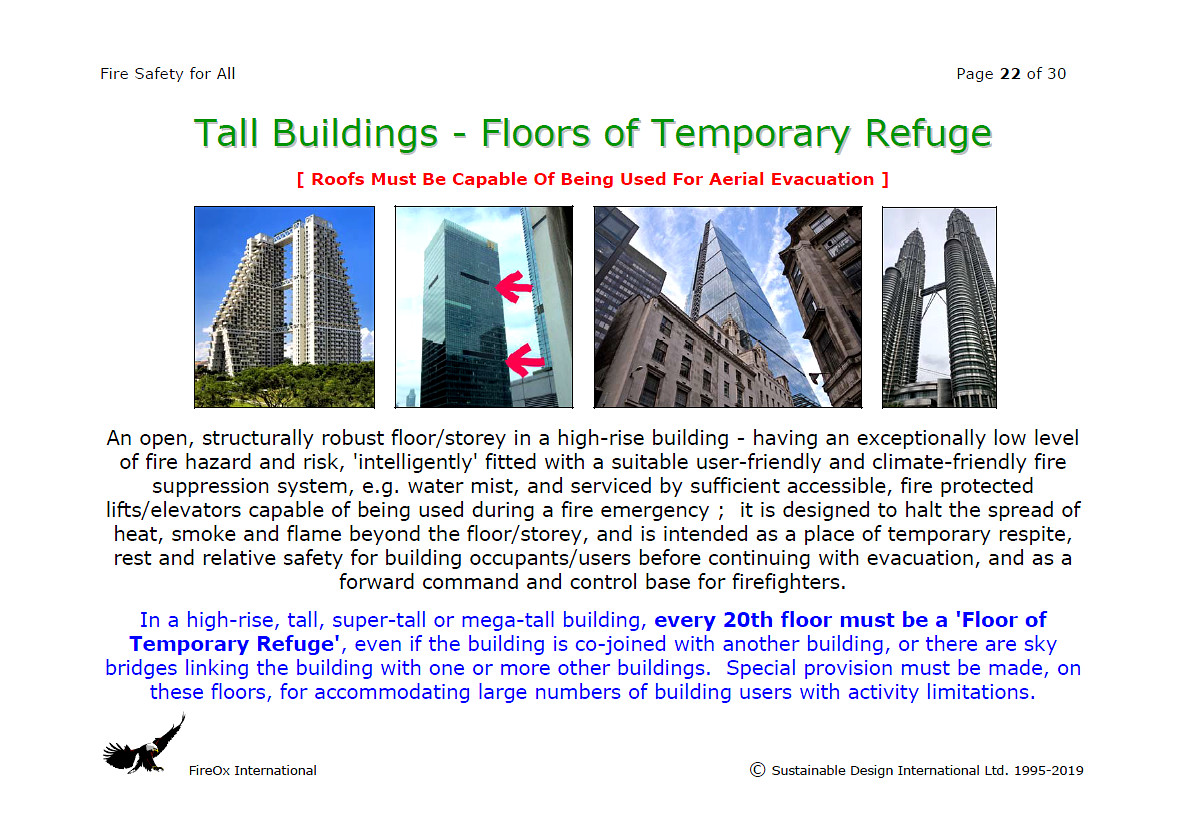
A Floor of Temporary Refuge is an open, structurally robust floor/storey in a tall building – having an exceptionally low level of fire hazard and risk, ‘intelligently’ fitted with a suitable user-friendly and climate-friendly fire suppression system, e.g. water mist, and serviced by sufficient accessible, fire protected lifts/elevators capable of being used for evacuation during a fire emergency ; it is designed and constructed to halt the spread of heat, smoke and flame beyond that floor/storey, and is intended as a place of temporary respite, rest and relative safety for building users before continuing with evacuation, and as a forward command and control base for firefighters.
In a high-rise, tall, super-tall or mega-tall building, every 20th floor must be a Floor of Temporary Refuge, even if the building is co-joined with another building, or there are sky bridges linking the building with one or more other buildings.
Special provision must be made, on these floors, for accommodating large numbers of building occupants/users with activity limitations … and because people will be waiting on Floors of Temporary Refuge, perhaps for extended periods of time, building designers and managers must ensure that these floors/storeys are properly fitted out with appropriate fire safety equipment, facilitation aids, smoke hoods, signage and communications, etc., etc.
Presentation Overhead, in colour, illustrating and explaining the design concept of Floors of Temporary Refuge. Click to enlarge.
.
Conclusion: Fire Engineering Capacity in England is Lacking
In England … the very important 2005 and 2008 U.S. NIST Recommendations following the 9-11 (2001) Attacks on the World Trade Center, in New York City, were completely ignored. Following the 2009 Lakanal House Fire, in London, the 2013 Coroner’s Recommendations were only partially implemented.
With regard to Vulnerable Building Users … there is NO capacity within the English Fire Establishment, including the National Fire Chiefs Council (NFCC), English Authorities Having Jurisdiction (AHJ’s), and its Building Design and Fire Engineering Communities … to properly respond to … never mind understand … the Fire Safety, Protection and Evacuation for ALL in Buildings.
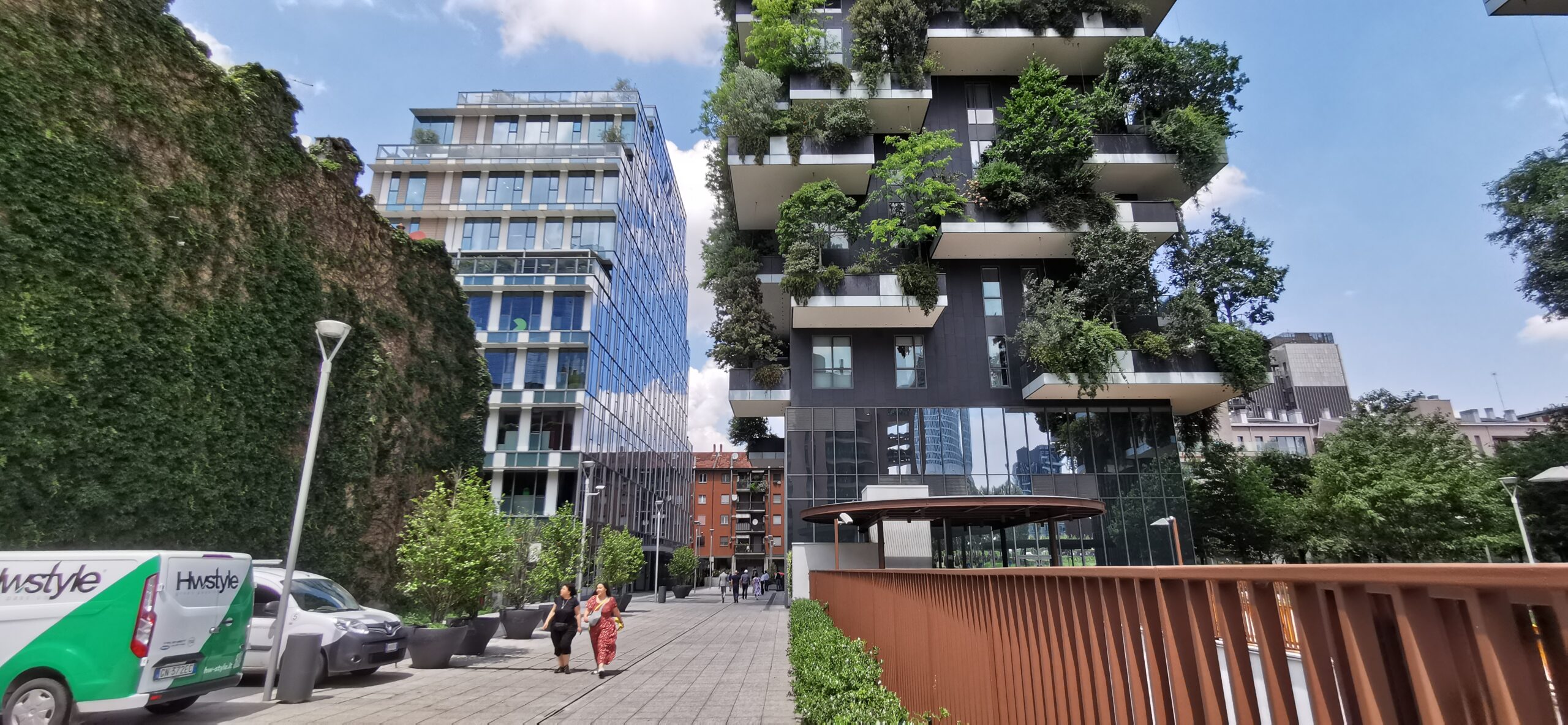
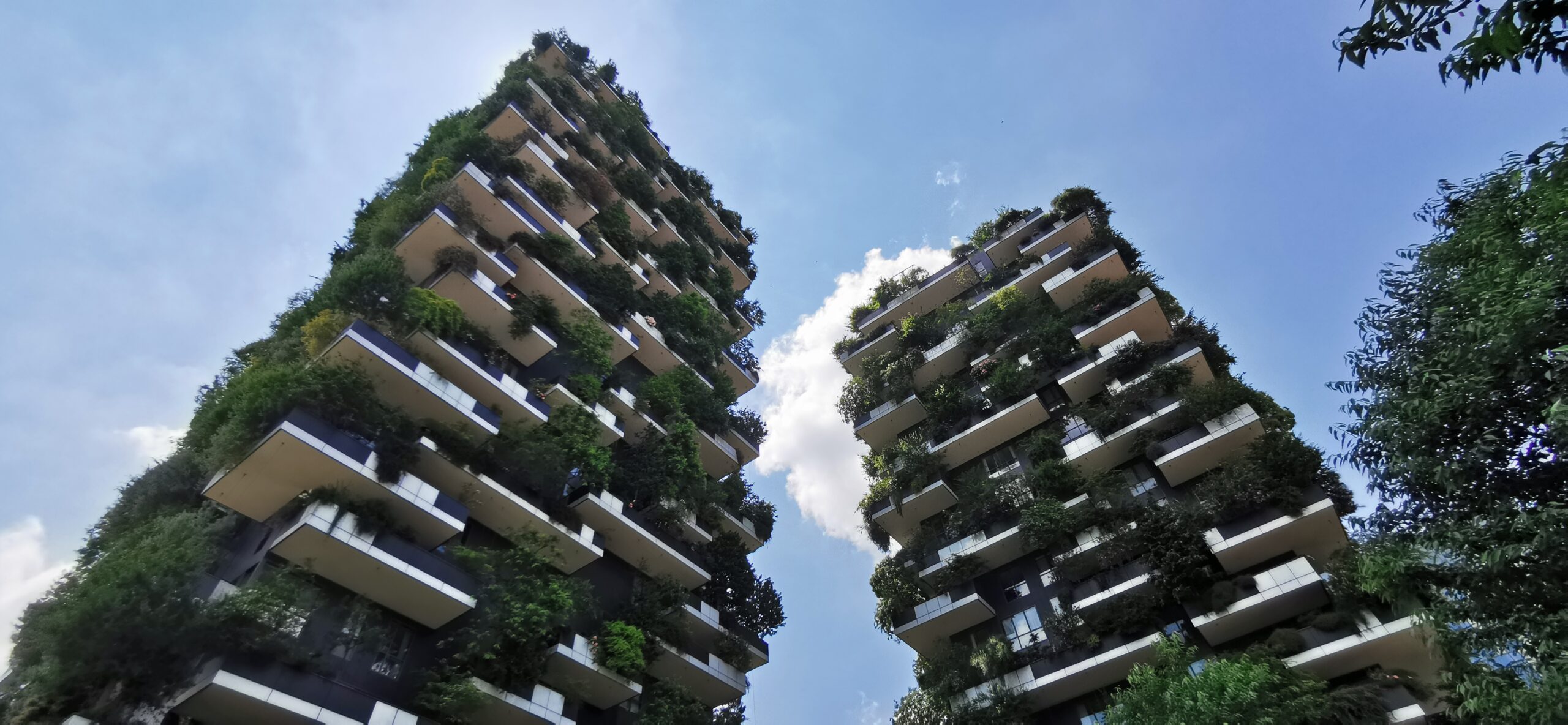
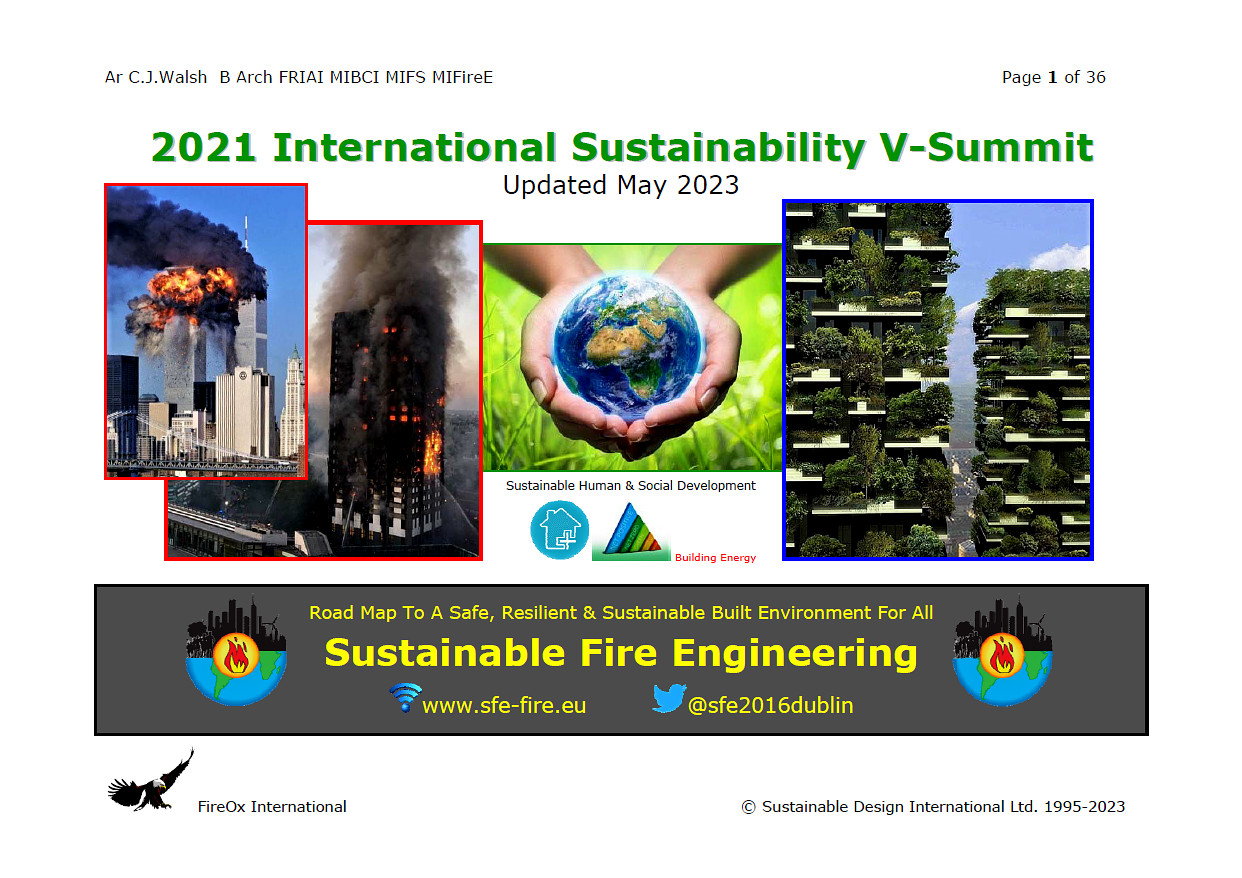
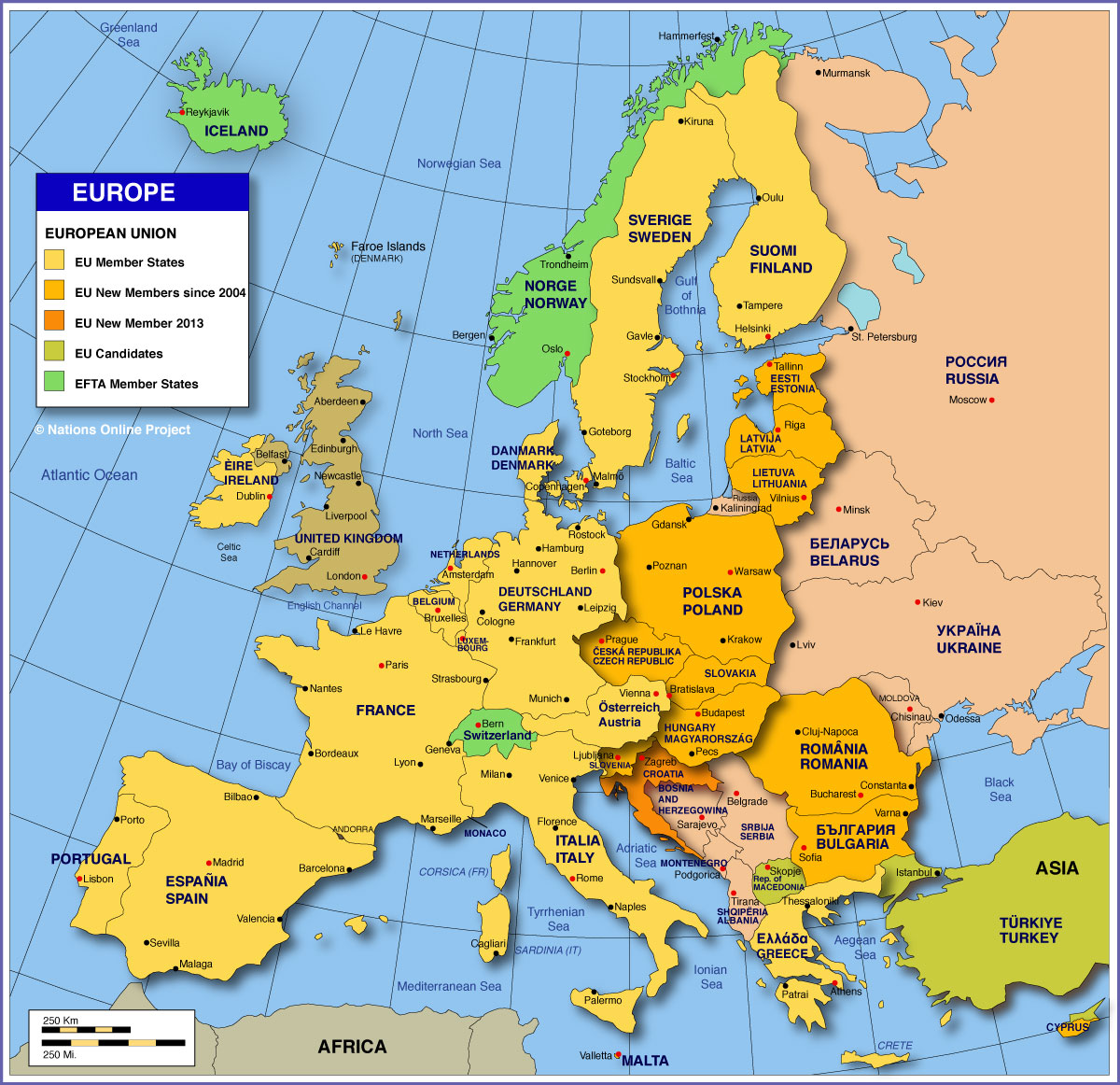

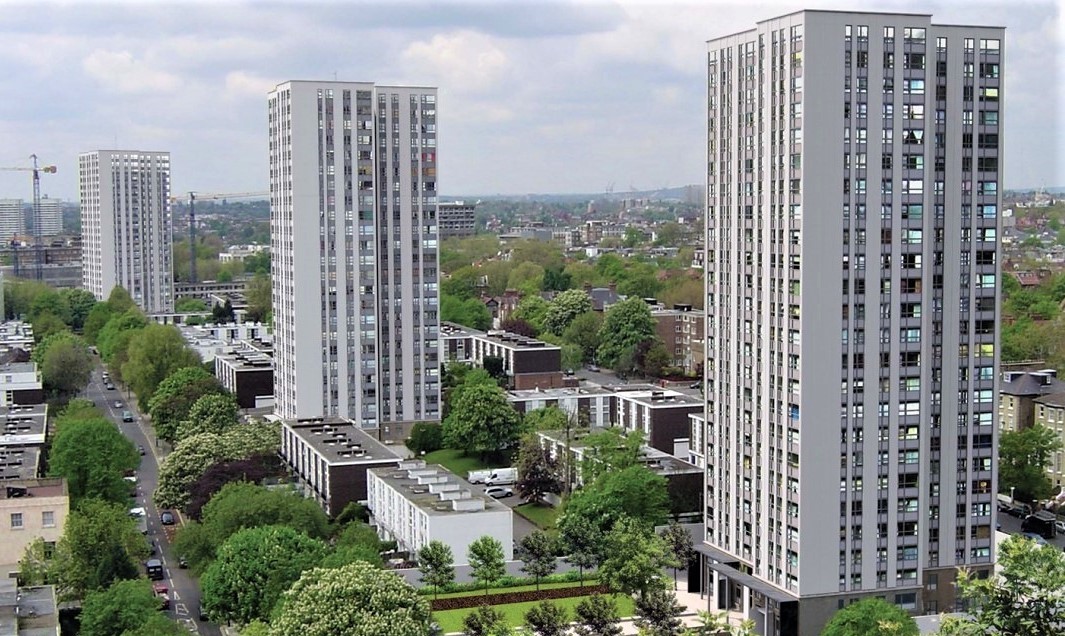
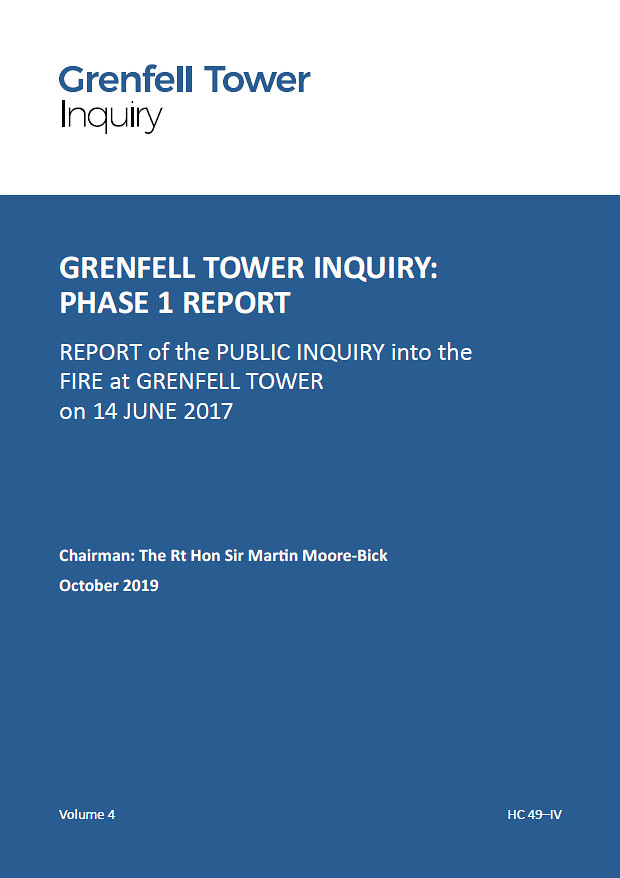
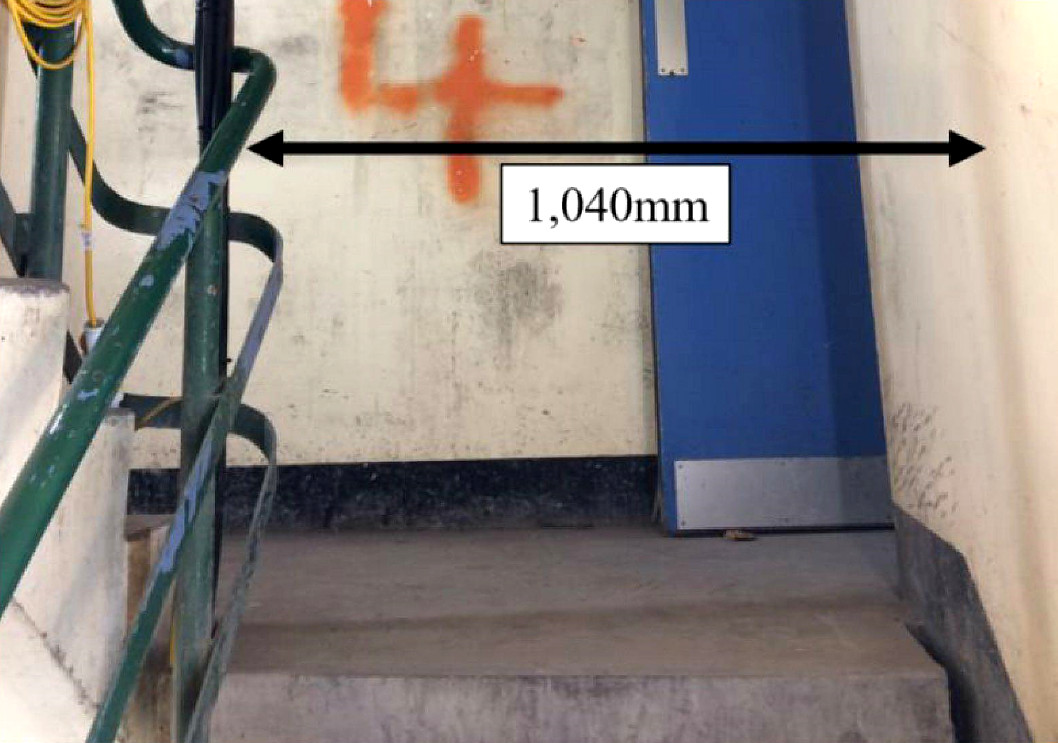
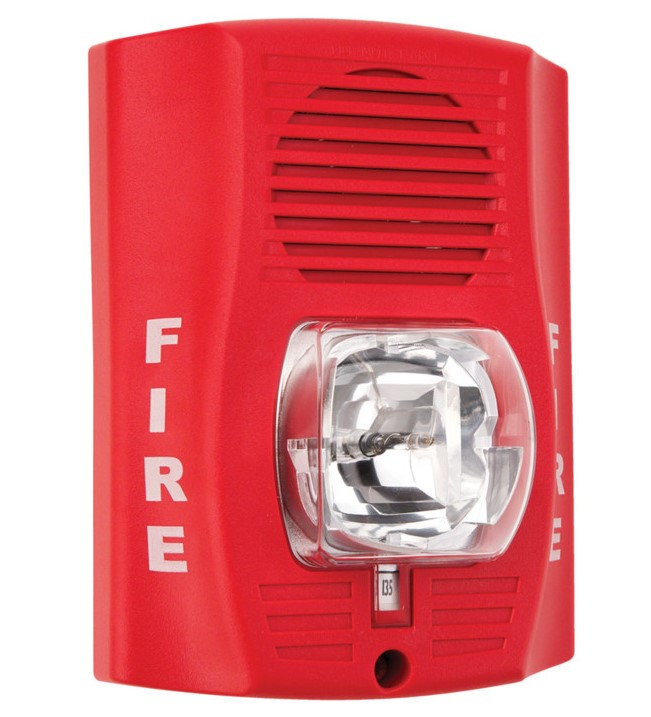

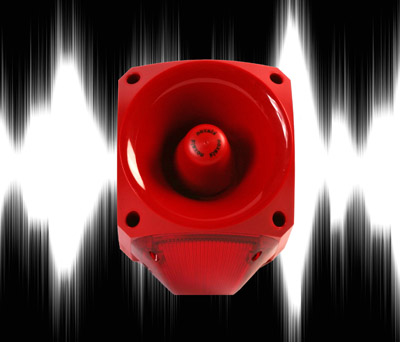
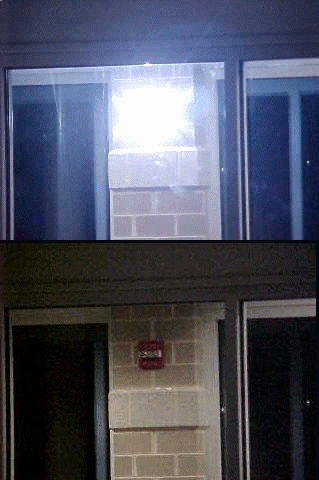
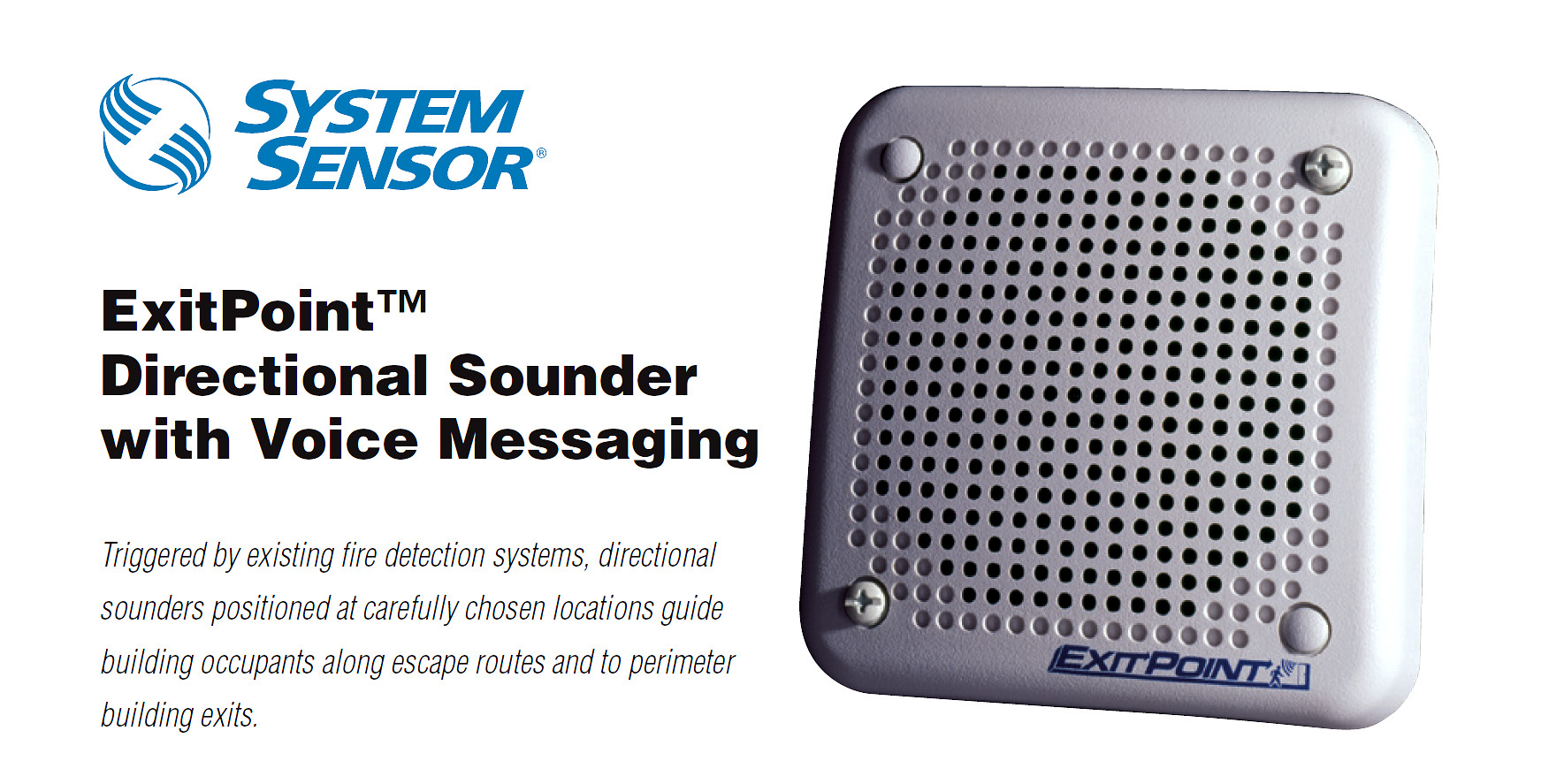
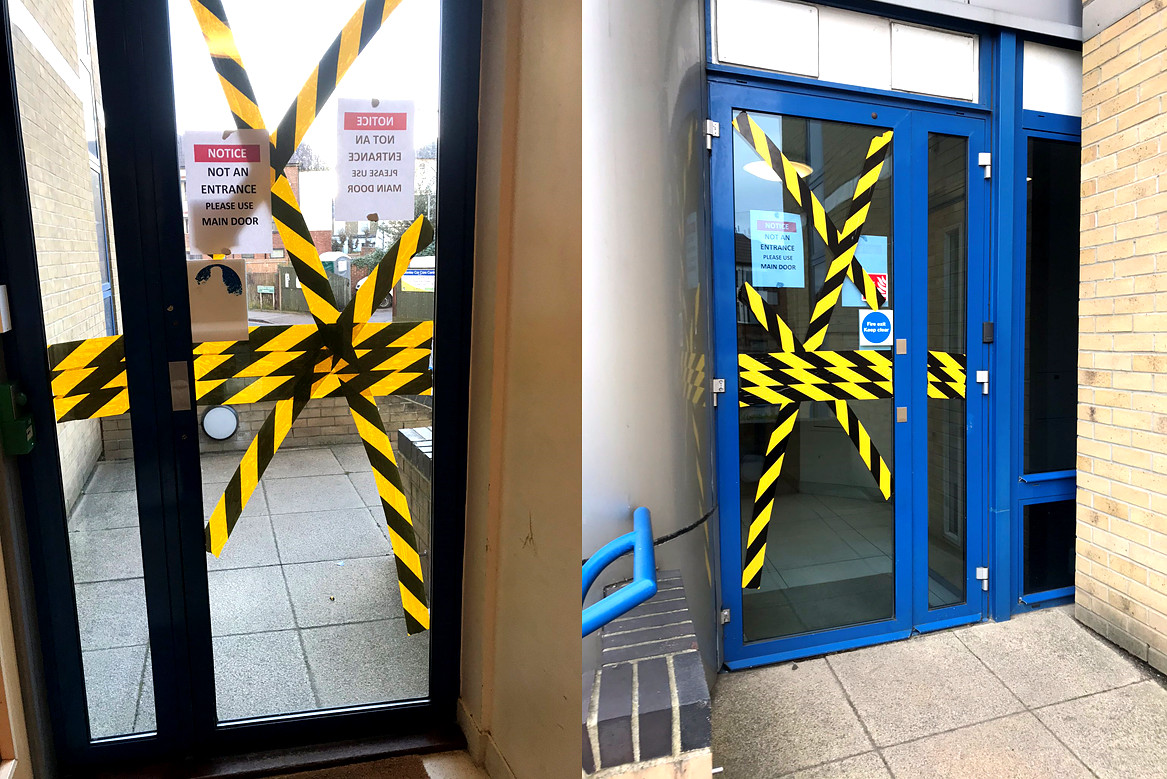
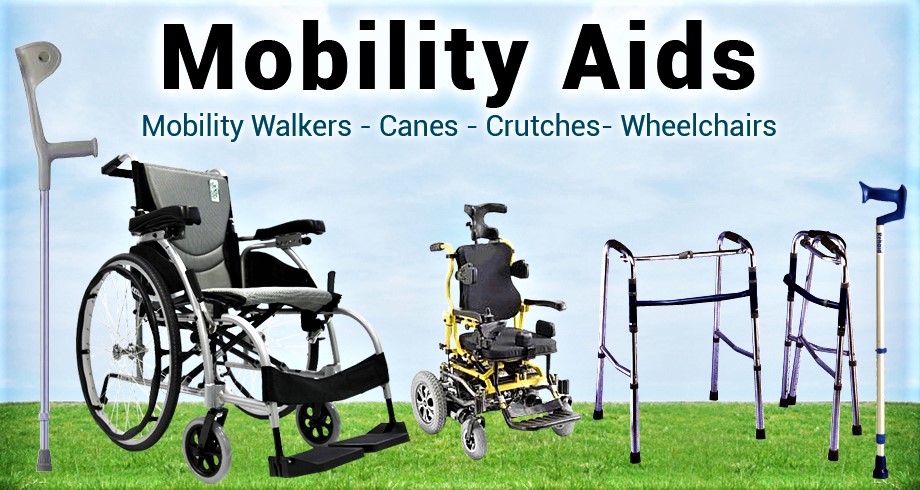
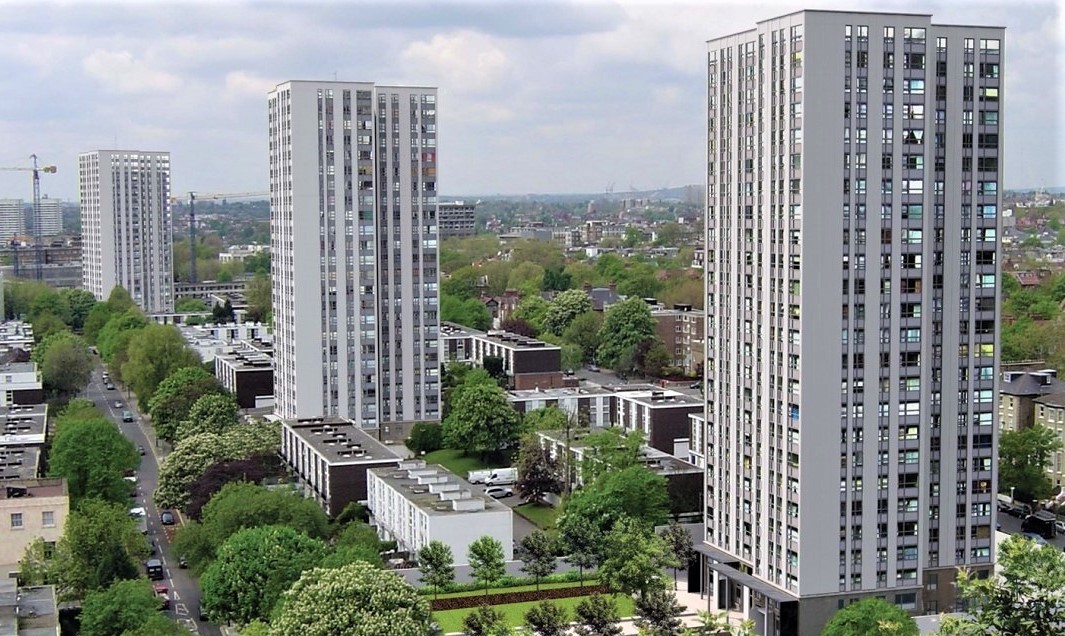

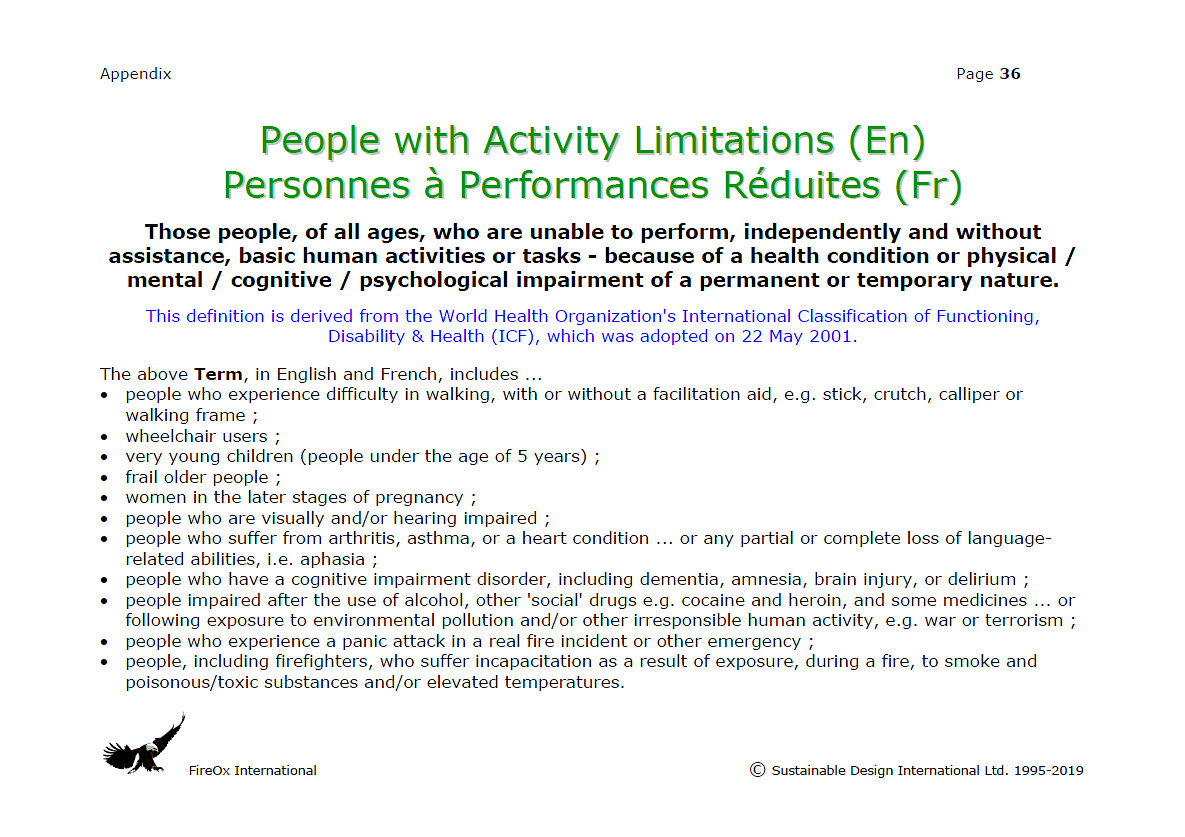
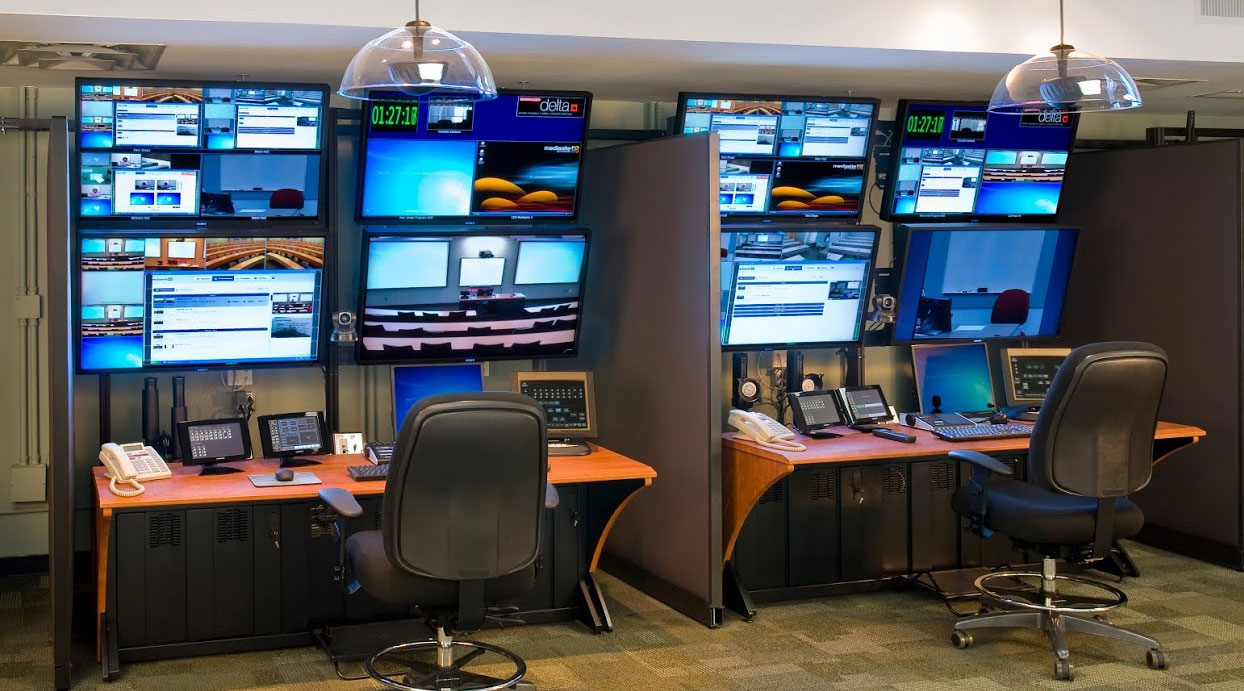
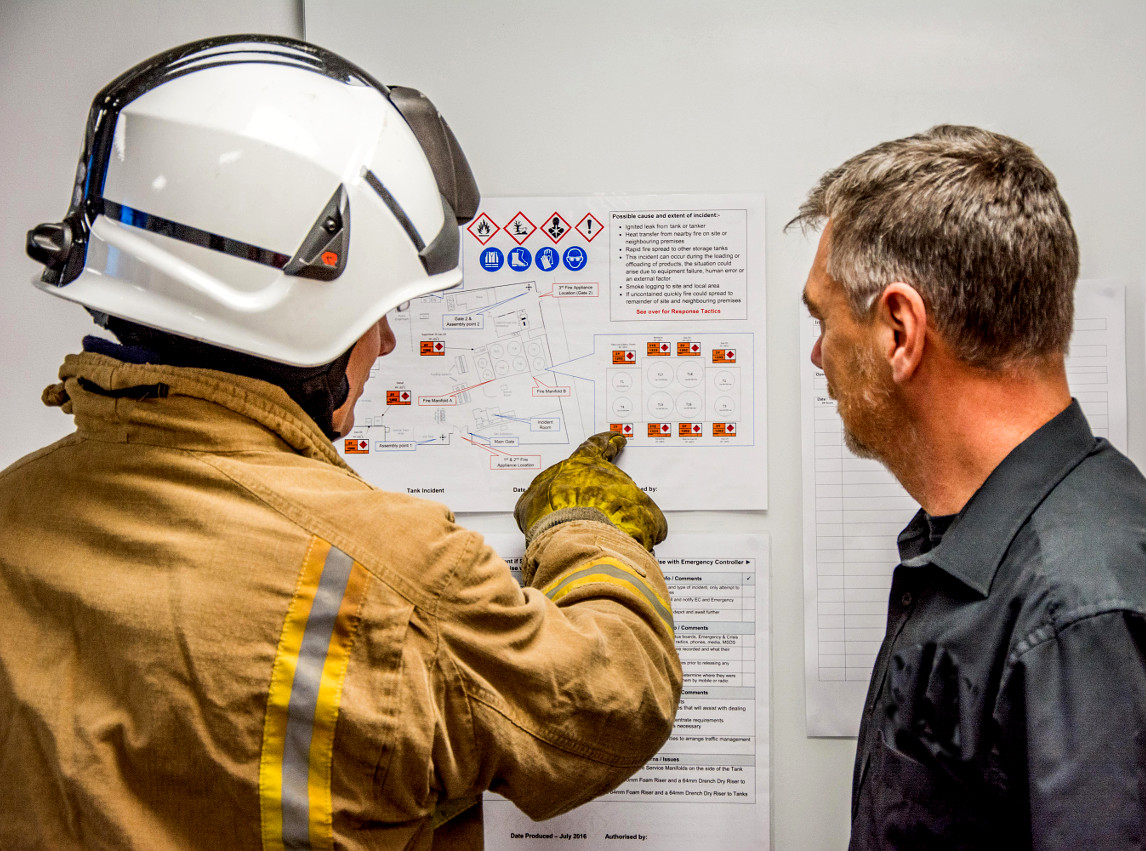
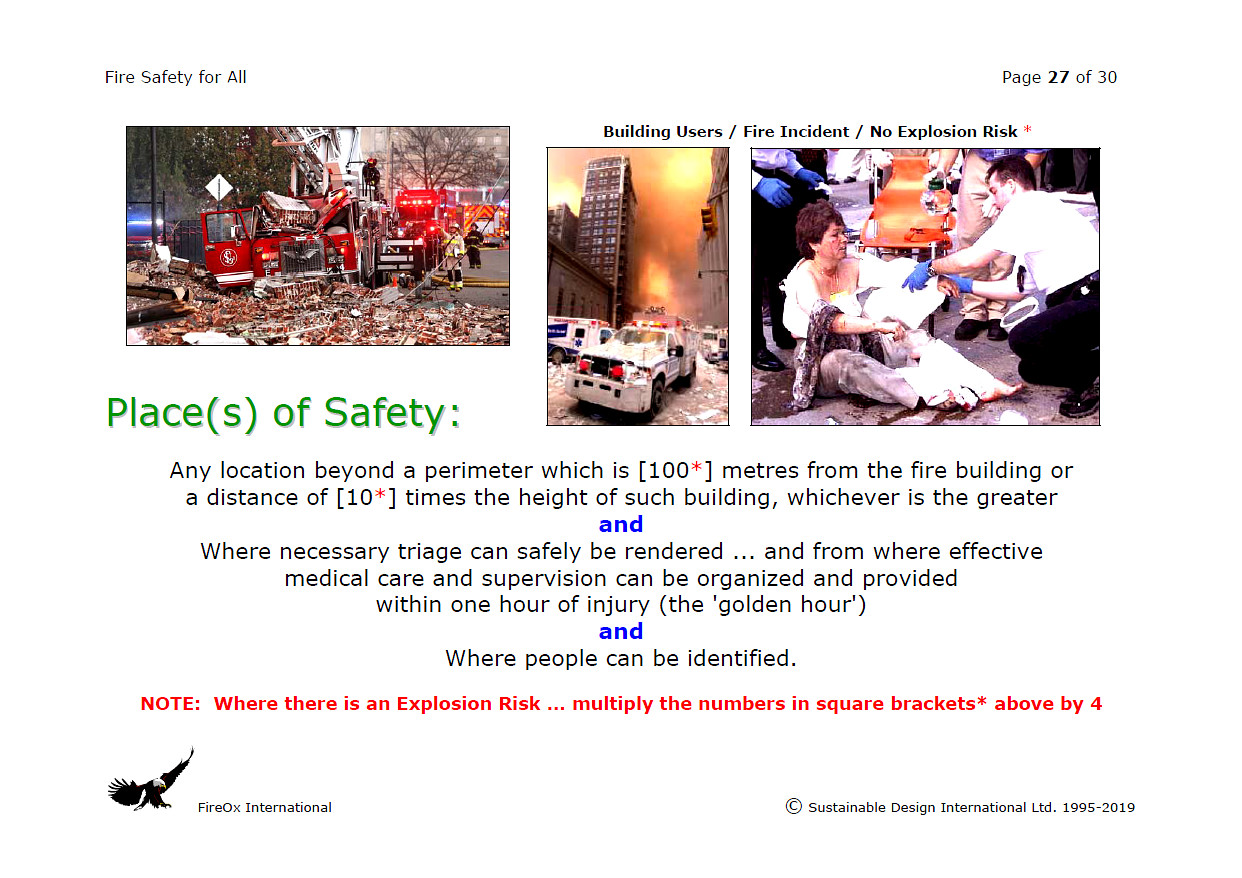
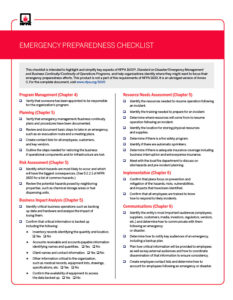 … which also covers